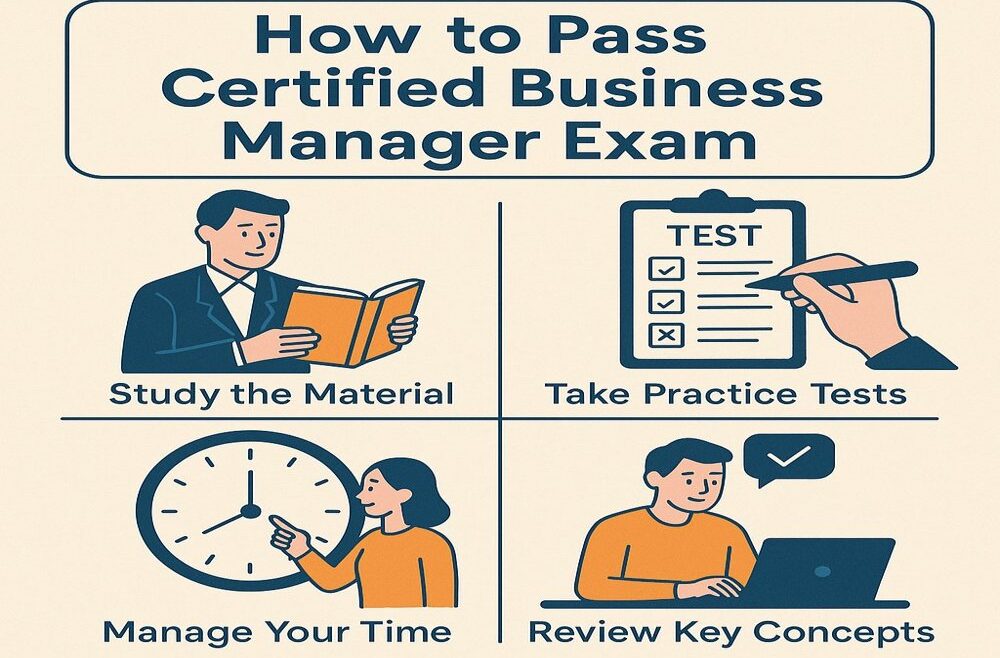

How to Pass Certified Business Manager Exam
Introduction
Earning a respected business credential can be a turning point in your professional journey. Among the most demanding yet rewarding qualifications is the Certified Business Manager Exam. This exam is not only a test of theory but also a measure of how you think, analyze, and apply business knowledge in real scenarios. Passing it requires far more than casual studying—it demands discipline, consistency, and a proven strategy.
This comprehensive guide has been designed to serve as your roadmap. Instead of simply telling you to “study harder,” it offers practical techniques, mindset shifts, and structured methods that successful candidates actually use. Whether your aim is to boost your leadership profile, climb to a management role, or broaden your strategic decision-making skills, these steps will help you.
We’ll explore ten powerful strategies, each around 300 words, covering everything from understanding the exam structure to handling the stress of exam day. Along the way, you’ll find comparison tables, practical examples, and tips that can transform your study sessions into meaningful progress.
If you’re serious about this goal, then commit to following these steps. By the time you’re done reading, you’ll have a clear action plan for certified business manager exam preparation that works.
- Understand the Exam Framework Before You Begin
Imagine stepping into a business meeting without knowing the agenda. You’d feel lost. The same applies here. The very first step is to understand the exam framework.
The Certified Business Manager Exam is divided into sections that cover operations, management, marketing, human resources, finance, accounting, IT, and case-based problem solving. Each section carries its own weight, and every candidate must be familiar with the proportion of questions and difficulty levels.
This matters because study time is not unlimited. You cannot afford to prepare blindly. Start by outlining each domain tested. Break it down into subtopics. For example, finance may cover cash flow analysis, ratios, and valuation. HR may involve leadership, recruitment, and performance management. By doing this, you transform a huge exam into manageable parts.
Take a step further—assess yourself honestly against each domain. Which areas are already strong for you, and which are weak? If you are a finance manager, you might breeze through numbers but need to spend more effort on marketing frameworks. Self-awareness helps you prioritize.
Finally, make sure you meet the eligibility requirements—educational qualifications, professional experience, and registration documents. Too many candidates focus only on the exam content and get stuck in paperwork delays. Preparing the admin side early means you can concentrate fully on studying later.
- Build a Realistic and Consistent Study Plan
Passing this exam is not about how hard you study for one week, but how consistently you prepare over several months. That’s why a study plan is essential.
Start by noting the number of weeks left until your exam. Then, divide that time into stages. A twelve-week plan is common, but even if you have more or less, the principle is the same: every week must have a clear theme.
Here’s an example outline:
- Weeks 1–2: General management and operations
- Weeks 3–4: Marketing and HR principles
- Weeks 5–7: Finance and accounting deep dive
- Weeks 8–9: Governance, IT, and international aspects
- Week 10: Case study practice
- Week 11: Mock tests under exam conditions
- Week 12: Final review and rest
This plan is flexible. Life happens, so build buffer time. More importantly, hold yourself accountable. At the end of each week, reflect: Did I achieve what I set out to? If not, why? Adjust, don’t abandon.
Consistency matters. It’s better to do two focused hours daily than marathon sessions once a week. Momentum keeps your brain primed and prevents last-minute panic.
Write down your plan, stick it on your wall or calendar, and treat it as non-negotiable. This structure is your ticket to turning effort into results.
- Use Active Learning, Not Passive Reading
One of the biggest mistakes candidates make is to sit for hours reading textbooks and hoping the knowledge will stick. The truth is, passive reading gives only an illusion of learning. What you need is active learning.
Active learning forces your brain to work harder, which is exactly what makes information stick. Instead of just reading about SWOT analysis, try applying it to your current company or a well-known business. Instead of skimming finance formulas, solve practice problems until you can explain them without notes.
Here are some active learning techniques:
- Self-quizzing: Close the book and test yourself. Recall definitions, frameworks, and formulas without looking.
- Teaching others: If you can explain a concept clearly to a friend or colleague, you truly understand it.
- Flashcards: Use them daily for key terms and numbers. Write your own examples on the back.
- Case scenarios: Apply theories to real or hypothetical situations. For example, “How would I handle an underperforming division?”
The exam is not just about remembering terms. It tests your ability to apply knowledge to decisions. Practicing active learning prepares you for that challenge.
- Master Time Management for Exam Success
The Certified Business Manager Exam is long, demanding, and mentally exhausting. Good time management is as important as knowing the material.
Start practicing with mock exams. Set a timer, sit in a quiet room, and replicate exam conditions. The goal is to learn pacing. If you have four hours for 200 questions, that’s roughly one minute per question. Learn to recognize when to move on.
Don’t let one tough question eat into your time. Mark it, move ahead, and return later if time permits. Successful candidates know how to manage momentum.
Time management also means managing your energy. Use small breaks to stretch, sip water, and reset your focus. Train your brain for endurance—studying for 30 minutes at a time is different from performing for four hours straight.
As you practice, track both accuracy and speed. If you are accurate but slow, push yourself to answer faster. If you are fast but careless, slow down just enough to improve precision. Finding the balance is what leads to success on exam day.
| Study Method | Effectiveness | Notes |
|---|---|---|
| Passive Reading | Low | Good for first exposure, but poor retention |
| Flashcards (Active Recall) | High | Reinforces key facts and definitions |
| Mock Tests | Very High | Best for simulating real exam conditions |
| Group Discussions | Moderate | Good for clarifying doubts |
| Case Studies | High | Builds applied problem-solving skills |
- Focus on High-Weight Topics Without Ignoring the Rest
The Certified Business Manager Exam covers a wide variety of topics, but not all are equally important. Smart preparation means giving more time to the sections that carry the highest weight.
Finance, accounting, and operations often form a large portion of the test. Integrated case scenarios also play a major role. These areas deserve more hours in your plan. But smaller domains like IT or international business should not be neglected. Even a handful of questions can change your score.
Divide your time strategically. If finance makes up 25% of the exam, dedicate at least 25% of your hours there. At the same time, assign shorter review sessions to minor topics. The key is balance.
Your personal strengths also matter. If you’re already skilled in HR, review it quickly and invest more time in weaker subjects. Preparation is not about studying everything equally; it’s about studying everything smartly.
- Practice With Full-Length Mock Exams and Simulations
Mock exams are the closest you’ll get to the real test. Treat them as rehearsals.
Sit down in exam-like conditions, set the timer, and take a full-length practice test. Do this several times in the final weeks. The benefits are enormous:
- You build stamina for a long test session.
- You practice pacing and time allocation.
- You get used to the pressure, so the real exam feels familiar.
But the real value comes afterward. Review every answer—correct and incorrect. Ask why you got something right, and why you got it wrong. Keep a log of mistakes. Over time, patterns will appear. Maybe you misinterpret certain question styles, or you rush through calculations. Identifying these patterns lets you fix them.
Don’t wait until the final week to take your first mock. Start early so you have time to improve. Each practice test should feel like a stepping stone closer to exam day.
- Develop Strong Test-Taking Strategies
Knowledge alone is not enough. You need exam techniques that convert knowledge into marks.
Some strategies include:
- Read carefully: Many errors come from missing words like “except” or “least.”
- Eliminate options: Cross out obvious wrong answers to improve your odds.
- Guess strategically: If there’s no penalty, never leave an answer blank.
- Flag and return: Don’t waste time stuck on one question.
- Watch for patterns: Some questions in one section may hint at answers in another.
Another tip is to decide your approach before the exam starts. Some people answer in order; others skim and do easier questions first. Choose what works for you, but practice it in your mocks so it feels natural.
With the right tactics, you’ll avoid careless mistakes and maximize your score.
- Hone Your Case-Study and Capstone Skills
One unique challenge of this exam is the case-study or capstone section. This is where you demonstrate applied business judgment.
To prepare, practice analyzing case studies using structured frameworks. For example, use SWOT to identify strengths and weaknesses, then build recommendations using balanced scorecards or Porter’s Five Forces.
When writing answers, follow a clear structure:
- Identify the problem
- Analyze using relevant models
- Present options with pros and cons
- Recommend a solution
- Suggest an implementation plan
Keep responses concise but comprehensive. Examiners value clarity and logic over lengthy paragraphs.
Practice under timed conditions. Case responses require not just knowledge but speed in structuring arguments. Over time, you’ll develop the ability to think and write like a manager under pressure.
- Track Your Progress and Learn From Mistakes
Success comes from reflection, not just repetition. That’s why tracking your progress is vital.
Create a study log where you record daily topics covered, hours spent, and mock scores. Note the types of mistakes you make: knowledge gaps, misreading, or rushing. Over time, you’ll see patterns.
Set benchmarks. For example, aim to score 80% on practice tests before considering yourself exam-ready. If you fall short, adjust your plan. Spend more time on weak areas, and reinforce strong ones through quick reviews.
Progress tracking is not about perfection. It’s about self-awareness. The more you know about your habits, the better you can correct them. By the time the exam comes, you’ll walk in with confidence, knowing you’ve tested yourself thoroughly.
- Prepare Mentally, Logistically, and Strategically for Exam Day
After months of preparation, the final hurdle is the exam day itself. How you manage it can make or break your performance.
Start with mental readiness. Get proper sleep the night before. Avoid cramming—it only increases anxiety. Spend the last day lightly reviewing flashcards and high-level notes.
Logistics are just as important. Know the exam center location, arrival time, and what materials you’re allowed to bring. Pack everything—ID, pens, calculator, snacks—the night before. Arrive early to avoid unnecessary stress.
During the exam, pace yourself. Start with easier sections to build confidence. Use flagging strategies for tough questions. Take short mental breaks to stay sharp. Above all, stay calm. Even if one section feels hard, the next may be easier. Don’t let temporary setbacks throw you off.
By combining preparation with calm execution, you maximize your chance of success.
Conclusion
Passing the Certified Business Manager Exam is not just about memorizing material; it is about proving you can think, analyze, and make decisions like a leader. By following a structured plan, engaging in active learning, prioritizing topics, practicing with mocks, and mastering test strategies, you set yourself up for success.
This credential is more than a certificate—it is a demonstration of discipline, knowledge, and professional readiness. Treat your preparation seriously, and it will not only help you pass the exam but also shape you into a more effective business manager.
If you’re ready to take the next step, you can strengthen your preparation with structured resources and mock practice tests available at Certified Business Manager Prep Commit to the journey, trust your preparation, and walk into the exam confident that you have done everything needed to succeed.