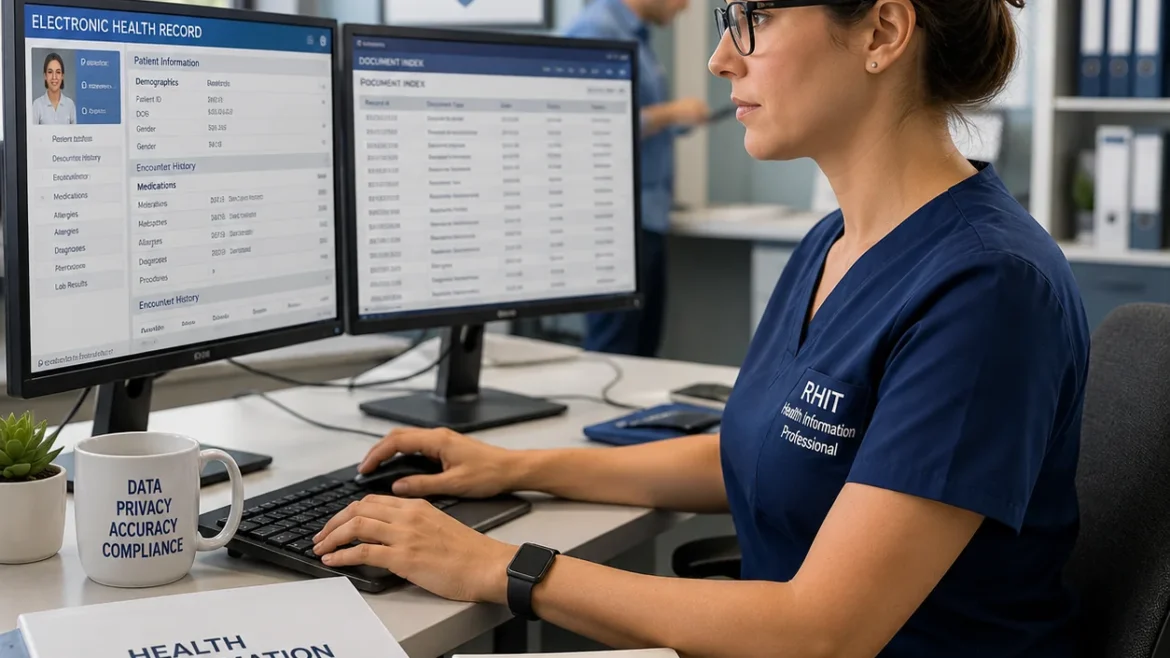

That professional may be an RHIT.
Many people entering healthcare careers initially assume hospitals operate only through doctors and nurses. However, modern healthcare systems depend heavily on health information professionals who manage patient records, documentation accuracy, healthcare data, and compliance processes every day.
What RHIT Professionals Commonly Work With:
- Electronic health records (EHRs)
- Patient documentation
- Medical coding systems
- Healthcare privacy regulations
- Data accuracy and quality review
- Hospital information systems
Why RHIT Roles Matter More Than Many People Realize
Healthcare decisions depend heavily on accurate information.
If patient records contain missing details, coding errors, incomplete documentation, or incorrect healthcare information, it can affect:
- Patient care coordination
- Insurance processing
- Healthcare compliance
- Medical reporting
- Hospital operations
RHIT professionals help maintain the structure and reliability of healthcare information systems that hospitals and clinics depend on daily.
What an RHIT Professional May Do During a Typical Workday
Unlike some clinical healthcare careers, RHIT professionals often work behind the scenes managing healthcare information rather than providing direct bedside care.
Daily responsibilities may include:
- Reviewing patient documentation
- Organizing electronic medical records
- Verifying healthcare data accuracy
- Supporting coding and billing processes
- Protecting confidential patient information
- Monitoring compliance standards
Although patients may never meet them directly, RHIT professionals support healthcare operations in ways that affect the entire system.
The Growing Importance of Electronic Health Records
Modern healthcare facilities rely heavily on electronic health record systems instead of traditional paper files.
This has dramatically increased the importance of healthcare information professionals who understand:
- Healthcare data organization
- Electronic record management
- Information accuracy standards
- Data security procedures
- Healthcare system workflows
As healthcare technology continues expanding, organizations increasingly depend on trained professionals who can manage healthcare information responsibly and efficiently.
Healthcare Reality:Accurate healthcare information is not only administrative — it directly supports safer patient care, communication, and healthcare coordination.
RHIT Work Environments
Many people assume RHIT professionals only work inside hospitals, but healthcare information careers exist across many healthcare environments.
RHIT-certified professionals may work in:
- Hospitals
- Physician offices
- Insurance organizations
- Outpatient clinics
- Government healthcare agencies
- Remote healthcare-information positions
This variety is one reason many students become interested in healthcare information careers even if they do not want traditional bedside-care roles.
A Common Misunderstanding About RHIT Careers
Some students incorrectly assume RHIT work involves simple data entry all day.
In reality, healthcare information management requires:
- Attention to detail
- Healthcare terminology knowledge
- Compliance awareness
- Analytical thinking
- Understanding healthcare workflows
Healthcare systems depend on accurate information management because patient care, reimbursement processes, and medical communication all rely on organized and reliable records.
Many students preparing for healthcare information careers build confidence using RHIT practice questions based on realistic healthcare documentation and information-management concepts because it helps them become more familiar with the professional thinking and terminology used throughout RHIT certification preparation.
How RHIT Professionals Support Patient Care Indirectly
RHIT professionals may not administer medications or treat patients directly, but their work still affects patient care every day.
Imagine a physician reviewing incomplete allergy information or a hospital department working with incorrect documentation during treatment planning.
Accurate healthcare records help medical teams:
- Communicate effectively
- Track patient history
- Review treatments safely
- Coordinate healthcare services
- Reduce documentation errors
This is why healthcare information accuracy remains such an important responsibility throughout modern healthcare systems.
Why Attention to Detail Is So Important in RHIT Careers
Healthcare information management requires careful attention because even small documentation problems can create larger operational issues later.
RHIT professionals often work with:
- Patient demographic records
- Clinical documentation
- Coding-related information
- Compliance reporting
- Healthcare data verification
Students interested in RHIT careers usually perform best when they enjoy organization, accuracy, structured systems, and detail-focused work environments.
The Difference Between RHIT and Direct Clinical Roles
One reason some students choose RHIT careers is because they want to work in healthcare without performing direct bedside-care responsibilities.
While nurses and clinical staff interact directly with patients, RHIT professionals often focus more on:
- Healthcare documentation systems
- Medical-record organization
- Data management workflows
- Privacy and compliance processes
- Information accuracy standards
This creates a different type of healthcare career path that still plays an important role inside hospitals and healthcare organizations.
How Technology Changed Healthcare Information Careers
Healthcare information careers have evolved significantly as hospitals moved from paper records into electronic healthcare systems.
Modern RHIT professionals may work with:
- Electronic health record platforms
- Digital documentation systems
- Healthcare databases
- Compliance software
- Data-analysis tools
As healthcare technology continues expanding, healthcare organizations increasingly need trained professionals who understand both healthcare operations and information-management systems.
What Makes RHIT Work Challenging
Many students assume healthcare information management is less stressful than other healthcare careers.
However, RHIT roles still involve significant responsibility because healthcare systems depend heavily on accurate records and organized documentation.
Challenges may include:
- Managing large amounts of healthcare information
- Maintaining privacy compliance
- Identifying documentation inconsistencies
- Working with changing healthcare regulations
- Protecting sensitive patient data
Students who understand these responsibilities early usually develop a more realistic understanding of healthcare information careers.
A Day-in-the-Life Example
During a busy hospital shift, an RHIT professional may review patient records for documentation completeness, verify healthcare data accuracy, assist with coding-related processes, and ensure confidential records remain compliant with privacy standards.
Although much of the work happens behind the scenes, organized healthcare information helps medical teams operate more efficiently throughout the day.
This is one reason healthcare organizations continue valuing trained professionals who understand how information systems support modern patient care.
Why RHIT Careers Continue Growing
Healthcare systems generate enormous amounts of patient information every day, and organizations need trained professionals who can manage that information accurately and securely.
As hospitals, clinics, and healthcare networks continue expanding digital systems, healthcare information careers are becoming increasingly important.
RHIT professionals help healthcare organizations:
- Maintain organized patient records
- Improve documentation accuracy
- Support healthcare communication
- Protect confidential information
- Maintain compliance standards
Because healthcare operations rely so heavily on reliable information systems, RHIT-related skills continue growing in long-term importance.
Skills That Help Students Succeed in RHIT Careers
Students interested in RHIT careers do not need identical personalities or backgrounds, but certain skills often help people succeed in healthcare information environments.
Important strengths may include:
- Organization and structure
- Attention to detail
- Analytical thinking
- Healthcare terminology understanding
- Technology adaptability
- Communication and documentation skills
Students who enjoy systems, accuracy, and problem-solving often feel more comfortable with healthcare information management responsibilities.
Common Misconceptions About RHIT Careers
Some people mistakenly assume RHIT professionals only handle paperwork or repetitive administrative tasks all day.
In reality, healthcare information management often involves:
- Healthcare-system coordination
- Information-quality review
- Compliance awareness
- Medical-record analysis
- Problem-solving within healthcare workflows
Healthcare information accuracy affects communication, reimbursement, reporting, and patient-care coordination throughout medical organizations.
Why RHIT Certification Matters
Healthcare employers often value RHIT certification because it demonstrates structured preparation in healthcare information management concepts and professional standards.
Certification preparation typically exposes students to:
- Medical-record systems
- Healthcare compliance concepts
- Data-management principles
- Healthcare terminology
- Information-governance procedures
Students who understand the practical role of healthcare information management often approach certification preparation with much stronger motivation and clarity.
How RHIT Careers Fit Into Modern Healthcare
Modern healthcare systems are becoming increasingly data-driven, technology-focused, and documentation-dependent.
This means healthcare organizations need professionals who can help maintain organized, secure, and accurate healthcare information systems while supporting communication between departments.
RHIT professionals contribute to healthcare operations in ways many patients never see directly, yet hospitals and clinics rely heavily on these systems functioning properly every day.
Final Thoughts on What RHIT Professionals Actually Do
RHIT professionals play an important role in healthcare by managing patient information, supporting documentation accuracy, maintaining compliance standards, and helping healthcare systems operate efficiently.
Although the role often happens behind the scenes, organized healthcare information directly supports communication, coordination, and patient-care quality throughout modern healthcare environments.
For students interested in healthcare careers that combine technology, organization, healthcare systems, and analytical thinking, RHIT pathways may offer a valuable and increasingly important professional direction.
As healthcare continues evolving digitally, healthcare information management skills are likely to remain essential across hospitals, clinics, insurance organizations, and healthcare systems nationwide.
Quick Questions Students Commonly Ask
Do RHIT professionals work directly with patients?
Most RHIT roles focus more on healthcare information systems and documentation management rather than bedside patient care.
Is RHIT only about medical coding?
No. RHIT careers involve broader healthcare information responsibilities including documentation, compliance, data accuracy, and health-record management.
Can RHIT professionals work remotely?
Some healthcare information positions may offer remote or hybrid opportunities depending on the employer and job responsibilities.
Why is healthcare information accuracy so important?
Accurate records support patient safety, healthcare communication, billing processes, compliance, and coordinated medical care.
Is RHIT a good career for detail-oriented people?
Yes. Students who enjoy organization, systems, and analytical work often adapt well to healthcare information careers.