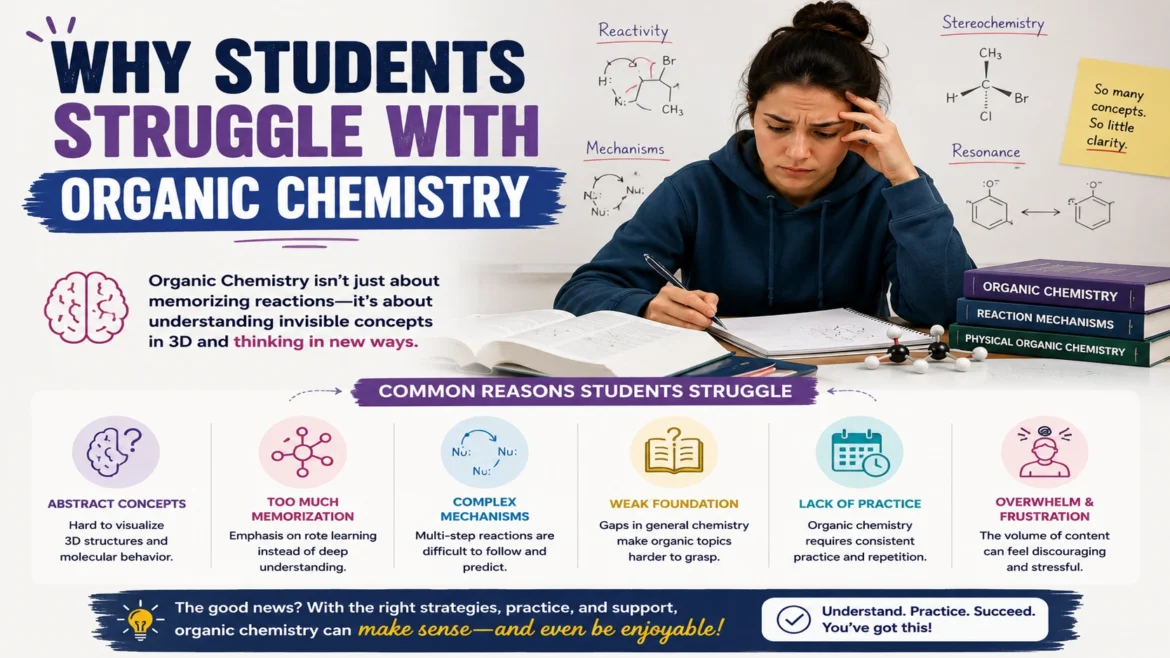

Even students who performed well in previous science courses sometimes struggle when they first encounter organic chemistry.
This experience is extremely common.
Organic chemistry often feels very different from many earlier science classes because it requires students to think through reactions, patterns, structures, and mechanisms instead of relying mainly on memorization alone.
Why Organic Chemistry Feels Challenging
- Large amount of reaction information
- Complex reaction mechanisms
- Heavy emphasis on problem-solving
- Need for pattern recognition
- Fast-paced course progression
- Difficulty balancing memorization and understanding
Why Organic Chemistry Feels Different From Other Science Courses
Many earlier science classes focus heavily on formulas, direct calculations, or straightforward memorization.
Organic chemistry often requires a different type of thinking.
Students frequently need to:
- Analyze reaction behavior
- Recognize structural patterns
- Understand reaction mechanisms
- Predict chemical outcomes
- Connect concepts across multiple chapters
This shift can feel difficult at first, especially for students who are used to memorizing information instead of reasoning through chemical processes.
Learning Perspective:
Many successful organic chemistry students eventually realize the course becomes easier when they focus more on understanding reaction patterns instead of trying to memorize every reaction individually.
Why Memorization Alone Usually Fails
One of the biggest mistakes students make in organic chemistry is trying to memorize massive amounts of information without understanding why reactions happen.
Students often attempt to memorize:
- Reaction steps
- Mechanisms
- Reagents
- Products
- Reaction conditions
However, organic chemistry problems frequently require students to apply concepts in unfamiliar ways.
Without understanding reaction behavior and mechanism logic, memorized information becomes difficult to use during exams.
| Common Student Difficulty | Why It Happens |
|---|---|
| Reaction Confusion | Students memorize reactions without understanding mechanisms |
| Information Overload | Large amount of reactions and structures introduced quickly |
| Falling Behind | Later concepts build heavily on earlier understanding |
| Exam Difficulty | Questions often test application and reasoning instead of memorization |
Source: General organic chemistry education principles and undergraduate STEM learning challenges.
Why Reaction Mechanisms Feel Overwhelming
Reaction mechanisms are often one of the most intimidating parts of organic chemistry for new students.
Mechanisms require students to understand:
- Electron movement
- Reaction steps
- Structural changes
- Chemical behavior patterns
- Reaction logic
At first, many mechanisms may appear random or impossible to follow.
However, students often improve significantly once they begin recognizing repeated reaction patterns and underlying chemical principles.
Why Falling Behind Happens So Quickly
Organic chemistry concepts build heavily on earlier material.
If students struggle with foundational topics such as:
- Bonding concepts
- Reaction mechanisms
- Functional groups
- Electron movement
- Nomenclature basics
later chapters may become increasingly difficult to understand.
Because the course moves quickly, small knowledge gaps can grow into much larger learning problems over time.
Many students improve confidence using realistic questions for ACS Organic Chemistry preparation and reaction-based study problems because repeated exposure to mechanisms and reaction patterns helps complex chemistry concepts feel more manageable and organized.
Why Pattern Recognition Matters in Organic Chemistry
One major difference between successful and struggling organic chemistry students is often the ability to recognize recurring reaction patterns.
Organic chemistry becomes easier when students begin noticing:
- Repeated mechanism behaviors
- Similar reaction pathways
- Common functional-group patterns
- Predictable electron movement
- Reaction-condition trends
Instead of viewing every reaction as completely separate information, stronger students often organize chemistry concepts into connected systems and patterns.
Important Learning Insight:
Organic chemistry often becomes more manageable when students focus on understanding “why reactions happen” rather than trying to memorize every reaction individually.
Why Problem-Solving Feels Difficult at First
Many organic chemistry exam questions test reasoning and application instead of direct memorization.
Students may need to:
- Predict reaction products
- Analyze reaction mechanisms
- Identify structural relationships
- Recognize reaction errors
- Apply concepts to unfamiliar problems
This can feel frustrating initially because students may not immediately know how to approach complex reaction-based questions logically.
| Organic Chemistry Skill | Why It Matters |
|---|---|
| Mechanism Understanding | Helps explain why reactions occur |
| Pattern Recognition | Improves ability to predict reaction behavior |
| Problem-Solving | Supports reaction analysis and exam performance |
| Consistent Practice | Strengthens reaction familiarity and confidence |
Source: General undergraduate organic chemistry education principles and STEM learning practices.
Why Practice Is More Important Than Passive Reading
Some students spend large amounts of time rereading textbooks or reviewing notes without actively solving chemistry problems.
However, organic chemistry understanding usually improves more effectively through:
- Reaction practice problems
- Mechanism analysis
- Structure drawing exercises
- Practice exams
- Step-by-step reaction review
Repeated exposure to chemistry problems helps students become more comfortable recognizing reaction logic and identifying common patterns.
Learning Reality:
Many students begin improving in organic chemistry only after shifting from passive memorization toward active problem-solving and mechanism practice.
Why Confidence Often Drops During Organic Chemistry
Even high-performing students sometimes lose confidence during organic chemistry courses.
Students may feel overwhelmed by:
- Fast-paced lectures
- Complex mechanisms
- Difficult exams
- Heavy workloads
- Comparisons with classmates
Because organic chemistry is widely considered challenging, many students incorrectly assume struggling means they are incapable of understanding the subject.
In reality, organic chemistry often requires a gradual adjustment in learning strategy and problem-solving approach.
Why Consistency Matters More Than Cramming
Organic chemistry concepts are difficult to master through last-minute memorization alone.
Students who study consistently often perform better because they have more time to:
- Review mechanisms repeatedly
- Recognize reaction patterns
- Strengthen conceptual understanding
- Practice applying reactions logically
- Identify weaker areas earlier
Small, regular study sessions usually help students retain chemistry concepts more effectively than infrequent intensive cramming.
Why Organic Chemistry Rewards Understanding Over Memorization
Many students eventually discover that organic chemistry becomes less intimidating when they focus more on understanding reaction behavior instead of trying to memorize isolated facts.
Strong organic chemistry students often learn to ask:
- Why does this reaction occur?
- What causes electron movement here?
- Which pattern does this mechanism follow?
- How are these reactions connected?
- What makes this product more likely?
This type of reasoning gradually helps students organize chemistry concepts more logically and predict reaction outcomes more confidently.
Learning Perspective:
Organic chemistry often feels overwhelming early on because students see many disconnected reactions before they begin recognizing the deeper reaction patterns connecting them together.
Why Study Strategy Matters in Organic Chemistry
Students sometimes struggle not because they lack intelligence, but because their study approach does not match the demands of the course.
More effective organic chemistry study habits often include:
- Practicing reaction mechanisms regularly
- Reviewing concepts consistently
- Drawing structures repeatedly
- Solving reaction-based problems
- Focusing on conceptual understanding
Students who actively work through chemistry problems usually improve more than students who rely mainly on passive reading or memorization.
| Helpful Organic Chemistry Habit | Why It Helps Students |
|---|---|
| Consistent Practice | Improves familiarity with reactions and mechanisms |
| Mechanism Review | Strengthens understanding of reaction behavior |
| Pattern Recognition | Helps students organize large amounts of chemistry information |
| Problem-Solving Practice | Builds confidence for reaction-based exam questions |
Source: General undergraduate organic chemistry education principles and STEM learning strategies.
Why Organic Chemistry Can Eventually Become More Interesting
Although many students initially feel frustrated by organic chemistry, some later begin enjoying the subject once reaction patterns and mechanisms become more understandable.
Students often become more confident when they start recognizing:
- Connections between reactions
- Predictable mechanism behavior
- Functional-group relationships
- Reaction logic and structure
- How chemistry concepts fit together
As understanding improves, the subject often shifts from memorization overload toward organized scientific reasoning and pattern recognition.
Important Reminder:
Struggling early in organic chemistry is extremely common and does not automatically mean a student cannot succeed in the course.
Why ACS Organic Chemistry Preparation Requires Practice
ACS Organic Chemistry exams often test conceptual understanding, reaction analysis, and problem-solving rather than memorization alone.
Students preparing for ACS-style questions frequently benefit from:
- Reaction-based practice problems
- Mechanism review exercises
- Timed chemistry questions
- Conceptual reaction analysis
- Repeated exposure to exam-style problems
Consistent chemistry practice helps students become more comfortable applying concepts logically during challenging exam situations.
Final Thoughts
Students struggle with organic chemistry for many reasons, including information overload, difficult reaction mechanisms, heavy problem-solving demands, and the need for conceptual reasoning instead of simple memorization.
However, many students improve significantly once they begin focusing on reaction patterns, mechanism understanding, consistent practice, and active problem-solving rather than memorization alone.
Organic chemistry often feels overwhelming at first because the subject introduces a completely different way of thinking compared to many earlier science courses.
With time, repetition, and stronger conceptual understanding, students often become much more confident navigating reactions, mechanisms, and ACS-style chemistry problems throughout the course.