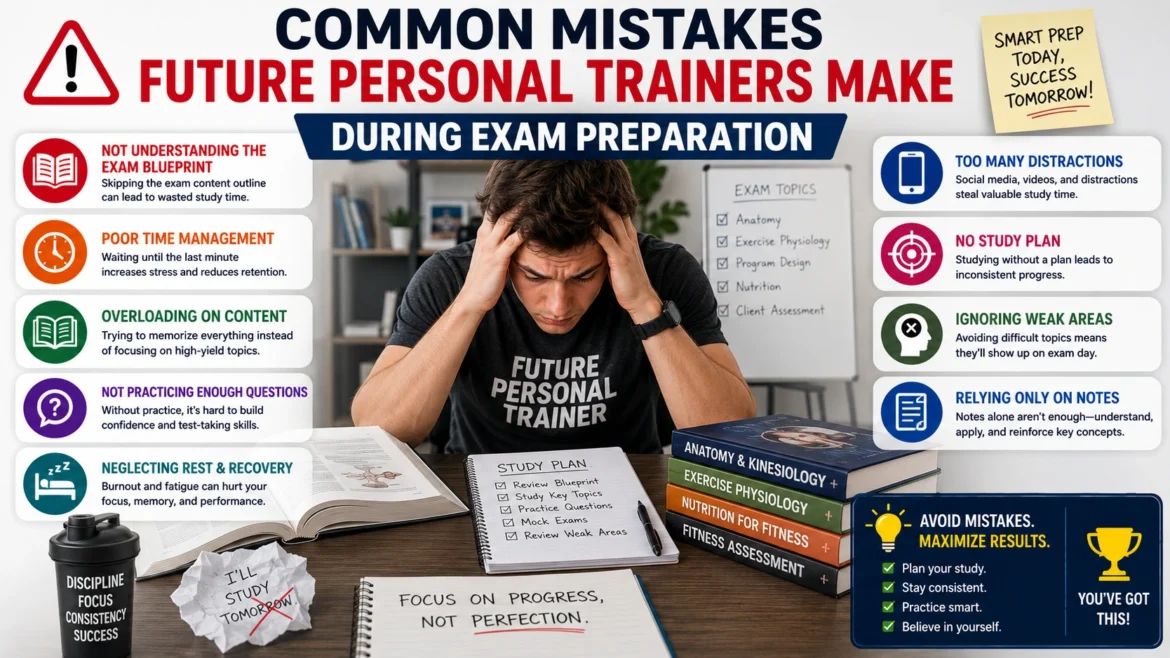

Many future trainers study hard and spend long hours reviewing information, yet still struggle to feel fully prepared when exam day arrives.
In many cases, the problem is not lack of effort. Instead, candidates often use study methods that do not match the type of reasoning required during certification exams.
Preparation Problems Are Extremely Common
Many certification candidates experience difficulty not because they are incapable of learning the material, but because they rely on preparation habits that make applied exam reasoning more difficult.
Small study mistakes repeated consistently over time can greatly affect confidence, retention, and overall exam readiness.
Mistake #1 — Relying Too Much on Passive Studying
One of the most common preparation mistakes involves spending nearly all study time rereading notes, highlighting textbooks, or watching educational videos without actively applying information.
Passive studying can feel productive because candidates remain constantly exposed to information. However, recognizing material while reading is very different from recalling and applying concepts independently during a timed certification exam.
Personal training exams often require candidates to:
- Interpret realistic client scenarios
- Apply exercise-science reasoning
- Identify safer recommendations
- Analyze movement-related concerns
- Make decisions under pressure
Passive studying alone usually does not fully prepare candidates for these types of applied situations.
Why This Mistake Creates Problems
Many candidates feel confident while reviewing notes but struggle during exams because they have not practiced actively retrieving and applying information independently.
Why Active Practice Usually Works Better
Active learning methods often help candidates engage more deeply with exercise-science concepts and improve long-term understanding.
Stronger preparation strategies may involve:
Scenario Analysis
Applying fitness concepts within realistic client situations.
Practice Questions
Strengthening recall and decision-making under exam conditions.
Concept Application
Connecting textbook information to practical training situations.
Candidates who actively apply concepts often develop stronger retention and more confidence during certification exams.
Mistake #2 — Ignoring Realistic Client Scenarios
Another common mistake involves studying exercise-science definitions without practicing how those concepts apply to real fitness situations.
Personal trainers frequently work with clients who have different:
- Fitness levels
- Movement abilities
- Exercise limitations
- Training goals
- Safety considerations
Certification exams often reflect these practical situations by testing applied reasoning instead of memorization alone.
Candidates who avoid realistic scenarios sometimes struggle when exam questions require them to evaluate exercise situations logically rather than simply recall definitions.
Applied Learning Matters
Many future trainers improve understanding much faster once they begin connecting exercise-science concepts to realistic client and movement situations instead of studying topics in isolation.
Many future trainers improve confidence using realistic ACSM-CPT Test Prep because repeated exposure to applied training situations helps exercise concepts feel more practical and easier to analyze during exam conditions.
Mistake #3 — Trying to Memorize Everything
Many certification candidates believe they must memorize every exercise term, anatomy detail, and training concept perfectly before feeling ready for the exam.
This approach often creates unnecessary stress because personal training certifications typically focus more on applied reasoning and practical understanding than on isolated memorization alone.
Candidates who focus entirely on memorization sometimes struggle when questions present unfamiliar situations requiring logical thinking instead of direct recall.
Why Memorization Alone Can Become a Problem
Candidates may recognize information while studying but still feel confused when they must apply concepts within realistic client or exercise situations during the exam.
Stronger preparation often involves understanding:
- Why exercises are selected
- How movement principles apply
- How trainers adjust programs safely
- Why client limitations matter
- How exercise-science concepts connect together
Candidates who focus on understanding concepts instead of memorizing isolated facts often feel more comfortable handling difficult certification questions.
Mistake #4 — Avoiding Weak Areas
Another extremely common preparation mistake involves repeatedly studying comfortable topics while avoiding areas that feel difficult or confusing.
For example, some candidates may repeatedly review familiar anatomy concepts while avoiding:
- Movement-analysis questions
- Program-design reasoning
- Client-safety scenarios
- Exercise progression concepts
- Applied exercise-science situations
Although reviewing strengths feels more comfortable, avoiding weak areas usually creates larger knowledge gaps over time.
Why Weak Areas Need Attention
Certification exams rarely focus only on a candidate’s strongest topics. Weak areas often become major sources of anxiety during timed testing situations.
Candidates who identify and practice weaker concepts earlier often improve overall readiness much more effectively.
Why Balanced Preparation Usually Works Better
Effective preparation often involves creating a study routine that includes both strengths and weaker topics instead of focusing heavily on only familiar material.
Balanced preparation may help improve:
Overall Confidence
Reducing fear surrounding difficult certification topics.
Concept Understanding
Strengthening practical exercise-science reasoning across multiple areas.
Exam Readiness
Helping candidates feel more prepared for varied question types.
Mistake #5 — Cramming Right Before the Exam
Some candidates wait until the final days before the exam to begin intensive studying, hoping long study sessions will compensate for limited preparation time.
Unfortunately, cramming often creates:
- Mental fatigue
- Information overload
- Reduced retention
- Increased stress
- Difficulty applying concepts clearly
Personal training certifications involve applied reasoning that usually improves more through repeated exposure over time than through short-term memorization sessions.
Consistency Often Beats Intensity
Many successful certification candidates build stronger understanding through smaller and repeated study sessions instead of relying heavily on stressful last-minute cramming.
Why Repetition Helps Learning Feel Easier
Repeated exposure to exercise-science concepts and certification-style questions often helps candidates recognize patterns more naturally over time.
Concepts that initially feel confusing frequently become easier after repeated practice involving:
- Client scenarios
- Movement analysis
- Exercise progression reasoning
- Safety-focused situations
- Program-design questions
Gradual repetition often reduces stress while helping candidates develop stronger long-term confidence with certification material.
Mistake #6 — Skipping Timed Practice Sessions
Many candidates spend time reviewing concepts but rarely practice answering questions under realistic timed conditions before the actual certification exam.
This can create problems because certification testing often requires candidates to:
- Interpret questions efficiently
- Manage exam pacing carefully
- Analyze scenarios under pressure
- Make decisions quickly
- Maintain focus for extended periods
Candidates who avoid timed practice sometimes understand the material well but struggle to apply concepts efficiently during the actual exam environment.
Why Timing Matters
Strong knowledge alone may not fully prepare candidates if they are unfamiliar with the pacing and mental pressure involved during certification testing situations.
How Timed Practice Improves Readiness
Timed practice sessions often help candidates become more comfortable balancing accuracy and efficiency during exam conditions.
Repeated timed practice may improve:
Question Interpretation
Helping candidates recognize key concepts more quickly during exams.
Decision-Making Speed
Supporting more efficient reasoning under time pressure.
Testing Confidence
Helping certification environments feel more familiar and manageable.
Over time, repeated exposure to timed situations often helps candidates remain calmer and more organized throughout longer certification exams.
Mistake #7 — Studying Without a Clear Plan
Another common preparation mistake involves studying randomly without a consistent structure or organized review strategy.
Candidates sometimes jump between unrelated topics each day without tracking:
- Weak areas
- Progress over time
- Practice-question performance
- Retention difficulties
- Concept understanding
Without a structured approach, preparation can become disorganized and mentally exhausting.
Why Organization Helps
Structured preparation often helps candidates feel more focused and less overwhelmed because study sessions become more purposeful and easier to manage.
Even simple planning strategies can improve consistency and reduce unnecessary stress during exam preparation.
Why Many Candidates Improve After Changing Study Methods
Many future trainers experience major improvement once they stop focusing only on memorization and begin using more active and applied preparation methods.
Candidates often improve readiness by:
- Practicing realistic scenarios
- Reviewing weaker topics consistently
- Using timed practice sessions
- Applying concepts actively
- Studying with greater consistency
Many candidates who understand how practice questions strengthen personal trainer exam readiness often realize that active learning and realistic scenario exposure can improve confidence far more effectively than passive review alone.
Preparation Improvement Often Happens Gradually
Many successful candidates build confidence step-by-step through consistent practice, realistic application, and repeated exposure to certification-style thinking situations.
Final Thoughts
Future personal trainers often struggle during exam preparation not because they lack potential, but because they rely on study habits that do not fully support applied learning and certification-style reasoning.
Common mistakes such as passive studying, avoiding weak topics, cramming, skipping timed practice, and relying too heavily on memorization can make certification preparation feel much harder than necessary.
Stronger preparation usually involves consistent practice, active learning, realistic scenario exposure, and repeated application of exercise-science concepts within practical fitness situations.
As personal training certifications continue emphasizing critical thinking and client-focused reasoning, candidates who build organized and realistic study habits often feel more confident, more prepared, and better equipped to handle certification exams successfully.