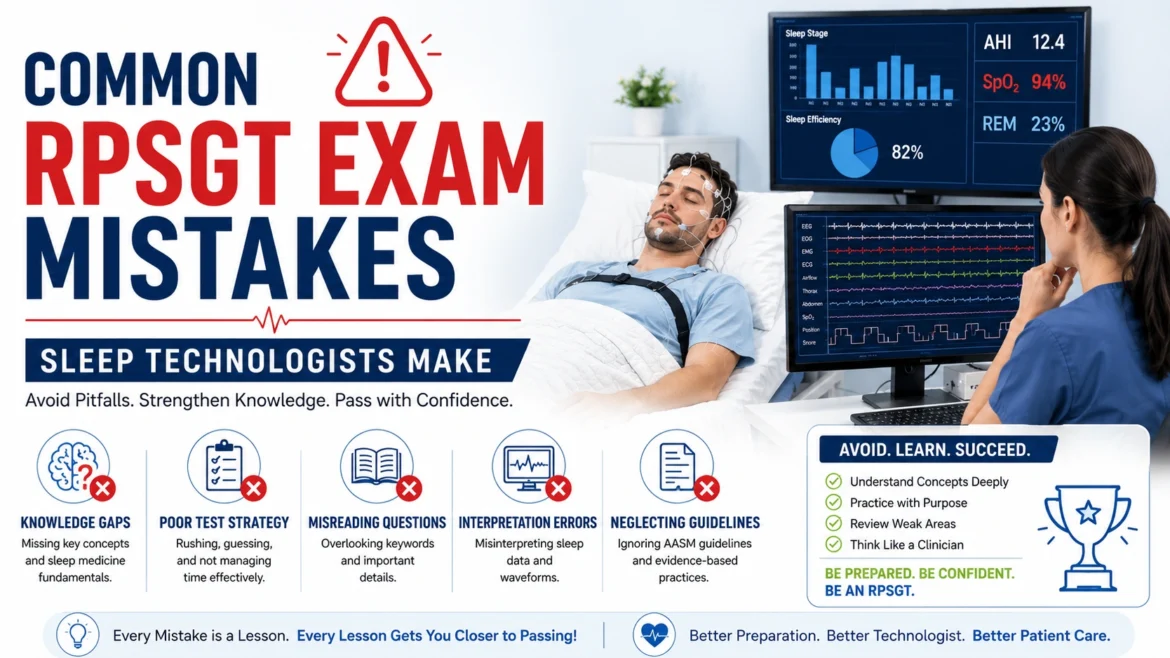

The Registered Polysomnographic Technologist (RPSGT) exam is considered one of the most important certifications in sleep medicine and polysomnography. While many candidates possess strong healthcare backgrounds and technical experience, the exam can still feel challenging because it evaluates both clinical reasoning and technical interpretation skills.
Many sleep technologists underestimate how much practical application the exam requires.
Instead of focusing only on memorized terminology, the RPSGT exam often evaluates whether candidates can:
- Interpret sleep-study data accurately
- Recognize respiratory abnormalities
- Identify sleep-stage changes
- Apply patient safety principles
- Troubleshoot monitoring issues
- Respond appropriately during clinical scenarios
Because of this, even experienced technologists may struggle if preparation methods are poorly structured or overly focused on memorization alone.
Mistake #1: Focusing Only on Memorization
One of the most common mistakes candidates make is relying too heavily on memorization without practicing technical interpretation and clinical application.
Many candidates spend large amounts of time reviewing:
- Definitions
- Technical terms
- Equipment names
- Sleep disorder terminology
- Study protocols
While foundational knowledge is important, the exam often requires candidates to interpret sleep-study scenarios involving multiple technical and physiological factors simultaneously.
For example, candidates may need to analyze:
- Respiratory event patterns
- Sleep-stage transitions
- Signal artifacts
- Patient monitoring changes
- Equipment-related complications
This level of application requires practical reasoning rather than isolated memorization.
Mistake #2: Weak Understanding of Sleep Staging
Sleep staging is one of the most important areas in polysomnography because accurate stage recognition directly affects study interpretation and sleep disorder evaluation.
Many candidates struggle because they:
- Confuse REM and non-REM patterns
- Misinterpret EEG activity
- Overlook arousal patterns
- Fail to recognize stage transitions
- Memorize stages without understanding physiology
The RPSGT exam may evaluate whether candidates can recognize neurological and physiological changes associated with different sleep stages.
Strong preparation requires repeated exposure to realistic sleep-study interpretation scenarios instead of passive reading alone.
Mistake #3: Ignoring Respiratory Event Interpretation
Respiratory monitoring is a major part of sleep technology because many sleep disorders involve breathing abnormalities during sleep.
Some candidates underestimate how heavily respiratory interpretation influences both clinical practice and exam preparation.
The RPSGT exam may evaluate understanding of:
- Apnea recognition
- Hypopnea interpretation
- Oxygen desaturation events
- Airflow monitoring
- Respiratory effort patterns
- CPAP-related respiratory responses
Candidates who focus only on theoretical review often struggle interpreting respiratory patterns within realistic sleep-study scenarios.
Repeated technical practice usually improves confidence and pattern recognition significantly.
Mistake #4: Neglecting Technical Troubleshooting Skills
Sleep studies rely heavily on accurate monitoring equipment and signal quality. Even small technical issues may interfere with study reliability and patient safety.
Many candidates spend too little time reviewing practical troubleshooting concepts involving:
- Sensor displacement
- Signal interference
- Poor electrode connections
- Equipment calibration problems
- Data recording disruptions
- Artifact recognition
The exam may include situations where candidates must identify the most appropriate response to technical monitoring problems.
Strong troubleshooting skills are extremely valuable because sleep technologists frequently encounter these challenges during real overnight studies.
Mistake #5: Overlooking Patient Safety Priorities
Patient safety remains one of the most important responsibilities in sleep medicine.
Some candidates become so focused on technical scoring and monitoring details that they overlook broader clinical safety priorities.
Sleep technologists must remain prepared to:
- Recognize respiratory distress
- Monitor oxygen instability
- Respond to patient discomfort
- Identify emergency situations
- Maintain safe equipment operation
The RPSGT exam may evaluate whether candidates can prioritize patient wellbeing appropriately during technical or clinical complications.
Strong preparation should therefore include both technical accuracy and patient-centered clinical awareness.
Mistake #6: Poor Time Management During Preparation
Many sleep technologists preparing for certification balance demanding overnight shifts, healthcare responsibilities, family obligations, and inconsistent schedules.
Without a structured study plan, preparation often becomes:
- Disorganized
- Inconsistent
- Emotionally exhausting
- Focused on the wrong topics
- Overwhelming near exam day
Some candidates delay realistic practice sessions until the final weeks before the exam, which increases anxiety significantly.
Consistent long-term preparation is usually far more effective than aggressive short-term cramming.
Why Active Learning Improves RPSGT Preparation
Because the RPSGT exam focuses heavily on technical interpretation and practical application, active learning methods often produce stronger results than passive review alone.
Examples of effective active learning strategies include:
- Sleep-study scenario analysis
- Respiratory event interpretation
- Practice scoring exercises
- Technical troubleshooting review
- Timed practice sessions
- Rationale analysis
Many sleep technologists preparing for certification improve technical reasoning and confidence by consistently working through realistic RPSGT practice test scenarios that simulate patient-monitoring situations, respiratory event analysis, and sleep-study interpretation challenges commonly seen during the actual exam.
Mistake #7: Studying Without Understanding Sleep Physiology
Many candidates attempt to memorize sleep-study procedures and scoring guidelines without fully understanding the physiological processes occurring during sleep.
However, sleep physiology forms the foundation of polysomnography interpretation.
Without conceptual understanding, candidates may struggle interpreting:
- Sleep-stage transitions
- Neurological activity patterns
- Respiratory instability
- Muscle tone changes
- Heart rate fluctuations
- Arousal events
The RPSGT exam often evaluates whether candidates understand how physiological changes affect sleep-study monitoring and patient outcomes.
Strong preparation therefore requires learning the “why” behind sleep-study patterns rather than memorizing isolated technical details alone.
Mistake #8: Ignoring CPAP and BiPAP Therapy Concepts
Positive airway pressure therapy plays a major role in sleep medicine because many patients undergoing sleep studies require CPAP or BiPAP treatment for sleep-related breathing disorders.
Some candidates review PAP terminology briefly but fail to develop deeper understanding of:
- Pressure adjustment principles
- Mask fitting challenges
- Patient tolerance issues
- Therapy troubleshooting
- Respiratory response interpretation
- Leak management concepts
The RPSGT exam may include scenarios requiring candidates to evaluate PAP-related patient responses and determine appropriate technical actions.
Repeated scenario-based practice often improves confidence significantly in this area.
Mistake #9: Overlooking Signal Artifacts and Monitoring Errors
Signal artifacts are extremely important in polysomnography because inaccurate recordings may interfere with proper interpretation and clinical decision-making.
Many candidates underestimate how frequently artifact-related issues appear in both real sleep studies and exam preparation.
Examples of monitoring complications may include:
- Movement-related interference
- Poor electrode contact
- Electrical signal disruptions
- Sensor displacement
- Respiratory channel inconsistencies
- Technical recording abnormalities
Technologists must recognize the difference between genuine physiological events and technical recording problems.
Strong troubleshooting abilities help maintain study quality and improve diagnostic reliability.
Mistake #10: Passive Reading Without Practice Application
Many sleep technologists spend large amounts of time reading textbooks, highlighting notes, or reviewing technical terminology without actively applying the information.
Passive studying may create temporary familiarity, but it often fails to strengthen technical reasoning and interpretation skills.
Active learning methods are usually much more effective because candidates must:
- Interpret sleep-study patterns
- Analyze respiratory events
- Recognize equipment problems
- Apply troubleshooting logic
- Evaluate patient-monitoring changes
Repeated technical application strengthens long-term retention far more effectively than passive review alone.
Mistake #11: Poor Exam Pacing During Practice Sessions
Some candidates prepare extensively but rarely practice under realistic timed conditions before exam day.
Without pacing practice, candidates may:
- Spend too much time on difficult questions
- Overanalyze technical details
- Lose concentration during longer sessions
- Rush later questions
- Experience unnecessary stress
Timed practice sessions help technologists improve:
- Decision-making speed
- Technical confidence
- Mental endurance
- Scenario interpretation efficiency
- Testing comfort
Repeated exposure to realistic testing conditions often reduces anxiety significantly before the actual certification exam.
Why Burnout Affects Technical Performance
Many sleep technologists preparing for certification already work physically and mentally demanding overnight schedules.
Long shifts, inconsistent sleep patterns, and emotional exhaustion can negatively affect:
- Concentration
- Memory retention
- Technical interpretation
- Motivation
- Learning efficiency
Some candidates attempt aggressive study schedules without allowing proper mental recovery, which may increase fatigue further.
Healthy preparation often includes:
- Reasonable study expectations
- Consistent sleep routines
- Mental recovery time
- Balanced schedules
- Stress management habits
Protecting mental focus is especially important because sleep medicine itself already requires strong sustained attention.
How Structured Preparation Improves Technical Confidence
Many candidates feel overwhelmed initially because the RPSGT exam covers both clinical and technical concepts across multiple sleep medicine domains.
Structured preparation helps candidates improve gradually by organizing study topics into manageable sections such as:
| Study Focus | Purpose |
|---|---|
| Sleep Physiology | Improves conceptual understanding. |
| Respiratory Monitoring | Strengthens event interpretation skills. |
| Sleep Staging | Supports accurate scoring. |
| Equipment Troubleshooting | Improves technical problem-solving. |
| Practice Simulations | Builds confidence under exam conditions. |
This type of organized preparation often reduces overwhelm while improving long-term retention and technical confidence.
Learning From Experienced Sleep Technologists
Many successful candidates improve preparation quality significantly by learning from experienced professionals already working in sleep medicine environments.
Experienced technologists often provide valuable insight involving:
- Practical monitoring challenges
- Common scoring errors
- Patient-management situations
- Technical troubleshooting strategies
- Clinical prioritization skills
Candidates seeking a stronger overall understanding of polysomnography responsibilities and sleep medicine career development may also benefit from reviewing a detailed professional overview of the RPSGT certification process and the broader role sleep technologists play within modern healthcare environments.
Why Clinical Awareness Matters During Sleep Studies
Many candidates focus heavily on technical memorization while underestimating the importance of clinical awareness during patient monitoring situations.
Sleep technologists must continuously evaluate both technical data and patient wellbeing simultaneously throughout overnight studies.
This includes recognizing:
- Respiratory instability
- Changes in oxygen saturation
- Abnormal neurological activity
- Patient discomfort
- Equipment-related complications
- Unexpected physiological events
The RPSGT exam may evaluate whether candidates can prioritize patient safety while maintaining accurate study procedures and technical interpretation standards.
Strong clinical awareness therefore becomes just as important as technical knowledge.
Why Candidates Should Practice Scenario Interpretation
Many RPSGT questions involve realistic monitoring situations requiring candidates to apply technical knowledge under pressure.
Scenario-based preparation helps technologists strengthen:
- Respiratory event recognition
- Sleep-stage interpretation
- Technical troubleshooting
- Patient safety prioritization
- Clinical decision-making speed
Repeated exposure to technical scenarios helps candidates become more comfortable interpreting complex sleep-study situations without excessive hesitation.
This type of active preparation usually improves both confidence and retention more effectively than passive reading alone.
How Poor Study Structure Creates Preparation Problems
Many sleep technologists preparing for certification struggle because they study inconsistently without organized topic prioritization.
Without structure, candidates may:
- Overfocus on familiar topics
- Ignore weak technical areas
- Delay practice testing
- Review material inefficiently
- Become overwhelmed near exam day
Structured preparation helps candidates improve steadily by balancing:
- Technical review
- Practice scenarios
- Respiratory interpretation
- Sleep-stage analysis
- Equipment troubleshooting
- Timed sessions
Even shorter daily study sessions often produce stronger long-term results when preparation remains organized and consistent.
Why Candidates Struggle With Technical Overanalysis
Some candidates develop the habit of overanalyzing every technical detail during practice questions and exam scenarios.
While careful interpretation is important, excessive second-guessing may lead to:
- Poor pacing
- Increased stress
- Mental fatigue
- Missed straightforward concepts
- Reduced confidence
Strong preparation helps candidates develop balanced technical reasoning while avoiding unnecessary overcomplication.
Many successful technologists learn to focus on the most clinically relevant monitoring information first before evaluating secondary details.
The Importance of Long-Term Technical Confidence
For many healthcare professionals, earning the RPSGT credential represents more than simply passing a certification exam.
The preparation process itself often strengthens:
- Technical interpretation skills
- Monitoring confidence
- Respiratory assessment awareness
- Patient safety understanding
- Professional discipline
- Clinical communication abilities
These improvements can positively affect long-term performance in sleep laboratories and specialized healthcare environments.
Many technologists later realize that the reasoning skills developed during preparation continue benefiting their professional careers long after certification.
How Sleep Medicine Continues Growing in Healthcare
Sleep medicine remains one of the growing specialty areas within healthcare because awareness of sleep disorders continues increasing across the United States.
Healthcare providers increasingly recognize how untreated sleep disorders may contribute to:
- Cardiovascular disease
- Respiratory complications
- Cognitive impairment
- Mental health concerns
- Workplace safety issues
- Reduced quality of life
This growing awareness increases demand for trained sleep technologists capable of performing accurate sleep-study monitoring and supporting specialized patient care.
Because of this, strong technical skills and professional certification may continue becoming increasingly valuable in the future.
How Practice Builds Professional Readiness
Repeated technical application helps future sleep technologists transition from memorizing information into thinking more confidently within real clinical environments.
Practice-based preparation strengthens:
| Professional Skill | Long-Term Benefit |
|---|---|
| Sleep Study Interpretation | Improves diagnostic support accuracy. |
| Technical Troubleshooting | Supports reliable monitoring quality. |
| Respiratory Monitoring | Strengthens patient safety awareness. |
| Clinical Reasoning | Improves real-world decision-making. |
| Professional Confidence | Supports long-term career growth. |
These practical abilities remain valuable throughout an entire sleep medicine career.
Final Thoughts
The RPSGT exam challenges candidates to combine technical accuracy, patient-monitoring awareness, clinical reasoning, and practical sleep medicine knowledge within realistic healthcare scenarios.
Many common preparation mistakes occur when candidates:
- Rely too heavily on memorization
- Ignore technical application
- Delay practice scenarios
- Overlook patient safety concepts
- Study inconsistently
- Neglect weak technical areas
Strong preparation usually involves consistent active learning, realistic scenario interpretation, technical troubleshooting review, and repeated respiratory-monitoring practice.
Over time, these habits help future sleep technologists build the confidence, technical judgment, and clinical awareness needed for both certification success and long-term professional growth within sleep medicine.
Frequently Asked Questions (FAQs)
What is the biggest mistake candidates make during RPSGT preparation?
One of the most common mistakes is focusing only on memorization without practicing technical interpretation and realistic sleep-study application.
Why is sleep staging important for the RPSGT exam?
Sleep staging supports accurate sleep-study interpretation and helps physicians diagnose sleep disorders more effectively.
How can candidates improve respiratory event interpretation?
Repeated practice with sleep-study scenarios, respiratory monitoring review, and active interpretation exercises often improve recognition skills significantly.
Why are technical troubleshooting skills important in polysomnography?
Troubleshooting helps technologists identify equipment problems, reduce monitoring errors, and maintain reliable study quality.
How can sleep technologists prepare more effectively for the RPSGT exam?
Consistent active learning, practice questions, sleep-study interpretation exercises, and structured topic review usually improve preparation outcomes.