
Why Many Qualified Candidates Still Struggle with the NBC-HIS Exam
Preparing for the National Board for Certification in Hearing Instrument Sciences (NBC-HIS) examination requires more than simply reading textbooks or reviewing class notes. Many candidates possess the necessary knowledge but still fall short because of avoidable mistakes made during preparation or while taking the exam.
Certification examinations are designed to evaluate not only what you know but also how effectively you apply your knowledge in realistic professional situations. Candidates who develop strong study habits, understand common pitfalls, and practice answering exam-style questions often feel more confident and perform better on exam day.
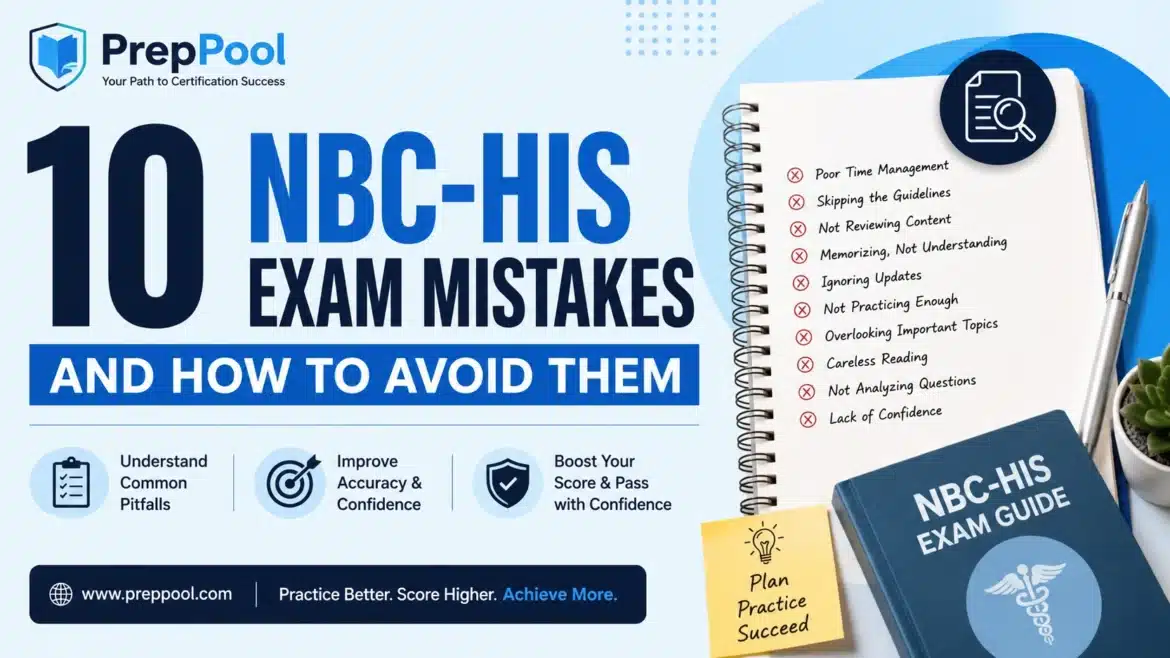
This guide explores ten common mistakes that can affect NBC-HIS exam performance and explains practical strategies to help you avoid them while building a more effective study plan.
Did You Know?
Many unsuccessful candidates discover that their biggest challenge was not a lack of knowledge—it was spending too much time reviewing familiar topics instead of strengthening weaker areas.
Mistake #1: Studying Without a Structured Plan
One of the most common mistakes is beginning exam preparation without a written study schedule. If you’re unsure how to organize your preparation, our NBC-HIS Exam Study Guide walks through the major exam topics, recommended study strategies, and practical preparation tips that complement regular practice questions.
Many candidates simply study whenever they have free time, resulting in inconsistent progress and missed topics.
A structured study plan keeps your preparation organized and ensures every major subject receives sufficient attention before exam day.
| Unstructured Study | Organized Study Plan |
|---|---|
| Random study sessions | Scheduled weekly objectives |
| Repeatedly reviewing favorite topics | Balanced review of all exam areas |
| Difficulty tracking progress | Easy identification of strengths and weaknesses |
Mistake #2: Relying Only on Reading Materials
Reading textbooks and study guides provides valuable background knowledge, but passive reading alone rarely prepares candidates for the style of questions found on certification examinations.
The NBC-HIS exam evaluates your ability to apply knowledge rather than simply recognize definitions. Practice questions encourage active learning by requiring you to analyze information before selecting the best answer.
Real Example
James spent nearly six weeks reading hearing science textbooks from beginning to end. When he attempted his first practice exam, he discovered that many questions required clinical reasoning rather than simple memorization.
He changed his approach by completing practice questions every evening and carefully reviewing every explanation. Within a month, he noticed significant improvement in both confidence and speed because he had learned how to apply his knowledge instead of simply recalling facts.
Mistake #3: Ignoring Answer Explanations
Many candidates review only the questions they answered incorrectly. While this may seem efficient, it also means missing opportunities to strengthen concepts you answered correctly by chance.
Detailed answer explanations help reinforce correct reasoning, clarify misunderstandings, and improve long-term retention of important concepts.
Mistake #4: Spending Too Much Time on Strong Subjects
Reviewing familiar material feels productive because it builds confidence. Unfortunately, it often leaves weaker subjects underprepared.
A better strategy is to regularly evaluate your performance and dedicate additional study time to areas where your practice scores remain lower.
| Study Priority | Recommended Focus |
|---|---|
| Strong topics | Quick review to maintain knowledge |
| Moderate topics | Regular practice and reinforcement |
| Weak topics | Extra practice questions and detailed review |
Improve Your Exam Readiness
Strengthen your preparation with realistic practice questions designed to simulate the NBC-HIS certification exam.
- ✔ 500 Practice Questions
- ✔ Detailed Answer Explanations
- ✔ Instant Download
- ✔ Lifetime Access
- ✔ Free Lifetime Updates
Mistake #5: Never Simulating the Real Exam
Studying without completing full-length practice sessions leaves many candidates unprepared for the pace and mental endurance required during the actual examination.
Timed practice tests help improve concentration, identify time management issues, and reduce exam-day anxiety by creating a realistic testing experience.
Mistake #6: Memorizing Answers Instead of Understanding Concepts
One of the most common problems candidates face is confusing memorization with true understanding. While remembering facts can be helpful, certification exams are designed to measure your ability to apply knowledge in realistic situations. A question may describe a patient scenario, provide hearing test results, or ask you to select the most appropriate recommendation based on professional judgment.
Instead of trying to remember individual questions, focus on understanding the reasoning behind the correct answer. Ask yourself why one option is more appropriate than the others. This approach improves critical thinking and prepares you for unfamiliar questions that assess the same concept in a different way.
After completing a practice question, explain the correct answer in your own words without looking at the explanation. If you can teach the concept, you are much more likely to remember it during the exam.
Mistake #7: Poor Time Management During Practice Tests
Some candidates spend several minutes trying to solve one difficult question. While careful thinking is important, spending too much time on a single question can reduce the time available for easier questions later in the exam.
Developing effective time management skills during practice sessions can improve your confidence and help you maintain a steady pace throughout the examination.
| Poor Strategy | Better Strategy |
|---|---|
| Spend several minutes on one difficult question. | Mark the question and return after completing easier ones. |
| Rush through the final section. | Maintain a consistent pace throughout the exam. |
| Never practice under timed conditions. | Complete full-length timed practice exams before test day. |
Mistake #8: Neglecting Hearing Instrument Technology
Modern hearing instruments continue to evolve, making it essential to understand both the technology and its practical application. Candidates should be comfortable with hearing aid components, programming concepts, troubleshooting procedures, maintenance, and patient education.
Rather than memorizing product names or specifications, focus on understanding how different technologies improve hearing outcomes and support patient needs in various listening environments.
A patient reports that conversations in quiet environments are clear, but understanding speech becomes difficult in busy restaurants. Instead of immediately recommending a different hearing aid, a Hearing Instrument Specialist should first evaluate whether programming adjustments, directional microphone settings, noise reduction features, or counseling could improve the patient’s experience.
Questions like this evaluate professional reasoning rather than simple recall.
Mistake #9: Ignoring Professional Ethics and Patient Communication
Technical knowledge alone does not make an effective Hearing Instrument Specialist. Successful professionals also communicate clearly, respect patient concerns, and follow ethical standards when recommending hearing solutions.
Review situations involving informed consent, patient expectations, confidentiality, referrals, documentation, and professional responsibility. Ethical decision-making frequently appears in certification examinations because it reflects real-world practice.
| Professional Skill | Importance During Practice |
|---|---|
| Patient Communication | Builds trust and improves long-term hearing aid success. |
| Ethical Decision-Making | Supports professional and legal responsibilities. |
| Accurate Documentation | Ensures quality patient care and regulatory compliance. |
Mistake #10: Waiting Until the Last Week to Practice
Many candidates delay taking full-length practice exams until just before the test date. By then, there may not be enough time to improve weaker areas.
Begin completing practice tests several weeks before your scheduled examination. Early practice identifies knowledge gaps while leaving enough time to strengthen those topics before exam day.
Take the Next Step in Your Preparation
Apply what you’ve learned with our comprehensive NBC-HIS Practice Test, developed to help you build confidence before exam day.
- ✔ 500 Practice Questions
- ✔ Detailed Answer Explanations
- ✔ Instant Download
- ✔ Lifetime Access
- ✔ Free Lifetime Updates
Final Thoughts
Success on the NBC-HIS examination comes from consistent preparation, thoughtful review, and regular practice. Candidates who understand concepts instead of memorizing facts, develop effective time management skills, and learn from detailed answer explanations often approach the exam with greater confidence.
Remember that every study session is an opportunity to improve. Focus on gradual progress, strengthen your weakest subjects, and use realistic practice questions to prepare for the types of decisions you’ll make as a future Hearing Instrument Specialist.
References
- National Board for Certification in Hearing Instrument Sciences (NBC-HIS). Certification information and candidate resources.
- American Speech-Language-Hearing Association (ASHA). Hearing healthcare practice resources.
- National Institute on Deafness and Other Communication Disorders (NIDCD). Hearing health education materials.
- Centers for Disease Control and Prevention (CDC). Hearing loss and public health information.