
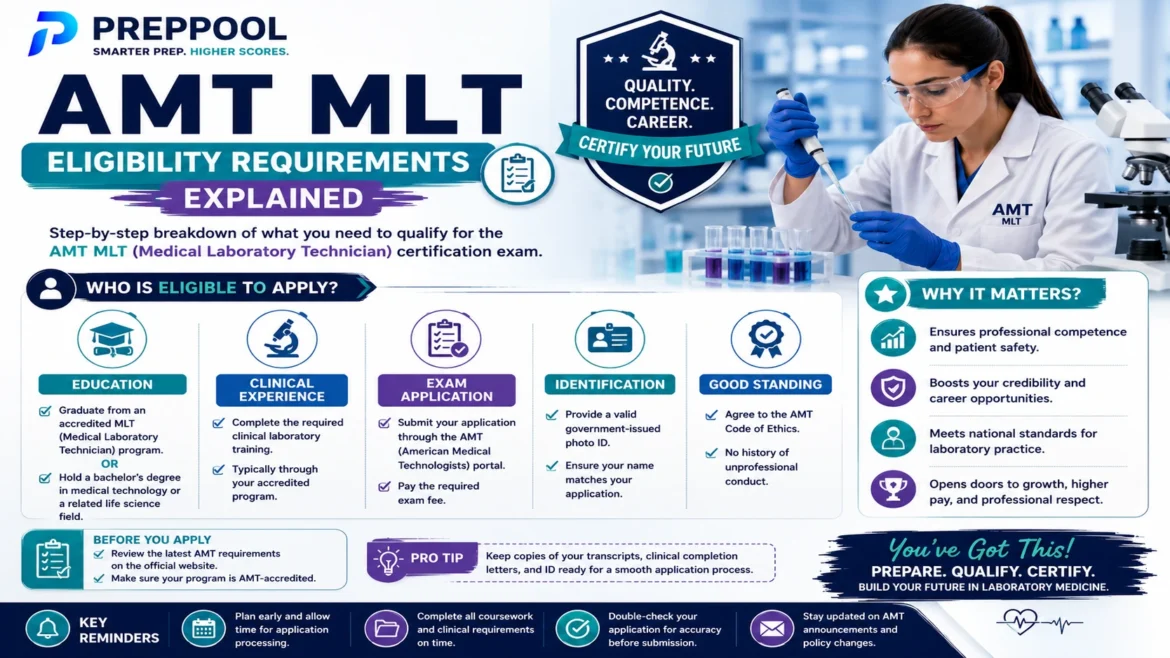

Before scheduling the American Medical Technologists (AMT) Medical Laboratory Technician (MLT) certification exam, candidates must first determine whether they meet the eligibility requirements. While many students focus primarily on studying and exam preparation, understanding eligibility is an equally important step in the certification process.
AMT certification is designed to validate professional competency in laboratory science and diagnostic testing. Because the credential carries significant value within the healthcare industry, candidates must demonstrate that they have acquired the necessary education, training, or experience before becoming eligible to sit for the examination.
For recent graduates, laboratory professionals, and individuals exploring a career in laboratory medicine, understanding these requirements early can help prevent delays and ensure a smoother certification journey.
This guide explains AMT MLT eligibility requirements, common qualification pathways, important considerations, and practical steps candidates can take before applying for certification.
- Who can apply for AMT MLT certification.
- Educational requirements.
- Training and experience pathways.
- Common eligibility mistakes.
- How to prepare documentation.
- Next steps after confirming eligibility.
What Is AMT MLT Certification?
The Medical Laboratory Technician (MLT) credential offered by the American Medical Technologists is a professional certification designed for individuals who perform laboratory testing and diagnostic procedures in healthcare environments.
Medical laboratory technicians play an essential role in healthcare by analyzing specimens, performing laboratory tests, maintaining quality standards, and helping provide accurate diagnostic information to physicians and healthcare teams.
The certification serves as evidence that a candidate possesses the knowledge and competencies necessary to perform laboratory responsibilities effectively.
Because laboratory testing directly influences patient care decisions, certification standards help maintain professional quality and consistency across the field.
Why Eligibility Requirements Matter
Eligibility requirements exist to ensure that candidates possess an appropriate educational and professional foundation before attempting certification.
The AMT MLT examination is designed to evaluate competency, not provide initial training. Candidates are expected to enter the certification process with sufficient laboratory knowledge and preparation.
By establishing eligibility standards, AMT helps ensure that individuals pursuing certification have completed relevant education, laboratory training, or qualifying experience.
This protects the integrity of the credential while supporting professional standards throughout the healthcare industry.
Who Typically Applies for AMT MLT Certification?
Individuals pursuing AMT MLT certification come from a variety of educational and professional backgrounds.
Common applicants include:
- Recent graduates of Medical Laboratory Technician programs.
- Students completing accredited laboratory science education.
- Laboratory professionals seeking professional certification.
- Individuals qualifying through approved experience pathways.
- Healthcare professionals transitioning into laboratory careers.
Although candidates may follow different routes to eligibility, all applicants must satisfy AMT requirements before becoming eligible for certification.
The Educational Foundation Required for MLT Certification
Education forms the foundation of most certification pathways. Laboratory professionals must develop a strong understanding of biological sciences, laboratory testing procedures, quality assurance principles, and diagnostic methodologies.
Formal education provides candidates with both theoretical knowledge and practical laboratory experience that prepare them for certification and future employment.
Many candidates satisfy eligibility requirements through completion of recognized educational programs that include laboratory science coursework and clinical training experiences.
This combination of classroom learning and hands-on practice helps build the competencies expected of entry-level medical laboratory technicians.
Why Accredited Laboratory Training Is Important
Accredited educational programs play a major role in preparing candidates for professional certification.
Accreditation helps ensure that programs meet established standards related to curriculum quality, laboratory instruction, clinical experiences, and educational outcomes.
Students who complete accredited programs often benefit from structured training that aligns closely with industry expectations.
This preparation can make the certification process more straightforward while supporting long-term career success.
The Role of Clinical Experience in Eligibility
Laboratory science is a hands-on profession. As a result, practical experience is an important component of professional development.
Clinical experiences allow students and trainees to apply classroom concepts in real laboratory environments while working with specimens, testing procedures, instrumentation, and quality control processes.
These experiences help bridge the gap between theory and practice.
Employers and certification organizations recognize the value of practical laboratory training because it strengthens competency and professional readiness.
| Eligibility Component | Purpose |
|---|---|
| Education | Provides scientific and technical knowledge. |
| Laboratory Training | Develops practical skills. |
| Clinical Experience | Supports real-world application. |
| Professional Standards | Ensures competency expectations. |
| Certification Exam | Validates knowledge and readiness. |
Common Misunderstandings About Eligibility
Many candidates assume that completing a science-related degree automatically qualifies them for certification. Others believe that laboratory experience alone guarantees eligibility.
In reality, eligibility requirements are often more specific than many people realize.
Educational background, laboratory coursework, clinical training, and professional experience may all play important roles depending on the pathway used.
Carefully reviewing current AMT eligibility standards before applying can help candidates avoid delays and unnecessary complications.
Questions Candidates Should Ask Before Applying
Before beginning the application process, prospective candidates should evaluate their qualifications carefully.
Helpful questions include:
- Have I completed the required education?
- Does my training meet certification standards?
- Do I possess qualifying laboratory experience?
- Have I gathered necessary documentation?
- Am I prepared for the certification examination?
Answering these questions early can help streamline the certification process and prevent unexpected obstacles.
Why Confirming Eligibility Early Saves Time
Some candidates wait until they are ready to schedule the examination before verifying eligibility requirements. This can create delays if additional documentation or verification is required.
Confirming eligibility early provides time to address potential issues, gather records, and prepare a complete application.
It also allows candidates to focus their energy on exam preparation rather than administrative concerns.
Planning ahead often makes the certification journey much less stressful.
Preparing for the Next Step After Eligibility
Once eligibility has been confirmed, the next phase involves preparing for the certification examination itself.
Candidates should begin reviewing major laboratory disciplines, strengthening weak content areas, and developing a structured study strategy.
Many successful candidates incorporate realistic AMT MLT practice exam questions into their preparation because they help identify knowledge gaps and improve confidence before exam day.
Early preparation often contributes significantly to first-attempt success.
Understanding eligibility requirements is the first step toward AMT MLT certification. Candidates who verify qualifications early can avoid delays, prepare more efficiently, and move confidently toward exam readiness.
Understanding the Different AMT MLT Eligibility Pathways
One reason many candidates become confused about eligibility is that there may be more than one pathway to qualification. Not every applicant follows the exact same educational or professional route.
Some candidates qualify through formal Medical Laboratory Technician education programs, while others may satisfy eligibility requirements through approved combinations of education, training, and laboratory experience.
Because eligibility standards can change over time, candidates should always verify current requirements directly with the certification organization before submitting an application.
Understanding which pathway applies to your background is one of the most important early steps in the certification process.
How Education Supports Eligibility Requirements
Education remains the most common foundation for certification eligibility. Laboratory science programs are designed to develop both theoretical understanding and practical skills necessary for professional laboratory work.
Students typically study subjects such as:
- Hematology.
- Clinical chemistry.
- Microbiology.
- Immunology.
- Urinalysis.
- Laboratory safety.
- Quality assurance.
This academic preparation helps ensure that candidates possess the scientific knowledge required for both certification and professional practice.
The Importance of Laboratory Coursework
Laboratory medicine is a highly specialized field. As a result, eligibility often depends not only on completing a degree but also on completing relevant laboratory coursework.
Specialized laboratory classes help candidates understand diagnostic testing principles, specimen handling procedures, instrumentation, quality control systems, and laboratory operations.
These subjects form the foundation of the knowledge evaluated during certification examinations.
Strong performance in laboratory coursework often contributes directly to exam readiness.
Why Clinical Training Matters
Classroom instruction alone is rarely sufficient preparation for laboratory practice. Clinical training provides opportunities to apply knowledge in real-world healthcare environments.
During clinical experiences, students often work with laboratory equipment, perform testing procedures, follow quality assurance protocols, and gain exposure to daily laboratory operations.
This practical experience strengthens competency and helps prepare candidates for both certification and future employment.
Clinical training also reinforces professional standards related to accuracy, safety, and patient care.
Can Work Experience Help Meet Eligibility Requirements?
In some circumstances, professional laboratory experience may play a role in establishing eligibility. Experienced laboratory personnel who have acquired skills through workplace training and practical responsibilities may qualify under specific pathways.
However, candidates should never assume that work experience automatically satisfies certification requirements.
The exact combination of education, training, and experience needed can vary depending on the pathway being used.
Reviewing current eligibility criteria carefully is essential before beginning the application process.
Documents You May Need During the Application Process
One of the most common causes of certification delays involves incomplete documentation. Preparing necessary records in advance can help avoid unnecessary complications.
Depending on individual circumstances, candidates may need documentation such as:
- Educational transcripts.
- Program completion records.
- Clinical training verification.
- Employment verification.
- Identification documents.
- Supporting eligibility forms.
Having these materials ready before applying can make the certification process significantly smoother.
Common Eligibility Mistakes Candidates Make
Many application delays occur because candidates misunderstand eligibility requirements or fail to verify qualifications before applying.
Common mistakes include:
- Assuming eligibility without verification.
- Submitting incomplete documentation.
- Misunderstanding educational requirements.
- Waiting until the last minute to gather records.
- Failing to review current certification standards.
Most of these issues can be avoided through careful planning and early preparation.
How Eligibility Requirements Protect Professional Standards
Eligibility requirements exist for an important reason. Healthcare organizations rely on laboratory professionals to provide accurate diagnostic information that directly influences patient care.
Certification standards help ensure that candidates possess the educational foundation, practical skills, and scientific understanding necessary to perform these responsibilities effectively.
By maintaining clear qualification requirements, the profession helps protect quality, consistency, and public trust.
This benefits patients, employers, healthcare systems, and laboratory professionals alike.
| Requirement Area | Purpose |
|---|---|
| Education | Develops scientific knowledge. |
| Laboratory Coursework | Builds technical understanding. |
| Clinical Training | Provides practical experience. |
| Documentation | Verifies qualifications. |
| Certification Exam | Confirms competency. |
What Happens After Eligibility Is Confirmed?
Once candidates verify that they meet eligibility requirements, attention can shift toward certification preparation.
This is often the stage where many applicants begin developing study schedules, reviewing laboratory science concepts, and identifying weak areas that need additional attention.
Candidates who want a detailed understanding of the certification process often benefit from reviewing a comprehensive AMT MLT exam guide covering exam structure, preparation strategies, and certification expectations before creating a study plan.
Having a complete picture of the process can make preparation more organized and efficient.
Why Many Candidates Pursue Certification After Meeting Eligibility Requirements
Meeting eligibility requirements is only the beginning of the certification journey. Many candidates pursue certification because they recognize the professional value associated with earning a recognized credential.
Certification can support professional credibility, strengthen confidence, and demonstrate commitment to laboratory excellence.
Individuals interested in the broader professional impact of certification often explore the many career and professional advantages associated with AMT MLT certification before deciding to pursue the credential.
These long-term benefits frequently motivate candidates to move forward with the certification process.
Planning Ahead Makes the Certification Process Easier
The most successful candidates typically begin planning long before they submit an application.
By understanding eligibility requirements, gathering documentation early, and confirming qualification pathways in advance, applicants can avoid many of the delays and frustrations that sometimes occur during certification.
Preparation at this stage creates a smoother transition into exam preparation and helps candidates stay focused on achieving certification success.
Organization and early planning remain valuable throughout every phase of the certification journey.
Eligibility verification should never be treated as a last-minute task. Confirming qualifications early provides more time for exam preparation and reduces the risk of application delays.
How to Verify Your Eligibility Before Applying
One of the smartest steps candidates can take is verifying eligibility well before they plan to schedule the certification examination. Waiting until the final stages of preparation can create unnecessary delays if documentation is incomplete or additional verification is required.
Reviewing educational records, training history, and professional experience early allows candidates to identify potential issues and address them before they become obstacles.
This proactive approach reduces stress and helps create a smoother certification experience.
Preparation is always easier when eligibility questions have already been resolved.
Questions to Ask Yourself Before Submitting an Application
Before beginning the application process, candidates should evaluate their qualifications carefully.
Helpful questions include:
- Have I completed the required education?
- Do I have the necessary laboratory training?
- Are my transcripts available and accurate?
- Do I possess any required work experience?
- Have I reviewed current certification standards?
- Do I have supporting documentation ready?
Answering these questions honestly can help prevent delays and improve application accuracy.
Why Documentation Matters
Certification organizations rely on documentation to verify that candidates satisfy eligibility requirements. Even highly qualified applicants can experience delays if records are incomplete or unavailable.
Maintaining organized copies of transcripts, training records, employment verification documents, and other supporting materials can simplify the process considerably.
Organization is especially important for candidates who completed education or training several years ago.
Locating records early often prevents last-minute complications.
What If You Do Not Currently Meet Eligibility Requirements?
Some individuals discover that they do not yet meet certification requirements. While this can be disappointing initially, it does not necessarily mean certification is out of reach.
In many cases, additional education, laboratory training, or professional experience may help candidates qualify in the future.
Rather than viewing eligibility gaps as setbacks, many successful professionals use them as opportunities to strengthen their qualifications and expand their knowledge.
Building a stronger foundation often improves both certification readiness and long-term career success.
How Eligibility Requirements Support Patient Safety
Medical laboratory technicians contribute directly to patient care by generating diagnostic information that healthcare providers use to make treatment decisions.
Because laboratory results influence critical medical choices, professional competency is essential.
Eligibility requirements help ensure that certification candidates possess the educational preparation and practical experience necessary to perform laboratory responsibilities accurately and responsibly.
These standards ultimately support patient safety and help maintain confidence in laboratory services.
Why Healthcare Employers Care About Certification Eligibility
Employers often place significant value on professional credentials because certification demonstrates that a candidate has met established qualification standards.
Eligibility requirements play an important role in this process by ensuring that certified individuals have completed appropriate preparation before earning their credential.
For employers, this creates additional confidence in a candidate’s educational background, technical knowledge, and professional readiness.
The combination of eligibility verification and certification testing helps reinforce industry standards across healthcare organizations.
How Eligibility Connects to Career Growth
Eligibility is the first milestone on the path toward certification. Once candidates qualify and successfully earn the credential, they often gain access to opportunities that support professional development and long-term career growth.
Certification can strengthen professional credibility, demonstrate commitment to excellence, and validate competency within the laboratory sciences field.
Although eligibility itself does not create career opportunities, it opens the door to a certification process that many professionals consider valuable for future advancement.
Every certification journey begins with meeting the necessary qualification standards.
| Certification Stage | Purpose |
|---|---|
| Eligibility Verification | Confirms qualification to apply. |
| Application Process | Submits documentation and records. |
| Exam Preparation | Strengthens laboratory knowledge. |
| Certification Examination | Evaluates competency. |
| Professional Credential | Validates laboratory expertise. |
Creating a Study Strategy After Eligibility Is Confirmed
Once eligibility has been verified, the next priority becomes exam preparation. Many candidates feel motivated to begin studying immediately, but a structured approach generally produces better results than random review sessions.
Breaking preparation into manageable sections, focusing on major laboratory disciplines, and using practice questions consistently can improve both retention and confidence.
Candidates balancing school, work, and family responsibilities often benefit from following a structured AMT MLT study plan designed specifically for busy students that organizes preparation into realistic and achievable goals.
A clear plan helps transform a large certification goal into manageable daily progress.
Why Practice Questions Are Important After Meeting Eligibility Requirements
Eligibility confirms that a candidate has the educational or professional background necessary to pursue certification. However, eligibility alone does not guarantee readiness for the examination.
Practice questions help bridge the gap between qualification and exam performance by reinforcing concepts, identifying weak areas, and developing familiarity with certification-style testing.
They also provide valuable insight into how laboratory knowledge is applied in practical scenarios.
Many successful candidates make practice questions a central component of their preparation strategy.
Common Signs You Are Ready to Apply and Prepare
Most successful candidates reach a point where they can confidently answer “yes” to the following questions:
- Have I confirmed my eligibility?
- Have I gathered required documentation?
- Do I understand the certification process?
- Have I developed a study plan?
- Am I committed to consistent preparation?
When these elements are in place, candidates are usually well-positioned to move forward with confidence.
Final Thoughts on AMT MLT Eligibility Requirements
Eligibility requirements are more than administrative requirements. They help ensure that candidates possess the educational background, training, and experience necessary to pursue professional certification responsibly.
Understanding these requirements early allows candidates to avoid delays, organize documentation effectively, and focus on preparation with greater confidence.
For aspiring medical laboratory technicians, eligibility verification represents the first important step toward earning a respected professional credential.
By planning ahead and confirming qualifications early, candidates can create a smoother path toward certification success.
Eligibility is the foundation of the AMT MLT certification process. Candidates who verify qualifications early, organize documentation carefully, and follow a structured preparation plan place themselves in the strongest position for success.
Conclusion
The AMT MLT certification process begins long before exam day. Understanding eligibility requirements helps candidates determine whether they qualify, gather necessary documentation, and prepare for the next stages of certification.
By verifying qualifications early and developing a clear preparation strategy, candidates can reduce stress and avoid common application challenges.
Eligibility is not simply a requirement—it is the first step toward demonstrating professional competency, strengthening laboratory knowledge, and pursuing long-term career growth in the field of laboratory medicine.
Frequently Asked Questions
What are the AMT MLT eligibility requirements?
Eligibility generally involves meeting specific education, laboratory training, and/or experience requirements established by the certification organization.
Can work experience qualify me for AMT MLT certification?
Depending on the pathway available, laboratory experience may contribute to eligibility, but candidates should verify current requirements before applying.
Do I need clinical laboratory training to become eligible?
Clinical training is often an important component of laboratory education and may be required depending on the qualification pathway.
Why should I verify eligibility before studying?
Confirming eligibility early helps avoid delays, ensures qualifications are met, and allows candidates to focus on preparation with confidence.
What should I do after confirming eligibility?
After eligibility is confirmed, candidates should begin structured exam preparation, review major laboratory disciplines, and complete practice questions regularly.