
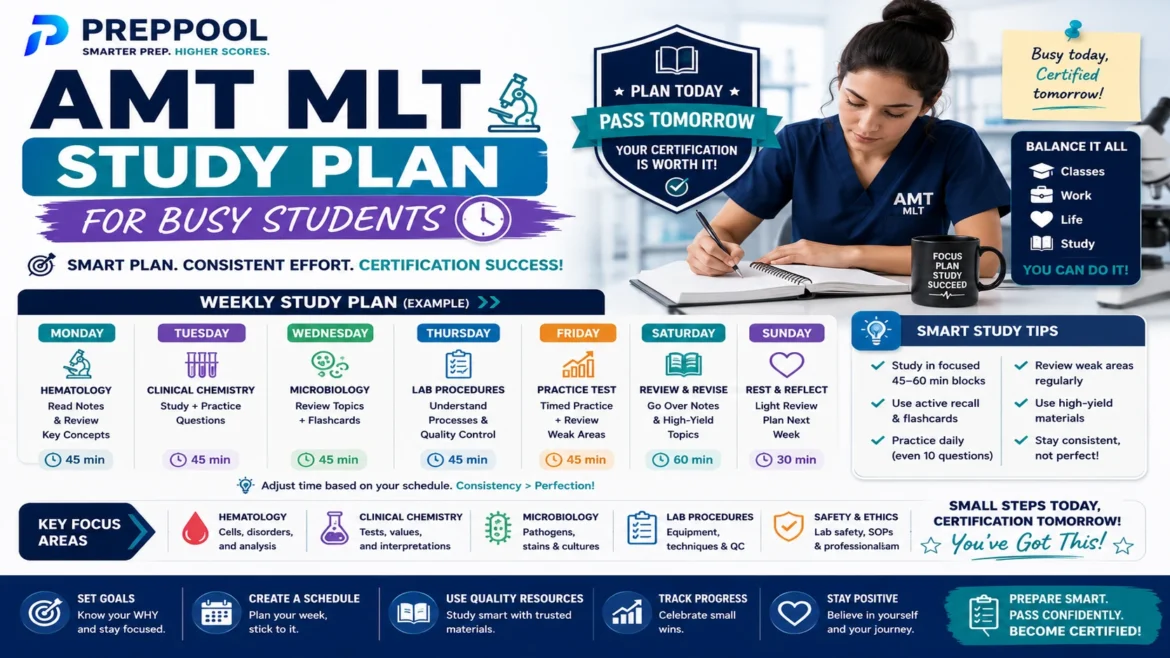

Preparing for the AMT Medical Laboratory Technician (MLT) certification exam can feel overwhelming, especially for students balancing coursework, clinical rotations, part-time jobs, family responsibilities, or other commitments.
Many candidates believe they need several hours of study time every day to succeed. In reality, the most successful students are often not those who study the longest, but those who study the most consistently.
The AMT MLT exam covers a broad range of laboratory science topics, including hematology, microbiology, clinical chemistry, immunology, urinalysis, laboratory operations, and quality assurance. Attempting to review everything at once can quickly lead to frustration and burnout.
A structured study plan helps candidates organize preparation, focus on high-priority topics, and make steady progress without becoming overwhelmed.
This guide provides a practical study strategy designed specifically for busy students who want to prepare efficiently and maximize their chances of passing the AMT MLT exam.
- Improve study efficiency.
- Reduce exam-related stress.
- Strengthen laboratory knowledge.
- Identify weak content areas.
- Build confidence gradually.
- Improve first-attempt pass potential.
Why Most Students Struggle With Certification Preparation
Many students begin studying with good intentions but without a clear plan. They jump between topics, use too many resources, and spend large amounts of time reviewing material they already understand.
Without structure, preparation can become inefficient and discouraging.
Another common challenge is inconsistency. Students often study intensely for a few days and then stop for extended periods because of academic demands or personal responsibilities.
A realistic and sustainable study plan helps solve these problems by creating a framework that supports long-term progress.
The Importance of Consistency Over Intensity
One of the biggest misconceptions about certification preparation is that success requires marathon study sessions.
While occasional extended review sessions can be useful, consistent study habits generally produce better long-term retention.
For example, studying thirty to sixty minutes several times per week often leads to stronger results than studying for several hours once every few weeks.
Regular exposure to laboratory concepts helps strengthen memory and makes it easier to build knowledge over time.
How Much Time Should You Study for the AMT MLT Exam?
There is no universal answer because every candidate begins with a different level of knowledge and experience.
Students currently enrolled in MLT programs may require less review in some areas because the material remains fresh. Graduates who have been away from formal education for longer periods may need additional preparation.
Rather than focusing solely on total study hours, candidates should focus on productive study sessions and measurable progress.
A well-organized plan often produces better results than simply increasing study time.
| Weekly Study Time | Recommended Approach |
|---|---|
| 3–4 Hours | Focused review of one major topic each week. |
| 5–6 Hours | Content review plus practice questions. |
| 7–10 Hours | Comprehensive preparation with regular assessments. |
| 10+ Hours | Accelerated preparation schedule. |
Start by Understanding the Exam Blueprint
Before creating a study schedule, candidates should understand what the AMT MLT exam actually covers.
Many students waste valuable time reviewing low-priority topics while neglecting major content areas that appear more frequently.
A successful study plan begins by identifying the primary laboratory disciplines tested on the examination.
This allows candidates to allocate study time more effectively and focus on areas that contribute most to exam success.
Breaking the Exam Into Manageable Sections
The broad scope of laboratory science can feel intimidating when viewed as a single subject. A better approach is dividing preparation into smaller, manageable sections.
Major study categories often include:
- Hematology.
- Clinical chemistry.
- Microbiology.
- Immunology and serology.
- Urinalysis.
- Laboratory operations.
- Quality assurance and safety.
Studying one section at a time makes preparation more manageable while helping students track progress more effectively.
Creating a Monthly Study Roadmap
Many successful candidates organize preparation into phases rather than trying to master every topic simultaneously.
A monthly roadmap helps establish realistic expectations and prevents information overload.
For example, the first phase may focus on content review, the second on practice questions, and the third on identifying weak areas and strengthening exam readiness.
This structured progression helps students build confidence while maintaining consistent momentum.
Prioritizing High-Yield Laboratory Topics
Although every content area is important, some subjects often require additional attention because they involve larger volumes of information or more complex concepts.
Students frequently spend extra preparation time reviewing:
- Hematology.
- Clinical chemistry.
- Microbiology.
- Quality assurance principles.
Strengthening these areas early can improve overall confidence and create a stronger foundation for later review.
Focus on understanding laboratory concepts rather than memorizing isolated facts. Conceptual understanding often improves retention and makes exam questions easier to answer.
Why Practice Questions Should Be Part of Every Study Plan
Practice questions provide one of the most efficient ways to evaluate progress and reinforce learning.
Many candidates wait until the final weeks before the exam to begin using practice questions. This often delays the discovery of weak areas that require additional review.
Introducing practice questions early allows students to identify knowledge gaps while there is still plenty of time to improve.
Regular use of realistic AMT MLT practice exam questions can help strengthen recall, improve confidence, and develop familiarity with certification-style testing.
A Real Example of Smart Study Planning
Emily was completing her final semester in an MLT program while working part-time. Initially, she attempted to review every laboratory topic simultaneously and quickly became overwhelmed.
After creating a structured study schedule, she focused on one content area at a time and incorporated practice questions into her weekly routine.
This change helped her stay organized, reduce stress, and make measurable progress each week.
Her experience demonstrates that an effective study plan is often less about studying harder and more about studying smarter.
Building a Weekly Study Schedule That Actually Works
One of the biggest reasons study plans fail is that they are unrealistic. Many candidates create ambitious schedules that require several hours of study every day, only to abandon them after a week because they cannot keep up with other responsibilities.
A successful study schedule should fit your actual lifestyle rather than an idealized version of it.
Students balancing classes, clinical experiences, work, and family commitments often benefit from shorter, focused study sessions that can be maintained consistently over several weeks or months.
The goal is sustainability, not perfection.
A Sample Four-Week Study Framework
While every candidate’s schedule will differ, a structured framework can provide a useful starting point.
| Week | Primary Focus |
|---|---|
| Week 1 | Hematology and clinical chemistry review. |
| Week 2 | Microbiology and immunology review. |
| Week 3 | Urinalysis, laboratory operations, and safety. |
| Week 4 | Practice exams, weak areas, and final review. |
This type of schedule helps candidates maintain direction while ensuring that all major content areas receive attention.
How to Balance Content Review and Practice Questions
Many students spend too much time reading and not enough time applying what they learn. While content review is essential, practice questions play a unique role in certification preparation.
Reading helps build knowledge, but practice questions reveal whether that knowledge can be applied effectively.
A balanced approach often works best:
- Review concepts first.
- Complete related practice questions.
- Analyze mistakes carefully.
- Revisit weak areas.
This cycle helps reinforce learning while improving retention and exam readiness.
Why Reviewing Mistakes Is More Important Than Reviewing Scores
Many candidates focus heavily on practice test scores. While scores provide useful feedback, they tell only part of the story.
The greatest learning opportunities often come from incorrect answers.
Every missed question highlights a concept that needs additional attention. Candidates who carefully review mistakes frequently make faster progress than those who simply track percentages.
Understanding why an answer was wrong is often more valuable than knowing whether it was wrong.
Identifying Your Weakest Laboratory Subjects
One advantage of regular practice testing is the ability to identify patterns.
For example, a candidate may consistently perform well in hematology but struggle with microbiology or quality assurance topics.
Recognizing these trends allows study time to be allocated more effectively.
Instead of spending equal time on every subject, candidates can focus additional attention on areas that need improvement.
How to Study Hematology More Efficiently
Hematology is often considered one of the most important sections of laboratory certification exams. The subject contains a large volume of information related to blood cells, coagulation, and hematologic disorders.
Rather than memorizing endless details, focus on understanding relationships between laboratory findings and disease processes.
When candidates understand why abnormalities occur, they often find it easier to interpret questions and remember key concepts.
Concept-based learning generally produces stronger long-term retention than rote memorization.
Improving Performance in Clinical Chemistry
Clinical chemistry requires understanding both laboratory procedures and the physiological significance of test results.
Many students find it helpful to group related analytes together and study them within clinical contexts rather than as isolated facts.
For example, reviewing kidney function markers alongside renal disease concepts often creates stronger connections and improves recall.
This approach makes laboratory values more meaningful and easier to remember.
Mastering Microbiology Without Becoming Overwhelmed
Microbiology can feel intimidating because of the large number of organisms, testing methods, and diagnostic procedures involved.
Instead of attempting to memorize every detail at once, focus on major categories, identification principles, and clinically significant organisms.
Building a strong foundation first often makes advanced concepts easier to understand later.
Progressive learning tends to be more effective than attempting to absorb everything simultaneously.
The Importance of Laboratory Safety and Quality Assurance
Some candidates spend most of their preparation time on technical laboratory disciplines while overlooking laboratory operations and quality assurance.
This can be a costly mistake.
Quality control, safety procedures, specimen integrity, and regulatory compliance are fundamental components of laboratory practice.
These topics also support patient safety and diagnostic accuracy, making them important areas for certification preparation.
Using Active Learning Techniques
Passive studying often creates the illusion of progress without producing strong retention.
Active learning strategies encourage deeper engagement with the material and often improve long-term memory.
Examples include:
- Explaining concepts aloud.
- Teaching material to a classmate.
- Creating laboratory case scenarios.
- Answering practice questions.
- Writing summary notes from memory.
These techniques require candidates to process information actively rather than simply reviewing it repeatedly.
Managing Study Fatigue and Preventing Burnout
Certification preparation is a marathon, not a sprint. Many students begin with enthusiasm but eventually become exhausted because they try to maintain unrealistic study schedules.
Burnout often leads to decreased motivation, poor concentration, and inconsistent study habits.
To avoid burnout:
- Schedule regular breaks.
- Maintain healthy sleep habits.
- Set realistic goals.
- Celebrate small milestones.
- Focus on consistency rather than perfection.
Maintaining balance throughout preparation is often more beneficial than maximizing study hours.
Tracking Progress Throughout Your Study Plan
Progress tracking helps maintain motivation and provides objective evidence of improvement.
Candidates can monitor:
- Practice question scores.
- Completed study topics.
- Weak areas addressed.
- Study hours completed.
- Confidence levels in major subjects.
Regular tracking helps ensure preparation remains focused and productive.
Small improvements accumulated over time often lead to significant gains by exam day.
The most effective AMT MLT study plans are not necessarily the most complicated. They are realistic, consistent, adaptable, and focused on steady improvement over time.
The Final Two Weeks Before the AMT MLT Exam
The final two weeks before the examination are often the most important phase of preparation. At this stage, candidates should shift their focus away from learning large amounts of new information and concentrate on strengthening existing knowledge.
This period is ideal for reviewing major concepts, reinforcing weak areas, and increasing familiarity with certification-style questions.
Many students make the mistake of attempting to study everything again from the beginning. A more effective strategy is to focus on high-yield topics and areas where practice-question performance indicates room for improvement.
The goal is confidence and readiness, not information overload.
A Practical Seven-Day Review Strategy
During the final week, structure becomes even more important. A focused review schedule can help ensure that key laboratory disciplines receive attention without creating unnecessary stress.
| Day | Focus Area |
|---|---|
| Day 1 | Hematology review and practice questions. |
| Day 2 | Clinical chemistry review. |
| Day 3 | Microbiology concepts and application. |
| Day 4 | Immunology, serology, and urinalysis. |
| Day 5 | Laboratory operations and quality assurance. |
| Day 6 | Comprehensive mixed-question review. |
| Day 7 | Light review and mental preparation. |
This type of schedule helps maintain focus while avoiding last-minute cramming.
How to Know If You Are Ready for the Exam
Many candidates struggle to determine when they are truly prepared. It is normal to feel some uncertainty before a professional certification exam.
Rather than aiming for perfection, consider the following indicators:
- You understand major laboratory concepts.
- You can explain key topics without relying heavily on notes.
- You consistently complete practice questions with confidence.
- You recognize and understand previous mistakes.
- You feel comfortable applying knowledge to unfamiliar scenarios.
Readiness is not about knowing every possible fact. It is about demonstrating competency across the major laboratory disciplines tested on the examination.
Common Study Plan Mistakes to Avoid
Even with a structured schedule, some candidates unintentionally make preparation mistakes that reduce efficiency.
Common mistakes include:
- Skipping difficult subjects.
- Using too many study resources.
- Ignoring practice questions.
- Studying inconsistently.
- Failing to review incorrect answers.
- Comparing progress to other students.
- Cramming during the final days.
Recognizing these habits early can help maintain a productive and sustainable study routine.
Why Practice Questions Remain Essential Until Exam Day
Practice questions should remain a central part of preparation throughout the entire study process.
They reinforce knowledge, improve recall, strengthen problem-solving skills, and expose weak areas that may otherwise go unnoticed.
More importantly, practice questions help candidates become comfortable applying laboratory concepts in a testing environment.
This experience often improves confidence and reduces anxiety during the actual examination.
Balancing Study Time and Personal Well-Being
Many candidates underestimate the importance of self-care during exam preparation. Sleep, nutrition, exercise, and stress management all contribute to cognitive performance.
Attempting to maximize study hours at the expense of health often produces diminishing returns.
Well-rested students generally concentrate better, retain information more effectively, and perform more consistently under pressure.
Maintaining balance throughout preparation helps support both learning and long-term success.
Exam-Day Preparation Tips
Preparation does not end when studying stops. Candidates should also develop a plan for exam day itself.
Helpful strategies include:
- Confirming testing details in advance.
- Preparing required identification.
- Arriving early.
- Avoiding last-minute cramming.
- Reading questions carefully.
- Maintaining a steady pace.
These simple steps can reduce stress and allow candidates to focus entirely on the examination.
How an Organized Study Plan Improves First-Attempt Success
One of the primary advantages of a structured study plan is that it reduces uncertainty. Instead of wondering what to study next, candidates follow a clear roadmap that guides preparation from beginning to end.
Students who want a complete understanding of exam structure, content areas, and certification requirements often benefit from reviewing a detailed AMT MLT exam preparation guide and certification overview alongside their study schedule.
Combining strategic planning with comprehensive exam knowledge creates a stronger foundation for success.
The more organized the preparation process becomes, the easier it is to maintain consistency.
Remembering Why Certification Matters
When preparation becomes challenging, it can be helpful to remember the long-term purpose behind certification.
AMT MLT certification is not simply about passing an examination. It represents professional growth, expanded laboratory knowledge, and commitment to quality healthcare.
Many candidates stay motivated by focusing on the broader career and professional advantages associated with AMT MLT certification, including increased credibility, confidence, and opportunities for advancement.
Keeping these goals in mind often makes the preparation journey more meaningful.
Why Consistency Beats Perfection
Some students become discouraged when they miss study sessions or encounter difficult topics. However, successful preparation is not about perfection.
The candidates who perform best are usually those who continue moving forward despite challenges.
Consistent effort over several weeks or months produces far greater results than occasional bursts of intensive studying.
Small improvements accumulated over time often become significant gains by exam day.
Your Final AMT MLT Study Plan Checklist
Before sitting for the examination, make sure you have completed the following steps:
- Reviewed all major content areas.
- Created and followed a study schedule.
- Completed multiple practice-question sessions.
- Strengthened weak subjects.
- Reviewed incorrect answers thoroughly.
- Practiced time management.
- Prepared exam-day logistics.
- Maintained healthy study habits.
Completing this checklist helps ensure that preparation has been both organized and comprehensive.
Conclusion
An effective AMT MLT study plan does not require endless hours of preparation. It requires consistency, organization, and a commitment to steady improvement.
By breaking preparation into manageable sections, focusing on high-yield topics, using practice questions regularly, and maintaining realistic expectations, busy students can prepare effectively without becoming overwhelmed.
The most successful candidates are rarely those who study the most. They are often the ones who study strategically, learn from mistakes, and remain consistent throughout the preparation process.
With the right plan, passing the AMT MLT certification exam becomes a realistic and achievable goal.
Frequently Asked Questions
How long should I study for the AMT MLT exam?
The amount of study time varies by candidate, but most students benefit from several weeks of consistent preparation that includes both content review and practice questions.
What is the best study method for the AMT MLT exam?
A combination of concept-based learning, practice questions, mistake analysis, and structured scheduling is often the most effective approach.
Can I pass the AMT MLT exam while working full-time?
Yes. Many candidates successfully prepare while balancing work, school, and family responsibilities by following a realistic study plan.
When should I start taking practice questions?
Practice questions should be introduced early in preparation so that weak areas can be identified and improved before exam day.
Is consistency more important than study hours?
In most cases, yes. Consistent study habits often produce stronger long-term retention and better exam readiness than occasional intensive study sessions.