
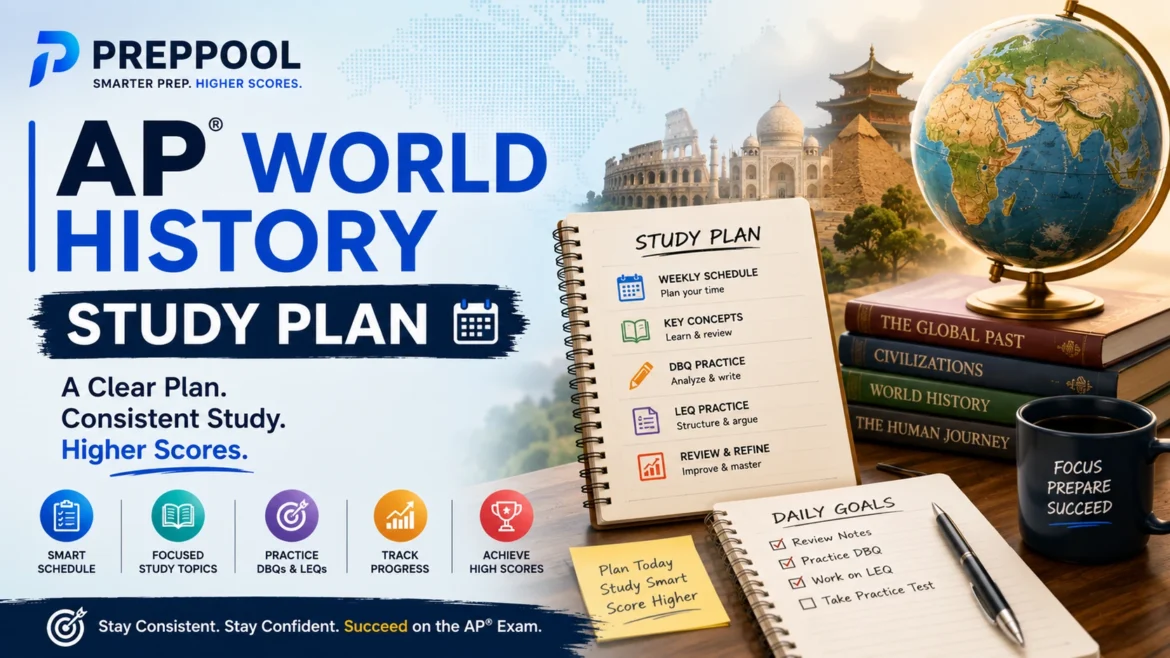

Every year, thousands of students begin preparing for AP World History with good intentions. They purchase review books, create study schedules, and promise themselves they will stay ahead of the material. Yet many still struggle when exam season arrives.
The problem is rarely a lack of effort. More often, students follow study methods that focus heavily on memorization while neglecting the historical reasoning skills tested on the exam. AP World History requires a different approach. Success depends on understanding patterns, connections, and historical processes rather than simply remembering isolated facts.
A well-designed study plan helps students balance content review, practice questions, essay writing, and performance analysis. It transforms preparation from a stressful last-minute scramble into a structured process that builds confidence over time.
This guide explains how to create an effective AP World History study plan, avoid common preparation mistakes, and maximize every hour spent reviewing material.
- Improve content retention.
- Strengthen historical reasoning skills.
- Increase confidence with DBQs and LEQs.
- Identify weak areas early.
- Reduce exam-day stress.
Why a Structured Study Plan Matters
Many students underestimate the scope of AP World History. The course covers centuries of political, economic, social, and cultural developments across multiple continents. Without a clear plan, it becomes easy to overlook important topics or spend too much time reviewing familiar material.
A structured study plan creates balance. Instead of reviewing randomly, students know exactly what they need to study each week and how their preparation connects to long-term goals.
Planning also helps prevent burnout. Smaller, consistent study sessions are generally more effective than occasional marathon review sessions that leave students exhausted.
Students who follow organized study schedules often retain information better because they revisit concepts repeatedly over time rather than trying to learn everything at once.
Understanding What the AP World History Exam Tests
Before building a study plan, students must understand what the exam actually measures. Many preparation mistakes occur because students focus exclusively on content while ignoring historical thinking skills.
The exam evaluates several areas:
- Historical knowledge.
- Source analysis.
- Historical reasoning.
- Argument development.
- Comparative thinking.
- Causation analysis.
- Continuity and change over time.
A successful study plan addresses each of these skills rather than concentrating on only one area.
| Skill Area | Importance |
|---|---|
| Content Knowledge | Provides evidence for essays and questions. |
| Historical Reasoning | Forms the foundation of analysis. |
| Document Analysis | Essential for DBQ success. |
| Essay Writing | Required for LEQ and DBQ sections. |
| Question Interpretation | Prevents costly mistakes. |
How Much Time Should You Study for AP World History?
One of the most common questions students ask is how many hours they should study each week. The answer depends on current performance, exam goals, and how much time remains before the test.
Students beginning preparation several months in advance often benefit from studying three to five hours per week. As the exam approaches, many increase their review time while maintaining a focus on quality rather than quantity.
The goal is not to spend every free moment studying history. The goal is to use study time efficiently by targeting weaknesses and reinforcing important concepts.
Consistent review typically produces better results than irregular study sessions, even when total study hours are similar.
The Three Phases of Effective AP World History Preparation
Successful preparation usually follows three major phases. Each phase serves a different purpose and builds upon previous progress.
Phase 1: Foundation Building
This stage focuses on understanding major historical developments, themes, and time periods. Students learn core concepts and establish a knowledge base that will support future analysis.
Phase 2: Skill Development
Once content knowledge improves, students shift toward practicing multiple-choice questions, DBQs, LEQs, and historical reasoning skills.
Phase 3: Exam Simulation
The final phase involves full-length practice exams, timing strategies, and targeted review of weak areas.
Students who progress through these phases systematically often feel more prepared than those who attempt to study everything simultaneously.
Building Your Weekly AP World History Schedule
A balanced weekly schedule helps students develop both content knowledge and exam skills. Many students spend too much time reviewing notes and not enough time applying what they learn.
A sample weekly structure might include:
- Two content review sessions.
- One multiple-choice practice session.
- One essay-writing session.
- One mistake-analysis session.
This approach creates variety while ensuring that every important skill receives attention.
The most productive study sessions often focus on active learning. Practice questions, essay writing, and historical analysis usually produce better results than passive rereading.
Starting with the Most Important Historical Foundations
The earliest AP World History units establish concepts that appear repeatedly throughout the course. Trade networks, cultural interactions, political systems, and technological developments influence many later historical events.
Students who strengthen their understanding of foundational topics often find it easier to understand advanced units because they can recognize long-term historical patterns.
For this reason, many successful study plans begin with a review of early course content before progressing to later historical developments.
Why Practice Questions Should Be Part of Every Study Plan
Many students spend weeks reviewing notes without testing their understanding. This creates a false sense of confidence because recognizing information is much easier than recalling it under exam conditions.
Practice questions reveal knowledge gaps, strengthen retention, and help students become familiar with the wording and structure of AP-style questions.
Regular practice also improves time management by teaching students how to process information efficiently.
Students looking to evaluate their readiness often benefit from working through an extensive collection of AP World History exam-style questions that mirrors the format and difficulty of the actual exam.
The Role of Essay Writing in Your Study Schedule
DBQs and LEQs represent a significant portion of the AP World History exam. Unfortunately, many students postpone essay practice until the final weeks before testing.
This approach can create unnecessary stress because historical writing improves gradually through repetition and feedback.
Including regular essay practice throughout the study process allows students to strengthen thesis development, evidence selection, historical reasoning, and organizational skills long before exam day arrives.
Even one essay every week or two can produce meaningful improvement over time.
A Real Student Example of Study Plan Success
Michael, a high school senior preparing for AP World History, initially struggled because he spent nearly all of his study time rereading notes. Although he recognized key concepts, his practice scores remained inconsistent.
After creating a structured study plan, he shifted toward active learning. He completed weekly practice questions, reviewed mistakes carefully, and began writing timed essays regularly.
Within two months, his confidence improved significantly. More importantly, he developed stronger historical reasoning skills that translated directly into better practice exam performance.
His experience demonstrates an important lesson: effective preparation is not about studying harder. It is about studying smarter.
Creating a Monthly AP World History Study Roadmap
A strong study plan should look beyond individual study sessions and focus on long-term progress. Breaking preparation into monthly goals helps students stay organized while ensuring that every major topic receives attention before exam day.
Rather than studying randomly, students should assign clear objectives to each stage of preparation. This structure creates momentum and reduces the feeling of being overwhelmed by the amount of material covered in the course.
| Month | Primary Goal |
|---|---|
| Month 1 | Build content foundations and review major themes. |
| Month 2 | Increase practice questions and essay writing. |
| Month 3 | Focus on weak areas and timed practice. |
| Final Weeks | Complete full-length practice exams and targeted review. |
Students who follow a roadmap often feel more confident because they can clearly measure their progress throughout the preparation process.
How to Study AP World History Units in the Right Order
One common mistake is jumping between unrelated topics without establishing a strong chronological understanding of world history. Because later developments often build upon earlier events, reviewing units in sequence can make historical connections easier to recognize.
The earliest course content introduces concepts that continue to influence later developments. Students reviewing early societies, networks, and historical foundations often develop a stronger understanding of how global systems evolved over time.
Trade and cultural exchange represent another critical area of study. Exploring commercial expansion and interregional interactions helps students understand how ideas, technologies, and goods moved across continents.
Political structures and state development also appear repeatedly throughout the curriculum. Reviewing major empires and methods of governance can provide valuable context for later discussions involving power, expansion, and administration.
As students progress through the course, understanding exploration, migration, and overseas expansion becomes increasingly important because these developments shaped many aspects of the modern world.
Balancing Content Review and Skill Development
Many students spend too much time reviewing content and too little time practicing exam skills. While historical knowledge is essential, success on the AP World History exam depends on the ability to apply that knowledge effectively.
A balanced study plan includes both content review and active skill development. Students should regularly practice multiple-choice questions, historical analysis, essay writing, and source evaluation.
This balance helps transform information into usable knowledge that can be applied during the exam.
- 40% Content Review
- 25% Practice Questions
- 20% Essay Writing
- 15% Mistake Analysis
How to Identify and Fix Weak Areas
One of the most valuable benefits of a structured study plan is the ability to identify weaknesses before they become major problems. Many students continue reviewing familiar material because it feels comfortable, but real improvement often comes from addressing areas that need additional attention.
Practice questions and timed assessments provide useful data about performance. By tracking results over time, students can identify recurring patterns and adjust their study priorities accordingly.
For example, a student who consistently struggles with comparison questions may benefit from additional practice involving similarities and differences between societies.
Targeted review is usually far more effective than studying everything equally.
Why Mistake Analysis Is One of the Most Powerful Study Tools
Many students complete practice questions and immediately move on without reviewing incorrect answers. This habit limits improvement because valuable learning opportunities are missed.
Strong students analyze mistakes carefully. They identify why an answer was incorrect, determine what concept was misunderstood, and create a plan to avoid repeating the same error.
Over time, this process helps students build stronger reasoning skills and improve performance across all sections of the exam.
In many cases, reviewing mistakes produces greater gains than simply completing additional questions.
Building a Strong AP World History Essay Strategy
Writing remains one of the most important skills tested on the exam. Students who practice essays regularly often perform better because they become comfortable organizing arguments and supporting claims with evidence.
A successful study plan should include dedicated time for both DBQ and LEQ preparation. Each essay format measures different skills, and both require consistent practice.
Students looking to strengthen source analysis and evidence integration may benefit from reviewing advanced techniques discussed in this detailed document-analysis writing guide. Understanding how to evaluate evidence can improve performance across multiple sections of the exam.
Likewise, students focusing on argument development and independent evidence selection often gain valuable insights from this specialized long-essay preparation resource, which explores effective essay structures and historical reasoning strategies.
Using Historical Themes to Improve Retention
AP World History is easier to understand when viewed through recurring themes rather than isolated events. Themes help students recognize connections between different regions and time periods.
Important themes include governance, economic systems, social interactions, technology, cultural developments, and human-environment relationships.
Studying through themes often improves retention because students can connect new information to existing knowledge rather than memorizing disconnected facts.
This approach also supports stronger essay writing because thematic thinking encourages broader historical analysis.
How to Avoid Burnout During Long-Term Preparation
Preparing for AP World History is a marathon rather than a sprint. Students who attempt to study for long hours every day often experience fatigue, frustration, and declining productivity.
A sustainable study plan includes regular breaks, realistic goals, and manageable workloads. Consistency is more important than intensity.
Short, focused study sessions frequently produce better results than exhausting review marathons. Students should also vary activities by alternating between reading, practice questions, essay writing, and review exercises.
This variety helps maintain engagement while reinforcing multiple skills simultaneously.
Tracking Progress Throughout Your Study Plan
One of the best ways to stay motivated is to track measurable progress. Students who monitor performance can see how their preparation is translating into improved results.
Useful metrics include:
- Practice question accuracy.
- Essay rubric scores.
- Completion of unit reviews.
- Timing improvements.
- Reduction in repeated mistakes.
Tracking these indicators helps students stay focused and provides evidence that their efforts are producing results.
Connecting Daily Study Habits to Long-Term Success
Major score improvements rarely happen overnight. Instead, they result from consistent daily habits repeated over weeks and months.
Students who dedicate even a small amount of focused time each day often outperform those who rely on occasional intensive review sessions. Consistency strengthens retention, improves confidence, and makes historical reasoning feel more natural.
For students seeking a broader perspective on overall preparation, score improvement strategies, and exam readiness, this complete AP World History success framework provides additional guidance on building effective preparation habits.
The most effective study plan is not necessarily the most complicated. It is the one you can follow consistently from the beginning of preparation until exam day.
Your Final 30-Day AP World History Study Plan
The final month before the AP World History exam is one of the most important phases of preparation. At this stage, students should shift their focus from learning entirely new material to reinforcing knowledge, improving exam skills, and identifying remaining weaknesses.
A structured 30-day plan helps ensure that every major topic receives attention while preventing last-minute panic.
| Week | Primary Focus |
|---|---|
| Week 1 | Review Units 1–3 and major historical themes. |
| Week 2 | Review Units 4–6 and complete targeted practice. |
| Week 3 | Review Units 7–9 and strengthen essay writing. |
| Week 4 | Take full-length practice exams and review weak areas. |
This structure creates a balance between content review and exam simulation while helping students maintain confidence as test day approaches.
A Proven 7-Day AP World History Review Schedule
The final week should focus on reinforcement rather than intensive studying. Students who attempt to learn large amounts of new information during the final days often experience unnecessary stress and information overload.
- Day 7: Review major themes and historical reasoning skills.
- Day 6: Complete a timed multiple-choice practice session.
- Day 5: Write a DBQ or LEQ under realistic conditions.
- Day 4: Review mistakes and weak areas.
- Day 3: Revisit important historical developments.
- Day 2: Light review and confidence building.
- Day 1: Rest, organize materials, and prepare mentally.
This approach allows students to remain sharp without becoming mentally exhausted before the exam.
Reviewing Revolutionary Movements Efficiently
Revolutions represent one of the most influential periods in world history and frequently appear in multiple-choice questions, essays, and historical reasoning exercises.
Students who revisit transformative political movements and societal change often strengthen their understanding of causation, continuity, and historical consequences.
When reviewing revolutionary topics, focus on causes, major developments, and long-term impacts rather than memorizing isolated details.
Strengthening Industrialization Knowledge Before Exam Day
Industrialization changed economies, societies, labor systems, and international relationships. Because its effects were so widespread, industrialization provides valuable evidence for many different essay topics.
Students preparing for the exam can reinforce key concepts by reviewing technological advancement and industrial growth patterns that shaped the modern world.
Understanding industrialization also helps students recognize broader themes involving innovation, economic change, and globalization.
Reviewing Modern Warfare and Global Tensions
The twentieth century introduced conflicts that reshaped political boundaries and altered global power structures. These developments frequently appear in AP World History assessments because they influenced nearly every region of the world.
Students who revisit twentieth-century military conflicts and power struggles often gain stronger examples for essays involving nationalism, technological change, and political transformation.
Understanding the causes and consequences of these conflicts can also improve historical reasoning skills.
Preparing for Cold War and Decolonization Topics
Many students underestimate the importance of post-World War II developments. However, decolonization movements and Cold War competition remain central themes within the AP World History curriculum.
Reviewing newly independent nations and global ideological competition can help students strengthen their understanding of political change, international relations, and continuity across different historical periods.
These topics also provide excellent evidence for essays involving long-term transformations and global interactions.
Connecting Historical Themes Through Globalization
One of the most effective review strategies is examining how earlier historical developments connect to the modern world. Globalization brings together many themes that students encounter throughout the course.
Students reviewing modern interconnected systems and worldwide integration often discover connections between trade, migration, technology, communication, and cultural exchange.
This perspective helps students understand world history as a continuous process rather than a collection of unrelated events.
Common AP World History Study Mistakes to Avoid
Even motivated students sometimes make preparation mistakes that limit their progress. Recognizing these pitfalls early can improve efficiency and maximize study time.
- Spending too much time rereading notes.
- Ignoring essay-writing practice.
- Avoiding difficult topics.
- Failing to review mistakes.
- Studying without clear goals.
- Relying entirely on memorization.
- Neglecting historical reasoning skills.
Students who avoid these mistakes often see stronger improvements because their study efforts remain focused on exam-relevant skills.
- Historical themes.
- Causation and comparison skills.
- DBQ and LEQ structure.
- Major global developments.
- Practice question analysis.
AP World History Exam-Day Strategy
Preparation does not end when studying stops. A clear exam-day strategy helps students remain focused and confident.
Arrive early, bring required materials, and avoid discussing difficult topics immediately before the exam. Trust the preparation process and focus on executing the skills developed over months of study.
During the exam, manage time carefully, read prompts thoroughly, and avoid spending too long on any single question. Staying calm and methodical often produces better results than rushing.
Final AP World History Preparation Checklist
Before exam day arrives, students should confirm that they have completed the following:
- Reviewed all major historical periods.
- Practiced multiple-choice questions.
- Written DBQs and LEQs.
- Analyzed common mistakes.
- Reviewed historical themes.
- Completed at least one full-length practice exam.
- Developed a time-management strategy.
- Prepared testing materials.
Completing this checklist can help students enter the exam with greater confidence and a stronger sense of readiness.
Why a Study Plan Is the Key to AP World History Success
Success on the AP World History exam rarely comes from last-minute cramming. Instead, it results from a consistent and organized approach that combines content review, historical reasoning, practice questions, and essay writing.
A well-designed study plan helps students stay focused, identify weaknesses, and build confidence gradually over time. More importantly, it transforms preparation into a manageable process rather than an overwhelming challenge.
Students who commit to consistent improvement often discover that AP World History becomes less about memorizing facts and more about understanding the patterns, connections, and developments that shaped the world.
Conclusion
The most effective AP World History study plans balance knowledge acquisition with skill development. By reviewing content strategically, practicing regularly, analyzing mistakes, and maintaining a structured schedule, students can significantly improve their chances of earning a strong score.
Whether preparation begins months in advance or during the final stages before the exam, the principles remain the same: stay organized, remain consistent, and focus on meaningful practice. With the right study plan, students can approach the AP World History exam with confidence and perform at their highest potential.
Frequently Asked Questions
When should I start studying for AP World History?
Ideally, students should begin preparing several months before the exam. Early preparation allows more time for content review, essay practice, and identifying weak areas.
How many hours per week should I study?
The amount varies by student, but consistent weekly study sessions are generally more effective than occasional intensive review periods.
Should I focus more on content review or practice questions?
A balanced approach works best. Content review builds knowledge, while practice questions help students apply that knowledge under exam conditions.
What is the best way to improve AP World History essay scores?
Regular DBQ and LEQ practice, rubric review, and careful analysis of previous essays often lead to the greatest improvement.
Can a study plan really improve my AP World History score?
Yes. Structured preparation helps students use their time more efficiently, strengthen weak areas, and develop the skills necessary for success on exam day.