
Understanding the Gap Between Studying and Passing
Walk into any certification exam center and you’ll notice a pattern that doesn’t get talked about enough. Most candidates sitting there are not underprepared. They’ve spent weeks going through study materials, reviewing notes, and trying to cover every topic outlined in the syllabus.
Yet a large percentage of them will not pass on their first attempt.
This raises an uncomfortable but important question: if people are studying so much, why are the results so inconsistent?
The answer lies in a fundamental misunderstanding of what exam preparation actually requires. Studying and preparing are not the same thing. One builds familiarity with information, while the other builds the ability to use that information under pressure.
That distinction is where practice testing becomes essential.
The Illusion of Being Prepared
Most candidates follow a familiar path. They start with a study guide, watch lectures, highlight key points, and feel a sense of progress as they move through the material. It feels structured and productive.
But there’s a hidden problem.
This method builds recognition, not recall.
When you reread a concept or review notes, your brain becomes familiar with the information. It gives you the impression that you understand it well. But familiarity is not the same as mastery.
In an exam setting, you are not asked to recognize the correct answer. You are required to retrieve it, often under time pressure and in unfamiliar formats.
That’s why many candidates experience a sudden drop in confidence during the actual test. Questions seem harder than expected, even though the topics were “covered.”
The issue is not a lack of effort. It’s a mismatch between how the brain was trained and what the exam demands.
What Practice Testing Actually Does
Practice testing changes the way your brain interacts with information.
Instead of passively reviewing content, you are actively trying to recall it. You are making decisions, evaluating options, and applying concepts in a simulated exam environment.
This shift from passive to active learning has a measurable impact.
Research in cognitive psychology has consistently shown that retrieval practice—actively recalling information—strengthens memory far more effectively than repeated exposure. When you struggle to remember something and then retrieve it, the memory becomes more durable.
This is often referred to as the “testing effect.”
A study published on ResearchGate examining certification candidates found that individuals who incorporated structured practice testing into their preparation performed better across multiple metrics, including recall accuracy and time management.
More importantly, they were significantly more likely to pass on their first attempt.
Why Exams Are Designed the Way They Are
To understand why practice testing works so well, it helps to understand how certification exams are designed.
Most professional exams are not built to test simple memorization. Instead, they focus on:
- Application of knowledge
- Decision-making under pressure
- Interpretation of scenarios
- Identification of the “best” answer among similar options
This means that even if you understand the theory, you can still struggle if you are not used to applying it in a test format.
Practice testing bridges that gap.
It exposes you to the way questions are framed, the level of detail expected, and the type of thinking required to arrive at the correct answer.
Over time, this familiarity reduces cognitive load during the actual exam. Instead of figuring out how to approach the question, your brain focuses on solving it.
The Role of Time Pressure
One of the most underestimated factors in exam performance is time pressure.
Many candidates who perform well during study sessions struggle during the exam simply because they are not used to working within strict time limits.
Practice testing introduces controlled pressure.
When you take timed tests, your brain adapts to making decisions more efficiently. You learn when to move on, how to avoid overthinking, and how to maintain a steady pace throughout the exam.
Without this training, even well-prepared candidates can run out of time or rush through critical questions.
Identifying Knowledge Gaps Early
Another advantage of practice testing is that it provides immediate feedback.
When you read a chapter, it’s easy to assume you understand everything. There is no clear indication of what you truly know versus what you only recognize.
Practice questions remove that ambiguity.
Every incorrect answer highlights a specific gap. It tells you exactly where your understanding is weak, allowing you to focus your efforts where they are needed most.
This targeted approach is far more efficient than reviewing entire sections repeatedly without knowing whether they require attention.
Moving from Information to Performance
At its core, exam success is not about how much information you have consumed. It is about how effectively you can use that information in a high-pressure environment.
Practice testing transforms information into usable knowledge.
It trains you to:
- Recall concepts quickly
- Apply them accurately
- Stay composed under pressure
- Navigate complex questions with confidence
These are performance skills, not just knowledge indicators.
And like any skill, they improve with deliberate practice.
A Real-World Example: Nursing Certification Preparation
This becomes even more critical in fields like nursing, where exams are designed to reflect real-world decision-making.
Candidates are not just tested on definitions. They are presented with scenarios that require judgment, prioritization, and clinical reasoning.
In such cases, passive study methods fall short.
Structured practice resources like Fundamentals of Nursing Exam Package provide candidates with exam-style questions that mirror real testing conditions. This allows them to move beyond theoretical understanding and develop the ability to respond effectively in practical situations.
By repeatedly engaging with scenario-based questions, candidates build both confidence and competence—two factors that play a critical role in first-attempt success.
Why Some Candidates Still Avoid Practice Testing
Despite its proven effectiveness, many candidates delay or avoid practice testing.
Common reasons include:
- Fear of scoring low in early attempts
- Belief that they need to “finish studying” first
- Preference for familiar study habits
- Discomfort with timed conditions
These concerns are understandable, but they often lead to poor outcomes.
Early practice tests are not meant to measure readiness. They are meant to guide preparation.
A low score at the beginning is not a failure—it is valuable feedback.
Building a Smarter Preparation Strategy
The most effective candidates do not separate studying and testing. They integrate both from the beginning.
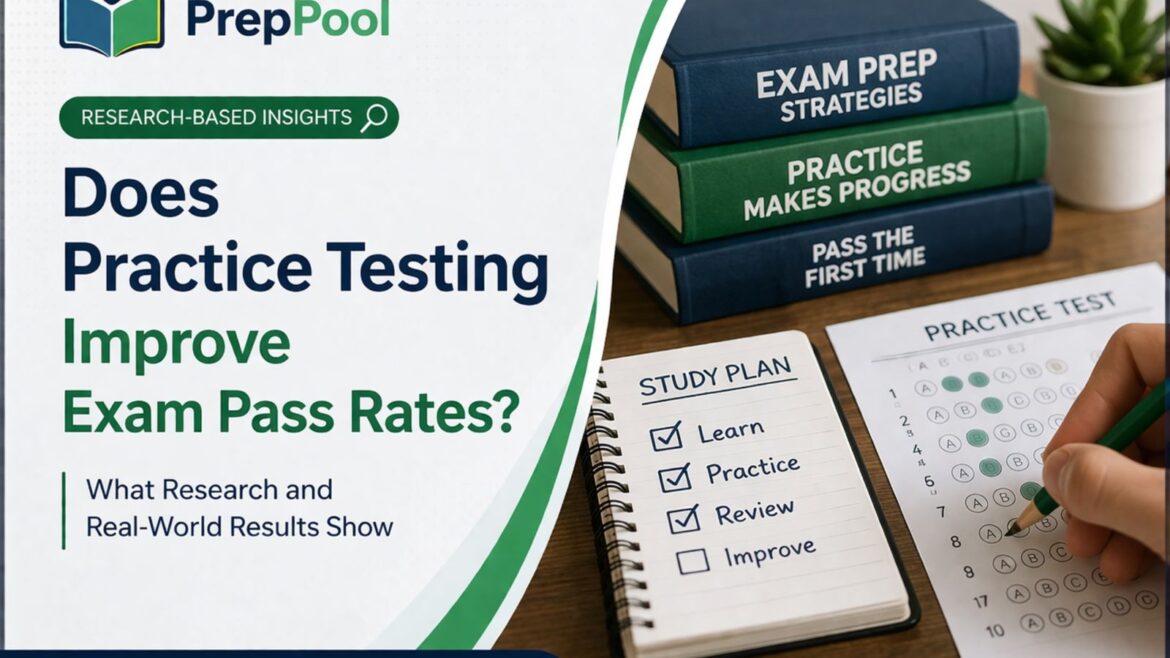
A balanced approach looks like this:
- Learn a concept
- Test yourself on it
- Identify gaps
- Review and refine
- Test again
This cycle ensures continuous improvement and prevents the buildup of weak areas.
Over time, scores improve not because of luck, but because of consistent, targeted effort.
Thoughts
The idea that more studying automatically leads to better results is deeply ingrained, but it is incomplete.
What matters is not just how much you study, but how you engage with the material.
Practice testing introduces a level of realism, feedback, and performance training that traditional study methods cannot provide on their own.
It shifts preparation from passive review to active mastery.
And that shift is often the difference between passing and failing—especially on the first attempt.
The Science Behind Why Practice Testing Works
Previous we explored the gap between studying and actual exam performance. We saw how many candidates fall into the trap of passive learning and why that approach often leads to disappointing results.
Now it’s time to go deeper.
If practice testing is so effective, what exactly is happening inside the brain that makes it work? And more importantly, how can you use that understanding to improve your own preparation?
The “Testing Effect”: More Than Just a Study Hack
One of the most well-documented findings in learning science is something known as the testing effect.
In simple terms, the testing effect means that actively recalling information strengthens your memory more than simply reviewing it.
This isn’t just theory—it has been demonstrated across decades of research in educational psychology.
When you attempt to retrieve an answer:
- Your brain works harder
- Neural pathways become stronger
- Information becomes easier to access later
In contrast, when you reread material, your brain recognizes it but doesn’t strengthen recall in the same way.
This is why students who repeatedly test themselves tend to retain information longer and perform better under pressure.
A study shared through ResearchGate on certification candidates supports this principle in real-world scenarios, showing improved retention and higher pass rates among those using structured practice testing.
Why Struggle Is Actually a Good Sign
There’s a common misconception that effective studying should feel smooth and easy.
In reality, the opposite is often true.
When practice testing feels difficult—when you struggle to recall answers—that’s when the most learning is happening.
This is known as desirable difficulty.
Struggle forces your brain to:
- Search for information
- Strengthen connections
- Correct mistakes
Every time you work through that process, your understanding becomes more solid.
So if your early practice tests feel challenging, that’s not a problem. It’s a sign that you are training your brain in the right way.
Feedback Loops: The Engine of Improvement
Practice testing doesn’t just strengthen memory—it creates a feedback loop.
Here’s how it works:
- You attempt a question
- You get it right or wrong
- You review the explanation
- You adjust your understanding
- You apply it again in the next test
This cycle is what drives improvement.
Without feedback, studying becomes guesswork. You may spend hours reviewing material without knowing whether you actually understand it.
With practice testing, every session gives you clear direction.
The Role of Spaced Repetition
Another powerful concept linked to practice testing is spaced repetition.
Instead of reviewing the same material in one long session, you revisit it over time.
When combined with testing, this becomes extremely effective:
- You forget slightly between sessions
- You force your brain to recall again
- Memory becomes stronger each time
This repeated retrieval over spaced intervals helps move information from short-term memory into long-term retention.
Candidates who combine practice testing with spaced repetition often see dramatic improvements in both accuracy and confidence.
Context Matters: Learning in Exam Conditions
One reason many candidates struggle during exams is that their preparation environment doesn’t match the actual test environment.
They study:
- Without time pressure
- With access to notes
- In a relaxed setting
But the exam is:
- Timed
- Closed-book
- Mentally demanding
Practice testing solves this mismatch.
By simulating real exam conditions, you train your brain in the same context in which it will be tested.
This concept, known as context-dependent learning, explains why performance improves when practice conditions resemble the real environment.
Reducing Anxiety Through Familiarity
Exam anxiety is another major factor that affects performance.
Even well-prepared candidates can underperform if they feel overwhelmed during the test.
Practice testing reduces this anxiety by creating familiarity.
When you’ve already experienced:
- Timed sessions
- Complex questions
- Mental fatigue
…the actual exam feels like something you’ve done before.
Familiarity replaces uncertainty, and that shift alone can significantly improve performance.
The Difference Between Knowing and Choosing
Many certification exams are designed with multiple-choice questions where several options may seem correct.
The challenge is not just knowing the material—it’s choosing the best answer.
This requires:
- Critical thinking
- Pattern recognition
- Decision-making under pressure
Practice testing trains this skill.
Over time, you begin to recognize:
- Common traps
- Distractor patterns
- Subtle differences between answer choices
This is something that passive study methods simply cannot provide.
Why Timing Practice Changes Everything
Time management is often the hidden reason behind exam failure.
Candidates may know the material but still struggle because:
- They spend too long on difficult questions
- They rush through easier ones
- They lose focus midway
Timed practice tests help you develop a natural rhythm.
You learn:
- How long to spend on each question
- When to move on
- How to maintain pace without panic
This turns time from an enemy into a manageable factor.
Turning Mistakes into Advantages
One of the most powerful aspects of practice testing is how it reframes mistakes.
In traditional studying, mistakes are often avoided or ignored.
In practice testing, mistakes become learning tools.
Each incorrect answer gives you:
- A clear signal of weakness
- An opportunity to improve
- A chance to prevent the same mistake in the real exam
Over time, your mistakes become fewer—and more importantly, less repeated.
Applying This to Nursing Exam Preparation
In nursing exams, the importance of practice testing becomes even more evident.
Questions often involve patient scenarios that require:
- Prioritization
- Clinical judgment
- Application of multiple concepts at once
Reading about these concepts is not enough.
You need to practice applying them in realistic situations.
Resources like Fundamentals of Nursing learning provide structured, scenario-based questions that reflect the complexity of actual exams. By working through these questions repeatedly, candidates develop the ability to think critically and respond accurately under pressure.
This kind of preparation builds both competence and confidence—two factors that directly influence first-attempt success.
Common Misconceptions About Practice Testing
Even when candidates use practice tests, they sometimes misunderstand how to use them effectively.
Let’s clear up a few common myths.
“I should only take practice tests after finishing the syllabus.”
Waiting too long delays feedback. Start early, even if your score is low.
“If I score poorly, it means I’m not ready.”
Early scores are not a measure of readiness—they are a guide for improvement.
“Doing more questions automatically leads to better results.”
Quality matters more than quantity. Focus on understanding, not just completion.
“I remember the answers, so I’m improving.”
Memorizing answers is not the goal. Understanding why they are correct is what matters.
Building a System That Works
To get the full benefit of practice testing, you need a structured approach.
A simple but effective system looks like this:
- Study a topic
- Take a short practice test
- Review every explanation
- Identify weak areas
- Revisit concepts
- Test again
Repeat this cycle consistently.
Over time, you will notice:
- Faster recall
- Fewer repeated mistakes
- Increased confidence
Closing Thoughts
Practice testing is not just a technique—it’s a shift in how you approach learning.
It aligns your preparation with how exams actually work.
It strengthens memory, improves decision-making, and builds the ability to perform under pressure.
Most importantly, it gives you clarity.
Instead of wondering whether you are ready, you can measure your progress and adjust your strategy accordingly.
Complete Strategy for First-Attempt Success
By now, the pattern should be clear.
Previous, we explored why traditional studying often falls short.
Previous, we broke down the science behind why practice testing works.
Now comes the most important part: how to apply all of this in a practical, structured way that actually leads to passing your exam on the first attempt.
Because knowing what works is one thing.
Executing it correctly is what makes the difference.
The Biggest Shift You Need to Make
Most candidates treat studying and testing as two separate phases:
- First, they study everything
- Then, they test themselves
This approach delays feedback and creates blind spots.
Top-performing candidates do the opposite.
They combine learning and testing from the very beginning.
Instead of waiting to feel “ready,” they use practice testing to become ready.
That shift alone can completely change your results.
A Proven Step-by-Step Preparation System
Let’s break this down into a simple, actionable system you can follow.
Phase 1: Build a Foundation (But Don’t Overdo It)
Start by understanding the core concepts.
This includes:
- Key principles
- Definitions
- Basic frameworks
But here’s the important part: don’t aim for perfection.
Your goal is familiarity, not mastery.
Spending too much time here leads to diminishing returns.
Phase 2: Start Practice Testing Early
As soon as you understand a topic, begin testing yourself on it.
Even if:
- You feel unsure
- Your scores are low
- You make frequent mistakes
This is where real learning begins.
Early testing helps you:
- Identify weak areas
- Adjust your focus
- Avoid wasting time on topics you already understand
Phase 3: Analyze Every Mistake
This is where most candidates fall short.
They take practice tests but don’t review them properly.
To improve, you need to go deeper.
For each incorrect answer, ask:
- Why was my answer wrong?
- What concept did I misunderstand?
- Was it a knowledge issue or a reading mistake?
This level of analysis turns mistakes into progress.
Phase 4: Introduce Timed Simulations
Once you’re comfortable with the format, start taking full-length, timed tests.
This step is critical.
It prepares you for:
- Real exam pressure
- Mental fatigue
- Time management challenges
At this stage, your focus shifts from learning to performance.
Phase 5: Refine and Repeat
Improvement comes from repetition with feedback.
Cycle through:
- Testing
- Reviewing
- Adjusting
Each cycle should bring:
- Higher accuracy
- Faster decision-making
- Greater confidence
Consistency matters more than intensity.
How to Balance Study and Practice
A common question is: how much time should be spent studying versus testing?
A practical balance looks like this:
- Early stage: 60% study, 40% testing
- Mid stage: 40% study, 60% testing
- Final stage: 20% study, 80% testing
As the exam approaches, practice testing should dominate your preparation.
Advanced Strategies Used by Top Performers
Once you have the basics in place, a few advanced techniques can give you an extra edge.
- Pattern Recognition
After enough practice, you’ll start noticing patterns:
- Common question formats
- Frequently tested concepts
- Typical distractor answers
Recognizing these patterns allows you to answer faster and more accurately.
- Strategic Skipping
Not every question deserves equal time.
Top candidates know when to:
- Skip difficult questions
- Return later with a fresh perspective
This prevents time loss and reduces stress.
- Energy Management
Exams are mentally demanding.
Practice testing helps you understand:
- When your focus drops
- How to maintain consistency
- How to pace yourself
This becomes especially important in longer exams.
- Reviewing Correct Answers
Many candidates only review mistakes.
But reviewing correct answers is equally important.
It helps you:
- Confirm your reasoning
- Reinforce correct thinking patterns
- Avoid lucky guesses
Applying This to Nursing Exam Success
In nursing exams, success depends heavily on applying knowledge in realistic scenarios.
You are expected to:
- Prioritize patient care
- Interpret clinical information
- Make safe and effective decisions
This level of complexity requires more than theoretical understanding.
It requires practice.
To improve performance before exam day, many candidates rely on fundamental of nursing practice bundle that simulate real test conditions and help build confidence under pressure.
Over time, candidates develop the ability to think clearly under pressure—a key factor in passing on the first attempt.
The Final Weeks Before the Exam
The last phase of preparation is crucial.
This is not the time to start new topics or overwhelm yourself with additional resources.
Instead, focus on:
- Full-length practice tests
- Reviewing weak areas
- Strengthening time management
At this stage, your goal is consistency.
You should aim to:
- Achieve stable scores
- Reduce careless mistakes
- Maintain confidence
A Simple Pre-Exam Checklist
Before your exam, make sure you can confidently say:
- I have completed multiple timed practice tests
- I understand my weak areas and have worked on them
- I can manage my time effectively
- I am familiar with the exam format
- I can stay calm under pressure
If the answer to these is yes, you are in a strong position.
What Separates Those Who Pass on the First Attempt
It’s not always intelligence or experience.
More often, it comes down to preparation strategy.
Candidates who pass on their first attempt typically:
- Use active learning methods
- Practice consistently
- Learn from mistakes
- Simulate real exam conditions
They don’t just study—they prepare for performance.
Final Verdict
So, does practice testing improve exam pass rates?
Yes—and not just slightly.
It changes the entire way you learn, retain, and apply information.
It turns preparation into a structured, measurable process.
And most importantly, it prepares you for the reality of the exam—not just the content.
Closing Thoughts
If there’s one takeaway from this entire discussion, it’s this:
Studying alone is not enough.
To succeed, you need to train your brain to perform under exam conditions.
Practice testing is the most effective way to do that.
It builds confidence, sharpens decision-making, and ensures that when exam day arrives, you are not facing something new—you are repeating something you’ve already done.
And that familiarity can make all the difference between passing and retaking.