
Some candidates focus too heavily on one subject while ignoring others completely. Others waste valuable study time reviewing material that appears less frequently instead of concentrating on high-impact areas.
The reality is that the CCMA exam is designed to evaluate whether candidates can handle real healthcare responsibilities safely and professionally in modern medical environments.
That means students are tested on much more than definitions alone. They must understand clinical reasoning, patient communication, infection prevention, documentation procedures, and healthcare workflow basics.
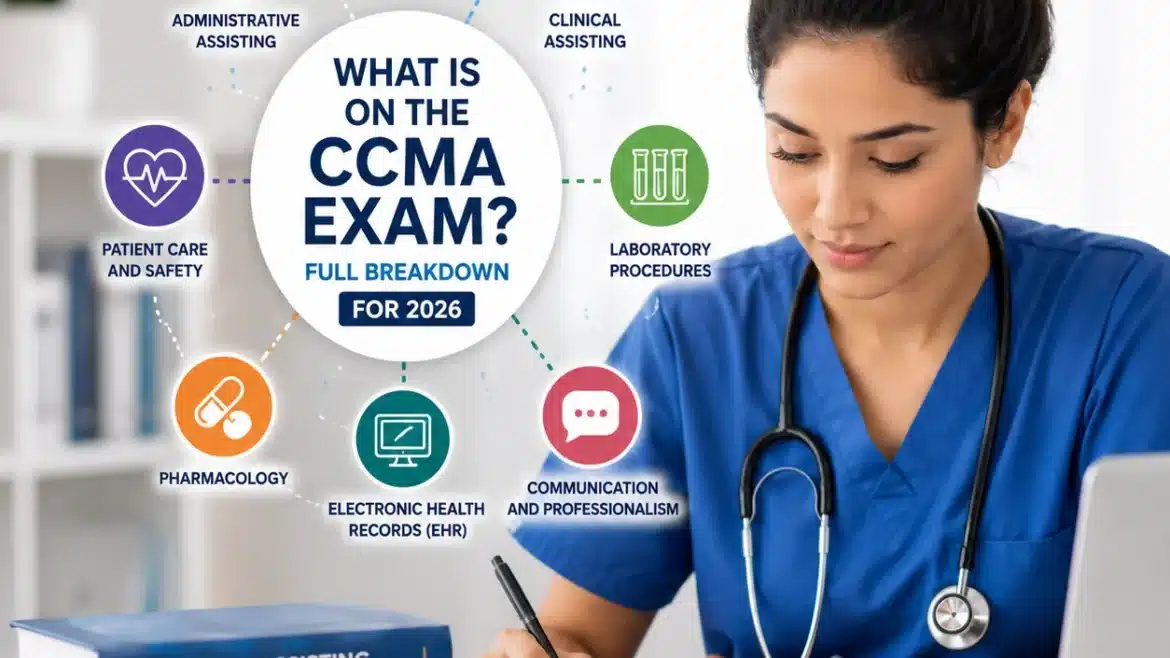
- Clinical patient care
- Medical terminology
- Infection control
- Pharmacology basics
- Laboratory procedures
- Administrative responsibilities
- Patient communication and professionalism
Why the CCMA Exam Feels Difficult for Many Students
One reason students struggle with the CCMA exam is because the questions often combine multiple concepts at once.
For example, a single question may require understanding medical terminology, patient safety procedures, and communication standards together instead of testing one isolated fact.
This creates pressure for candidates who relied mainly on memorization during preparation.
Healthcare professionals make decisions constantly throughout the workday, and the exam reflects that reality by testing practical understanding instead of textbook repetition alone.
How the CCMA Exam Is Structured
The CCMA exam typically includes questions from both clinical and administrative healthcare areas. Students should expect scenario-based questions alongside knowledge-based questions.
Instead of simply asking for definitions, many questions test whether candidates understand how healthcare concepts apply during real patient interactions.
| Exam Area | Focus |
|---|---|
| Clinical Patient Care | Vital signs, procedures, patient interaction |
| Infection Control | Safety protocols and contamination prevention |
| Medical Terminology | Healthcare vocabulary and abbreviations |
| Administrative Tasks | Scheduling, records, communication |
| Pharmacology Basics | Medication safety and terminology |
Because the exam covers multiple healthcare responsibilities, balanced preparation is extremely important.
Clinical Patient Care Questions
Clinical patient care is one of the most important sections of the CCMA exam because medical assistants work directly with patients every day.
Students preparing for this section should understand:
- Vital sign measurement
- Patient intake procedures
- Preparing examination rooms
- Patient positioning
- Clinical safety standards
- Assisting during procedures
Many questions focus on proper procedure order, patient comfort, and safe healthcare practices.
Students who understand why procedures matter usually perform better than students who only memorize steps mechanically.
Why Infection Control Is Extremely Important
Infection control questions appear frequently because patient safety is one of the highest priorities in healthcare environments.
Medical assistants must understand how to prevent contamination, protect patients, and maintain safe clinical conditions throughout the workday.
Questions may involve:
- Hand hygiene procedures
- Personal protective equipment
- Sterilization concepts
- Biohazard disposal
- Cross-contamination prevention
Medical Terminology Appears Everywhere
Students often underestimate how important medical terminology becomes across the entire exam.
Terminology affects nearly every section because healthcare communication depends heavily on accurate vocabulary and abbreviations.
Weak terminology skills can make even simple questions confusing.
Instead of memorizing random terms individually, students usually improve faster when they group words by body systems and learn common prefixes, roots, and suffixes.
Pharmacology Basics Students Should Know
The pharmacology portion of the CCMA exam usually focuses on medication safety awareness rather than advanced pharmacy calculations.
Students should understand:
- Basic medication terminology
- Routes of administration
- Medication safety procedures
- Common abbreviations
- Patient safety considerations
This section becomes easier when students focus on practical understanding instead of trying to memorize endless medication names.
Real Story: Why One Student Felt Overwhelmed Initially
Jasmine started studying for the CCMA exam by reading random chapters every evening after work. After two weeks, she felt even more stressed because she realized the exam covered far more material than she expected.
Instead of continuing randomly, she reorganized her preparation completely.
She separated topics into weekly sections, focused heavily on weak areas, and began practicing mixed-topic questions regularly. Once she understood how the exam was structured, her confidence improved dramatically.
Many students experience the same turning point once they stop studying blindly and begin preparing strategically.
Why Practice Questions Help Students Understand the Exam Better
Reading notes alone often does not prepare students for the wording and pressure of healthcare certification exams.
Practice questions help candidates understand how topics appear in realistic testing situations while improving clinical reasoning and pacing.
Students preparing for certification usually feel more comfortable after working through realistic CCMA exam practice materials with answer explanations because they become familiar with mixed healthcare scenarios before the actual exam day.
Administrative Questions on the CCMA Exam
Many students focus heavily on clinical procedures while underestimating the administrative side of the CCMA exam.
However, medical assistants regularly handle scheduling, patient communication, documentation, and office workflow responsibilities in real healthcare environments.
Because of that, administrative topics remain an important part of the exam structure.
Students may encounter questions involving:
- Patient scheduling procedures
- Medical records management
- Professional communication
- Confidentiality and privacy standards
- Electronic health record basics
- Office workflow organization
Healthcare employers expect medical assistants to stay organized and communicate professionally, so this section reflects real workplace expectations.
Laboratory Procedures and Specimen Handling
Laboratory-related questions can feel intimidating for some students because they involve both technical knowledge and patient safety responsibilities.
Candidates should understand proper specimen collection procedures, handling techniques, labeling standards, and basic safety precautions.
Questions may also test whether students know how to avoid contamination and maintain accurate documentation during laboratory processes.
- Specimen labeling accuracy
- Safety and contamination prevention
- Proper handling procedures
- Basic laboratory workflow
- Patient identification standards
Students who connect laboratory procedures to patient safety usually understand these questions much more easily.
Patient Communication and Professionalism
The CCMA exam also evaluates professionalism because medical assistants interact with patients constantly throughout the workday.
Questions in this category may involve:
- Handling difficult patient situations
- Maintaining professional behavior
- Protecting patient privacy
- Communicating respectfully
- Following ethical healthcare standards
Many students underestimate this area because it does not feel as technical as clinical procedures or terminology. However, healthcare employers care deeply about communication and professionalism because these directly affect patient experience and workplace quality.
Which Topics Do Students Usually Find Hardest?
Most students do not struggle equally across every section of the exam.
Certain areas consistently create problems because they require both memorization and practical understanding.
| Frequently Difficult Topics | Why Students Struggle |
|---|---|
| Medical Terminology | Large vocabulary and abbreviations |
| Pharmacology | Medication-related terminology confusion |
| Infection Control | Scenario-based safety decisions |
| Clinical Procedures | Remembering correct procedural order |
Students often improve dramatically once they stop avoiding weak subjects and begin reviewing them consistently.
Why Passive Reading Is Usually Not Enough
One major mistake students make is relying only on reading notes repeatedly without testing themselves actively.
Passive review creates false confidence because information looks familiar while reading, but recall becomes much harder during a timed exam.
Active learning methods are much more effective for certification preparation.
Examples include:
- Answering practice questions
- Teaching concepts aloud
- Writing quick summaries from memory
- Reviewing missed answers carefully
- Practicing timed quizzes
Students following a structured 30-day CCMA exam preparation routine often retain information more effectively because their study sessions combine review, practice, and clinical application together.
Why Students Fail Even After Studying Hard
Some candidates spend long hours studying but still perform poorly because their preparation methods are ineffective.
Common problems include:
- Cramming at the last minute
- Ignoring weak topics
- Never practicing under timed conditions
- Overthinking difficult questions
- Studying passively for too many hours
Understanding these preparation mistakes early can prevent unnecessary frustration later. Students who want to avoid the habits that commonly damage scores can review these major preparation errors that lead many CCMA candidates to fail before finalizing their study strategy.
How Real Healthcare Scenarios Appear on the Exam
The CCMA exam is designed to reflect realistic healthcare situations rather than simple textbook memorization.
Questions may describe:
- A nervous patient interaction
- An infection control concern
- A documentation mistake
- A laboratory handling issue
- A medication safety situation
Students who think through the safest and most professional response usually perform better than those trying to memorize isolated facts only.
Why Confidence Matters During the Exam
Even well-prepared students can struggle if anxiety takes control during testing.
Some candidates panic after seeing a few difficult questions and begin doubting everything they studied.
Confidence usually improves when students become familiar with exam pacing, scenario-based wording, and mixed-topic questions before test day.
That is why realistic practice testing plays such a major role in preparation success.
How to Study Each CCMA Exam Section More Effectively
Different sections of the CCMA exam require different study approaches. Many students struggle because they use the exact same method for every subject.
For example, medical terminology usually improves through repetition and pattern recognition, while clinical procedures require practical understanding and step-by-step reasoning.
- Medical Terminology: Flashcards and body-system grouping
- Clinical Procedures: Scenario-based practice questions
- Infection Control: Real-world safety examples
- Pharmacology: Understanding medication categories and terminology
- Administrative Tasks: Workflow and documentation review
Students who adjust their study methods based on the topic often retain information more effectively and feel less overwhelmed during preparation.
What Students Should Focus on Most During Final Preparation
As exam day gets closer, students should focus more heavily on high-impact review instead of trying to relearn every small detail.
The final days before testing should prioritize:
- Mixed-topic practice questions
- Weak subject review
- Medical terminology refreshers
- Clinical reasoning practice
- Confidence building
Trying to memorize huge amounts of new information at the last minute usually increases stress more than performance.
Students who stay calm and review strategically often perform better than those who panic during the final week.
Why Real Clinical Understanding Improves Scores
Students sometimes ask why the CCMA exam feels harder than classroom quizzes. One major reason is that certification exams test real-world thinking instead of simple memorization.
Healthcare workers must make safe and professional decisions throughout the workday. Medical assistants communicate with patients, follow infection control standards, assist providers, and manage clinical responsibilities under pressure.
The exam reflects those expectations.
Students who understand why procedures matter usually handle scenario-based questions more confidently because they can think through situations logically.
Common Signs a Student Is Underprepared
Some students do not realize they are underprepared until exam day arrives.
Warning signs often include:
- Difficulty understanding mixed-topic questions
- Weak terminology recall
- Poor timing during practice exams
- Avoiding difficult subjects repeatedly
- Heavy dependence on memorization only
Recognizing these problems early gives students time to improve before the real exam.
How Certification Preparation Connects to Real Healthcare Work
The CCMA exam is not only about passing a test. The concepts students learn during preparation directly connect to daily healthcare responsibilities.
In real medical environments, certified medical assistants may:
- Prepare patients for examinations
- Record vital signs accurately
- Handle laboratory specimens safely
- Maintain patient confidentiality
- Support infection prevention procedures
- Communicate professionally with healthcare teams
That is why practical understanding matters so much throughout the certification process.
Choosing the Right Certification Path Matters Too
Some students researching the CCMA exam are still comparing multiple medical assistant certifications before committing fully to one path.
Understanding how different certifications align with specific career goals can help students feel more confident about their long-term direction in healthcare.
For students comparing credentials and trying to understand which option fits their interests better, this detailed guide covering how CCMA and CMA certifications compare in real healthcare settings explains the practical differences between both career paths.
Why Understanding the Profession Improves Motivation
Students often stay more motivated during exam preparation when they clearly understand the opportunities waiting after certification.
Medical assistants work in fast-growing healthcare environments including:
- Urgent care clinics
- Family medicine practices
- Pediatric offices
- Cardiology clinics
- Dermatology centers
- Hospital outpatient departments
Learning more about the profession itself can help students stay focused during difficult study periods. This complete guide to becoming a certified medical assistant explains career growth, workplace responsibilities, and what future opportunities look like after passing the exam.
Final Thoughts on the CCMA Exam Breakdown
The CCMA exam covers much more than memorized healthcare facts. It evaluates whether candidates can apply clinical knowledge safely, communicate professionally, and think through realistic healthcare situations.
Students who understand the structure of the exam early usually prepare more effectively because they stop studying randomly and focus on high-priority concepts instead.
Balanced preparation matters because every section contributes to overall exam performance. Clinical procedures, infection control, terminology, professionalism, administrative workflows, and patient communication all reflect real responsibilities medical assistants handle daily.
Instead of trying to memorize everything perfectly, successful students focus on consistent improvement, realistic practice, and understanding healthcare concepts deeply.
With proper preparation and structured study habits, the CCMA exam becomes far more manageable than many students initially believe.
Frequently Asked Questions (FAQs)
What subjects are covered most on the CCMA exam?
The exam heavily focuses on clinical patient care, infection control, medical terminology, pharmacology basics, and administrative healthcare responsibilities.
Is the CCMA exam mostly clinical?
The exam includes both clinical and administrative topics, but many questions involve patient care procedures and healthcare safety concepts.
Are there scenario-based questions on the CCMA exam?
Yes. Many questions test practical clinical thinking and real-world healthcare decision-making instead of simple memorization alone.
What topic do students struggle with most?
Medical terminology, pharmacology, and infection control are commonly difficult areas because they require both memorization and practical understanding.
How should I study for the CCMA exam?
Students usually perform best with structured study plans, active practice questions, weak-area review, and consistent daily preparation.