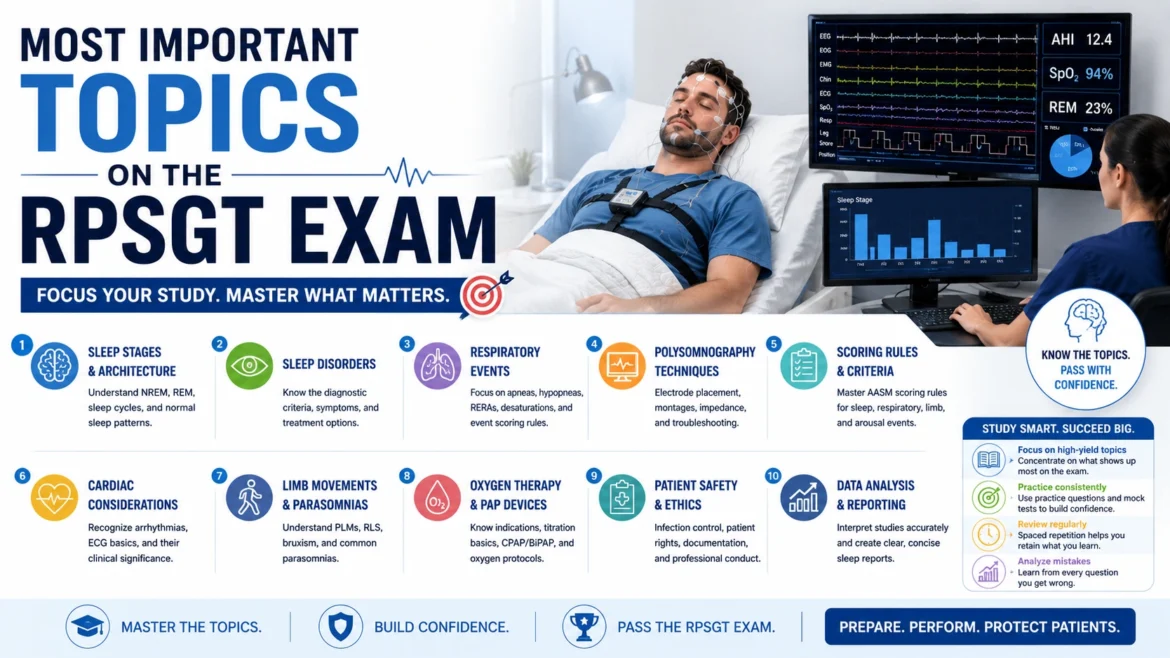

The Registered Polysomnographic Technologist (RPSGT) exam continues to evolve alongside advancements in sleep medicine, respiratory monitoring technology, patient safety standards, and clinical sleep-study procedures.
In 2026, candidates preparing for the RPSGT exam are expected to demonstrate both strong technical knowledge and practical clinical reasoning related to modern sleep medicine environments.
The exam evaluates whether future sleep technologists can safely and accurately perform responsibilities involving:
- Sleep-study monitoring
- Respiratory event recognition
- Sleep-stage scoring
- Patient safety management
- CPAP and BiPAP therapy
- Equipment troubleshooting
- Clinical documentation
Because the field of polysomnography combines healthcare knowledge with advanced technical interpretation, many candidates feel overwhelmed trying to determine which subjects deserve the most attention during preparation.
While every topic matters, certain high-yield areas consistently play a major role in both exam success and real-world sleep medicine practice.
Sleep Physiology and Sleep Architecture
Sleep physiology remains one of the foundational concepts within polysomnography because understanding how the body functions during sleep is essential for accurate monitoring and interpretation.
Candidates should understand:
- Sleep-cycle progression
- REM and non-REM sleep
- Brainwave activity patterns
- Muscle tone changes
- Respiratory changes during sleep
- Neurological activity differences
The RPSGT exam may evaluate whether candidates can recognize how physiological changes affect sleep-stage scoring and patient-monitoring interpretation.
Strong understanding of sleep architecture also supports more accurate recognition of abnormal sleep patterns and sleep disorders.
Sleep Staging and EEG Interpretation
Sleep staging is one of the highest-priority technical areas on the RPSGT exam because accurate staging plays a major role in sleep-study interpretation and diagnosis.
Candidates preparing for the exam should feel comfortable recognizing:
- Stage N1 sleep
- Stage N2 sleep
- Stage N3 sleep
- REM sleep patterns
- Sleep-stage transitions
- Arousal events
- EEG waveform characteristics
Many candidates struggle in this area because they attempt to memorize scoring rules without fully understanding the neurological meaning behind the patterns.
Repeated exposure to realistic EEG interpretation scenarios often improves confidence significantly.
Respiratory Monitoring and Breathing Disorders
Respiratory monitoring remains one of the most important clinical responsibilities for sleep technologists because many sleep disorders involve breathing irregularities occurring during sleep.
The exam may evaluate understanding of:
- Obstructive sleep apnea
- Central sleep apnea
- Hypopnea events
- Oxygen desaturation
- Respiratory effort monitoring
- Airflow interpretation
- Snoring-related events
Candidates should understand how respiratory events affect oxygen levels, sleep quality, cardiovascular health, and patient safety.
Strong respiratory interpretation skills are essential because sleep technologists must identify breathing abnormalities accurately during overnight studies.
CPAP and BiPAP Therapy Concepts
Positive airway pressure therapy remains a major topic area in modern sleep medicine because CPAP and BiPAP therapy are widely used to manage sleep-related breathing disorders.
The RPSGT exam may include questions involving:
- CPAP titration principles
- Pressure adjustment concepts
- Mask fitting challenges
- Leak management
- Patient tolerance issues
- Therapy troubleshooting
Candidates should understand how PAP therapy affects respiratory stability and sleep quality during overnight monitoring.
Because many patients experience therapy adaptation challenges, technologists must also understand patient-centered communication and troubleshooting strategies.
Patient Safety and Clinical Awareness
Patient safety is one of the most important responsibilities in sleep medicine because technologists monitor patients continuously during overnight studies.
The RPSGT exam often evaluates whether candidates can recognize situations involving:
- Respiratory instability
- Oxygen desaturation concerns
- Equipment-related risks
- Medical emergencies
- Patient discomfort
- Monitoring abnormalities
Strong clinical awareness helps technologists protect patient wellbeing while maintaining accurate sleep-study procedures.
Healthcare employers also highly value professionals who combine technical precision with strong patient-care awareness.
Technical Troubleshooting and Signal Artifacts
Modern sleep studies rely heavily on accurate equipment performance and reliable physiological signal recording.
Candidates should understand how to identify and manage:
- Signal interference
- Electrode displacement
- Sensor malfunctions
- Artifact recognition
- Recording inconsistencies
- Equipment calibration issues
The exam may present scenarios where candidates must determine the most appropriate response to technical monitoring problems while preserving study quality.
Strong troubleshooting skills remain extremely important in real-world sleep laboratory environments.
Sleep Disorders and Clinical Interpretation
Candidates preparing for the RPSGT exam should also understand major sleep disorders commonly encountered within polysomnography settings.
Important disorders may include:
- Sleep apnea syndromes
- Insomnia
- Narcolepsy
- Parasomnias
- Restless legs syndrome
- Circadian rhythm disorders
The exam may evaluate whether candidates can recognize physiological patterns associated with these disorders during sleep-study interpretation.
Strong clinical understanding supports more accurate patient monitoring and communication within sleep medicine teams.
Many sleep technologists preparing for certification strengthen technical reasoning and confidence by consistently working through realistic RPSGT practice exam questions and Answers focused on respiratory monitoring, sleep-stage interpretation, troubleshooting, and patient-monitoring decisions commonly encountered during modern polysomnography environments in 2026.
Polysomnography Procedures and Study Setup
Polysomnography procedures remain one of the most important technical areas on the RPSGT exam because accurate study preparation directly affects monitoring quality, patient safety, and diagnostic reliability.
Candidates should understand proper procedures involving:
- Electrode placement
- Sensor application
- Patient preparation
- Equipment calibration
- Signal verification
- Study initiation protocols
Even small setup mistakes may interfere with sleep-study interpretation and create inaccurate physiological recordings.
The exam may evaluate whether candidates understand how proper preparation contributes to reliable overnight monitoring.
Artifact Recognition and Signal Quality
Signal artifacts remain a major topic within polysomnography because monitoring interference can affect sleep-stage interpretation, respiratory analysis, and study accuracy.
Important artifact-related concepts may include:
- Movement artifacts
- Electrical interference
- Poor electrode contact
- Loose sensor connections
- Respiratory channel abnormalities
- ECG-related signal disturbances
Candidates preparing for the RPSGT exam should understand how to differentiate between true physiological events and technical recording problems.
Strong signal-quality awareness helps technologists maintain more reliable studies and improve physician interpretation accuracy.
Cardiac Monitoring and ECG Basics
Cardiac monitoring concepts are also important because sleep studies frequently involve evaluating heart-rate activity and rhythm changes during sleep.
The exam may include questions involving:
- Basic ECG waveform recognition
- Heart-rate variability
- Cardiac rhythm awareness
- Sleep-related cardiovascular changes
- Monitoring abnormalities
Sleep technologists should understand how cardiovascular patterns interact with respiratory disturbances and sleep-stage transitions during overnight studies.
Strong ECG awareness supports broader patient-monitoring interpretation skills.
Patient Communication and Professional Conduct
Although polysomnography is highly technical, communication skills remain extremely important in sleep medicine environments.
Many patients arriving for overnight studies feel:
- Anxious about testing
- Uncomfortable with equipment
- Concerned about sleep disorders
- Embarrassed about symptoms
- Frustrated by chronic fatigue
Professional communication helps technologists:
- Reduce patient anxiety
- Explain procedures clearly
- Improve patient cooperation
- Support study quality
- Maintain patient trust
The RPSGT exam may evaluate understanding of professional behavior, patient interaction standards, and healthcare communication responsibilities.
Documentation and Clinical Reporting
Accurate documentation remains essential in sleep medicine because physicians rely heavily on sleep-study records and technical reports during diagnosis and treatment planning.
Candidates should understand proper documentation involving:
- Patient observations
- Respiratory events
- Equipment adjustments
- Sleep-stage changes
- Technical interruptions
- Clinical concerns
Strong documentation practices help support:
- Patient safety
- Clinical communication
- Study reliability
- Professional accountability
The exam may include scenarios evaluating whether candidates understand accurate reporting and technical communication standards.
How Sleep Technology Continues Evolving
Sleep medicine technology continues advancing rapidly as healthcare systems improve monitoring capabilities, respiratory therapy equipment, and sleep-disorder diagnostic methods.
Modern sleep laboratories increasingly use:
- Advanced digital monitoring systems
- Improved PAP therapy equipment
- Enhanced respiratory sensors
- Remote data management systems
- Updated scoring technologies
Because of these advancements, modern sleep technologists must combine technical adaptability with strong foundational polysomnography knowledge.
Continuous learning therefore remains important throughout a professional sleep medicine career.
Why Scenario-Based Practice Improves Technical Confidence
Many candidates improve significantly when they practice interpreting realistic polysomnography scenarios instead of relying only on textbook review.
Scenario-based learning helps strengthen:
- Respiratory interpretation
- Sleep-stage scoring
- Technical troubleshooting
- Clinical awareness
- Patient-monitoring prioritization
- Decision-making under pressure
Repeated exposure to technical situations often improves confidence and pattern recognition much faster than passive reading methods alone.
Many successful technologists gradually become more comfortable recognizing monitoring abnormalities and responding appropriately during overnight studies.
How Structured Topic Review Improves Retention
Because the RPSGT exam covers multiple technical and clinical areas, organized topic review often improves long-term retention and reduces study overwhelm.
Many candidates create focused study schedules involving:
| Study Focus Area | Main Goal |
|---|---|
| Sleep Physiology | Strengthen conceptual understanding. |
| Respiratory Monitoring | Improve breathing-event recognition. |
| Sleep Staging | Support accurate scoring skills. |
| CPAP and BiPAP | Improve therapy understanding. |
| Technical Troubleshooting | Build monitoring confidence. |
This type of structured preparation helps candidates improve gradually while maintaining stronger technical organization.
Learning the Bigger Role of Sleep Technologists
Many candidates preparing for certification benefit from understanding how sleep technologists contribute to broader patient care and healthcare outcomes.
Sleep medicine professionals help support:
- Respiratory disorder diagnosis
- Sleep-quality improvement
- Cardiovascular risk management
- Patient safety monitoring
- Long-term therapy support
Candidates seeking a broader understanding of polysomnography responsibilities, career pathways, and certification expectations may also benefit from reviewing a complete sleep technology certification overview for future RPSGT professionals while preparing for modern sleep medicine environments in 2026.
Why Clinical Reasoning Is Essential for the RPSGT Exam
One of the biggest misconceptions about the RPSGT exam is that success depends only on technical memorization. In reality, the exam strongly evaluates clinical reasoning and the ability to interpret physiological changes within realistic patient-monitoring situations.
Sleep technologists must continuously evaluate:
- Respiratory changes
- Sleep-stage transitions
- Neurological activity
- Equipment performance
- Patient comfort and safety
- Therapy effectiveness
The ability to combine technical knowledge with practical judgment is extremely important because sleep medicine environments often involve rapidly changing physiological conditions.
Strong clinical reasoning helps technologists recognize problems early while supporting accurate study interpretation and patient wellbeing.
How Time Management Affects RPSGT Preparation
Many candidates preparing for the RPSGT exam balance overnight shifts, healthcare responsibilities, family obligations, and physically demanding work schedules.
Without effective time management, preparation may become:
- Inconsistent
- Emotionally exhausting
- Poorly organized
- Focused on the wrong topics
- Overwhelming before exam day
Structured preparation schedules often improve learning efficiency significantly.
Many successful candidates use:
- Short daily review sessions
- Weekend practice simulations
- Topic rotation schedules
- Weak-area tracking systems
- Timed technical practice
Consistent preparation usually produces stronger long-term retention than aggressive last-minute cramming.
Why Repeated Practice Improves Technical Confidence
Technical confidence develops gradually through repeated exposure to realistic sleep-study interpretation and monitoring scenarios.
Practice-based preparation helps strengthen:
- Sleep-stage scoring
- Respiratory event recognition
- Artifact interpretation
- Equipment troubleshooting
- Clinical prioritization
- Decision-making speed
Repeated technical application also helps candidates become more comfortable working through complex physiological situations without excessive hesitation.
Over time, many technologists begin recognizing important sleep-study patterns more naturally and efficiently.
Why Candidates Should Understand Common Preparation Problems
Many sleep technologists unknowingly develop study habits that interfere with long-term retention and technical interpretation performance.
Examples may include:
- Overreliance on memorization
- Ignoring weak technical areas
- Avoiding timed practice
- Passive rereading without application
- Overanalyzing technical details
Recognizing these patterns early can improve preparation quality significantly.
Educational resources discussing common polysomnography preparation challenges can help candidates strengthen study habits while improving technical confidence and clinical interpretation skills before exam day.
The Growing Importance of Sleep Medicine Careers
Sleep medicine continues expanding rapidly because healthcare providers increasingly recognize the impact sleep disorders have on long-term health outcomes.
Untreated sleep disorders may contribute to:
- Cardiovascular disease
- Respiratory complications
- Cognitive impairment
- Mental health concerns
- Daytime fatigue
- Reduced workplace safety
As awareness increases, demand for qualified sleep technologists capable of performing accurate overnight monitoring and respiratory interpretation is expected to remain strong.
Professionals with advanced polysomnography skills and RPSGT certification may continue benefiting from specialized career opportunities within modern healthcare systems.
Why Communication Skills Matter in Sleep Medicine
Although the RPSGT exam focuses heavily on technical knowledge, communication skills remain extremely important within sleep medicine environments.
Sleep technologists often work with patients experiencing:
- Chronic fatigue
- Respiratory distress
- Sleep-related anxiety
- Difficulty tolerating CPAP therapy
- Emotional frustration from poor sleep quality
Strong communication skills help technologists:
- Explain procedures clearly
- Improve patient cooperation
- Reduce anxiety during studies
- Support patient comfort
- Maintain professional trust
These abilities contribute significantly to overall patient experience and study effectiveness.
How Long-Term Learning Supports Career Growth
The RPSGT certification process often strengthens far more than technical exam performance alone.
Strong preparation may improve:
- Professional discipline
- Technical interpretation skills
- Clinical awareness
- Monitoring confidence
- Patient-care understanding
- Healthcare communication abilities
These improvements can positively affect long-term performance within hospitals, sleep laboratories, pulmonary clinics, and specialized sleep medicine facilities.
Many technologists later discover that the reasoning skills developed during preparation continue helping them throughout their healthcare careers.
Building a Sustainable Study Routine
Modern healthcare professionals often benefit from flexible but structured preparation routines that fit realistically within demanding work schedules.
Many candidates use balanced weekly structures involving:
| Study Day | Suggested Focus |
|---|---|
| Monday | Sleep physiology review |
| Tuesday | Respiratory event interpretation |
| Wednesday | Sleep staging practice |
| Thursday | CPAP and BiPAP review |
| Friday | Artifact recognition |
| Weekend | Timed practice simulations |
This type of balanced structure often improves consistency while reducing mental exhaustion.
Final Thoughts
The RPSGT exam in 2026 continues emphasizing technical interpretation, respiratory monitoring, patient safety, sleep physiology, and practical polysomnography reasoning.
Some of the most important focus areas include:
- Sleep staging
- Respiratory event recognition
- CPAP and BiPAP therapy
- Artifact interpretation
- Technical troubleshooting
- Patient safety awareness
- Clinical documentation
Strong preparation usually involves consistent active learning, realistic scenario interpretation, and repeated exposure to technical sleep-study situations.
Over time, these habits help future sleep technologists build the technical confidence, clinical awareness, and professional judgment needed for both RPSGT certification success and long-term growth within sleep medicine.
Frequently Asked Questions (FAQs)
What are the most important topics on the RPSGT exam?
Important topics often include sleep staging, respiratory monitoring, sleep physiology, PAP therapy, artifact recognition, patient safety, and technical troubleshooting.
Why is sleep staging important for the RPSGT exam?
Sleep staging supports accurate sleep-study interpretation and plays a major role in diagnosing sleep disorders.
How can candidates improve respiratory event interpretation?
Repeated practice with realistic sleep-study scenarios and respiratory monitoring exercises often improves technical confidence significantly.
Why are troubleshooting skills important in polysomnography?
Troubleshooting helps technologists identify monitoring problems, reduce recording errors, and maintain reliable study quality.
How should candidates prepare for the RPSGT exam in 2026?
Strong preparation usually includes active learning, technical scenario review, timed practice sessions, and consistent topic rotation schedules.