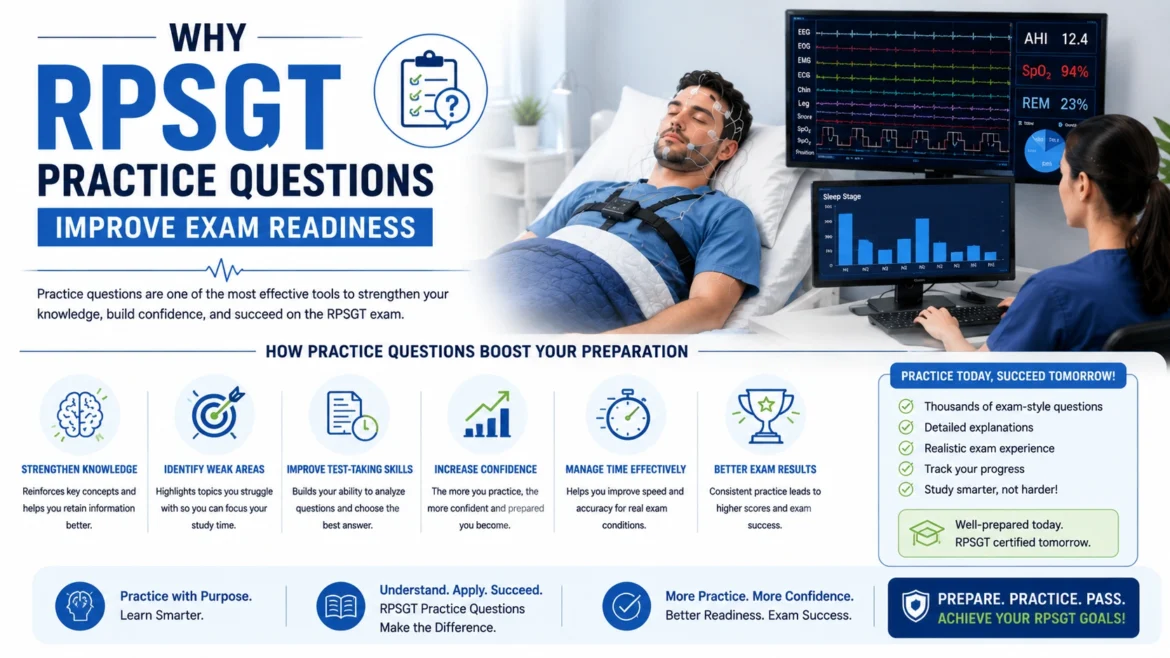

Preparing for the Registered Polysomnographic Technologist (RPSGT) exam involves much more than memorizing technical definitions or reviewing sleep medicine terminology. The exam evaluates whether candidates can apply polysomnography knowledge within realistic patient-monitoring and sleep-study situations.
Because of this, many candidates discover that passive studying alone is not enough to build strong technical confidence.
Practice questions play an important role in preparation because they help candidates strengthen:
- Clinical reasoning
- Sleep-study interpretation
- Respiratory event recognition
- Technical troubleshooting
- Sleep-stage analysis
- Patient-monitoring judgment
Repeated exposure to realistic technical scenarios helps future sleep technologists become more comfortable applying knowledge under pressure.
Preparation Insight:Practice questions help transform technical memorization into practical polysomnography reasoning and decision-making ability.
Why Passive Reading Often Is Not Enough
Many candidates preparing for healthcare certification exams spend large amounts of time rereading notes, highlighting textbooks, or reviewing technical vocabulary without actively applying the information.
Although passive reading may improve short-term familiarity, it often fails to strengthen the real-world interpretation skills required during the RPSGT exam.
For example, candidates may understand definitions involving:
- Sleep stages
- Respiratory events
- CPAP therapy
- Signal artifacts
- EEG activity
However, the exam often requires candidates to interpret these concepts within realistic monitoring situations involving multiple physiological and technical factors simultaneously.
Practice questions help bridge the gap between theoretical knowledge and practical application.
How Practice Questions Strengthen Clinical Reasoning
Clinical reasoning is one of the most important professional skills for sleep technologists because polysomnography environments involve continuous monitoring, technical interpretation, and patient-safety awareness.
Practice questions help candidates improve the ability to:
- Interpret respiratory patterns
- Recognize abnormal monitoring changes
- Identify sleep-stage transitions
- Evaluate technical monitoring issues
- Prioritize patient safety concerns
Repeated technical analysis helps candidates develop stronger problem-solving confidence over time.
This gradual improvement often becomes especially noticeable during complex sleep-study scenarios involving multiple overlapping monitoring variables.
Technical Reminder:Strong clinical reasoning allows sleep technologists to interpret patient-monitoring information more accurately and efficiently.
Why Repetition Improves Pattern Recognition
Sleep medicine involves recognizing physiological and technical patterns repeatedly across many different patient situations.
Practice questions improve pattern recognition by exposing candidates to:
- Respiratory-event examples
- Sleep-stage variations
- Artifact-related problems
- CPAP therapy scenarios
- Technical troubleshooting situations
- Patient-monitoring abnormalities
Over time, repeated exposure helps technologists recognize important monitoring patterns more naturally and quickly.
This becomes extremely valuable during both the certification exam and real overnight sleep studies.
How Practice Questions Improve Sleep Staging Skills
Sleep staging remains one of the most technically demanding areas for many RPSGT candidates because accurate stage recognition requires understanding neurological and physiological changes occurring during sleep.
Practice-based learning helps candidates improve confidence with:
- REM sleep recognition
- Non-REM stage differentiation
- EEG interpretation patterns
- Arousal-event identification
- Sleep-cycle progression
Repeated sleep-stage interpretation exercises often improve scoring accuracy significantly compared to passive textbook review alone.
This type of active reinforcement helps strengthen long-term retention and technical consistency.
Why Respiratory Monitoring Requires Practical Application
Respiratory interpretation is another major area where active practice becomes extremely important.
Many sleep disorders involve breathing irregularities that technologists must recognize accurately during overnight monitoring.
Practice questions help candidates strengthen understanding of:
- Obstructive sleep apnea
- Central sleep apnea
- Hypopnea events
- Oxygen desaturation
- Airflow interpretation
- Respiratory effort monitoring
Repeated scenario analysis helps future technologists become more confident identifying clinically important respiratory changes.
Healthcare Insight:Strong respiratory interpretation skills are essential because sleep-related breathing disorders can significantly affect patient health and safety.
How Practice Questions Reduce Exam Anxiety
Many candidates experience anxiety before the RPSGT exam because the certification process directly affects career advancement and professional opportunities.
Practice questions often help reduce stress because they increase familiarity with:
- Technical terminology
- Question structure
- Sleep-study scenarios
- Respiratory interpretation
- Clinical reasoning demands
- Timed testing environments
As familiarity increases, many candidates feel more comfortable and confident approaching difficult technical scenarios.
Repeated exposure also helps reduce panic caused by unfamiliar question styles or complex monitoring situations.
Why Active Recall Improves Long-Term Retention
Practice questions support active recall, which is one of the most effective learning methods for long-term technical retention.
Active recall requires candidates to retrieve information actively instead of simply rereading it passively.
This process strengthens:
| Learning Benefit | Why It Matters |
|---|---|
| Memory Retention | Improves long-term recall during exams. |
| Technical Confidence | Strengthens interpretation accuracy. |
| Clinical Reasoning | Supports practical decision-making. |
| Pattern Recognition | Improves monitoring interpretation speed. |
| Testing Comfort | Reduces anxiety during timed sessions. |
Because polysomnography involves repeated technical interpretation, active recall becomes extremely valuable during preparation.
Many sleep technologists improve confidence and technical reasoning by consistently working through realistic RPSGT Exam Practice Questions designed to simulate modern sleep-study monitoring, respiratory analysis, and polysomnography interpretation challenges commonly encountered during certification preparation.
How Practice Questions Improve Technical Troubleshooting Skills
Technical troubleshooting remains one of the most important responsibilities for sleep technologists because even small monitoring problems may affect study reliability and patient safety.
Practice questions help candidates strengthen the ability to recognize:
- Signal artifacts
- Electrode displacement
- Sensor malfunctions
- Recording inconsistencies
- Calibration issues
- Respiratory channel disruptions
Repeated troubleshooting exercises improve technical awareness and help candidates respond more confidently during real overnight studies.
Because the RPSGT exam often includes practical monitoring scenarios, active troubleshooting practice becomes extremely valuable during preparation.
Technical Insight:Strong troubleshooting abilities help maintain accurate sleep-study recordings and support reliable patient-monitoring interpretation.
Why Scenario-Based Learning Builds Real Confidence
Many candidates initially feel overwhelmed when analyzing complex polysomnography scenarios involving multiple physiological changes at the same time.
Scenario-based practice helps technologists improve confidence by repeatedly applying knowledge within realistic clinical situations.
These scenarios may involve:
- Respiratory instability
- Sleep-stage transitions
- CPAP tolerance issues
- Monitoring interruptions
- Patient movement artifacts
- Unexpected physiological changes
Repeated technical application gradually helps candidates become more comfortable interpreting sleep-study data under pressure.
This type of preparation often feels much more realistic and clinically useful than memorization alone.
How Practice Questions Strengthen Time Management
Many sleep technologists preparing for certification underestimate how important pacing and time management can become during the exam.
Without repeated timed practice, candidates may:
- Overanalyze technical details
- Spend too much time on difficult questions
- Lose focus during long sessions
- Rush later questions
- Experience unnecessary anxiety
Practice questions improve pacing by helping candidates become more comfortable recognizing patterns and prioritizing clinically important information quickly.
Over time, repeated exposure often improves both efficiency and technical confidence.
Study Reminder:Strong pacing skills help candidates maintain focus and technical accuracy throughout longer certification exams.
Why Weak-Area Review Improves Long-Term Retention
Practice questions also help candidates identify weaker technical areas that may require additional review.
Many technologists discover recurring difficulties involving:
- Sleep-stage scoring
- Respiratory event interpretation
- PAP therapy concepts
- Artifact recognition
- Signal-quality evaluation
- Clinical prioritization
Recognizing these weaknesses early allows candidates to create more targeted study plans instead of reviewing every topic equally.
This focused preparation strategy often improves learning efficiency significantly.
How Practice Questions Support Clinical Awareness
The RPSGT exam evaluates more than technical terminology. Candidates must also demonstrate awareness of patient safety and broader clinical monitoring responsibilities.
Practice-based learning helps technologists improve understanding of:
- Patient-monitoring priorities
- Respiratory distress recognition
- Oxygen saturation concerns
- Emergency response awareness
- Patient comfort considerations
- Professional communication responsibilities
These clinical skills remain extremely important because sleep technologists monitor patients continuously during overnight studies.
Strong patient-awareness habits also support better long-term professional performance within healthcare environments.
Why Practice Questions Help Reduce Memorization Overload
Many candidates become overwhelmed trying to memorize large amounts of technical terminology, scoring criteria, and sleep medicine concepts simultaneously.
Practice questions help organize information into practical application patterns instead of isolated facts.
For example, candidates begin connecting:
- Respiratory events with oxygen desaturation
- Sleep stages with EEG patterns
- Signal artifacts with troubleshooting decisions
- CPAP therapy with respiratory improvement
This conceptual organization often improves retention far more effectively than passive memorization alone.
Learning Insight:Understanding how sleep medicine concepts connect together often improves long-term technical reasoning significantly.
How Practice Questions Prepare Candidates for Modern Sleep Medicine
Sleep medicine technology continues evolving rapidly as healthcare systems adopt improved monitoring equipment, advanced respiratory therapies, and updated diagnostic approaches.
Modern sleep technologists must understand:
- Advanced respiratory monitoring
- Digital polysomnography systems
- Modern PAP therapy approaches
- Updated patient-monitoring techniques
- Signal-quality management
- Clinical workflow efficiency
Practice questions exposing candidates to realistic technical situations help improve readiness for modern sleep laboratory environments.
This preparation becomes especially valuable as polysomnography technology continues advancing in 2026 and beyond.
Learning From Professional Sleep Medicine Guidance
Many candidates improve preparation quality by reviewing educational resources explaining broader sleep medicine responsibilities and common polysomnography preparation challenges.
For example, candidates may strengthen understanding of:
- Clinical monitoring responsibilities
- Sleep-study workflows
- Technical interpretation expectations
- Professional sleep medicine standards
- Certification preparation strategies
Future technologists seeking a broader understanding of polysomnography careers and certification expectations may benefit from reviewing a complete sleep medicine career and certification resource while preparing for technical monitoring responsibilities within modern healthcare environments.
Candidates may also improve study efficiency by learning about frequent polysomnography exam-preparation errors that commonly interfere with technical confidence, respiratory interpretation accuracy, and long-term retention during RPSGT preparation.
Why Consistency Builds Better Technical Judgment
Technical interpretation skills develop gradually through repeated exposure to respiratory monitoring, sleep-study scoring, troubleshooting scenarios, and patient-monitoring situations.
Even shorter daily practice sessions often strengthen:
| Skill Area | Long-Term Benefit |
|---|---|
| Respiratory Interpretation | Improves event recognition accuracy. |
| Sleep Staging | Supports reliable scoring consistency. |
| Technical Troubleshooting | Builds monitoring confidence. |
| Clinical Awareness | Strengthens patient safety judgment. |
| Pattern Recognition | Improves technical efficiency. |
Over time, this consistency helps future sleep technologists feel more confident interpreting complex monitoring situations during both certification preparation and real clinical practice.
Why Practice Questions Improve Sleep Staging Accuracy
Sleep staging remains one of the most technically demanding areas within polysomnography because technologists must recognize neurological and physiological patterns accurately throughout overnight studies.
Many candidates initially struggle with:
- REM sleep identification
- Non-REM stage differentiation
- EEG waveform interpretation
- Arousal-event recognition
- Sleep-cycle transitions
Practice questions help strengthen these skills through repeated exposure to realistic scoring and interpretation scenarios.
Over time, repeated technical application helps candidates become more comfortable recognizing sleep-stage patterns quickly and accurately.
Technical Insight:Consistent sleep-stage practice helps improve scoring reliability and long-term polysomnography confidence.
How Practice Questions Improve Respiratory Interpretation
Respiratory monitoring plays a major role in sleep medicine because many sleep disorders involve breathing abnormalities that occur during sleep.
Practice-based learning helps candidates strengthen understanding of:
- Obstructive sleep apnea
- Central sleep apnea
- Hypopnea events
- Airflow interpretation
- Respiratory effort monitoring
- Oxygen desaturation patterns
Repeated respiratory analysis improves pattern recognition and helps technologists identify clinically important breathing changes more efficiently.
This type of active preparation is especially important because respiratory interpretation strongly affects both patient safety and sleep-study accuracy.
Why Active Learning Improves Long-Term Retention
One of the biggest advantages of practice questions is that they require candidates to retrieve and apply information actively instead of reviewing it passively.
Active learning helps strengthen:
- Technical memory retention
- Clinical reasoning
- Monitoring interpretation speed
- Problem-solving confidence
- Long-term technical consistency
Many candidates discover that repeated technical application improves retention much more effectively than rereading notes or memorizing isolated terminology.
This becomes especially important during complex sleep-study scenarios where multiple physiological and technical factors overlap simultaneously.
Study Reminder:Technical confidence develops gradually through repeated interpretation practice and realistic monitoring application.
How Practice Questions Improve Clinical Decision-Making
Sleep technologists must continuously make practical decisions involving patient safety, technical monitoring quality, respiratory interpretation, and troubleshooting during overnight studies.
Practice questions help strengthen decision-making skills involving:
- Prioritizing patient safety concerns
- Recognizing technical abnormalities
- Responding to monitoring disruptions
- Interpreting physiological changes
- Managing PAP therapy issues
Repeated exposure to realistic scenarios often helps candidates become more comfortable making clinical judgments under pressure.
This confidence becomes valuable both during the exam and in real-world sleep medicine environments.
Why Technical Confidence Matters in Sleep Medicine
Sleep technologists work in highly detail-oriented healthcare environments where technical accuracy directly affects diagnostic reliability and patient care.
Strong technical confidence helps professionals:
- Interpret studies more accurately
- Respond calmly to technical issues
- Maintain reliable monitoring quality
- Support physician interpretation
- Protect patient safety
Practice questions help build this confidence gradually by exposing candidates to a wide variety of technical monitoring situations and respiratory scenarios.
Over time, many technologists become more comfortable identifying important patterns without excessive hesitation or second-guessing.
How Practice Questions Prepare Candidates for Modern Sleep Labs
Modern sleep laboratories continue evolving with advanced digital monitoring systems, improved PAP therapy technologies, and updated polysomnography procedures.
Because of these advancements, sleep technologists must combine:
- Technical adaptability
- Respiratory interpretation skills
- Patient-monitoring awareness
- Troubleshooting abilities
- Clinical reasoning
Practice-based preparation helps candidates adapt more effectively to modern sleep medicine environments by improving familiarity with realistic monitoring situations and technical workflows.
This preparation is especially valuable as healthcare technology continues advancing throughout 2026 and beyond.
Career Insight:Strong technical reasoning and practical monitoring skills remain highly valuable within modern polysomnography environments.
Why Candidates Should Prioritize High-Yield Topics
Many RPSGT candidates feel overwhelmed because the exam covers multiple clinical and technical subject areas.
Practice questions help candidates identify which areas require the most attention during preparation.
High-yield areas often include:
- Sleep staging
- Respiratory event interpretation
- CPAP and BiPAP therapy
- Artifact recognition
- Technical troubleshooting
- Patient safety
Candidates looking to strengthen preparation efficiency may benefit from reviewing detailed educational resources covering the highest-priority RPSGT exam concepts commonly connected to respiratory monitoring, sleep-study interpretation, and modern polysomnography practice.
Building Long-Term Professional Skills Through Practice
The benefits of practice questions extend far beyond passing a certification exam.
Repeated technical application often strengthens:
| Professional Skill | Career Benefit |
|---|---|
| Respiratory Interpretation | Supports accurate patient monitoring. |
| Technical Troubleshooting | Improves study reliability. |
| Clinical Awareness | Strengthens patient safety decisions. |
| Sleep Staging | Improves scoring consistency. |
| Professional Confidence | Supports long-term career growth. |
These practical skills continue benefiting technologists throughout their careers in hospitals, sleep laboratories, pulmonary clinics, and specialized sleep medicine centers.
Final Thoughts
Practice questions remain one of the most effective tools for improving RPSGT exam readiness because they help candidates apply technical knowledge within realistic polysomnography situations.
Strong practice-based preparation often improves:
- Clinical reasoning
- Sleep-stage interpretation
- Respiratory monitoring
- Technical troubleshooting
- Patient safety awareness
- Testing confidence
Rather than relying only on memorization, many successful sleep technologists strengthen long-term technical confidence through consistent active learning and repeated scenario interpretation.
Over time, these habits help future professionals build the practical monitoring skills, clinical awareness, and technical judgment needed for both RPSGT certification success and long-term growth within modern sleep medicine.
Frequently Asked Questions (FAQs)
Why are practice questions important for the RPSGT exam?
Practice questions help candidates improve technical interpretation, respiratory monitoring, sleep staging, troubleshooting, and clinical reasoning skills.
Do practice questions improve sleep-stage scoring?
Yes. Repeated exposure to realistic scoring scenarios often improves sleep-stage recognition and technical consistency significantly.
How do practice questions help with respiratory interpretation?
They strengthen recognition of apnea events, oxygen desaturation, airflow abnormalities, and respiratory monitoring patterns.
Can practice questions reduce RPSGT exam anxiety?
Yes. Familiarity with realistic technical scenarios often improves confidence and reduces stress during certification testing.
What topics should candidates practice most often?
Important focus areas include sleep staging, respiratory monitoring, PAP therapy, troubleshooting, artifact recognition, and patient safety.