
The counseling profession continues to grow across the United States as demand rises for qualified mental health professionals, school counselors, rehabilitation counselors, and community support specialists. As more states strengthen licensure standards and employers seek evidence of professional competence, the National Counselor Examination (NCE) has become one of the most important milestones in a counselor’s career journey.
For many aspiring counselors, passing the NCE is not simply another test. It represents the transition from academic preparation to professional practice. It demonstrates mastery of counseling principles, ethical decision-making, human development theories, assessment strategies, and evidence-based interventions that directly impact clients’ lives.
Whether you are currently enrolled in a counseling graduate program or preparing for state licensure, understanding the purpose and value of the NCE can help you build a clear roadmap toward a rewarding career.
- The NCE is one of the most widely accepted counselor licensure examinations in the United States.
- Many state licensing boards use NCE scores as part of the licensure process.
- Passing the exam can improve employment opportunities and professional credibility.
- The test evaluates both counseling knowledge and practical application skills.
- Strong preparation often leads to greater confidence during licensure and job searches.
What Exactly Is the National Counselor Examination?
The National Counselor Examination, commonly known as the NCE, is a standardized assessment developed to evaluate the knowledge and competencies expected of entry-level professional counselors. The examination is administered by the National Board for Certified Counselors (NBCC) and serves as a key requirement for many counseling credentials and state licensure pathways.
The exam measures a candidate’s understanding of counseling theories, professional ethics, assessment methods, group counseling principles, career development concepts, helping relationships, multicultural awareness, and research methodologies.
Unlike classroom exams that often focus on memorization, the NCE challenges candidates to apply counseling knowledge in realistic professional situations. Questions frequently require analytical thinking, ethical judgment, and the ability to identify the most appropriate counseling intervention.
NCE Exam Snapshot
| Category | Details |
|---|---|
| Exam Name | National Counselor Examination (NCE) |
| Administered By | National Board for Certified Counselors (NBCC) |
| Primary Purpose | Counselor licensure and certification |
| Exam Format | Multiple-choice questions |
| Target Audience | Graduate counseling students and professionals |
| Key Domains | Human Development, Ethics, Assessment, Career Counseling, Group Work, Research and More |
Why Thousands of Future Counselors Pursue NCE Certification
Every year, thousands of counseling graduates invest significant time and effort into preparing for the NCE because the benefits extend far beyond passing an examination.
Certification and licensure demonstrate that a counselor possesses the foundational competencies needed to serve clients responsibly and ethically. In an increasingly competitive job market, employers often prioritize candidates who have successfully completed recognized professional examinations.
For many professionals, earning licensure opens doors to private practice opportunities, advanced clinical roles, leadership positions, and expanded responsibilities within healthcare systems, schools, rehabilitation facilities, and community organizations.
Additionally, clients are becoming more informed when selecting mental health providers. Credentials help establish trust and reassure individuals that their counselor has met recognized professional standards.
Real-World Story: How NCE Certification Changed a Career Path
Consider the experience of a graduate counseling student named Sarah. After completing her master’s degree, she struggled to secure interviews despite having strong academic credentials. Several employers indicated a preference for candidates who had already completed key licensure requirements.
Sarah dedicated three months to focused NCE preparation, passed the examination, and updated her professional profile accordingly. Within weeks, she received multiple interview invitations from community mental health agencies and school counseling programs.
While every career journey differs, Sarah’s experience illustrates a common reality: professional credentials often serve as a signal of readiness and commitment to employers.
The Growing Demand for Licensed Counselors in America
Mental health awareness has increased dramatically across the United States. Schools, healthcare organizations, government agencies, and private employers are investing more resources into behavioral health services than ever before.
As a result, qualified counselors are needed in numerous settings, including:
- Mental health clinics
- Hospitals and healthcare systems
- Substance abuse treatment centers
- Veterans support programs
- School counseling departments
- College counseling centers
- Private counseling practices
- Correctional facilities
- Employee assistance programs
- Community outreach organizations
The counseling profession offers meaningful opportunities to improve lives while building a stable and respected career.
Career Opportunities Available After Licensure
One of the most attractive aspects of becoming a licensed counselor is the diversity of career options available. Professionals can specialize in populations, treatment approaches, or specific settings that align with their interests and strengths.
| Career Path | Primary Focus |
|---|---|
| Clinical Mental Health Counselor | Assessment, diagnosis, and treatment planning |
| School Counselor | Academic, social, and emotional support |
| Career Counselor | Career development and workforce planning |
| Rehabilitation Counselor | Disability support and vocational rehabilitation |
| Substance Abuse Counselor | Addiction treatment and recovery services |
| Private Practice Counselor | Independent counseling services |
Each specialty requires a unique combination of skills, but all share a common foundation built upon the knowledge tested within the NCE.
How the NCE Supports Long-Term Professional Growth
The preparation process itself provides significant professional value. Reviewing counseling theories, ethical standards, assessment procedures, multicultural competencies, and evidence-based interventions reinforces critical knowledge that counselors use throughout their careers.
Many successful candidates discover that structured preparation not only helps them pass the examination but also strengthens their confidence when working with real clients.
Students seeking additional exam-focused practice often benefit from working through realistic question banks and case-based scenarios such as those found in comprehensive NCE practice exam resources, which can help bridge the gap between academic learning and examination readiness.
Understanding the Path From Student to Licensed Counselor
The journey toward professional counseling typically involves several major milestones. Understanding these steps early can reduce confusion and help candidates develop a realistic timeline.
While exact requirements vary by state, most aspiring counselors progress through graduate education, supervised clinical experience, examination completion, and licensure application.
In the next section, we will explore the complete certification pathway, major exam domains, study strategies, and common mistakes that prevent otherwise qualified candidates from achieving success on the NCE.
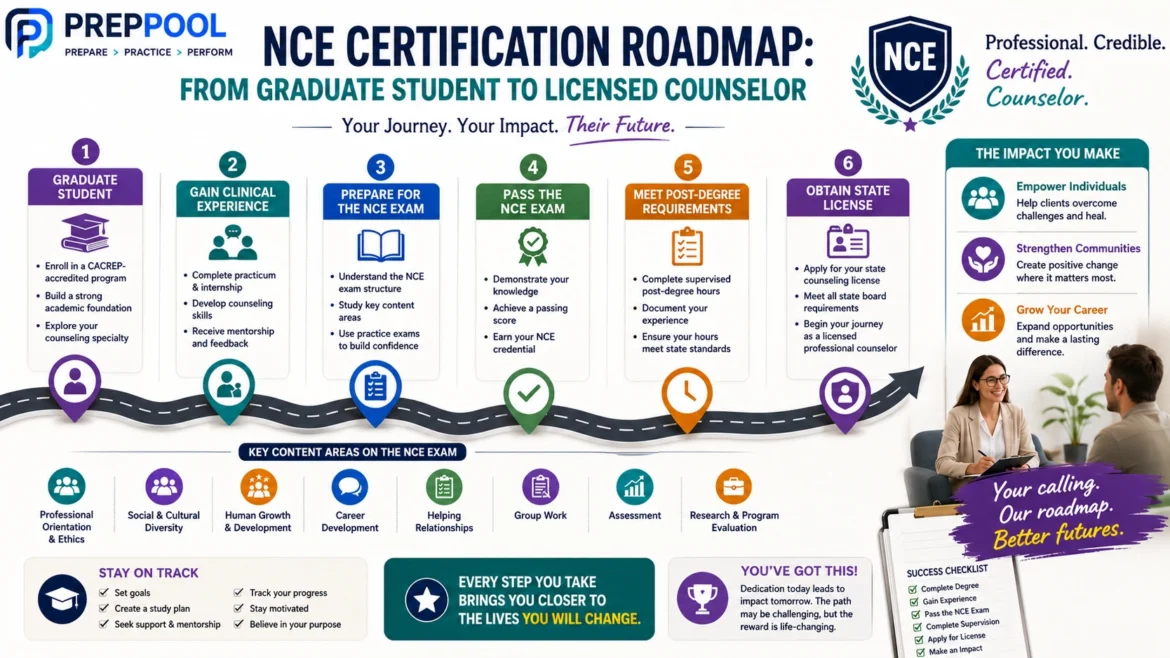
How to Become NCE Certified: Step-by-Step Career Roadmap
Many counseling students become overwhelmed when they begin researching licensure requirements because every state has its own regulations. However, the overall pathway remains remarkably similar across the United States. Understanding each stage can help you stay organized and avoid delays during the licensure process.
- Earn a bachelor’s degree.
- Complete a CACREP-accredited or approved master’s counseling program.
- Finish supervised practicum and internship requirements.
- Apply for NCE eligibility.
- Pass the National Counselor Examination.
- Complete post-graduate supervised clinical hours if required by your state.
- Apply for professional counselor licensure.
- Maintain continuing education requirements.
Although individual timelines vary, most professionals spend several years building the educational and practical experience needed to become licensed counselors.
Educational Requirements for Future Counselors
The foundation of every successful counselor begins with formal education. Most states require candidates to complete a master’s degree in counseling or a closely related field before becoming eligible for licensure.
Graduate programs expose students to counseling theories, psychopathology, assessment techniques, multicultural counseling, ethics, research methods, and supervised clinical experiences. These academic experiences directly support success on the NCE because many exam questions are derived from concepts introduced during graduate study.
Students who actively engage in coursework rather than simply memorizing information often find the examination significantly easier because they understand how theories and interventions apply in real-world situations.
Major NCE Content Areas You Must Master
One of the biggest mistakes candidates make is treating every topic equally. While all content areas matter, successful test-takers understand how the domains connect and support one another.
| Domain | Focus Area |
|---|---|
| Human Growth and Development | Developmental theories, lifespan transitions, and psychological growth |
| Social and Cultural Foundations | Diversity, inclusion, multicultural competence, and advocacy |
| Helping Relationships | Counseling techniques, rapport building, and intervention strategies |
| Group Counseling | Group development, leadership styles, and therapeutic groups |
| Career Development | Career theories, vocational assessment, and workforce planning |
| Assessment | Testing principles, evaluation tools, and interpretation methods |
| Research and Program Evaluation | Statistics, research design, and outcome measurement |
| Professional Orientation and Ethics | Legal responsibilities, ethical standards, and professional identity |
Rather than studying these domains independently, high-performing candidates learn how concepts overlap. For example, ethical decision-making influences assessment practices, multicultural competence affects helping relationships, and developmental theory shapes treatment planning.
Most Tested Counseling Theories and Models
Counseling theories form the backbone of professional practice. Candidates who understand the major theoretical approaches are often able to answer a wide range of questions across multiple domains.
Some of the most frequently encountered theories include:
- Person-Centered Therapy
- Cognitive Behavioral Therapy (CBT)
- Rational Emotive Behavior Therapy (REBT)
- Reality Therapy
- Existential Counseling
- Gestalt Therapy
- Psychodynamic Theory
- Adlerian Counseling
- Behavioral Therapy
- Solution-Focused Brief Therapy
Successful candidates move beyond simple definitions. They learn the goals, techniques, founder, strengths, limitations, and appropriate client applications for each approach.
Why Ethics Questions Often Determine Pass-or-Fail Outcomes
Ethics is one of the most important areas tested on the NCE because professional counselors regularly encounter situations requiring careful judgment and decision-making.
Questions may involve confidentiality, informed consent, dual relationships, record keeping, supervision, mandated reporting, professional boundaries, or counselor competence.
In practice, ethical competence protects both clients and counselors. This is why licensing boards and employers place significant importance on ethical knowledge.
Effective Study Strategies Used by Top Scorers
Passing the NCE rarely depends on intelligence alone. More often, success comes from consistency, organization, and strategic preparation.
Candidates who begin studying several months before their exam date generally experience lower stress levels and stronger retention of key concepts.
The most effective preparation plans typically include:
- Structured weekly study schedules
- Content review by domain
- Practice examinations
- Flashcards for theories and terminology
- Case-study analysis
- Performance tracking
- Targeted review of weak areas
A Practical 12-Week NCE Study Plan
| Weeks | Primary Focus |
|---|---|
| 1-2 | Human Development and Counseling Theories |
| 3-4 | Helping Relationships and Group Counseling |
| 5-6 | Assessment and Career Development |
| 7-8 | Research Methods and Statistics |
| 9-10 | Professional Ethics and Legal Issues |
| 11 | Full-Length Practice Exams |
| 12 | Final Review and Weak Area Reinforcement |
This type of systematic approach helps candidates build confidence while reducing the risk of overlooking critical topics.
Common NCE Mistakes That Cost Candidates Valuable Points
Many otherwise qualified counseling graduates fail to achieve their target score because they make avoidable preparation mistakes.
The most common issues include:
- Waiting too long to begin studying
- Relying exclusively on memorization
- Ignoring practice questions
- Neglecting research and statistics topics
- Failing to review ethics thoroughly
- Skipping full-length practice exams
- Studying without a structured plan
- Focusing only on favorite topics
One frequently overlooked challenge is test endurance. The NCE requires sustained concentration over an extended period. Candidates who never simulate real testing conditions may struggle with fatigue during the actual examination.
The Value of Practice Questions and Scenario-Based Learning
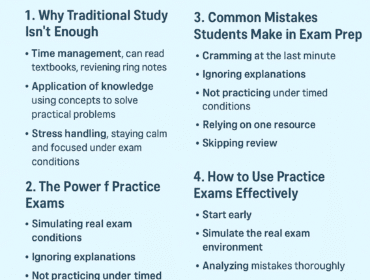
Reading textbooks provides knowledge, but answering realistic exam questions teaches application. This distinction often separates average performers from exceptional performers.
Practice questions expose candidates to exam wording, distractor choices, counseling scenarios, ethical dilemmas, and time-management challenges that closely resemble the actual testing experience.
Scenario-based learning is especially valuable because professional counseling involves making decisions in complex situations rather than simply recalling facts. Reviewing realistic cases encourages critical thinking and helps candidates develop the judgment expected of entry-level counselors.
Building Exam-Day Confidence Before Test Week
The final weeks before the examination should focus less on learning new information and more on reinforcing existing knowledge. Candidates who constantly switch resources or attempt to study every possible topic often increase anxiety rather than improve performance.
Confidence grows when preparation becomes consistent. Regular review, repeated exposure to practice questions, and familiarity with major concepts create the foundation needed for success.
In the final section, we’ll explore why NCE certification matters in today’s counseling landscape, long-term career advantages, salary and advancement opportunities, professional credibility, and the most frequently asked questions from future counselors.
Why NCE Certification Matters in the Modern U.S. Counseling Profession
The counseling profession has evolved significantly over the past decade. Mental health services are no longer viewed as optional support systems. Today, they are considered an essential component of healthcare, education, workplace wellness, and community development.
As awareness of anxiety, depression, trauma, substance use disorders, and behavioral health challenges continues to increase, employers are seeking professionals who possess verified counseling competencies and professional credentials.
This is where NCE certification becomes particularly valuable. Passing the examination demonstrates that a counselor has achieved a nationally recognized standard of knowledge and professional readiness.
For employers, certification provides confidence. For clients, it creates trust. For counselors, it represents a major milestone that can support career advancement for years to come.
- Demonstrates professional commitment.
- Validates counseling knowledge.
- Supports licensure eligibility.
- Shows readiness for client-facing responsibilities.
- Reduces onboarding and training concerns.
- Strengthens professional credibility.
Long-Term Career Benefits Beyond Passing the Exam
Many candidates focus exclusively on passing the NCE without considering its long-term professional impact. In reality, the examination serves as a gateway to opportunities that can influence an entire career trajectory.
Licensed counselors often gain access to broader employment options, increased professional autonomy, and opportunities to specialize in areas that align with their interests.
Over time, these advantages may include leadership positions, clinical supervision roles, private practice ownership, program management responsibilities, and advanced certifications.
Employers frequently view licensure candidates and licensed counselors differently during hiring decisions because credentials signal professional readiness and compliance with regulatory requirements.
How NCE Preparation Improves Real Counseling Skills
One overlooked benefit of NCE preparation is the practical knowledge gained during the study process.
Many candidates discover that reviewing counseling theories, ethical standards, assessment procedures, multicultural competencies, and intervention strategies strengthens their effectiveness in real client interactions.
For example, a counselor studying developmental theories may gain a deeper understanding of age-specific client concerns. Another candidate reviewing ethics may become more confident handling confidentiality questions and professional boundary issues.
These improvements extend beyond the testing center and directly contribute to professional growth.
The Expanding Need for Qualified Mental Health Professionals
Across the United States, organizations continue investing in mental health support services. Hospitals are expanding behavioral health departments. Schools are increasing counseling resources. Community agencies are strengthening outreach programs. Employers are adding employee wellness initiatives.
This growing demand creates opportunities for professionals who possess both education and recognized credentials.
Counselors may work with:
- Children and adolescents
- College students
- Families and couples
- Veterans and military personnel
- Individuals experiencing trauma
- Substance abuse recovery populations
- Individuals managing chronic mental health conditions
- Career transition clients
- Community support populations
The broad range of available specialties allows counselors to build careers that match their passions while making meaningful contributions to society.
Professional Skills That NCE Candidates Develop
Successful counselors possess much more than academic knowledge. They develop a combination of interpersonal, analytical, ethical, and communication skills that support effective client outcomes.
| Professional Skill | Why It Matters |
|---|---|
| Active Listening | Helps counselors understand client concerns accurately. |
| Empathy | Builds trust and therapeutic relationships. |
| Critical Thinking | Supports treatment planning and decision-making. |
| Ethical Judgment | Protects clients and maintains professional standards. |
| Cultural Competence | Improves effectiveness across diverse populations. |
| Assessment Skills | Assists with evaluation and intervention planning. |
| Communication | Facilitates productive counseling interactions. |
The NCE evaluates many of these competencies indirectly through scenario-based questions and practical applications.
What Sets High-Performing NCE Candidates Apart?
After reviewing thousands of candidate experiences, a consistent pattern emerges among top performers.
High-scoring candidates rarely rely on last-minute cramming. Instead, they create structured study schedules, review weak areas honestly, complete multiple practice exams, and focus on understanding concepts rather than memorizing isolated facts.
They also recognize that the NCE is designed to evaluate professional judgment. As a result, they spend time analyzing counseling scenarios and ethical situations rather than simply reading summaries.
This deeper level of preparation often translates into stronger examination performance and greater professional confidence after passing.
Future Trends Shaping the Counseling Profession
The counseling field continues to evolve alongside societal changes, healthcare innovations, and technological advancements.
Several emerging trends are influencing the future of professional counseling:
- Telehealth and virtual counseling services
- Integrated behavioral healthcare models
- Trauma-informed treatment approaches
- Workplace mental health programs
- Expanded access to community mental health services
- Data-driven treatment evaluation
- Increased focus on diversity and inclusion
- Preventive mental health interventions
Professionals entering the field today have opportunities to contribute to one of the fastest-growing and most impactful areas of healthcare and human services.
Final Thoughts: Is the NCE Worth It?
For aspiring counselors pursuing professional licensure, the answer is often yes. The National Counselor Examination remains one of the most important milestones on the path toward becoming a licensed professional counselor.
Beyond licensure requirements, the preparation process strengthens counseling knowledge, reinforces ethical decision-making, improves professional confidence, and supports long-term career development.
Whether your goal is clinical mental health counseling, school counseling, rehabilitation counseling, private practice, or community service, success on the NCE can help establish the foundation for a rewarding and meaningful professional future.
The journey requires dedication, discipline, and consistent preparation, but the rewards extend far beyond a passing score. For many counselors, the NCE serves as the bridge between graduate education and a lifelong career dedicated to helping others achieve healthier and more fulfilling lives.
Frequently Asked Questions About the NCE
What is the primary purpose of the NCE?
The National Counselor Examination evaluates the knowledge, skills, and professional competencies expected of entry-level counselors and is commonly used for licensure and certification purposes throughout the United States.
Can I take the NCE before graduation?
Eligibility requirements vary depending on state regulations and program policies. Some counseling students may be permitted to take the examination before completing all degree requirements, while others must graduate first.
How long should I study for the NCE?
Most candidates benefit from a structured study plan lasting approximately two to four months. The ideal timeline depends on prior knowledge, available study time, and familiarity with counseling concepts.
What topics are most important on the NCE?
Major focus areas include human development, helping relationships, counseling theories, ethics, assessment, group counseling, multicultural counseling, career development, research methods, and professional orientation.
Are practice exams useful for NCE preparation?
Yes. Practice examinations help candidates become familiar with question formats, identify weak areas, improve time management skills, and build confidence before the actual examination.