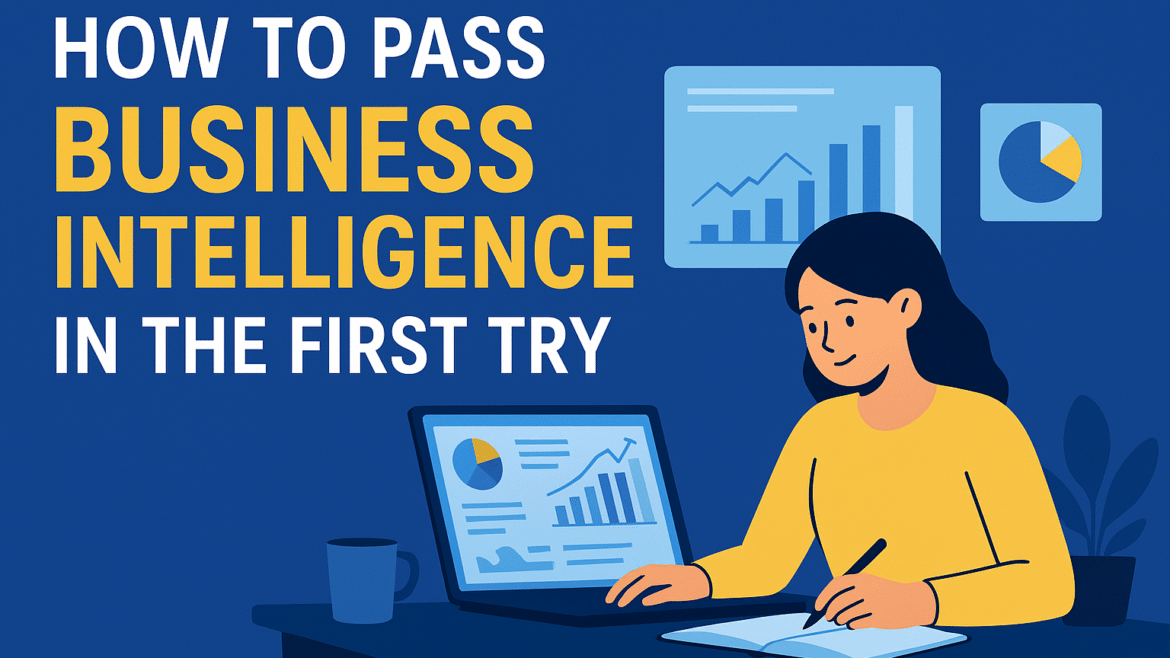

How to Pass Business Intelligence Exam in the First Try
Business Intelligence (BI) has become one of the most in-demand skills for professionals in data, analytics, and decision-making. With businesses across industries adopting data-driven strategies, earning a BI certification can be a game-changer for your career. But here’s the challenge: most candidates fail their BI exams on the first try.
Why? Not because the content is impossible, but because they lack the right strategy, preparation plan, and exam-day mindset.
This guide gives you a step-by-step roadmap on how to prepare effectively, avoid common pitfalls, and build the confidence needed to pass your Business Intelligence exam on the first attempt.
Many professionals use practice resources like Business Intelligence practice exams to build confidence before test day.”
Why Business Intelligence Certification Matters
Business Intelligence is no longer just a “nice-to-have” skill. It is a core driver of business strategy in today’s world. Organizations depend on BI to:
- Extract actionable insights from raw data.
- Monitor KPIs in real-time through dashboards.
- Improve decision-making with predictive and prescriptive analytics.
- Create data models that streamline reporting and planning.
For you as a professional, passing a BI certification signals that you:
- Understand core BI principles.
- Can work with industry-standard tools like Power BI, Tableau, or SQL.
- Can manage large data sets, build reports, and design dashboards.
- Are ready to support business decision-making with data-driven insights.
This credibility makes you more employable, increases your earning potential, and sets you apart in a competitive job market.
Understanding the BI Exam Landscape
Not all Business Intelligence exams are the same, but most share common domains:
- Conceptual Knowledge: BI fundamentals, data strategy, governance.
- Technical Knowledge: Data warehousing, ETL, SQL queries, dashboards.
- Practical Skills: Building KPIs, dashboards, OLAP analysis, tool-based tasks.
Popular certifications include:
- Microsoft Power BI Certification
- Tableau Desktop Specialist
- SAP BusinessObjects
- CBIP (Certified Business Intelligence Professional)
Even though each exam has its unique blueprint, the core concepts remain evergreen. If you master them, you’ll be well-prepared regardless of which BI exam you take.
Core Topics You Must Master
Business Intelligence Fundamentals
Start with the basics. Understand what BI is, why it matters, and how it transforms raw data into actionable insights. Questions in this area test whether you can define BI, explain its role in organizations, and identify its benefits.
Data Warehousing and ETL Processes
Every BI exam includes questions on ETL (Extract, Transform, Load) and data warehousing. You must know:
- How data is extracted from source systems.
- How it is transformed (cleaned, normalized, enriched).
- How it is loaded into a data warehouse.
Data warehouses and data marts are central to BI. Make sure you can explain their purpose and structure.
Data Modeling
Data modeling ensures data is stored logically for reporting and analysis. Focus on:
- Star schema vs. snowflake schema.
- Dimension tables and fact tables.
- How data models support OLAP and dashboards.
Dashboards, KPIs, and Data Visualization
BI is not just about data—it’s about communicating insights. Expect questions on:
- Designing dashboards for clarity.
- Defining and tracking KPIs.
- Using charts, graphs, and visuals effectively.
OLAP and Aggregate Tables
OLAP (Online Analytical Processing) allows multi-dimensional analysis of data. You may be asked to:
- Define OLAP cubes.
- Explain how aggregate tables improve query performance.
- Distinguish between OLAP and OLTP.
BI Tools: Power BI, Tableau, and SQL
No BI exam ignores tools. Expect practical scenarios involving:
- Building reports in Power BI or Tableau.
- Writing SQL queries for reporting.
- Understanding joins, filters, and calculated fields.
Real-Time BI and Complex Event Processing
With real-time data streams, exams may test:
- The difference between batch vs. real-time BI.
- CEP (Complex Event Processing) — detecting patterns in streaming data.
Governance, Data Integrity, and Security
Data without governance is dangerous. Be ready for:
- Data quality and accuracy questions.
- Security protocols in BI systems.
- Compliance with privacy regulations (GDPR, HIPAA, etc.).
Analytics Types: Descriptive, Predictive, Prescriptive
BI involves more than reporting. Learn to:
- Define descriptive (what happened), predictive (what will happen), and prescriptive analytics (what should be done).
- Apply examples for each.
Industry-Specific BI Applications
BI is used everywhere. Exams may test application in:
- Finance (risk analysis, revenue dashboards).
- Marketing (customer insights, campaign analytics).
- Operations (supply chain optimization).
- HR (employee performance metrics).
Creating a Smart Study Plan
A structured plan is your best ally. Here’s a recommended roadmap:
- Week 1–2: Review BI fundamentals and core concepts.
- Week 3–4: Deep dive into ETL, data warehousing, and modeling.
- Week 5–6: Focus on dashboards, KPIs, OLAP, and visualization.
- Week 7–8: Practice tool-based questions (Power BI, Tableau, SQL).
- Final 2 weeks: Take timed practice exams, review weak areas, revise notes.
How to Use Practice Resources Effectively
Practice tests are crucial. They help you:
- Familiarize yourself with the question style.
- Test your time management.
- Identify weak areas for targeted revision.
Pro tip: Don’t just memorize answers. Understand why each answer is correct. The most effective way to measure readiness is through Business Intelligence mock tests
Hands-On Strategies with BI Tools
You can’t pass a BI exam by theory alone. Spend time with tools like Power BI and Tableau. Try to:
- Import sample datasets.
- Create dashboards and reports.
- Practice SQL queries to extract insights.
The more hands-on experience you gain, the more confident you’ll feel on exam day.
Common Mistakes That Cause Exam Failure
Avoid these pitfalls:
- Skipping fundamentals: Jumping to advanced tools without mastering BI basics.
- Ignoring time management: Spending too long on one question.
- Over-reliance on memorization: Failing to apply knowledge to scenarios.
- Not practicing with tools: BI exams test practical skills, not just theory.
Mindset, Test-Taking Strategy, and Time Management
On exam day:
- Stay calm. Anxiety wastes time and focus.
- Read questions carefully. Many BI questions are scenario-based.
- Manage time. Don’t get stuck; mark and return later.
- Trust your preparation. You’ve put in the work—now show it.
Frequently Asked Questions
- How long does it take to prepare for a BI exam?
On average, 6–10 weeks of consistent study is enough, depending on prior experience. - Is BI certification difficult?
It’s challenging but manageable with the right strategy. Difficulty depends on your background in data and tools. - Which tools should I focus on?
Power BI, Tableau, and SQL are most commonly tested. - Can I pass without hands-on practice?
Unlikely. Practical skills are key. You should practice building dashboards, queries, and reports. - What is the pass rate for BI exams?
Pass rates vary, but many candidates fail the first attempt due to poor preparation. With a smart plan, your chances rise significantly.
 As you are here, you may want to check out the following Business Practice Exams:
Introduction to Business and Technology Exam
Transforming Business with AI (Capstone) Exam
Business Mobile Commerce and Monetization Exam
Advanced Agribusiness Analysis Exam
Conclusion
Passing a Business Intelligence exam on the first try is absolutely possible if you:
- Master core concepts.
- Build a structured study plan.
- Practice consistently with BI tools.
- Avoid common pitfalls and manage your exam mindset.
Think of certification not just as a test, but as proof of your ability to turn raw data into meaningful decisions. If you commit to learning the concepts deeply, practice with real tools, and stay disciplined, your first attempt can be your only attempt.
Passing a Business Intelligence exam on the first try requires more than luck—it demands preparation, strategy, and the right mindset. Business Intelligence is a fast-growing field, and certifications prove you can transform raw data into actionable insights using tools like Power BI, Tableau, and SQL.
To succeed, start with BI fundamentals, then build your knowledge of data warehousing, ETL, and data modeling. Learn how dashboards and KPIs communicate business performance, and understand OLAP, aggregate tables, and real-time BI concepts. Governance, data integrity, and security are equally critical exam areas.
Beyond theory, practice is everything. Hands-on work with BI tools builds confidence and prepares you for scenario-based exam questions. Use mock tests to measure your progress, identify weak areas, and refine your time management.
Common mistakes—like skipping fundamentals, relying only on memorization, or neglecting practical exercises—lead to failure. Instead, approach the exam with balance: strong foundational knowledge, tool-based practice, and a calm, focused mindset on test day.
With 6–10 weeks of consistent effort, you can turn preparation into success. With the right strategy, preparation, and BI exam practice resources you can pass on the first try and move your career forward.”