
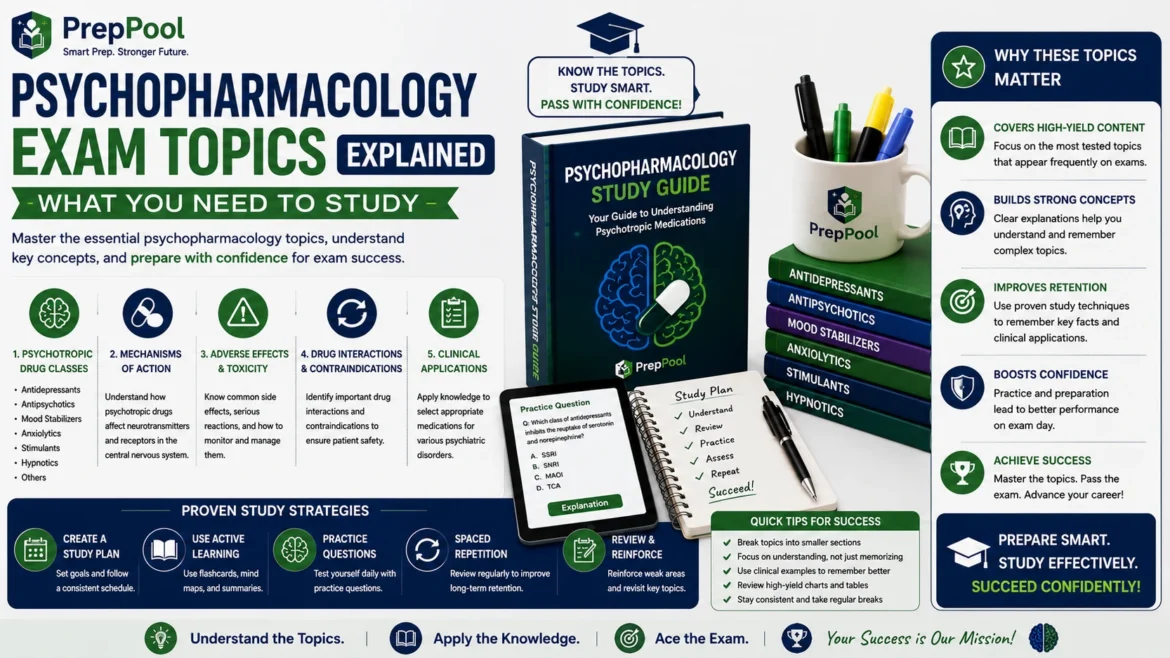

Understanding the major psychopharmacology exam topics is one of the best ways to prepare efficiently and avoid spending valuable study time on less important material. While individual examinations vary by institution or certification, most assess your ability to apply pharmacologic knowledge to realistic clinical situations rather than simply recalling medication names.
Successful learners develop a strong understanding of medication mechanisms, therapeutic indications, adverse effects, contraindications, drug interactions, patient monitoring, and medication safety. Focusing on these core concepts helps build the clinical reasoning skills needed for both examinations and professional practice.
Topics Covered in This Guide
- Major psychotropic medication classes.
- High-yield psychiatric disorders and treatments.
- Medication safety and patient monitoring.
- Common adverse effects and drug interactions.
- Clinical reasoning skills commonly assessed on psychopharmacology examinations.
Antidepressant Medications
Antidepressants are among the most frequently tested medication classes because they are widely prescribed for depressive disorders, anxiety disorders, obsessive-compulsive disorder, post-traumatic stress disorder, and several other psychiatric conditions. You should understand each class’s mechanism of action, common indications, adverse effects, contraindications, and important patient counseling points.
Important medication groups include:
- Selective serotonin reuptake inhibitors (SSRIs)
- Serotonin-norepinephrine reuptake inhibitors (SNRIs)
- Tricyclic antidepressants (TCAs)
- Monoamine oxidase inhibitors (MAOIs)
- Atypical antidepressants
Antipsychotic Medications
Another major focus is antipsychotic therapy. Examinations often assess your ability to distinguish between first-generation and second-generation antipsychotics, recognize common adverse reactions, and identify serious complications that require immediate intervention.
Key concepts include:
- Dopamine receptor blockade.
- Metabolic adverse effects.
- Extrapyramidal symptoms.
- Tardive dyskinesia.
- Neuroleptic malignant syndrome.
- Patient monitoring recommendations.
Mood Stabilizers
Mood stabilizers are commonly tested because they require careful monitoring and play an important role in treating bipolar disorder. Learners should understand therapeutic uses, toxicity risks, laboratory monitoring, and important drug interactions.
Special attention is often given to lithium because safe prescribing depends on recognizing early signs of toxicity and maintaining appropriate serum drug concentrations.
Anxiolytics, Sedatives, and Hypnotics
Psychopharmacology examinations frequently evaluate medications used to treat anxiety disorders, panic disorder, insomnia, and acute agitation. Questions may focus on appropriate medication selection, dependence potential, withdrawal symptoms, sedation risks, and patient counseling.
Attention-Deficit/Hyperactivity Disorder (ADHD) Medications
Stimulant and non-stimulant medications are another important topic. You should understand therapeutic indications, mechanisms of action, cardiovascular precautions, misuse potential, and routine patient monitoring.
| Medication Class | High-Yield Areas |
|---|---|
| Antidepressants | Mechanisms, adverse effects, indications, interactions. |
| Antipsychotics | EPS, metabolic effects, monitoring, safety. |
| Mood Stabilizers | Therapeutic monitoring, toxicity, laboratory testing. |
| Anxiolytics | Dependence, withdrawal, patient counseling. |
| ADHD Medications | Mechanisms, monitoring, adverse effects. |
Strengthen Your Understanding Through Consistent Review
Covering these medication classes systematically helps build a solid foundation, but long-term retention requires organized review. If you’re looking for a resource that explains how to structure your preparation, our complete psychopharmacology learning guide outlines the essential study resources and review methods that support effective exam preparation.
Learning the content is only the first step. In the next section, we’ll explore medication safety, drug interactions, patient monitoring, and other high-yield topics that are frequently tested on psychopharmacology examinations.
Medication Safety and Patient Monitoring
Understanding how to prescribe or administer psychotropic medications safely is just as important as knowing their therapeutic uses. Many psychopharmacology examinations include questions that evaluate your ability to recognize adverse reactions, identify contraindications, recommend appropriate monitoring, and provide effective patient education.
As you study each medication class, pay attention to:
- Baseline patient assessment before treatment.
- Routine laboratory monitoring.
- Drug-specific contraindications.
- Serious adverse reactions requiring immediate intervention.
- Patient counseling and medication adherence.
Drug Interactions
Psychotropic medications frequently interact with other prescription drugs, over-the-counter medications, and herbal supplements. Understanding these interactions helps reduce adverse events and supports safe medication management.
Rather than memorizing hundreds of individual interactions, focus on recognizing common patterns, such as medications that increase serotonin activity, prolong the QT interval, or produce additive central nervous system depression.
| High-Yield Safety Topic | Why It Matters |
|---|---|
| Drug interactions | Prevent potentially serious medication-related complications. |
| Black box warnings | Identify medications requiring heightened clinical awareness. |
| Laboratory monitoring | Supports safe long-term medication management. |
| Patient education | Improves adherence and reduces preventable adverse events. |
| Medication contraindications | Guides appropriate treatment selection. |
Adverse Effects and Serious Drug Reactions
Psychopharmacology examinations commonly test your ability to recognize both common and life-threatening adverse effects. You should be comfortable identifying which reactions require patient reassurance, dosage adjustment, or immediate discontinuation of therapy.
Examples of important conditions include serotonin syndrome, neuroleptic malignant syndrome, lithium toxicity, severe allergic reactions, and significant metabolic complications associated with certain antipsychotic medications.
Study TipCreate a separate review sheet that lists each medication class alongside its most important adverse effects, monitoring recommendations, and patient counseling points. Reviewing this summary regularly can significantly improve long-term retention.
Patient Assessment and Clinical Decision-Making
Many modern psychopharmacology examinations emphasize clinical application rather than simple factual recall. Instead of asking which medication belongs to a particular class, questions often require you to evaluate patient symptoms, review medical history, identify contraindications, and recommend an appropriate treatment plan.
Practicing this style of clinical reasoning helps prepare you for both examinations and real-world healthcare settings.
Use Case-Based Questions Throughout Your Preparation
One of the best ways to reinforce psychopharmacology concepts is by answering realistic patient scenarios that require you to interpret clinical information before selecting the most appropriate answer. This approach strengthens critical thinking while helping you apply pharmacologic knowledge in practical situations.
If you want to improve your clinical reasoning skills, PrepPool’s collection of psychopharmacology case-based practice questions provides detailed explanations that help you understand the rationale behind every answer.
Strengthen Your Overall Study Strategy
Learning what topics appear on the exam is only part of effective preparation. Equally important is developing study habits that improve retention and make it easier to recall information under exam conditions.
Our guide to practical psychopharmacology study methods explains evidence-based techniques such as active recall, spaced repetition, and structured review schedules that can help you study more efficiently.
Build a Strong Clinical Foundation
Psychopharmacology is closely connected with psychology and nursing practice. Understanding patient behavior, psychiatric assessment, and evidence-based nursing care provides valuable context for medication selection and long-term treatment planning.
To broaden your understanding, explore PrepPool’s psychology test preparation resources and nursing exam review questions, which complement psychopharmacology by strengthening foundational clinical knowledge.
In the final section, we’ll summarize the most important psychopharmacology exam topics, explain how to evaluate your readiness, and answer frequently asked questions that can help you prepare with confidence.
Review High-Yield Topics Regularly
Psychopharmacology involves a large amount of information, making regular review essential for long-term retention. Instead of trying to memorize every detail in a single study session, revisit high-yield concepts throughout your preparation. Consistent review helps strengthen memory, improve clinical reasoning, and reduce exam-day anxiety.
Pay particular attention to medication classes that frequently appear on examinations, including antidepressants, antipsychotics, mood stabilizers, anxiolytics, stimulants, and medications used in substance use disorders.
| Study Priority | What to Master |
|---|---|
| Medication Mechanisms | Understand how psychotropic medications produce their therapeutic effects. |
| Clinical Indications | Know which psychiatric disorders each medication class commonly treats. |
| Adverse Effects | Recognize both common side effects and serious medication-related complications. |
| Patient Monitoring | Review laboratory testing, follow-up assessments, and patient counseling. |
| Clinical Decision-Making | Apply medication knowledge to realistic patient scenarios. |
Measure Your Readiness Before Exam Day
A thorough understanding of psychopharmacology topics should be supported by regular self-assessment. As your exam approaches, complete mixed-topic practice sessions that cover multiple medication classes instead of studying one subject at a time. This better reflects the format of many healthcare examinations and strengthens your ability to switch between different clinical concepts.
Keep track of recurring mistakes and revisit those subjects until you can confidently explain the correct clinical reasoning without referring to your notes.
- Why would this medication be chosen?
- When should it be avoided?
- What should the patient be monitored for?
- What counseling points are most important?
Answering these questions develops the critical thinking skills that psychopharmacology examinations commonly assess.
Practice with Realistic Clinical Scenarios
One of the most effective ways to prepare is by working through case-based questions that mirror real patient encounters. Clinical scenarios require you to combine pharmacology knowledge with assessment findings, treatment goals, medication safety, and patient-specific considerations.
PrepPool’s extensive psychopharmacology practice exam includes more than 1,000 board-style questions with detailed explanations to help you strengthen clinical judgment, reinforce high-yield concepts, and identify knowledge gaps before your examination.
Continue Building Your Healthcare Knowledge
Strong psychopharmacology skills are supported by a broad understanding of behavioral science, patient assessment, and evidence-based nursing care. Expanding your knowledge in these areas can improve both examination performance and clinical confidence.
PrepPool’s psychology study resources and practice exams for nursing students provide additional opportunities to reinforce concepts that frequently complement psychopharmacology education.
Key Takeaways
- Study medication classes systematically instead of memorizing isolated facts.
- Master mechanisms of action, therapeutic uses, adverse effects, contraindications, and monitoring recommendations.
- Understand important drug interactions and medication safety principles.
- Use case-based practice questions to strengthen clinical reasoning.
- Review difficult topics regularly and monitor your progress throughout your preparation.
- Build a strong foundation in psychology and nursing concepts to support medication-related decision-making.
Final Thoughts
Understanding the major psychopharmacology exam topics allows you to focus your study time on the concepts most likely to appear on examinations. By organizing your preparation around medication classes, reinforcing knowledge through active learning, and practicing realistic clinical scenarios, you can build the confidence needed to succeed on exam day.
Remember that effective preparation is about understanding how medications are used in patient care—not simply memorizing drug names. Developing strong clinical reasoning skills will benefit you throughout your examination and your future healthcare career.
FAQs
What topics are most commonly tested on psychopharmacology exams?
Most examinations emphasize antidepressants, antipsychotics, mood stabilizers, anxiolytics, ADHD medications, medication safety, adverse effects, drug interactions, patient monitoring, and clinical decision-making.
Should I memorize every psychotropic medication?
No. It’s generally more effective to learn medications by class, understand shared pharmacologic principles, and recognize important differences between individual drugs.
Why are clinical scenarios important during exam preparation?
Case-based questions help you apply medication knowledge in realistic patient situations, improving critical thinking and preparing you for application-focused examination questions.
How can I remember adverse effects more effectively?
Create comparison charts, use spaced repetition, review patient cases, and associate adverse effects with specific medication classes instead of memorizing isolated lists.
How do I know if I’m ready for the psychopharmacology exam?
You’re making good progress when you can consistently perform well on mixed-topic practice questions, explain your clinical reasoning, recognize medication safety issues, and confidently identify appropriate treatment options across multiple psychiatric conditions.


