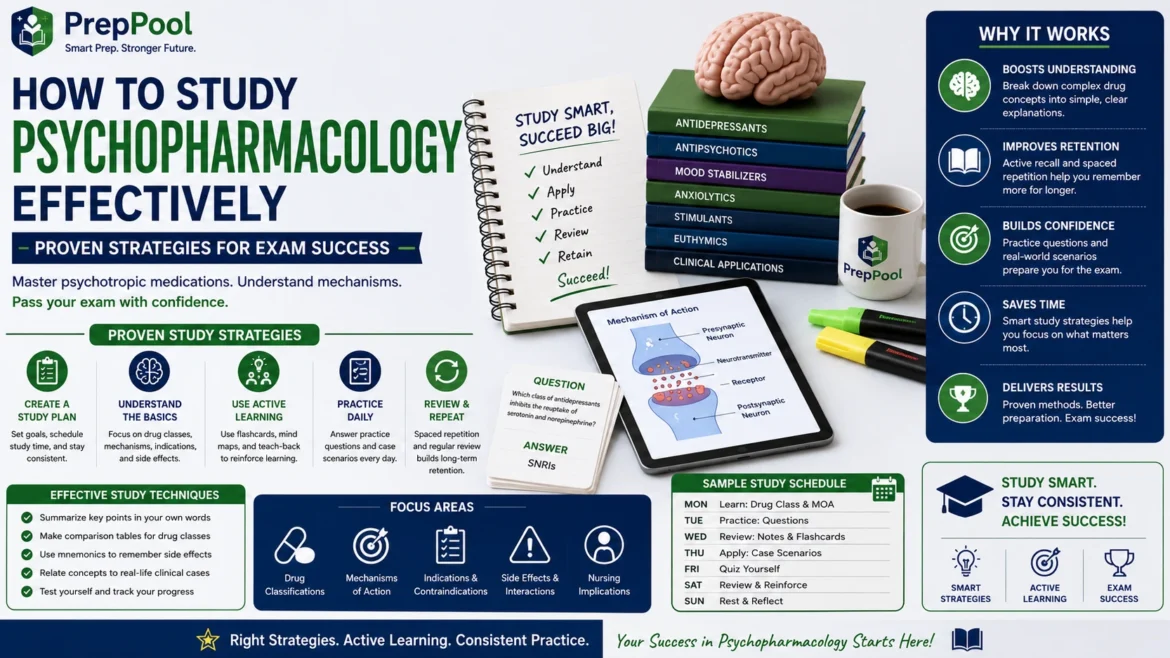

Psychopharmacology is one of the most challenging subjects for many healthcare students because it requires understanding complex medication mechanisms, therapeutic uses, adverse effects, drug interactions, and patient monitoring. Instead of relying solely on memorization, successful learners develop structured study habits that emphasize clinical reasoning and long-term knowledge retention.
Whether you’re preparing for a nursing examination, psychiatric certification, psychology course, or another healthcare assessment, using effective study techniques can help you learn psychotropic medications more efficiently and improve your confidence on exam day.
- How to organize your psychopharmacology study sessions.
- The most effective ways to remember medication information.
- Why active learning improves exam performance.
- How practice questions strengthen clinical reasoning.
- Common study mistakes to avoid.
Build a Structured Study Schedule
One of the biggest mistakes students make is studying medications randomly. A more effective approach is to organize your review by medication class. This allows you to recognize similarities, compare medications, and understand treatment principles instead of memorizing isolated facts.
A sample weekly schedule might include:
- Day 1: Antidepressants
- Day 2: Antipsychotics
- Day 3: Mood Stabilizers
- Day 4: Anxiolytics and Sedatives
- Day 5: ADHD Medications
- Day 6: Substance Use Disorder Medications
- Day 7: Comprehensive review and practice questions
Breaking your preparation into manageable sections makes studying less overwhelming while helping reinforce previously learned material.
Understand Medication Classes Before Individual Drugs
Rather than trying to memorize dozens of medication names immediately, first learn the characteristics shared by each drug class. Understanding mechanisms of action, common indications, adverse effects, contraindications, and monitoring recommendations provides a framework that makes learning individual medications much easier.
For example, once you understand how selective serotonin reuptake inhibitors (SSRIs) work, it’s easier to recognize similarities among medications within that class while also remembering important differences.
Use Active Recall Instead of Passive Reading
Reading the same chapter repeatedly often creates the illusion of learning without significantly improving retention. Active recall forces your brain to retrieve information from memory, strengthening long-term learning and improving your ability to apply knowledge during examinations.
Examples of active recall include:
- Answering practice questions without looking at notes.
- Explaining medication mechanisms aloud.
- Creating flashcards for high-yield concepts.
- Teaching difficult topics to another student.
- Writing summary notes from memory.
Learn Through Clinical Scenarios
Many psychopharmacology examinations assess your ability to apply medication knowledge in realistic patient situations rather than simply recalling isolated facts. Studying clinical scenarios helps you understand how medications are selected, monitored, and adjusted in practice while strengthening critical thinking skills.
One of the most effective ways to reinforce this type of learning is by regularly working through a psychopharmacology exam practice question bank that presents patient cases with detailed answer explanations. Reviewing the clinical reasoning behind each answer helps transform theoretical knowledge into practical decision-making skills.
Choose High-Quality Study Materials
Your study techniques are only as effective as the resources you use. Select materials that provide current clinical information, organized medication reviews, realistic case-based questions, and comprehensive answer explanations. High-quality resources reduce confusion and help you focus on concepts that are most relevant for examination success.
If you’re still selecting study materials, our recommended psychopharmacology review resources compares the characteristics of effective study guides and explains how to build a balanced preparation strategy.
In the next section, we’ll explore memory techniques, spaced repetition, practice testing, and other proven learning strategies that can help you retain psychopharmacology concepts more effectively throughout your exam preparation.
Use Spaced Repetition to Improve Long-Term Retention
One of the most effective learning strategies for psychopharmacology is spaced repetition. Instead of reviewing a topic only once, revisit important concepts at increasing intervals over several days or weeks. This technique strengthens long-term memory and makes it easier to recall medication information during examinations and clinical practice.
For example, review antidepressants today, revisit them two days later, then again the following week while continuing to study new medication classes. Regular review helps prevent forgetting and reinforces connections between related concepts.
Create Comparison Charts for Medication Classes
Many psychotropic medications share similar therapeutic uses but differ in adverse effects, monitoring requirements, contraindications, or drug interactions. Creating comparison tables helps organize complex information and makes it easier to recognize important differences between medications.
| Comparison Area | Examples to Review |
|---|---|
| Mechanism of Action | How each medication class produces its therapeutic effect. |
| Clinical Indications | Primary psychiatric disorders treated by each medication. |
| Common Adverse Effects | Frequently encountered side effects requiring patient education. |
| Serious Safety Concerns | Black box warnings, toxicity, and life-threatening reactions. |
| Monitoring Requirements | Laboratory tests, follow-up assessments, and ongoing patient evaluation. |
Practice Explaining Concepts in Your Own Words
Being able to explain why a medication is prescribed or how it works demonstrates a deeper understanding than simply recognizing the correct answer on a multiple-choice question. Try describing medication mechanisms, adverse effects, and patient counseling points aloud without looking at your notes.
If you struggle to explain a concept clearly, it’s often a sign that additional review is needed before moving on to the next topic.
Review Answer Explanations Carefully
Practice questions are most valuable when you carefully analyze the explanations that follow each question. Instead of checking only whether your answer was correct, identify the clinical reasoning that supports the correct option and understand why the remaining choices were less appropriate.
This habit improves decision-making skills and prepares you for application-based questions commonly found on healthcare examinations.
Study Patient Safety Alongside Medications
Medication knowledge should always be connected with patient safety. As you review each drug class, pay close attention to contraindications, important drug interactions, monitoring recommendations, patient counseling points, and strategies for preventing adverse events.
Understanding these safety principles not only improves exam performance but also supports safe and effective patient care in clinical practice.
Strengthen Related Clinical Knowledge
Psychopharmacology does not exist in isolation. A solid understanding of psychology, behavioral health, patient assessment, and nursing principles provides valuable context when selecting medications and evaluating treatment outcomes.
To reinforce these foundational concepts, explore PrepPool’s behavioral science exam resources, which cover important psychology topics frequently studied alongside psychopharmacology.
If your examination includes broader patient care topics, our clinical nursing practice question collection offers additional opportunities to strengthen assessment skills, pharmacology knowledge, and evidence-based clinical decision-making.
Evaluate Your Progress Regularly
Successful learners continuously monitor their performance throughout the study process. Track your scores on practice questions, identify recurring weaknesses, and adjust your study schedule accordingly. Spending additional time on difficult medication classes is generally more productive than repeatedly reviewing concepts you’ve already mastered.
In the final section, we’ll discuss how to recognize when you’re ready for the exam, review the most effective study habits one final time, and answer common questions about preparing for psychopharmacology examinations.
Know When You’re Ready for the Exam
As your examination approaches, shift your focus from learning new material to reinforcing the knowledge you’ve already built. Consistently performing well on mixed-topic practice questions, accurately identifying medication classes, and confidently explaining treatment decisions are all signs that you’re making meaningful progress.
Rather than aiming for perfection, concentrate on recognizing your remaining weak areas and reviewing those topics until you feel comfortable applying the concepts in different clinical situations.
| Preparation Strategy | Benefit |
|---|---|
| Study by medication class | Improves understanding of shared pharmacologic principles. |
| Active recall | Strengthens long-term memory and knowledge retention. |
| Spaced repetition | Reduces forgetting and reinforces previously learned material. |
| Clinical case practice | Develops critical thinking and clinical decision-making skills. |
| Regular self-assessment | Identifies knowledge gaps and tracks improvement over time. |
Avoid Common Study Mistakes
Many learners spend too much time rereading notes without testing their understanding. Others try to memorize every medication individually without first learning the characteristics of each drug class. These approaches often make studying more difficult than necessary.
Instead, focus on understanding concepts, recognizing medication patterns, reviewing patient cases, and applying knowledge through regular practice. Clinical reasoning is far more valuable than memorizing isolated facts.
- Mechanism of action
- Primary indications
- Common adverse effects
- Serious safety warnings
- Monitoring recommendations
- Important patient education points
Review this checklist every time you revisit the medication class to reinforce your understanding.
Practice Under Exam Conditions
Completing timed practice sessions helps improve concentration, pacing, and confidence before exam day. Simulating actual testing conditions also reduces anxiety by familiarizing you with answering multiple clinical questions in a structured environment.
After each practice session, spend more time reviewing your incorrect answers than celebrating the correct ones. Understanding your mistakes is one of the fastest ways to improve future performance.
Reinforce Your Learning with Comprehensive Practice Questions
One of the most effective ways to prepare is by working through realistic, case-based questions that require you to apply pharmacology knowledge in clinical situations. This approach strengthens decision-making skills while reinforcing medication mechanisms, therapeutic uses, adverse effects, contraindications, and monitoring principles.
PrepPool’s comprehensive psychopharmacology question collection features more than 1,000 board-style practice questions with detailed explanations, helping learners build confidence through repeated application of high-yield psychopharmacology concepts.
Expand Your Knowledge Across Related Healthcare Subjects
Developing a strong understanding of psychology and nursing concepts can improve your ability to interpret patient presentations, communicate effectively, and apply medication knowledge in clinical practice. A well-rounded study approach prepares you not only for examinations but also for real-world patient care.
PrepPool offers a growing library of psychology practice materials and nursing exam study resources to help learners strengthen related clinical knowledge alongside psychopharmacology.
Key Takeaways
- Study medication classes systematically instead of memorizing isolated drugs.
- Use active recall and spaced repetition to improve long-term retention.
- Practice with realistic clinical scenarios to strengthen decision-making skills.
- Review detailed answer explanations to understand the reasoning behind every question.
- Track your progress regularly and spend extra time on weaker topics.
- Combine psychopharmacology review with related psychology and nursing concepts for a broader understanding of patient care.
Final Thoughts
Learning psychopharmacology effectively requires consistent effort, organized study habits, and regular application of knowledge through clinical practice questions. By focusing on understanding medication classes, using evidence-based learning strategies, and reviewing realistic patient scenarios, you can build the confidence needed to perform well on your examination.
Remember that successful preparation is not about studying the longest—it’s about studying efficiently. A structured plan, quality learning resources, and continuous self-assessment will help you retain important concepts and apply them confidently in both exam settings and clinical practice.
FAQs
What is the best way to memorize psychopharmacology medications?
Focus on learning medications by class, use active recall, create comparison charts, and apply spaced repetition rather than memorizing individual drug names in isolation.
How often should I practice psychopharmacology questions?
Completing practice questions after each study session is an effective way to reinforce learning and identify areas that require additional review.
Is active recall better than rereading notes?
Yes. Active recall strengthens memory by requiring you to retrieve information without looking at your notes, making it one of the most effective evidence-based study techniques.
Should I study drug mechanisms or clinical applications first?
Both are important, but understanding mechanisms of action first provides a foundation for learning indications, adverse effects, monitoring, and patient counseling.
How can I improve my confidence before the psychopharmacology exam?
Follow a structured study schedule, review high-yield concepts regularly, complete timed practice sessions, analyze detailed answer explanations, and focus on improving weaker topics identified through self-assessment.