
Every year, thousands of counseling graduates begin preparing for the National Counselor Examination (NCE) with good intentions. They purchase study materials, join online groups, download flashcards, and create ambitious schedules. Yet many candidates still struggle to feel prepared when exam day arrives.
The problem usually is not intelligence, motivation, or educational background. Instead, most candidates fail because they follow ineffective study plans that prioritize quantity over strategy.
Some attempt to review every textbook they used during graduate school. Others spend weeks reading notes without answering practice questions. Many underestimate how much time is needed to retain information across multiple counseling domains.
Passing the NCE requires more than simply studying hard. It requires studying smart.
Key TakeawayThe highest-scoring candidates typically follow structured study plans that balance content review, practice questions, weak-area analysis, and exam simulations.
Understanding What Makes the NCE Challenging
One reason candidates struggle to prepare effectively is the broad scope of the examination. The NCE covers multiple knowledge domains that counseling professionals develop throughout graduate education and supervised training.
Rather than focusing on a single specialty, the examination evaluates a comprehensive understanding of professional counseling practice.
This means candidates must be prepared to answer questions involving human development, counseling theories, multicultural competence, ethics, assessment methods, career counseling, group work, research concepts, and professional standards.
The challenge is not necessarily the difficulty of individual questions. The challenge is managing the volume of information while maintaining long-term retention.
What a Successful NCE Study Plan Looks Like
Effective preparation follows a simple principle: build knowledge first, reinforce it through repetition, and then apply it through practice testing.
Candidates who jump directly into practice exams without reviewing content often become discouraged. On the other hand, candidates who spend months reading textbooks without testing themselves rarely develop exam readiness.
The most successful approach combines both methods.
| Study Component | Purpose |
|---|---|
| Content Review | Builds foundational knowledge |
| Practice Questions | Applies knowledge to exam scenarios |
| Flashcards | Improves memory retention |
| Weak Area Analysis | Targets knowledge gaps |
| Practice Exams | Builds endurance and confidence |
| Final Review | Strengthens recall before exam day |
When these elements work together, candidates develop both knowledge and exam-taking skills.
Start With a Realistic Timeline
One of the biggest mistakes candidates make is creating unrealistic expectations. Some attempt to prepare for the NCE in only two weeks, while others continuously delay testing because they never feel fully ready.
A realistic timeline allows enough time to review content thoroughly without causing burnout.
For most candidates, a study period of eight to twelve weeks provides an ideal balance between knowledge retention and scheduling flexibility.
The exact timeline depends on several factors:
- Graduate coursework performance
- Clinical experience level
- Daily study availability
- Previous exposure to counseling theories
- Comfort with research and assessment concepts
- Strength in ethics and professional standards
Someone who recently completed graduate school may require less review than a candidate returning to testing after several years in the workforce.
The First Step: Assess Your Starting Point
Before building a study schedule, determine your current strengths and weaknesses.
This step is frequently skipped, yet it often produces the greatest improvement in study efficiency.
Many candidates assume they know which topics need attention. After taking a diagnostic practice test, however, they discover entirely different areas requiring review.
A candidate who feels confident about assessment principles may perform poorly on assessment questions. Another candidate who worries about counseling theories may discover that theory is actually a strength.
Diagnostic testing removes guesswork and helps create a targeted preparation plan.
Building Your Weekly NCE Study Schedule
Consistency matters more than occasional marathon study sessions. Research on learning and retention consistently shows that spaced repetition produces stronger long-term recall than cramming.
Instead of studying for eight hours once per week, successful candidates often study one to two hours daily across multiple days.
A sample weekly structure might include:
- Monday: Human Development
- Tuesday: Counseling Theories
- Wednesday: Ethics and Professional Practice
- Thursday: Assessment and Diagnosis
- Friday: Career Counseling and Group Work
- Saturday: Practice Questions
- Sunday: Review Weak Areas
This approach keeps all major content domains active while preventing mental fatigue.
The Highest-Value Topics to Study First
Although every domain matters, some topics consistently appear among the most important areas for preparation.
Candidates should prioritize understanding rather than memorization in these subjects:
- Counseling theories and interventions
- Ethical decision-making models
- Human growth and development theories
- Assessment principles and interpretation
- Group counseling stages
- Career development theories
- Multicultural counseling competencies
- Research and statistical concepts
Mastering these foundational topics creates a framework that supports success across many different question types.
Why Practice Questions Matter More Than Additional Reading
Many candidates spend months reading study guides but never develop confidence applying knowledge in exam-style scenarios.
Practice questions reveal weaknesses that passive reading often hides. They also improve critical thinking, reinforce memory, and familiarize candidates with the wording commonly encountered on professional examinations.
As preparation progresses, candidates should gradually increase the number of scenario-based questions they complete each week. High-quality NCE practice questions and exam simulations can help transform theoretical knowledge into practical exam readiness.
The Psychology of Successful Exam Preparation
Passing the NCE is not only an academic challenge. It is also a mental challenge. Confidence, consistency, and discipline often influence outcomes just as much as content knowledge.
Candidates who trust their preparation process tend to perform more effectively under pressure than those who constantly change study resources or compare themselves to others.
Building a structured plan early creates momentum and reduces anxiety throughout the preparation journey.
In the next section, we’ll build a complete 12-week NCE study schedule, identify the best review methods for each content domain, and examine proven techniques used by successful first-time test takers.
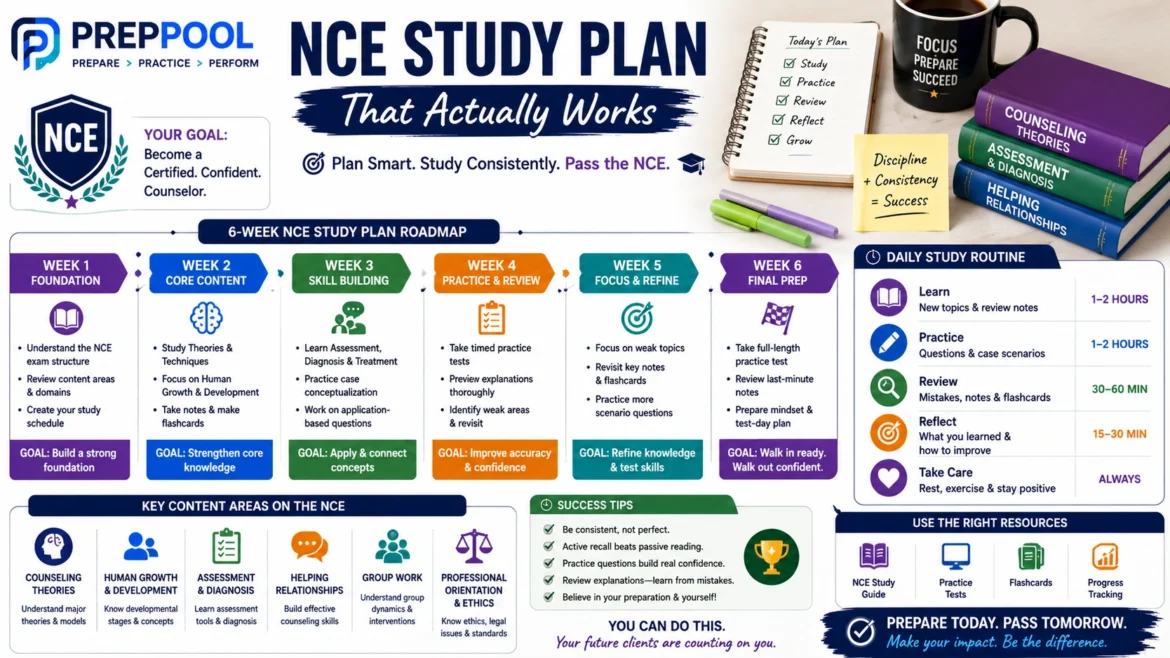
The Complete 12-Week NCE Study Schedule
A structured study schedule removes uncertainty and helps candidates make steady progress toward exam readiness. Instead of wondering what to study each day, a clear roadmap allows you to focus your energy on learning and retention.
The following 12-week framework is designed to balance content review, practice questions, knowledge reinforcement, and exam simulation. Candidates can adjust the timeline based on their individual strengths, work schedules, and testing dates.
| Week | Primary Focus | Goal |
|---|---|---|
| 1 | Diagnostic Assessment | Identify strengths and weaknesses |
| 2 | Human Growth and Development | Master lifespan theories |
| 3 | Counseling Theories | Understand major approaches |
| 4 | Helping Relationships | Strengthen intervention knowledge |
| 5 | Group Counseling | Review group dynamics and leadership |
| 6 | Career Development | Learn major career theories |
| 7 | Assessment | Understand testing principles |
| 8 | Research and Statistics | Improve analytical understanding |
| 9 | Social and Cultural Foundations | Develop multicultural competence |
| 10 | Professional Ethics | Master ethical decision-making |
| 11 | Full-Length Practice Exams | Build endurance and confidence |
| 12 | Final Review | Strengthen weak areas |
Weeks 1–3: Building Your Knowledge Foundation
The first phase focuses on creating a strong conceptual foundation. Candidates should avoid rushing through material during these weeks because understanding core concepts now will make later review significantly easier.
Human development theories deserve special attention because they frequently appear throughout counseling scenarios. Candidates should understand developmental milestones, psychosocial theories, cognitive development models, and lifespan transitions.
During counseling theory review, focus on identifying:
- The founder of each theory
- Primary assumptions
- Treatment goals
- Counselor role
- Client role
- Common interventions
- Strengths and limitations
Many NCE questions require distinguishing between theoretical approaches rather than simply identifying definitions.
Weeks 4–6: Developing Practical Counseling Knowledge
The middle phase of preparation shifts from theoretical understanding toward practical counseling applications.
Helping relationships represent the heart of counseling practice. Candidates should understand active listening, empathy, rapport building, reflection techniques, confrontation skills, and intervention selection.
Group counseling often presents challenges because many students have less direct experience leading therapeutic groups. Understanding group development stages, leadership styles, and group dynamics can significantly improve performance in this area.
Career counseling should not be underestimated. Questions involving Holland’s Theory, Super’s Life-Span Theory, and career assessment methods appear regularly and reward candidates who understand both theory and application.
Study TipAt the end of each week, complete 50 to 75 practice questions related to the domains you studied. Immediate application improves retention and reveals areas needing additional review.
Weeks 7–10: Tackling the Most Challenging Domains
Many candidates identify assessment, research, statistics, and ethics as the most intimidating sections of the NCE. This is precisely why they deserve focused attention during the later stages of preparation.
Assessment questions often evaluate understanding of reliability, validity, standardization, scoring methods, and interpretation principles. Rather than memorizing definitions, learn how assessment concepts influence counseling decisions.
Research and statistics frequently cause anxiety because many counseling professionals do not use statistical terminology daily. However, candidates who break these topics into manageable sections usually find them easier than expected.
Focus on understanding:
- Research design types
- Sampling methods
- Statistical significance
- Measures of central tendency
- Correlation concepts
- Program evaluation methods
- Outcome assessment principles
Professional ethics should receive continuous review throughout the study process rather than being limited to a single week.
How to Study Counseling Theories Efficiently
One of the most common mistakes candidates make is attempting to memorize entire chapters of theory textbooks. This approach often leads to information overload.
A more effective method involves creating comparison charts that highlight similarities and differences between counseling models.
| Theory | Founder | Main Goal |
|---|---|---|
| Person-Centered | Carl Rogers | Self-actualization |
| REBT | Albert Ellis | Challenge irrational beliefs |
| CBT | Aaron Beck | Modify thoughts and behaviors |
| Reality Therapy | William Glasser | Personal responsibility |
| Gestalt | Fritz Perls | Present-moment awareness |
Comparative review helps candidates quickly recognize patterns commonly tested on the NCE.
Using Active Recall Instead of Passive Reading
One of the most powerful learning techniques is active recall. Instead of repeatedly reading the same material, actively test yourself on concepts without looking at notes.
For example, after studying developmental theories, close your book and attempt to explain each theory from memory. Then verify accuracy and identify gaps.
This process strengthens neural connections and improves long-term retention far more effectively than passive review.
How to Review Wrong Answers the Right Way
Practice questions only improve performance when mistakes are analyzed properly. Many candidates immediately move on after receiving a score without understanding why they missed questions.
Every incorrect answer represents a learning opportunity.
When reviewing mistakes, ask yourself:
- Did I misunderstand the concept?
- Did I overlook a keyword?
- Did I confuse similar theories?
- Did I rush through the question?
- Was this an ethics or judgment issue?
Maintaining an error log helps identify recurring weaknesses and allows for targeted improvement throughout the study process.
Balancing Study Time With Work and Internship Responsibilities
Many NCE candidates are balancing graduate coursework, internships, employment, family responsibilities, and personal commitments. Attempting to study for several hours every day is not realistic for everyone.
Fortunately, consistency is more important than volume.
Even 60 to 90 minutes of focused daily study can produce substantial results when maintained over several months. Candidates should prioritize quality sessions over lengthy but distracted study periods.
Creating a predictable schedule also reduces decision fatigue and helps transform studying into a routine habit rather than a daily challenge.
Knowing When You’re Actually Ready for the NCE
Many candidates continuously postpone their examination because they never feel fully prepared. The reality is that few people ever feel completely ready for a professional licensing examination.
A better indicator of readiness is objective performance. Consistently strong scores on practice exams, confidence in major content domains, and the ability to explain counseling concepts without relying heavily on notes often signal exam readiness.
By the end of Week 10, candidates should have reviewed every major content area and completed hundreds of practice questions.
In the final section, we’ll cover advanced test-taking strategies, common exam-day mistakes, time management techniques, stress reduction methods, and the exact actions that successful first-time NCE candidates take during their final week of preparation.
Advanced Test-Taking Strategies for the NCE
By the time candidates reach the final phase of preparation, the goal shifts from learning new material to maximizing performance on exam day. At this stage, success often depends less on knowledge acquisition and more on execution.
Many candidates possess enough knowledge to pass but lose valuable points because of poor time management, test anxiety, or ineffective question-analysis techniques.
Understanding how to approach the examination strategically can make a meaningful difference in overall performance.
Final Month Focus
- Take full-length practice exams.
- Review weak content areas.
- Strengthen ethics knowledge.
- Improve question-analysis skills.
- Build testing endurance.
- Reduce anxiety through preparation.
How to Approach Difficult NCE Questions
Every examination includes questions that seem confusing or unfamiliar. The difference between successful and unsuccessful candidates is often how they respond to these moments.
When facing a difficult question, avoid panic. Instead, focus on eliminating clearly incorrect answers first. Narrowing four options down to two dramatically increases the probability of selecting the correct response.
Many counseling questions contain clues within the scenario itself. Pay close attention to client concerns, developmental factors, ethical considerations, cultural influences, and counselor responsibilities.
Frequently, the best answer is the option that prioritizes client welfare while remaining consistent with professional counseling standards.
The Most Common Exam-Day Mistakes
Even well-prepared candidates occasionally undermine their performance through avoidable mistakes.
The following errors appear repeatedly among unsuccessful test-takers:
- Reading questions too quickly.
- Changing answers without justification.
- Spending excessive time on one question.
- Ignoring keywords such as “best,” “first,” or “most appropriate.”
- Allowing anxiety to affect concentration.
- Neglecting sleep before the exam.
- Skipping practice exams during preparation.
Awareness of these pitfalls allows candidates to proactively avoid them.
Understanding Keywords That Change Question Meaning
One overlooked aspect of NCE preparation involves learning to identify critical keywords. A single word can completely alter the correct answer.
| Keyword | What It Signals |
|---|---|
| Best | Select the strongest overall response |
| First | Identify the initial counselor action |
| Most Appropriate | Choose the professionally preferred option |
| Primary | Focus on the main issue or goal |
| Except | Look for the incorrect option |
| Least Likely | Identify the weakest answer choice |
Carefully reading these keywords prevents unnecessary mistakes and improves accuracy throughout the examination.
Why Full-Length Practice Exams Are Essential
One of the biggest differences between average candidates and top performers is exam simulation.
Many individuals complete small sets of practice questions but never experience the mental demands of a full testing session. As a result, concentration begins to decline during the actual examination.
Full-length practice exams help candidates:
- Build testing endurance.
- Improve pacing.
- Reduce uncertainty.
- Identify recurring weaknesses.
- Develop confidence.
- Practice stress management.
Ideally, candidates should complete several comprehensive practice exams during the final weeks of preparation.
Creating a High-Impact Final Week Review Plan
The week before the NCE should focus on reinforcement rather than overload. Attempting to learn large amounts of new information during the final days often increases stress without improving performance.
A productive final week may include:
- Reviewing counseling theories.
- Refreshing ethical standards.
- Practicing assessment concepts.
- Completing short question sets.
- Reviewing flashcards.
- Analyzing previously missed questions.
The goal is to strengthen confidence and retention, not completely redesign your study strategy.
The Night Before the NCE
The evening before the examination should be calm and structured.
Many candidates make the mistake of studying late into the night, believing additional review will improve their score. In reality, fatigue often causes greater harm than benefit.
Instead, consider:
- Reviewing a few high-yield notes.
- Preparing identification documents.
- Planning transportation.
- Setting alarms.
- Eating a balanced meal.
- Prioritizing quality sleep.
A rested mind performs significantly better than an exhausted one.
Managing Test Anxiety During the Examination
Feeling nervous before a professional licensing examination is completely normal. In fact, some level of nervousness can improve focus and alertness.
The key is preventing anxiety from disrupting decision-making.
When stress increases during the exam:
- Pause briefly.
- Take a slow breath.
- Refocus on one question at a time.
- Avoid thinking about previous questions.
- Trust your preparation process.
Successful candidates understand that temporary uncertainty is part of the testing experience. They remain focused on the current question rather than worrying about the final result.
What Successful First-Time Passers Do Differently
Although every candidate’s journey is unique, first-time passers often share several habits.
They start preparing early, follow a structured schedule, complete practice questions consistently, review mistakes carefully, and remain disciplined throughout the preparation process.
Most importantly, they focus on understanding counseling concepts rather than memorizing isolated facts.
Professional counseling requires critical thinking, ethical judgment, and practical application. The NCE reflects these expectations, which is why conceptual understanding is so valuable.
Using Practice Questions as a Performance Tool
Practice questions should not simply be viewed as assessment tools. They should also be treated as learning tools.
Every question provides an opportunity to reinforce concepts, identify gaps, and improve professional reasoning.
Candidates who consistently work through realistic scenarios often develop stronger judgment and faster decision-making abilities. Comprehensive NCE practice exam questions & answers can help candidates evaluate readiness while gaining exposure to the types of situations commonly encountered on the examination.
The NCE evaluates a comprehensive understanding of professional counseling practice. Before creating a preparation strategy, many candidates first review the complete NCE certification roadmap to better understand how the examination fits into the broader journey toward professional counselor licensure.
Final Thoughts: A Study Plan Is Only Effective If You Follow It
The perfect study plan does not guarantee success. Execution does.
Many candidates spend weeks searching for the ideal schedule, the ideal study guide, or the ideal strategy. Meanwhile, successful candidates begin studying, remain consistent, and improve steadily over time.
The National Counselor Examination rewards preparation, discipline, and professional understanding. Candidates who dedicate themselves to a structured study process place themselves in a strong position to succeed.
Whether you are preparing months in advance or beginning your final review, remember that every focused study session moves you one step closer to your goal of becoming a licensed professional counselor.
Build a plan, follow it consistently, evaluate your progress honestly, and trust the preparation process. Those simple actions have helped countless counseling professionals successfully navigate the NCE and move forward in their careers.
Frequently Asked Questions
How many weeks should I study for the NCE?
Most candidates benefit from an eight- to twelve-week study schedule, although timelines may vary depending on prior knowledge, work commitments, and testing confidence.
What is the most important subject on the NCE?
No single domain guarantees success, but counseling theories, ethics, helping relationships, assessment, and human development are among the most important areas to master.
How many practice questions should I complete?
Many successful candidates complete several hundred practice questions throughout their preparation while carefully reviewing incorrect answers and weak areas.
Should I focus on reading or practice exams?
The most effective preparation combines both. Content review builds knowledge, while practice exams strengthen application, pacing, and confidence.
What should I do during the final week before the NCE?
Focus on reviewing key concepts, analyzing previous mistakes, completing light practice sessions, managing stress, and ensuring adequate rest before exam day.