
Certified physician assistants have more than one pathway for maintaining certification, which often leads to an important question: should you choose the traditional Physician Assistant National Recertifying Examination (PANRE®) or the Physician Assistant National Recertifying Examination–Longitudinal Assessment (PANRE-LA®)? Understanding how these two options differ can help you select the approach that best fits your learning style, work schedule, and professional goals.
Although both pathways are designed to evaluate continued medical knowledge, they use different assessment formats. Knowing how each option works before your recertification cycle begins allows you to prepare more effectively and avoid unnecessary uncertainty.
- How PANRE and PANRE-LA differ.
- What both assessment options have in common.
- Factors to consider when choosing a recertification pathway.
- How each option may affect your study strategy.
- Tips for preparing regardless of the assessment you choose.
What Is the PANRE?
The PANRE is a comprehensive recertification examination that assesses broad medical knowledge across multiple specialties. Candidates complete the assessment during an approved testing window, demonstrating continued clinical competence through a structured examination.
Many physician assistants appreciate the traditional exam format because it allows them to prepare for one scheduled assessment after completing a structured review of the required medical content.
What Is PANRE-LA?
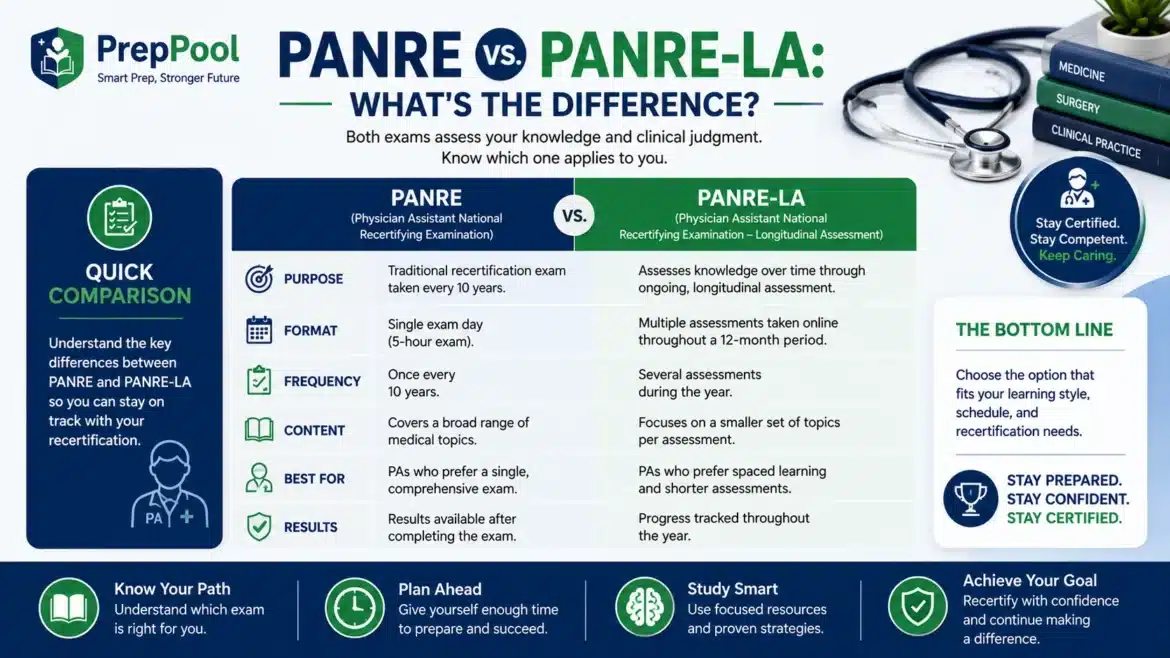
PANRE-LA is an alternative recertification pathway that evaluates medical knowledge over time rather than through a single examination session. Instead of completing one comprehensive exam, participants answer questions during multiple assessment periods, allowing for continuous evaluation throughout the recertification process.
This approach may appeal to physician assistants who prefer spreading their assessment over time instead of preparing for one large exam.
Key Differences at a Glance
| Feature | PANRE | PANRE-LA |
|---|---|---|
| Assessment Style | Traditional comprehensive examination. | Longitudinal assessment completed over time. |
| Preparation | Structured review before the exam. | Continuous learning throughout the assessment period. |
| Scheduling | Completed during an approved testing window. | Completed through scheduled assessment periods. |
| Learning Approach | Focused preparation leading up to exam day. | Ongoing review and reinforcement of medical knowledge. |
Which Option Is Better?
There isn’t a single answer that works for everyone. Some physician assistants prefer the familiarity of a traditional examination, while others appreciate the flexibility of an assessment completed over time. The best choice depends on your preferred learning style, study habits, work responsibilities, and personal preferences.
If you’re concerned about the level of preparation required for the traditional examination, our guide on how challenging the PANRE can be explains what candidates commonly experience and how preparation can improve confidence.
Choosing the Right Path for Your Career
Before deciding between PANRE and PANRE-LA, consider how you prefer to learn, how much study time you can realistically dedicate, and whether you feel more comfortable with one comprehensive assessment or an ongoing evaluation process.
In the next section, we’ll compare the two options in greater detail, discuss factors that may influence your decision, and explain how to prepare effectively for either pathway.
How Your Study Approach May Differ
Although both PANRE and PANRE-LA evaluate continued medical knowledge, your preparation strategy may vary depending on which option you choose. Candidates preparing for the traditional PANRE often follow a structured study schedule leading up to their examination, while those participating in PANRE-LA typically benefit from consistent review over a longer period.
Regardless of the assessment format, the goal remains the same: maintaining a strong understanding of core medical concepts and applying sound clinical reasoning in patient-care scenarios.
Consider Your Learning Style
Every physician assistant has a different approach to learning. Some prefer concentrating their efforts toward one scheduled examination, while others find it easier to study in smaller portions over time. Understanding your own study habits can help you choose the recertification pathway that best matches your routine.
| If You Prefer… | You May Appreciate… |
|---|---|
| A clearly defined exam date | The traditional PANRE format. |
| Continuous learning over time | The PANRE-LA assessment model. |
| Creating a focused study schedule | Preparing for one comprehensive examination. |
| Regular knowledge checks | An assessment completed in multiple stages. |
What Both Options Have in Common
Despite their different formats, PANRE and PANRE-LA share the same overall objective: helping physician assistants demonstrate continued medical knowledge as part of maintaining certification. Both pathways encourage ongoing professional development and emphasize clinical reasoning across a broad range of medical specialties.
No matter which option you select, you’ll benefit from regularly reviewing important clinical concepts rather than relying solely on day-to-day practice.
Don’t wait until you begin your recertification process to refresh your medical knowledge. Reviewing important topics throughout the year makes preparation more manageable and helps reinforce long-term retention.
Know Your Recertification Requirements
Before deciding between PANRE and PANRE-LA, confirm that you understand the current recertification requirements and your available options. Knowing your eligibility, certification timeline, and assessment choices allows you to make an informed decision without feeling rushed.
If you haven’t already reviewed the general requirements, our guide to PANRE eligibility guidelines provides an overview of who can participate in the recertification process and when preparation should begin.
Build a Preparation Plan That Fits Your Schedule
Whether you’re preparing for a traditional examination or participating in a longitudinal assessment, creating a realistic study routine is one of the best ways to stay on track. Small, consistent study sessions often produce better results than trying to cover large amounts of material in a short period.
Many busy physician assistants benefit from planning weekly review sessions, revisiting weaker subjects regularly, and practicing clinical decision-making through realistic patient scenarios.
Review the Full Range of Medical Topics
Whichever assessment option you choose, comprehensive preparation is essential. Review major body systems, common medical conditions, diagnostic evaluation, treatment strategies, preventive care, and evidence-based management. Covering a broad range of topics helps build confidence and reduces the likelihood of unexpected knowledge gaps.
In the final section, we’ll discuss how practice questions can support your preparation, summarize the key differences between PANRE and PANRE-LA, and share practical tips for maintaining confidence throughout your recertification journey.
Practice Questions Benefit Both Recertification Pathways
Whether you choose the traditional PANRE or PANRE-LA, practicing with realistic clinical questions remains one of the most effective ways to strengthen your medical knowledge. Practice questions encourage you to apply clinical reasoning, identify knowledge gaps, and reinforce important concepts that span multiple medical specialties.
Instead of focusing only on getting the correct answer, review the explanation for every question. Understanding the reasoning behind each answer helps improve diagnostic thinking and prepares you to make sound clinical decisions in both assessment formats.
| Preparation Strategy | Why It Helps |
|---|---|
| Study consistently | Builds and maintains medical knowledge over time. |
| Review all major specialties | Reduces knowledge gaps across the full scope of the assessment. |
| Complete practice questions | Strengthens clinical reasoning and decision-making skills. |
| Analyze answer explanations | Improves understanding of evidence-based patient care. |
| Monitor weaker subjects | Helps guide future review sessions more effectively. |
Choosing the Option That Fits You Best
There is no universal “better” choice between PANRE and PANRE-LA. The right option depends on how you prefer to learn, your professional responsibilities, and the assessment format that best supports your long-term success.
Some physician assistants appreciate preparing for one comprehensive examination, while others prefer demonstrating their knowledge through a series of assessments completed over time. Regardless of your choice, maintaining consistent study habits is the key to staying confident throughout the recertification process.
Prepare with Confidence Using PrepPool
High-quality practice materials can support your preparation whether you’re planning to take the traditional PANRE or participating in PANRE-LA. Working through realistic clinical scenarios helps reinforce medical knowledge while improving confidence in applying evidence-based decision-making.
PrepPool offers PANRE practice exam resources with detailed answer explanations to help physician assistants review essential medical topics, strengthen clinical reasoning, and prepare effectively for recertification.
Continue Expanding Your Medical Knowledge
If you’re preparing for additional professional certifications, explore PrepPool’s collection of healthcare certification practice exams. These resources provide opportunities to review core medical concepts and practice with exam-style questions across a variety of healthcare disciplines.
Key Takeaways
- PANRE and PANRE-LA are both accepted pathways for maintaining physician assistant certification.
- The traditional PANRE uses a comprehensive examination, while PANRE-LA follows a longitudinal assessment approach.
- Your preferred learning style and work schedule can help determine which option is the better fit.
- Consistent study habits and regular review are valuable regardless of the pathway you choose.
- Practice questions help reinforce clinical reasoning and prepare you for either assessment format.
Final Thoughts
Choosing between PANRE and PANRE-LA is a personal decision based on your learning preferences, professional commitments, and approach to recertification. Both options are designed to support continued clinical competence and encourage ongoing professional development throughout your career as a physician assistant.
Whichever pathway you select, beginning your preparation early, reviewing the full range of medical topics, and practicing with realistic clinical questions can help you approach the recertification process with greater confidence.
FAQs
What is the main difference between PANRE and PANRE-LA?
The primary difference is the assessment format. PANRE is completed as a traditional comprehensive examination, while PANRE-LA evaluates medical knowledge through a longitudinal assessment completed over time.
Does one option cover different medical topics than the other?
Both pathways are designed to assess broad medical knowledge and clinical reasoning. Regardless of the format, candidates should prepare by reviewing major body systems, common medical conditions, and evidence-based patient management.
Which option is better for busy physician assistants?
The best choice depends on individual preferences. Some clinicians prefer preparing for one scheduled examination, while others appreciate the flexibility of completing assessments over an extended period.
Should I use practice questions for both PANRE and PANRE-LA?
Yes. Practice questions help strengthen clinical reasoning, reinforce important concepts, identify weaker subjects, and improve confidence regardless of the assessment format you choose.
How can I decide which recertification pathway is right for me?
Consider your learning style, available study time, work schedule, and preferred assessment format. Reviewing the current recertification requirements and planning a consistent study routine can help you make an informed decision.