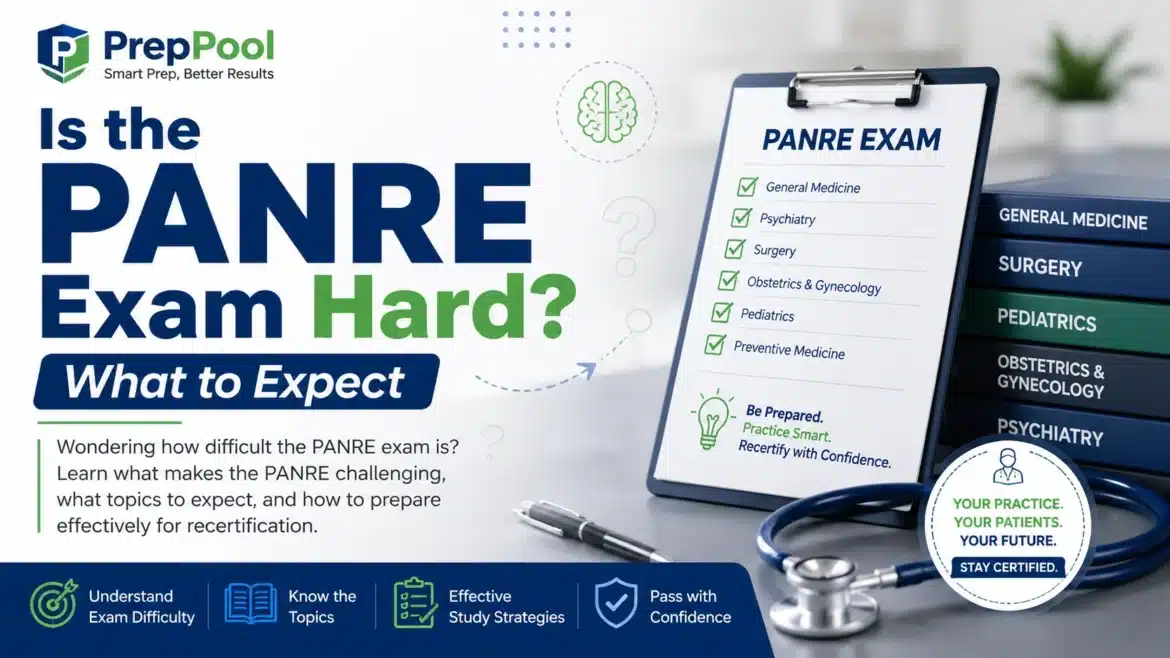

Many physician associates/physician assistants preparing for recertification ask the same question: Is the PANRE exam hard? The answer depends on your recent clinical experience, how long it’s been since your last certification exam, and the amount of time you dedicate to preparation. While the PANRE is designed to evaluate ongoing medical knowledge rather than introduce unfamiliar concepts, it still requires thoughtful preparation and a solid understanding of current clinical practice.
Unlike exams that reward simple memorization, the PANRE emphasizes clinical reasoning and decision-making. Questions often present patient scenarios that require you to analyze symptoms, interpret diagnostic findings, and choose the most appropriate next step in management.
- Why many PAs consider the PANRE challenging.
- What types of questions appear on the exam.
- The factors that influence exam difficulty.
- How to prepare more effectively.
- Strategies for improving your confidence before exam day.
How Difficult Is the PANRE Exam?
The PANRE is intended to confirm that certified physician assistants continue to possess the medical knowledge needed for safe and effective clinical practice. Rather than testing obscure facts, the examination focuses on applying medical knowledge to realistic patient-care situations across a broad range of specialties.
For many candidates, the biggest challenge isn’t the complexity of individual questions—it’s the breadth of content. The exam covers multiple body systems, disease processes, diagnostic evaluation, treatment decisions, preventive care, and professional practice. Even experienced clinicians may encounter topics they don’t see regularly in their daily practice.
The Exam Rewards Clinical Judgment
Most PANRE questions require more than recalling isolated facts. You’ll often need to evaluate a patient’s history, physical examination findings, laboratory results, or imaging studies before determining the best answer. This approach reflects the real-world decision-making expected of practicing physician assistants.
Success comes from understanding how medical concepts connect rather than memorizing lists of symptoms or treatment guidelines.
Why Some Candidates Find the PANRE Challenging
Every physician assistant develops expertise in specific specialties during clinical practice. Someone working in orthopedics may have less day-to-day exposure to dermatology, endocrinology, or women’s health, while a provider practicing family medicine may rarely encounter certain emergency or surgical conditions.
Because the PANRE evaluates knowledge across a wide range of medical disciplines, candidates often need to review subjects outside their primary area of practice. A structured study plan helps ensure that less familiar topics receive enough attention before the exam.
Common Factors That Affect Exam Difficulty
| Factor | Impact on Preparation |
|---|---|
| Time since your last certification exam | Longer gaps often require a more comprehensive review. |
| Current clinical specialty | You may need extra study time for less familiar medical disciplines. |
| Consistency of preparation | Regular study sessions generally lead to better knowledge retention. |
| Experience with practice questions | Helps improve clinical reasoning and familiarity with exam style. |
| Understanding of current clinical guidelines | Supports better decision-making during scenario-based questions. |
Preparation Makes a Difference
Although the PANRE is comprehensive, candidates who prepare consistently often find the exam much more manageable than expected. A balanced study plan that combines content review with realistic practice questions can strengthen both knowledge and confidence.
In the next section, we’ll look at the most common reasons candidates struggle on the PANRE and discuss practical strategies that can help you overcome those challenges.
Why Candidates Struggle on the PANRE
One of the biggest challenges of the PANRE is its broad scope. Even experienced physician assistants may not encounter every specialty or condition regularly in clinical practice. As a result, candidates are often required to review medical topics they haven’t used recently, making consistent preparation essential.
Another common mistake is relying entirely on clinical experience. While practical experience provides a strong foundation, the examination also evaluates your ability to apply current medical knowledge across multiple specialties using evidence-based clinical reasoning.
Expect Questions from Multiple Medical Disciplines
The PANRE assesses knowledge across a wide range of medical specialties rather than focusing on a single area of practice. Candidates should be comfortable evaluating patient presentations, selecting appropriate diagnostic tests, recognizing common diseases, and choosing evidence-based management strategies.
Some of the major subject areas include:
- Cardiovascular medicine
- Pulmonary medicine
- Gastroenterology
- Endocrinology
- Infectious diseases
- Emergency medicine
- Musculoskeletal disorders
- Dermatology
- Neurology
- Women’s health
- Pediatrics
- Behavioral and mental health
Because every specialty contributes to your overall score, a balanced study strategy is more effective than concentrating on only the subjects you use in your current clinical practice.
| Common Challenge | Recommended Strategy |
|---|---|
| Forgetting topics not used regularly | Review every major medical specialty during your study plan. |
| Focusing only on memorization | Practice applying knowledge through clinical scenarios. |
| Limited study time | Use shorter, consistent study sessions each week. |
| Difficulty interpreting patient cases | Complete scenario-based practice questions regularly. |
| Last-minute preparation | Begin reviewing several weeks before your scheduled exam. |
Clinical Reasoning Is Essential
Many PANRE questions present patient cases that require more than remembering facts. You may need to identify the most likely diagnosis, determine the next diagnostic step, recognize an emergency condition, or choose the most appropriate treatment based on the patient’s presentation.
Developing strong clinical reasoning skills is one of the best ways to prepare. As you study, think through each patient scenario as you would during an actual clinical encounter instead of focusing only on memorizing disease characteristics.
Don’t Ignore Your Weaker Subjects
It’s natural to spend more time studying topics you already enjoy or use frequently. However, focusing only on familiar material can leave significant knowledge gaps. Identify the specialties where you feel least confident and include them in your weekly review schedule.
A balanced preparation plan helps ensure you’re ready for questions across the full range of medical disciplines rather than only those related to your current practice setting.
Use High-Quality Study Resources
Choosing reliable study materials is just as important as the amount of time you spend studying. Look for resources that reflect current clinical practice, include realistic patient scenarios, and provide detailed explanations for both correct and incorrect answers.
If you’re preparing for additional healthcare certification or licensure exams, PrepPool also offers a wide range of Medical Exam Preparation resources covering numerous medical specialties and professional certification exams.
How to Improve Your Chances of Passing the PANRE
Success on the PANRE comes from consistent preparation rather than last-minute cramming. Instead of trying to memorize thousands of facts, focus on understanding disease processes, recognizing common clinical presentations, and practicing evidence-based decision-making. Building these skills over time will help you answer both straightforward and complex patient scenarios with greater confidence.
Create a realistic study schedule, review every major body system, and regularly assess your progress with exam-style practice questions. Small, consistent study sessions are generally more effective than occasional marathon review sessions.
| Preparation Strategy | Benefit |
|---|---|
| Create a structured study schedule | Keeps your preparation organized and consistent. |
| Review every major specialty | Reduces knowledge gaps across the exam blueprint. |
| Complete practice questions regularly | Improves clinical reasoning and decision-making. |
| Study answer explanations | Strengthens understanding of key medical concepts. |
| Revisit weaker subjects | Builds confidence before exam day. |
Practice Questions Build Clinical Confidence
Reading textbooks and reviewing notes are valuable, but applying your knowledge through realistic practice questions is one of the best ways to prepare for the PANRE. Practice questions expose you to different patient presentations, reinforce clinical reasoning, and help identify topics that require additional review.
When reviewing your results, don’t focus only on the score. Carefully read every explanation to understand why the correct answer is appropriate and why the other options are less suitable. This process helps strengthen long-term retention and improves your ability to approach similar questions on the actual exam.
Prepare with PrepPool
If you’re ready to test your knowledge, PrepPool offers PANRE Exam Prep Questions designed to help physician assistants prepare with confidence. The practice materials include realistic, exam-style questions covering major medical specialties, patient management, diagnostic reasoning, and evidence-based clinical decision-making.
Detailed answer explanations help you understand the reasoning behind each response, making it easier to identify knowledge gaps and strengthen your overall preparation before exam day.
Explore Additional Medical Certification Resources
If you’re preparing for other healthcare certification or licensure exams, explore PrepPool’s growing collection of Medical Exam Preparation resources. These study materials support healthcare professionals preparing for a wide variety of medical and allied health examinations.
- The PANRE evaluates clinical reasoning across multiple medical specialties.
- Consistent study is more effective than last-minute cramming.
- Review both familiar and less frequently encountered medical topics.
- Practice questions help strengthen decision-making and identify weaker areas.
- A structured study plan can significantly improve confidence before the exam.
Final Thoughts
The PANRE is a comprehensive recertification examination, but it is designed to reflect the knowledge and clinical judgment expected of practicing physician assistants. With a balanced study plan, regular review of high-yield topics, and consistent practice using exam-style questions, you can approach the exam with confidence and improve your chances of success.
Preparing thoroughly not only helps you perform well on the PANRE but also reinforces the clinical knowledge and decision-making skills that support high-quality patient care throughout your career.
FAQs
Is the PANRE harder than the initial PANCE?
Both exams assess medical knowledge, but the PANRE is designed for certified physician assistants with clinical experience. Many candidates find it challenging because it covers a broad range of specialties and emphasizes clinical application rather than basic recall.
What makes the PANRE difficult?
The breadth of medical content, scenario-based questions, and the need to apply evidence-based clinical reasoning across multiple specialties are the primary challenges for most candidates.
How long should I study for the PANRE?
Preparation time varies depending on your experience and familiarity with the exam content. Many physician assistants benefit from following a structured study schedule over several weeks or months.
Are practice questions important for PANRE preparation?
Yes. Practice questions help reinforce medical knowledge, improve clinical reasoning, and familiarize you with the style of questions commonly encountered on the examination.
Can I pass the PANRE while working full time?
Absolutely. Many physician assistants successfully prepare while working by following a consistent study routine, reviewing high-yield topics regularly, and completing practice questions throughout their preparation.