
One of the smartest ways to prepare for the CCRC® examination is to understand exactly what you’ll be tested on before opening a textbook or answering your first practice question. A clear understanding of the exam topics helps you organize your study time, prioritize high-value content, and avoid spending hours on material that receives little emphasis.
The Certified Clinical Research Coordinator (CCRC) examination evaluates the knowledge and professional judgment required to coordinate clinical research studies safely, ethically, and in accordance with applicable regulations. Rather than focusing on memorizing isolated facts, the exam measures how well you can apply clinical research principles throughout the lifecycle of a study.
If you’re still deciding whether certification is the right step for your career, exploring the benefits of becoming CCRC certified can help you understand the long-term professional value of earning this credential.
In This Guide You’ll Learn
- The major knowledge areas covered on the CCRC exam.
- Which subjects deserve the most attention during your preparation.
- How the different exam domains work together.
- The best way to organize your study plan.
- How to focus on understanding instead of memorization.
Why Understanding the Exam Topics Matters
Many candidates begin studying by reading textbooks from beginning to end. While this approach may increase your knowledge, it doesn’t always lead to efficient preparation. Understanding the major exam domains allows you to divide your study sessions into manageable sections and ensure that each important subject receives adequate attention.
A structured review also makes it easier to identify weaker areas early, giving you more time to strengthen your understanding before exam day.
The CCRC Exam Covers the Entire Clinical Research Process
Clinical Research Coordinators play an important role throughout every stage of a clinical trial. As a result, the certification examination evaluates knowledge that extends far beyond participant enrollment or study documentation. Candidates are expected to understand how research studies are planned, conducted, monitored, documented, and completed while protecting participant safety and maintaining regulatory compliance.
The exam brings together scientific knowledge, ethical principles, communication skills, documentation requirements, and operational responsibilities into one comprehensive assessment.
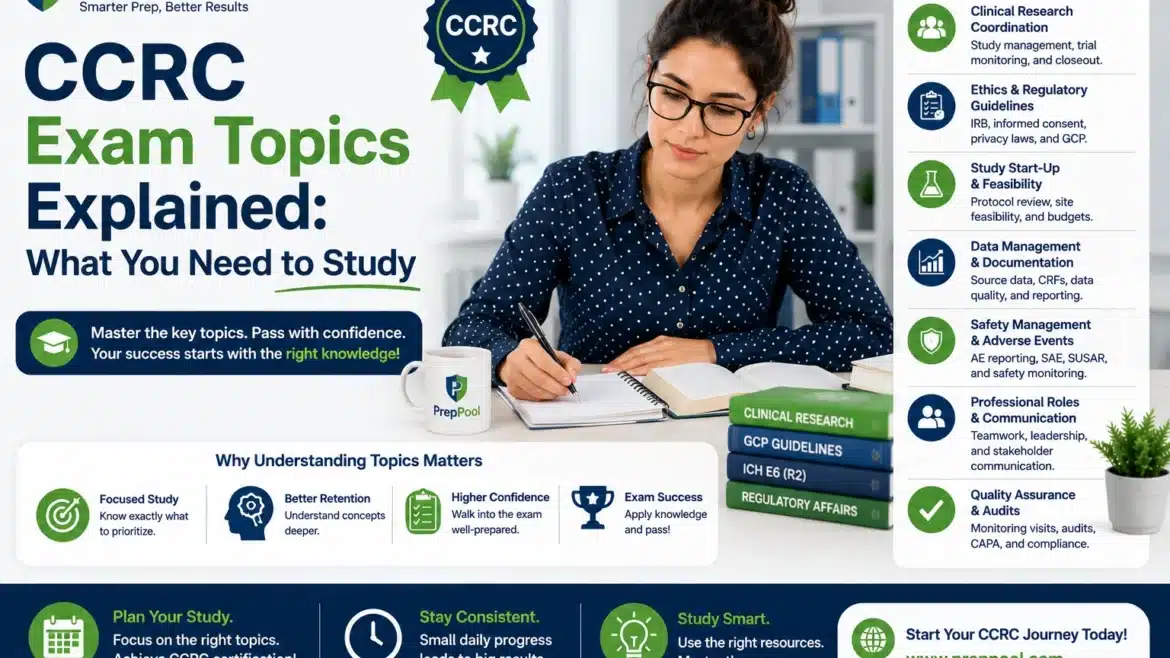
Major Knowledge Areas You’ll Encounter
Although individual questions vary, most topics fall into several broad areas that reflect the responsibilities of an experienced Clinical Research Coordinator.
| Knowledge Area | What You’ll Need to Understand |
|---|---|
| Research Ethics | Protecting participants and maintaining ethical research practices. |
| Good Clinical Practice (GCP) | International quality standards for conducting clinical research. |
| Regulatory Compliance | Following applicable regulations, guidelines, and study requirements. |
| Study Coordination | Managing clinical trial activities from initiation through closeout. |
| Documentation | Maintaining accurate, complete, and compliant study records. |
| Participant Safety | Monitoring, documenting, and reporting participant safety issues. |
Expect Questions That Require Practical Judgment
The CCRC examination is designed to measure your ability to apply knowledge rather than simply recall definitions. Many questions describe situations that Clinical Research Coordinators encounter during routine study activities and ask you to identify the most appropriate course of action.
For this reason, understanding the relationships between different topics is just as important as learning each topic individually. Clinical research decisions often involve ethics, regulations, participant safety, documentation, and communication at the same time.
Preparation TipAs you study each topic, think about how it would apply during an actual clinical trial. Connecting theory to real-world situations improves retention and prepares you for application-based exam questions.
Build Your Preparation Around the Exam Blueprint
A well-organized study plan begins with understanding the exam content before deciding how much time to spend on each subject. If you’ve already confirmed who qualifies for the CCRC examination, organizing your preparation around the major knowledge domains is the next logical step toward exam readiness.
In the next section, we’ll look more closely at each major topic and discuss how much emphasis it deserves during your preparation.
Research Ethics and Participant Protection
Ethical conduct is the foundation of every clinical research study, which is why this area receives significant attention on the CCRC examination. Clinical Research Coordinators are responsible for protecting the rights, safety, and well-being of study participants throughout the research process.
As you prepare, be sure you understand ethical principles such as respect for persons, beneficence, justice, confidentiality, participant privacy, and the responsibilities of Institutional Review Boards (IRBs). You should also know when ethical concerns must be reported and how participant welfare influences clinical research decisions.
Good Clinical Practice (GCP)
Good Clinical Practice (GCP) provides the internationally recognized standards for designing, conducting, monitoring, recording, and reporting clinical research. Because GCP influences nearly every aspect of study coordination, it is one of the highest-value topics to review.
Rather than memorizing guidelines word for word, focus on understanding how GCP principles apply during routine research activities, including documentation, protocol compliance, participant safety, and data integrity.
Regulatory Compliance and Study Documentation
Clinical trials operate within a highly regulated environment. The CCRC exam evaluates your understanding of regulatory responsibilities throughout the life of a study, from startup activities to study closeout.
Important areas include maintaining essential documents, following approved study protocols, handling protocol deviations appropriately, preparing for monitoring visits, and ensuring research records remain accurate, complete, and audit-ready.
| Topic | Why It Matters |
|---|---|
| Research Ethics | Protects participant rights and supports ethical decision-making. |
| Good Clinical Practice (GCP) | Guides quality standards throughout clinical research. |
| Regulatory Compliance | Ensures studies meet applicable regulations and guidelines. |
| Study Documentation | Provides accurate records for monitoring and audits. |
| Participant Safety | Supports timely identification and reporting of safety concerns. |
| Study Coordination | Keeps research activities organized from initiation to closeout. |
Participant Safety and Safety Reporting
Protecting study participants is one of the primary responsibilities of every Clinical Research Coordinator. The examination may include questions about identifying adverse events, documenting safety information accurately, reporting serious adverse events when required, and communicating safety concerns to investigators, sponsors, and other appropriate parties.
Understanding the purpose behind safety reporting is more valuable than simply memorizing definitions. Focus on how safety monitoring supports ethical research and regulatory compliance throughout a clinical trial.
High-Yield Study TipIf your study time is limited, prioritize topics that appear throughout multiple stages of a clinical trial, such as Good Clinical Practice (GCP), participant safety, informed consent, regulatory compliance, and study documentation. These concepts often overlap and strengthen your understanding of other exam domains.
Study Coordination and Trial Management
The CCRC examination also evaluates your ability to coordinate the operational aspects of clinical research. This includes participant recruitment, scheduling study visits, maintaining communication with investigators and sponsors, managing study documentation, supporting monitoring visits, and helping ensure protocol requirements are followed consistently.
Many questions require you to think like an experienced coordinator who can balance participant care with regulatory responsibilities while maintaining the integrity of the study.
Which Topics Should You Prioritize?
Although every knowledge area is important, candidates often benefit from spending additional time on subjects that influence multiple aspects of clinical research. These foundational topics make it easier to understand more specialized concepts later in your preparation.
If you’re wondering how challenging these subjects become during the certification process, this guide on what makes the CCRC exam challenging explains why candidates are expected to apply knowledge rather than simply memorize information.
Once you’ve identified the major exam topics, the next step is creating a practical schedule that allows you to review them consistently. Following a practical CCRC study schedule can help you cover every major subject without becoming overwhelmed, even if you’re preparing while working full time.
How to Prioritize Your Study Time
Not every candidate begins preparation with the same level of experience. Some Clinical Research Coordinators work primarily with participant recruitment, while others spend more time managing regulatory documents, coordinating study visits, or supporting monitoring activities. For this reason, your study plan should place extra emphasis on the topics you encounter less frequently in your day-to-day role.
Start by identifying your strongest and weakest knowledge areas. Continue reviewing familiar subjects to maintain confidence, but dedicate additional time each week to strengthening topics that require more attention.
| Study Priority | Recommended Approach |
|---|---|
| High Confidence Topics | Review regularly to reinforce your knowledge. |
| Moderate Confidence Topics | Combine content review with practice questions. |
| Low Confidence Topics | Spend extra study time and revisit answer explanations frequently. |
| Scenario-Based Concepts | Practice applying knowledge to realistic clinical research situations. |
| Final Review | Focus on revision, practice tests, and reinforcing weaker areas. |
Don’t Study Each Topic in Isolation
One of the most effective preparation strategies is recognizing how different areas of clinical research connect. For example, informed consent relates to research ethics, participant safety, regulatory compliance, and proper documentation. Likewise, protocol compliance affects study quality, participant protection, data integrity, and monitoring activities.
Understanding these relationships makes it easier to answer application-based questions because you’ll be thinking like a Clinical Research Coordinator rather than simply recalling isolated facts.
Preparation TipAfter completing each major topic, explain the concept in your own words or discuss it with a colleague. Teaching a concept is an excellent way to confirm that you truly understand it rather than simply recognizing familiar terminology.
Use Practice Questions to Reinforce Every Topic
Reading textbooks and reviewing notes build foundational knowledge, but practice questions help transform that knowledge into practical decision-making skills. They expose you to realistic scenarios, highlight weaker areas, and improve your ability to apply clinical research principles under exam conditions.
When reviewing practice questions, pay attention to every answer explanation—not only the questions you answered incorrectly. Understanding why the correct answer is appropriate often provides valuable insight that can help you solve similar questions on the actual exam.
Prepare with Confidence Using PrepPool
If you’re ready to apply what you’ve learned, PrepPool offers Certified Clinical Research Coordinator Practice Test designed to reinforce the major knowledge areas tested on the certification exam. The practice materials include scenario-based questions covering Good Clinical Practice (GCP), participant safety, informed consent, regulatory compliance, study documentation, protocol management, and other essential clinical research topics.
Working through exam-style questions allows you to identify knowledge gaps early and build confidence before exam day.
Explore More Healthcare Certification Resources
If you’re planning to pursue additional healthcare credentials, PrepPool also offers a growing collection of Healthcare Certification Exam Preparation resources that support professionals across a wide range of healthcare and allied health specialties.
Key Takeaways
- Understand the major CCRC exam domains before creating your study schedule.
- Focus on applying clinical research principles rather than memorizing definitions.
- Prioritize weaker subject areas while continuing to review familiar topics.
- Practice with scenario-based questions to strengthen clinical reasoning.
- Study consistently over time instead of relying on last-minute cramming.
Final Thoughts
The CCRC examination covers a broad range of clinical research knowledge, but every topic reflects responsibilities that Clinical Research Coordinators encounter throughout the conduct of a study. By understanding the major exam domains, organizing your preparation strategically, and reinforcing your knowledge with realistic practice questions, you’ll approach the exam with greater confidence and a stronger understanding of the material.
A focused study plan built around the exam topics not only prepares you for certification but also strengthens the practical skills needed to coordinate high-quality clinical research throughout your career.
FAQs
What topics are covered on the CCRC exam?
The CCRC exam covers major areas of clinical research, including research ethics, Good Clinical Practice (GCP), informed consent, participant safety, regulatory compliance, study coordination, protocol management, documentation, quality assurance, and clinical trial operations.
Which CCRC exam topics should I study first?
Many candidates begin with foundational subjects such as Good Clinical Practice (GCP), research ethics, participant protection, regulatory requirements, and study documentation because these topics support many other areas of the exam.
Does the CCRC exam include scenario-based questions?
Yes. Many questions require candidates to apply clinical research principles to realistic situations rather than simply recalling definitions or regulations.
How can I remember so many CCRC exam topics?
Break the material into manageable sections, follow a structured study schedule, review topics consistently, and use practice questions to reinforce your understanding through real-world application.
Are practice tests helpful for learning the CCRC exam topics?
Yes. High-quality practice tests help identify weaker subject areas, strengthen critical thinking, and improve your ability to apply clinical research concepts in the types of situations commonly presented on the certification exam.