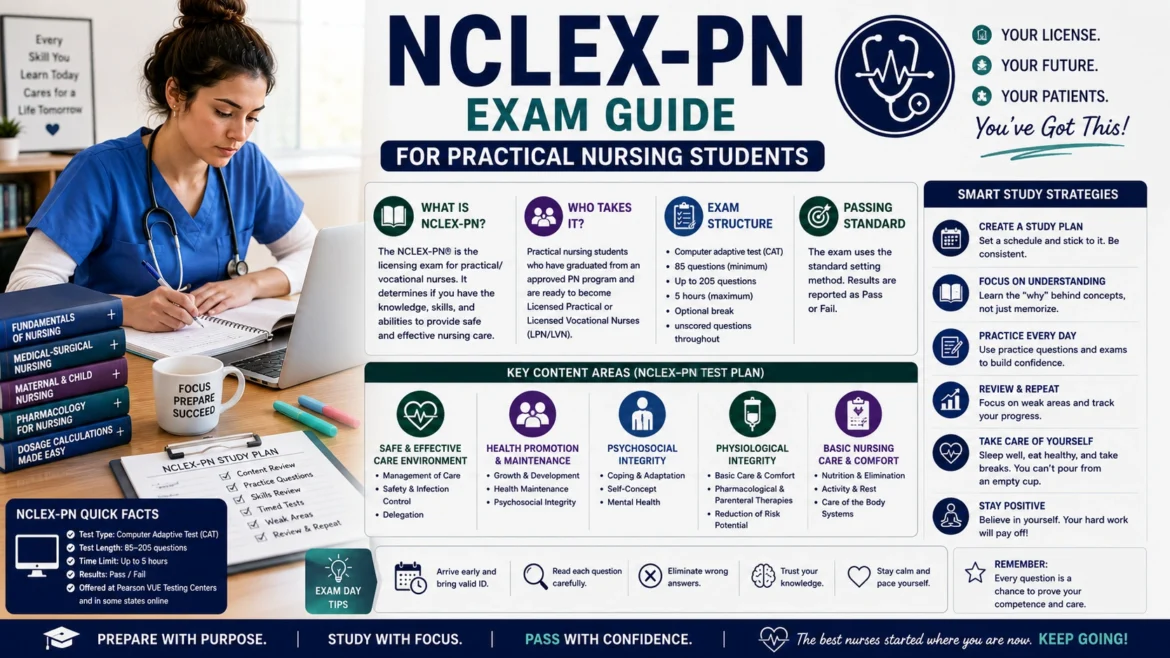

The National Council Licensure Examination for Practical Nurses (NCLEX-PN) is the licensing exam used in the United States to evaluate whether practical nursing candidates are prepared to provide safe and effective patient care in real healthcare environments.
The exam plays a major role in the nursing profession because it helps determine whether future Licensed Practical Nurses (LPNs) and Licensed Vocational Nurses (LVNs) possess the clinical judgment, patient-care knowledge, and safety awareness required for entry-level nursing practice.
Unlike many traditional academic exams, the NCLEX-PN focuses heavily on clinical application and decision-making rather than simple memorization.
Candidates preparing for the exam must demonstrate understanding of:
- Patient care fundamentals
- Safety and infection control
- Pharmacology basics
- Health promotion
- Clinical judgment
- Nursing procedures
- Communication skills
- Care planning concepts
Because modern healthcare environments continue evolving rapidly, the NCLEX-PN remains one of the most important milestones for future practical nurses entering the healthcare field.
Nursing Insight:The NCLEX-PN exam evaluates whether nursing candidates can apply patient-care knowledge safely within realistic healthcare situations.
Why Becoming a Licensed Practical Nurse Matters
Licensed Practical Nurses play an essential role within hospitals, clinics, rehabilitation facilities, long-term care centers, physician offices, and many other healthcare environments across the United States.
LPNs frequently support:
- Direct patient care
- Medication administration
- Patient monitoring
- Vital sign assessment
- Clinical documentation
- Patient communication
- Basic nursing procedures
Because healthcare systems continue experiencing high patient demand, skilled practical nurses remain extremely important within modern patient-care teams.
Many nursing students pursue practical nursing careers because the profession may offer:
- Career stability
- Healthcare experience
- Professional growth opportunities
- Pathways into advanced nursing education
- Meaningful patient interaction
Why the NCLEX-PN Can Feel Challenging
Many practical nursing students discover that the NCLEX-PN feels very different from traditional classroom testing.
Instead of asking candidates to simply repeat memorized information, the exam often requires them to:
- Analyze patient situations
- Prioritize nursing actions
- Recognize safety concerns
- Apply pharmacology knowledge
- Interpret clinical information
- Use sound nursing judgment
This practical application focus is one reason many candidates initially feel overwhelmed during preparation.
Strong NCLEX-PN preparation usually requires consistent active learning and repeated exposure to realistic patient-care scenarios.
Preparation Reminder:The NCLEX-PN measures clinical reasoning and safe nursing judgment, not just memorized textbook knowledge.
Main Areas Covered on the NCLEX-PN Exam
The NCLEX-PN evaluates multiple nursing competencies connected to safe patient care and entry-level nursing responsibilities.
Major content areas often include:
- Safe and effective care environments
- Health promotion and maintenance
- Psychosocial integrity
- Physiological integrity
- Basic care and comfort
- Pharmacological therapies
- Reduction of risk potential
- Coordinated patient care
Because nursing care involves both technical procedures and human interaction, candidates must understand how to apply knowledge safely within realistic healthcare situations.
Why Patient Safety Is a Major Priority
Patient safety remains one of the most important concepts throughout the NCLEX-PN exam because nurses are directly responsible for protecting patient wellbeing during healthcare delivery.
The exam may evaluate whether candidates can recognize:
- Medication safety risks
- Infection-control concerns
- Patient deterioration signs
- Communication breakdowns
- Unsafe clinical situations
- Care-prioritization needs
Strong patient-safety awareness is essential because nurses make clinical decisions continuously throughout daily patient care.
Healthcare employers also highly value nurses who demonstrate strong safety awareness and professional accountability.
Healthcare Insight:Safe patient care is one of the central responsibilities evaluated throughout the NCLEX-PN licensing process.
How Clinical Judgment Affects NCLEX-PN Success
Clinical judgment is one of the most important nursing skills evaluated during the NCLEX-PN because nurses must often make decisions quickly while balancing patient safety, symptoms, priorities, and healthcare procedures.
The exam may include scenarios involving:
- Patient deterioration
- Medication administration decisions
- Prioritization challenges
- Delegation situations
- Communication responsibilities
- Emergency response considerations
Strong clinical judgment helps nursing students analyze patient situations more effectively while choosing the safest nursing actions.
This skill becomes increasingly valuable throughout long-term nursing careers.
Why Communication Skills Matter in Nursing
Practical nursing involves far more than performing technical procedures.
Nurses communicate constantly with:
- Patients
- Families
- Physicians
- Healthcare teams
- Supervisors
- Caregivers
Strong communication skills help nurses:
- Reduce patient anxiety
- Improve care coordination
- Support patient education
- Prevent misunderstandings
- Maintain patient trust
The NCLEX-PN may evaluate whether candidates understand therapeutic communication and professional nursing interaction principles.
How Active Learning Improves NCLEX-PN Preparation
Many nursing students preparing for licensure exams spend large amounts of time rereading notes or highlighting textbooks without actively applying nursing concepts.
However, active learning methods often improve retention much more effectively.
Examples of active learning include:
- Patient-care scenarios
- Practice questions
- Clinical judgment exercises
- Pharmacology drills
- Prioritization practice
- Case-study review
Repeated scenario interpretation helps candidates strengthen clinical reasoning and nursing confidence gradually over time.
Many nursing students preparing for licensure improve confidence and patient-care reasoning by consistently working through realistic NCLEX-PN practice exam questions designed to simulate modern nursing situations involving patient safety, pharmacology, communication, prioritization, and clinical judgment responsibilities.
Understanding Pharmacology for the NCLEX-PN
Pharmacology remains one of the most important and challenging areas for many practical nursing students preparing for the NCLEX-PN exam.
Nurses are directly involved in medication administration and patient monitoring, so the exam often evaluates whether candidates can apply medication-safety principles correctly.
Important pharmacology concepts may include:
- Medication classifications
- Dosage safety
- Side effects
- Adverse reactions
- Medication administration procedures
- Patient education responsibilities
Strong pharmacology understanding helps nurses reduce medication errors and improve patient safety within healthcare environments.
Many students improve retention more effectively by focusing on medication patterns and nursing interventions rather than memorizing isolated drug names alone.
Medication Safety Reminder:Safe medication administration is one of the most important responsibilities for practical nurses in patient-care settings.
Why Prioritization Questions Feel Difficult
Many NCLEX-PN candidates struggle with prioritization questions because these scenarios require strong clinical judgment and patient-safety awareness.
The exam may ask candidates to determine:
- Which patient requires immediate attention
- Which nursing action should occur first
- Which symptom represents the greatest risk
- Which patient condition is most urgent
Strong prioritization skills help nurses manage patient care safely within busy healthcare environments.
Many successful candidates improve in this area by repeatedly analyzing realistic patient-care scenarios and understanding why certain situations require faster intervention.
Infection Control and Safety Procedures
Infection control remains a major nursing responsibility because healthcare-associated infections can create serious risks for patients, healthcare workers, and healthcare systems.
The NCLEX-PN may evaluate understanding of:
- Standard precautions
- Isolation procedures
- Hand hygiene
- Personal protective equipment
- Sterile technique
- Cross-contamination prevention
Strong infection-control knowledge helps nurses maintain safer patient-care environments and reduce preventable healthcare complications.
Because patient safety remains central to nursing practice, infection-control concepts often appear throughout many different exam scenarios.
Clinical Insight:Patient safety and infection prevention are closely connected throughout modern nursing care environments.
How the NCLEX-PN Evaluates Real Nursing Situations
One reason many candidates find the NCLEX-PN difficult is because the exam focuses heavily on real clinical application rather than textbook memorization.
Questions may involve situations requiring candidates to:
- Recognize patient deterioration
- Interpret symptoms
- Choose safe nursing interventions
- Communicate effectively with patients
- Prioritize care appropriately
- Respond to emergencies safely
This application-based structure helps evaluate whether future nurses can function safely within actual healthcare environments.
Strong preparation therefore requires repeated exposure to patient-care reasoning and realistic nursing scenarios.
Why Nursing Fundamentals Matter So Much
Although nursing students often focus heavily on advanced topics, many NCLEX-PN questions still rely on strong understanding of foundational nursing principles.
Important nursing fundamentals may include:
- Patient positioning
- Basic hygiene care
- Vital sign interpretation
- Mobility assistance
- Nutrition support
- Documentation basics
- Communication techniques
Strong nursing fundamentals help practical nurses provide safer and more effective patient care across many healthcare settings.
These foundational skills also support stronger clinical reasoning during more complex patient-care situations.
Why Stress Management Is Important During NCLEX-PN Preparation
Many practical nursing students preparing for licensure exams experience significant stress due to academic pressure, clinical responsibilities, family obligations, and career expectations.
Excessive stress can negatively affect:
- Memory retention
- Concentration
- Testing confidence
- Clinical reasoning
- Motivation
Healthy preparation strategies often include:
- Structured study schedules
- Reasonable daily goals
- Mental recovery time
- Balanced routines
- Consistent sleep habits
Maintaining emotional balance becomes important because nursing itself already requires strong mental focus and professional resilience.
Study Insight:Balanced preparation routines often improve learning consistency and reduce burnout during long-term exam preparation.
How Clinical Experience Supports NCLEX-PN Readiness
Many nursing students notice that clinical rotations and patient-care experiences help strengthen NCLEX-PN preparation significantly.
Clinical exposure helps students connect textbook concepts with:
- Real patient symptoms
- Healthcare teamwork
- Medication administration
- Patient communication
- Care prioritization
- Safety procedures
This practical exposure often improves understanding of why certain nursing decisions matter within real healthcare environments.
Students frequently develop stronger confidence once they begin applying nursing concepts directly within patient-care settings.
Why Time Management Improves Nursing Exam Performance
Many candidates preparing for the NCLEX-PN underestimate how important pacing and time management become during exam preparation.
Without structure, students may:
- Study inconsistently
- Overfocus on weak areas excessively
- Neglect high-yield topics
- Delay practice questions
- Experience burnout before exam day
Structured preparation schedules often improve long-term retention and reduce unnecessary stress.
Many successful candidates organize preparation using:
| Study Focus | Main Goal |
|---|---|
| Pharmacology Review | Improve medication safety understanding. |
| Patient Scenarios | Strengthen clinical judgment. |
| Practice Questions | Improve application skills. |
| Safety Review | Reinforce patient protection concepts. |
| Weak-Area Tracking | Improve targeted review efficiency. |
This type of organization often helps nursing students maintain stronger focus throughout preparation.
How Practice Questions Improve Clinical Judgment
Clinical judgment remains one of the most important skills evaluated throughout the NCLEX-PN because practical nurses make patient-care decisions continuously during daily healthcare responsibilities.
Practice questions help nursing students strengthen the ability to:
- Recognize patient deterioration
- Identify safety concerns
- Prioritize nursing actions
- Interpret symptoms correctly
- Choose appropriate interventions
- Respond to emergencies safely
Repeated exposure to realistic nursing scenarios helps candidates become more comfortable analyzing patient-care situations under pressure.
Over time, this active learning process often improves both confidence and long-term retention significantly.
Nursing Insight:Strong clinical judgment helps practical nurses provide safer patient care within fast-moving healthcare environments.
Why Communication Skills Matter for Practical Nurses
Practical nurses communicate constantly with patients, families, physicians, supervisors, and healthcare teams throughout daily patient-care responsibilities.
Strong communication skills help nurses:
- Reduce patient anxiety
- Improve care coordination
- Prevent misunderstandings
- Support patient education
- Maintain patient trust
- Improve healthcare teamwork
The NCLEX-PN may evaluate whether candidates understand therapeutic communication principles and professional nursing interaction standards.
Effective communication becomes especially important when patients are emotionally distressed, confused, or experiencing medical complications.
Why Ethical and Professional Nursing Behavior Matters
Nursing involves significant professional responsibility because nurses work directly with patient health, privacy, safety, and emotional wellbeing.
The NCLEX-PN may include situations involving:
- Patient confidentiality
- Professional boundaries
- Ethical decision-making
- Documentation accuracy
- Patient advocacy
- Professional accountability
Strong ethical awareness helps practical nurses provide safer and more respectful patient care while maintaining healthcare standards.
Healthcare employers also highly value nurses who demonstrate professionalism and strong ethical judgment.
Professional Reminder:Nursing professionalism involves both technical competence and ethical responsibility toward patient wellbeing.
How Active Learning Improves NCLEX-PN Readiness
Many nursing students preparing for licensure exams spend too much time passively reviewing textbooks without actively applying nursing concepts.
Active learning strategies often improve retention much more effectively because they require students to:
- Analyze patient-care situations
- Interpret symptoms
- Practice prioritization
- Apply safety concepts
- Evaluate nursing interventions
Examples of effective active learning methods include:
- Practice questions
- Case-study analysis
- Clinical simulations
- Medication drills
- Prioritization exercises
Repeated scenario interpretation helps students develop stronger clinical reasoning and testing confidence gradually over time.
How NCLEX-PN Preparation Supports Long-Term Nursing Growth
Preparing for the NCLEX-PN often strengthens much more than exam performance alone.
The preparation process frequently improves:
- Patient-safety awareness
- Clinical reasoning
- Communication abilities
- Medication knowledge
- Professional discipline
- Healthcare confidence
These skills remain valuable throughout long-term nursing careers in hospitals, clinics, rehabilitation centers, long-term care facilities, and many other healthcare environments.
Many experienced nurses later realize that the habits developed during NCLEX preparation continued benefiting them long after licensure.
Why Healthcare Demand Continues Growing in the United States
The demand for skilled nursing professionals continues growing throughout the United States because healthcare systems care for large patient populations across hospitals, clinics, long-term care facilities, and specialized treatment centers.
Practical nurses remain important because they help support:
- Direct patient care
- Medication administration
- Patient monitoring
- Clinical communication
- Healthcare teamwork
- Long-term patient support
As healthcare needs continue increasing, practical nursing remains an important career path for students seeking meaningful healthcare roles and long-term professional opportunities.
Career Insight:Practical nursing continues playing an important role in patient-care delivery throughout modern healthcare systems.
How Consistent Preparation Improves Confidence
Many nursing students initially feel overwhelmed because the NCLEX-PN covers multiple patient-care concepts, clinical procedures, medication topics, and safety responsibilities.
Consistent preparation helps students improve gradually by strengthening:
| Preparation Area | Long-Term Benefit |
|---|---|
| Practice Questions | Improves clinical application. |
| Patient Scenarios | Strengthens decision-making skills. |
| Pharmacology Review | Improves medication safety awareness. |
| Safety Concepts | Supports patient protection skills. |
| Time Management | Reduces testing stress. |
Even shorter consistent study sessions often improve retention more effectively than exhausting last-minute cramming sessions.
Final Thoughts
The NCLEX-PN exam plays a major role in preparing future practical nurses for safe patient care and entry-level nursing responsibilities within modern healthcare environments.
Strong preparation usually involves:
- Patient-care scenario review
- Clinical judgment practice
- Pharmacology reinforcement
- Safety and infection-control review
- Practice-question analysis
- Consistent active learning
Because the exam focuses heavily on real-world nursing application, successful candidates often improve most through repeated clinical reasoning and patient-care interpretation practice.
Over time, these habits help future nurses build the confidence, judgment, communication skills, and patient-safety awareness needed for both NCLEX-PN success and long-term growth within the nursing profession.
Frequently Asked Questions (FAQs)
What does the NCLEX-PN exam evaluate?
The NCLEX-PN evaluates whether practical nursing candidates can provide safe and effective entry-level patient care within healthcare environments.
Why is clinical judgment important for NCLEX-PN?
Clinical judgment helps nurses prioritize patient care, recognize safety concerns, and choose appropriate nursing interventions.
What subjects are important for the NCLEX-PN?
Important topics often include pharmacology, patient safety, infection control, nursing fundamentals, communication, and prioritization.
How can nursing students prepare effectively for the NCLEX-PN?
Practice questions, patient-care scenarios, active learning methods, and consistent topic review often improve preparation significantly.
Why is patient safety emphasized so heavily on the NCLEX-PN?
Patient safety is central to nursing because nurses make important healthcare decisions that directly affect patient wellbeing.