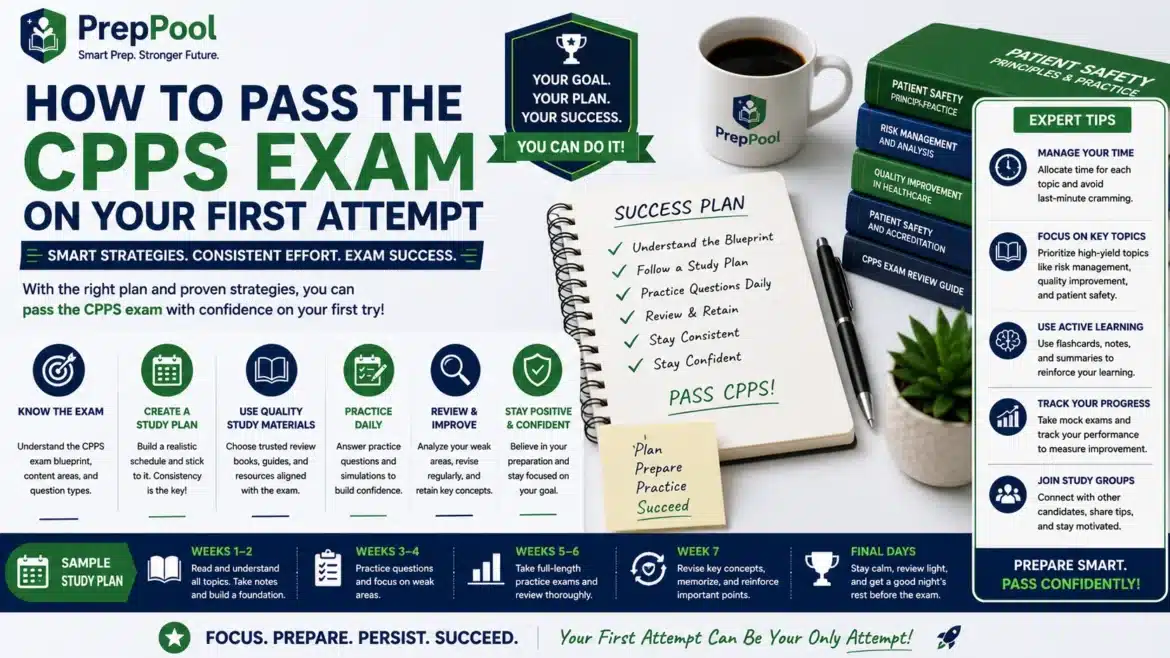

Passing the Certified Professional in Patient Safety (CPPS) exam on your first attempt is an achievable goal with the right preparation strategy. While the exam evaluates your understanding of patient safety principles, systems thinking, and quality improvement, success depends on much more than simply reading a study guide. Candidates who pass the first time typically combine structured learning, consistent practice, and realistic exam preparation.
If you’re preparing for the CPPS certification, this guide will walk you through proven strategies that successful candidates use to maximize their study time, improve knowledge retention, and approach exam day with confidence.
Whether you’re a nurse, physician, pharmacist, patient safety officer, healthcare administrator, or quality improvement professional, these practical tips can help you prepare more effectively and avoid common mistakes that prevent many candidates from reaching a passing score.
Quick Highlights
- Develop a structured study schedule instead of cramming.
- Focus on understanding patient safety concepts rather than memorizing definitions.
- Practice with realistic scenario-based questions.
- Review incorrect answers to strengthen weak areas.
- Build confidence through consistent self-assessment.
Why Many Candidates Don’t Pass the CPPS Exam the First Time
Most unsuccessful candidates aren’t lacking experience—they’re lacking a structured preparation plan. Healthcare professionals often assume that years of clinical or administrative experience will automatically translate into exam success. However, the CPPS examination measures how well you apply patient safety principles across a variety of situations, not just your day-to-day responsibilities.
Another common issue is relying on a single resource. Reading one review book without reinforcing the material through practice questions or self-assessment often leaves knowledge gaps that become apparent during the exam.
Successful candidates recognize that certification requires both knowledge and application. They invest time in understanding why patient safety practices matter, how healthcare systems function, and how to analyze situations from a quality improvement perspective.
What It Really Takes to Pass the CPPS Exam
Passing the CPPS exam isn’t about finding shortcuts or memorizing hundreds of facts. It’s about building a solid understanding of patient safety science and learning how to apply that knowledge to realistic healthcare scenarios.
A successful preparation strategy usually includes four essential components:
| Preparation Element | Why It Matters |
|---|---|
| Study Plan | Keeps preparation organized and consistent. |
| Quality Study Materials | Ensures complete coverage of important concepts. |
| Practice Questions | Improves critical thinking and exam readiness. |
| Regular Review | Reinforces learning and improves long-term retention. |
When these four elements work together, candidates are far more likely to feel prepared and perform confidently during the examination.
Step 1: Understand the CPPS Exam Before You Start Studying
One of the smartest ways to improve your chances of passing is to understand what the exam is designed to evaluate. Rather than jumping directly into study materials, take time to familiarize yourself with the major content areas and the overall purpose of the certification.
The CPPS exam focuses on practical patient safety knowledge that can be applied in real healthcare environments. Questions often require you to analyze situations, identify potential risks, and determine the most appropriate action based on patient safety principles.
This means your preparation should emphasize understanding relationships between concepts rather than isolated memorization.
Step 2: Choose Reliable Study Resources
The quality of your study materials directly influences the quality of your preparation. Instead of collecting dozens of books, websites, and notes, choose a few trusted resources that complement one another.
A comprehensive study guide should explain patient safety concepts clearly, while practice questions should challenge you to apply those concepts in realistic situations.
If you’re still deciding which study materials to use, our guide on choosing the best CPPS study guide compares the features that matter most when selecting preparation resources.
As your understanding grows, reinforce each study session with realistic practice questions. Working through exam-style scenarios helps identify weak areas and improves decision-making under exam conditions. Resources such as the CPPS Practice Test with detailed answer explanations can help you measure your progress while becoming familiar with the style of questions commonly encountered during certification preparation.
Step 3: Build a Weekly Study Schedule You Can Follow
Many candidates create overly ambitious study plans that become difficult to maintain. A better approach is to build a realistic schedule that fits your work and personal commitments.
For example, studying for 45 to 60 minutes several evenings each week is often more effective than trying to complete several hours of reading on a single day. Consistent review keeps information fresh and reduces the stress associated with last-minute preparation.
A Simple Weekly Strategy
- Study one major topic each week.
- Review previous material before starting something new.
- Complete practice questions after every study session.
- Keep a notebook for concepts you find challenging.
- Schedule a short review session every weekend.
Consistency Beats Intensity
It’s natural to feel motivated at the beginning of your preparation, but long-term consistency is what leads to success. Candidates who make steady progress week after week generally perform better than those who rely on intensive last-minute study sessions.
In the next section, we’ll explore the highest-priority CPPS topics, common preparation mistakes, practical study techniques, and how to know when you’re truly ready to sit for the exam.
Step 4: Prioritize the Topics That Carry the Most Weight
One of the fastest ways to improve your chances of passing the CPPS exam is to spend more time on high-impact topics instead of giving every subject equal attention. While every domain is important, some concepts appear repeatedly because they form the foundation of patient safety programs in healthcare organizations.
Rather than trying to memorize every detail, focus on understanding how these concepts work together to improve patient outcomes. When you understand the reasoning behind patient safety practices, answering scenario-based questions becomes much easier.
| Priority Topic | Why You Should Master It | Preparation Tip |
|---|---|---|
| Patient Safety Culture | Forms the foundation of safe healthcare organizations. | Learn how leadership and communication influence outcomes. |
| Human Factors | Explains why errors occur within complex systems. | Focus on system improvement instead of individual blame. |
| Risk Assessment | Helps prevent adverse events before they occur. | Practice identifying hazards in clinical scenarios. |
| Communication | Critical for teamwork and patient safety. | Understand standardized communication methods. |
| Performance Improvement | Measures success of safety initiatives. | Study continuous quality improvement models. |
Step 5: Practice Like You’re Taking the Real Exam
Many candidates spend weeks reading but very little time answering questions. Unfortunately, this creates a false sense of confidence. Reading helps you learn concepts, but practice questions teach you how to apply those concepts under exam conditions.
Every practice session should simulate the way you’ll think during the actual examination. Instead of guessing and moving on, pause after each question and ask yourself why the correct answer is right and why the other options are less appropriate.
As your confidence grows, gradually increase the number of questions you complete in one sitting. This not only improves your knowledge but also builds the mental stamina needed for the certification exam.
Step 6: Learn From Your Mistakes
One of the habits shared by successful candidates is reviewing every incorrect answer. Your mistakes reveal exactly where your understanding needs improvement.
Create a notebook or digital document that lists concepts you frequently miss. Review these notes every week. Over time, you’ll notice patterns that help you focus your remaining study sessions more effectively.
This approach turns every mistake into an opportunity to improve instead of a reason to feel discouraged.
Common Mistakes That Prevent Candidates From Passing
Knowing what not to do can be just as valuable as knowing what to study. Here are some of the most common preparation mistakes.
| Mistake | Better Approach |
|---|---|
| Waiting until the last week to study | Follow a weekly study schedule. |
| Memorizing definitions only | Understand practical application. |
| Skipping difficult topics | Spend extra time on weaker areas. |
| Ignoring practice questions | Practice regularly throughout preparation. |
| Studying without reviewing progress | Take regular self-assessments. |
A Real-World Example
Consider a hospital quality coordinator preparing for the CPPS certification while managing a busy work schedule. Instead of attempting to study for several hours on weekends, she dedicated one hour every Monday through Thursday to reviewing one topic followed by 20 to 30 practice questions.
Each Friday, she reviewed only the concepts she answered incorrectly during the week. By focusing on weak areas instead of repeatedly studying familiar material, she steadily improved her understanding and entered exam day feeling confident rather than overwhelmed.
This type of structured preparation is far more effective than relying on last-minute cramming.
Pro Tip
Confidence comes from preparation—not luck. Every focused study session, every reviewed explanation, and every corrected mistake brings you one step closer to passing the CPPS exam on your first attempt.
Track Your Progress Every Week
Don’t wait until the week before your exam to find out whether you’re ready. Set measurable goals throughout your preparation.
- Can you explain key patient safety concepts without looking at your notes?
- Are you consistently improving on practice questions?
- Have you reviewed every major content area at least twice?
- Can you confidently analyze scenario-based questions?
- Are your weak areas becoming fewer each week?
If you answer “yes” to most of these questions, you’re likely progressing in the right direction. In the final section, we’ll discuss how to prepare during the last week before the exam, what to expect on exam day, why PrepPool can support your preparation, and answer the most common CPPS exam questions.
How to Prepare During the Final Week Before Your CPPS Exam
The final week before your CPPS exam should be about reinforcing what you’ve already learned—not trying to cover entirely new material. At this stage, your goal is to improve confidence, sharpen critical thinking, and become comfortable answering scenario-based questions under realistic conditions.
Review your notes, revisit topics where you’ve struggled, and complete timed practice sessions. If you consistently perform well on practice questions, avoid the temptation to dramatically change your study routine. Trust the preparation you’ve already completed.
Final Week Checklist
- Review summary notes instead of entire chapters.
- Complete at least one full-length practice session.
- Focus extra attention on weaker content areas.
- Review incorrect answers and understand the reasoning.
- Maintain a consistent sleep schedule before exam day.
- Prepare everything you’ll need for the testing appointment.
What to Expect on Exam Day
Walking into the exam with a clear strategy can reduce unnecessary stress. Read every question carefully before looking at the answer choices. Many scenario-based questions include details that help identify the safest or most appropriate response.
If you’re unsure about a question, eliminate answers that are clearly incorrect before choosing between the remaining options. This simple strategy improves your odds and helps prevent rushed decisions.
Remember that the exam measures your ability to apply patient safety principles—not your ability to memorize every detail from a textbook.
Signs You’re Ready to Pass the CPPS Exam
Although every candidate progresses at a different pace, these indicators suggest you’re approaching exam readiness.
| Readiness Indicator | Why It’s Important |
|---|---|
| You understand every major content domain. | Shows balanced preparation. |
| Your practice scores are consistently improving. | Indicates growing confidence and knowledge. |
| You can explain patient safety concepts clearly. | Demonstrates genuine understanding. |
| You complete practice sessions comfortably within time limits. | Builds confidence for exam day. |
Why Practice Questions Make a Difference
Reading educational material builds knowledge, but applying that knowledge is what helps candidates succeed on the CPPS exam. Practice questions encourage active learning by requiring you to evaluate situations, identify risks, and choose the most appropriate response.
As you progress through your preparation, try to answer questions without immediately checking the explanation. Afterwards, carefully review the reasoning behind every answer—especially the questions you missed. This process strengthens critical thinking and improves long-term retention.
If your goal is to pass the CPPS exam on your first attempt, practice questions should become a regular part of your weekly study routine rather than something you save for the last few days before the exam.
Why Choose PrepPool for CPPS Exam Preparation?
Choosing the right preparation resources can make your study time more productive. PrepPool is designed for candidates who want practical, exam-focused preparation supported by detailed explanations that reinforce important patient safety concepts.
Instead of simply testing your memory, high-quality practice questions encourage you to analyze realistic healthcare situations and apply what you’ve learned. This approach helps build confidence while identifying areas that need additional review.
Prepare Smarter with PrepPool
Ready to put your knowledge to the test?
Strengthen your preparation with realistic exam-style questions, detailed explanations, and focused review designed to help you feel more confident before exam day.
Final Thoughts
Passing the CPPS exam on your first attempt doesn’t require perfect study conditions—it requires a consistent plan, reliable resources, and a commitment to learning from every practice session. Candidates who prepare gradually, focus on understanding concepts, and regularly assess their progress often approach the exam with greater confidence.
Remember that certification preparation is a process. Stay organized, review your weak areas, continue practicing with realistic questions, and trust the knowledge you’ve built over time. Every focused study session moves you closer to earning your CPPS credential.
FAQs
How difficult is the CPPS exam?
The CPPS exam is challenging because it emphasizes applying patient safety principles to realistic healthcare scenarios rather than recalling simple facts. A structured study plan and consistent practice can significantly improve your readiness.
How long should I prepare before taking the CPPS exam?
The ideal preparation time varies based on your experience and familiarity with patient safety concepts. Many candidates study over several weeks, combining focused reading with regular practice questions.
Can I pass the CPPS exam on my first attempt?
Yes. Many healthcare professionals successfully pass on their first attempt by following a realistic study schedule, using reliable study materials, and consistently reviewing practice questions with detailed explanations.
What is the best way to prepare for the CPPS exam?
A balanced approach works best. Use a comprehensive study guide, review every major exam domain, complete exam-style practice questions, and revisit topics where you need additional improvement.
Are practice questions worth using for CPPS preparation?
Absolutely. Practice questions help reinforce key concepts, improve critical thinking, identify weak areas, and build confidence by exposing you to scenarios similar to those encountered during the certification exam.