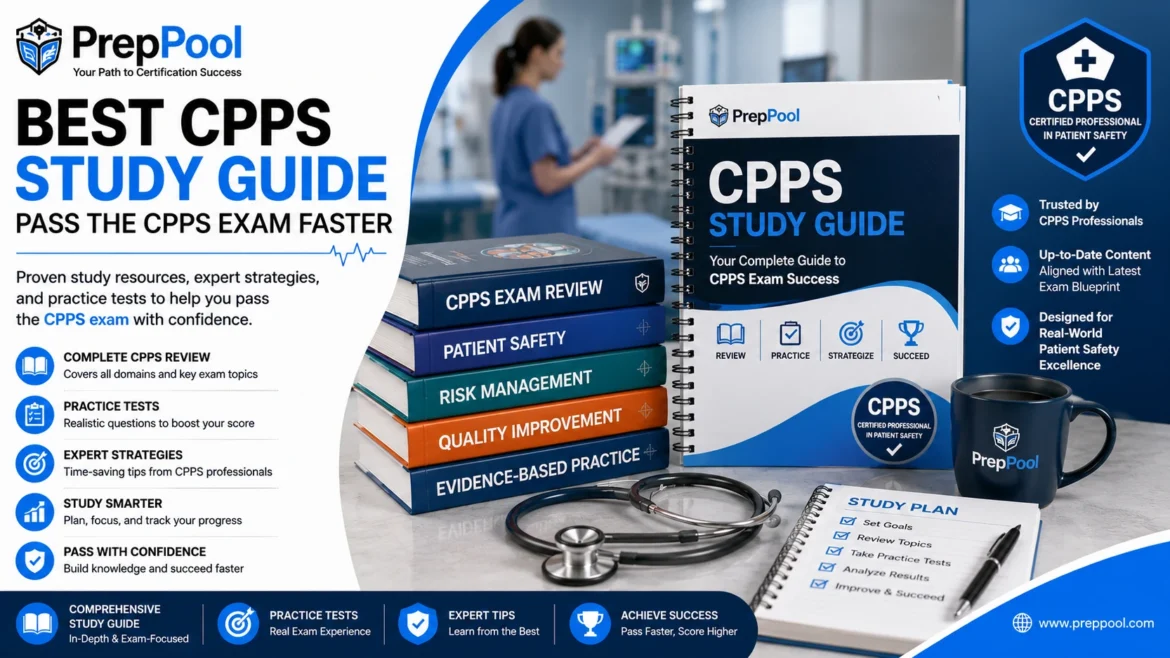

The Certified Professional in Patient Safety (CPPS) credential has become one of the most respected certifications for healthcare professionals committed to improving patient safety and reducing preventable harm. Whether you work in a hospital, ambulatory care center, long-term care facility, or another healthcare setting, earning the CPPS certification demonstrates that you understand the principles, science, and practical application of patient safety.
Choosing the right CPPS study guide is one of the most important decisions you’ll make during your preparation. A well-structured resource not only explains the concepts tested on the exam but also helps you build confidence through realistic practice questions, detailed explanations, and focused review.
This guide explains what to look for in a CPPS study guide, which topics deserve the most attention, common preparation mistakes to avoid, and how to build an efficient study strategy that fits your schedule.
Quick Takeaways
- Understand the official CPPS content domains before choosing study materials.
- Use multiple learning methods instead of relying on a single textbook.
- Practice with scenario-based questions that reflect real exam conditions.
- Create a realistic study schedule based on your available time.
- Regular self-assessment helps identify weak areas early.
Why Choosing the Right CPPS Study Guide Matters
Many candidates assume that reading one review book is enough to pass the examination. In reality, the CPPS exam evaluates how well you apply patient safety principles to practical healthcare situations rather than simply recalling definitions.
An effective study guide should help you connect patient safety concepts with everyday clinical practice. Instead of memorizing isolated facts, you’ll learn how safety culture, communication, risk reduction, systems thinking, and quality improvement work together to improve patient outcomes.
High-quality study materials also reduce wasted study time. Rather than searching through multiple websites or outdated notes, you’ll have organized content covering every major domain tested on the certification exam.
What Is the CPPS Certification Exam?
The Certified Professional in Patient Safety (CPPS) credential recognizes professionals who possess the knowledge and skills necessary to improve patient safety across healthcare organizations. Individuals pursuing this certification often include nurses, physicians, pharmacists, healthcare administrators, quality improvement specialists, patient safety officers, and risk management professionals.
Unlike certifications focused on a single profession, the CPPS credential emphasizes interdisciplinary collaboration. Patient safety requires teamwork across departments, making this certification valuable for professionals involved in quality improvement initiatives throughout an organization.
| Area | Importance During Preparation |
|---|---|
| Patient Safety Science | Builds the foundation for understanding exam concepts. |
| Human Factors | Helps explain why errors occur within healthcare systems. |
| Communication | Essential for preventing adverse events. |
| Risk Management | Frequently appears in scenario-based questions. |
| Performance Improvement | Links patient safety initiatives with measurable outcomes. |
Effective CPPS Study Guide
Not every study resource offers the same level of preparation. Before investing your time or money, compare available materials using these criteria.
Comprehensive Coverage
A reliable guide should address every major content domain instead of focusing heavily on only one topic.
Practice Questions with Explanations
Practice questions are most valuable when each answer includes a detailed explanation. Understanding why an answer is correct—and why the other options are not—strengthens long-term retention.
Realistic Case Scenarios
Because patient safety is highly practical, scenario-based learning helps you think through situations similar to those encountered on the certification exam.
Clear Organization
Well-structured chapters, summary boxes, key terms, and review sections make studying more efficient and reduce information overload.
Study Tip: Don’t choose a study guide solely because it has the most pages. A concise, organized resource paired with high-quality practice questions is often more effective than an overly detailed textbook that lacks active learning opportunities.
How Successful Candidates Prepare
Successful CPPS candidates rarely depend on a single learning method. Instead, they combine structured reading, note-taking, practice questions, and regular review sessions.
For example, a healthcare quality coordinator preparing for the exam might spend the first week reviewing patient safety science, the second week focusing on human factors and communication, and later reinforce those topics through realistic practice questions. This layered approach helps transform theoretical knowledge into practical decision-making skills.
As your preparation progresses, incorporating realistic question banks becomes increasingly valuable. Practicing with exam-style questions helps identify knowledge gaps while improving your ability to interpret complex scenarios. Resources such as the CPPS practice test with detailed answer explanations can complement your primary study guide by providing additional opportunities to apply what you’ve learned under conditions similar to the actual examination.
Build a Study Strategy Instead of Simply Reading
One of the biggest differences between candidates who pass and those who struggle is having a structured plan. Reading chapters without testing yourself often creates a false sense of confidence. Instead, divide your preparation into manageable sections, review one topic at a time, and reinforce each section with practice questions before moving forward.
Create a CPPS Study Plan That Fits Your Schedule
One of the biggest misconceptions about the CPPS exam is that you need months of uninterrupted study time to succeed. In reality, consistency matters far more than the number of hours you spend in a single sitting. A realistic study plan keeps you motivated, helps you retain information, and prevents last-minute cramming.
Start by estimating how many weeks you have before your exam date. Then divide the major content areas into manageable sections. Reserve time each week for reviewing previous topics and completing practice questions to reinforce what you’ve learned.
Recommended Weekly Study Routine
- Review one major domain each week.
- Take notes using your own words.
- Complete practice questions after every study session.
- Review incorrect answers instead of simply checking your score.
- Spend one day each week revisiting previously studied topics.
Focus on Understanding, Not Memorization
The CPPS exam evaluates your ability to apply patient safety principles in realistic healthcare situations. Simply memorizing definitions or terminology is unlikely to prepare you for scenario-based questions. Instead, aim to understand why safety processes exist and how they improve patient outcomes.
For example, rather than memorizing the definition of a root cause analysis, understand when it is used, how it identifies contributing factors, and how organizations implement corrective actions after adverse events.
This approach makes it easier to answer questions that present unfamiliar scenarios because you’ll recognize the underlying concepts instead of relying on memorized facts.
Key Topics Every CPPS Candidate Should Master
Although every domain is important, some concepts appear repeatedly throughout patient safety education and professional practice. Make sure your study guide provides thorough coverage of these areas.
| Study Topic | Why It Matters | Study Priority |
|---|---|---|
| Patient Safety Culture | Foundation of organizational improvement. | High |
| Human Factors Engineering | Explains why medical errors occur. | High |
| Communication | Supports safer teamwork and patient care. | High |
| Risk Assessment | Identifies potential hazards before harm occurs. | High |
| Performance Improvement | Measures the effectiveness of safety initiatives. | Medium |
| Systems Thinking | Encourages identifying process failures instead of individual blame. | High |
Common CPPS Study Mistakes to Avoid
Even highly experienced healthcare professionals can struggle if their preparation strategy is ineffective. Recognizing common mistakes early can improve both your confidence and exam readiness.
Studying Only During the Final Week
Cramming large amounts of information shortly before the exam often leads to poor retention. Short, consistent study sessions spread over several weeks are generally more effective.
Ignoring Practice Questions
Reading alone doesn’t prepare you for exam-style decision making. Practice questions expose weak areas and help you become comfortable interpreting complex scenarios.
Skipping Difficult Topics
Many candidates repeatedly review subjects they already understand while avoiding challenging concepts. Instead, devote extra attention to areas where your confidence is lowest.
Not Reviewing Incorrect Answers
Your mistakes provide valuable feedback. Rather than focusing only on your score, spend time understanding why an answer was incorrect and how to approach similar questions in the future.
Completing hundreds of practice questions without reviewing explanations limits your progress. Every incorrect answer should become a learning opportunity that strengthens your understanding of patient safety concepts.
A Real-World Example of Effective Preparation
Consider a quality improvement coordinator preparing for the CPPS certification while working full-time. Instead of studying for several hours only on weekends, she scheduled 45-minute study sessions four evenings each week. Each session focused on one topic followed by 20 to 30 practice questions.
After every study session, she recorded concepts that required additional review and revisited them at the end of the week. This systematic approach helped reinforce knowledge gradually rather than overwhelming herself with information all at once.
The lesson is simple: a consistent study routine combined with quality practice materials often produces better results than long, infrequent study sessions.
Should You Use More Than One Study Resource?
Many successful candidates combine multiple learning resources because each serves a different purpose. A comprehensive study guide explains the concepts, while practice questions help you apply those concepts in realistic situations.
Adding flashcards, summary notes, or short review videos can also reinforce learning, especially for visual or auditory learners. The goal is not to collect dozens of resources but to choose a few high-quality materials that complement one another.
Ideal Study Resource Combination
- Comprehensive CPPS study guide
- Practice question bank with detailed explanations
- Personal notes and summaries
- Weekly self-assessment quizzes
- Final comprehensive practice exam before test day
How Practice Questions Strengthen Exam Readiness
Reading improves knowledge, but answering questions improves performance. Practice questions encourage active learning by requiring you to analyze situations, evaluate options, and apply patient safety principles under realistic conditions.
As your confidence grows, increase the number of questions you complete in a single session. Simulating exam conditions can also improve time management and reduce anxiety on test day.
Rather than aiming to complete the highest possible number of questions, focus on understanding the reasoning behind each answer. This approach builds long-term confidence and prepares you for unfamiliar scenarios you may encounter during the actual CPPS examination.
Measure Your Progress Regularly
Preparation should never rely on guesswork. Every week, evaluate your strengths and identify areas that still need improvement. Tracking your performance helps ensure your study time is directed toward the topics that need the most attention.
As your exam date approaches, you’ll want to spend less time learning new material and more time reinforcing existing knowledge through comprehensive review sessions and realistic practice exams.
Why the CPPS Certification Matters in Today’s Healthcare Industry
Healthcare organizations across the United States continue to place greater emphasis on patient safety, quality improvement, and reducing preventable harm. Every hospital, outpatient clinic, rehabilitation center, and long-term care facility depends on professionals who understand how to identify risks, improve clinical processes, and build a culture focused on safe patient care.
The Certified Professional in Patient Safety (CPPS) credential demonstrates that you understand these principles and can contribute to meaningful improvements within a healthcare organization. While certification alone doesn’t guarantee a promotion, it strengthens your professional profile and highlights your commitment to continuous improvement.
Many employers also recognize professional certifications as evidence of ongoing education and dedication to patient-centered care. For professionals seeking leadership opportunities in quality, risk management, accreditation, or patient safety, the CPPS credential can help distinguish them from other applicants with similar clinical experience.
Why Employers Value CPPS Certification
- Demonstrates knowledge of patient safety principles.
- Shows commitment to continuous professional development.
- Supports organizational quality improvement initiatives.
- Builds confidence when participating in patient safety programs.
- Strengthens credibility across multidisciplinary healthcare teams.
Who Can Benefit from a High-Quality CPPS Study Guide?
A comprehensive study guide is valuable for professionals from many healthcare backgrounds. Because patient safety affects every department, candidates often include:
- Registered Nurses (RNs)
- Nurse Managers
- Healthcare Quality Specialists
- Risk Management Professionals
- Patient Safety Officers
- Hospital Administrators
- Clinical Educators
- Pharmacists
- Physicians
- Healthcare Consultants
Even professionals who are not directly involved in bedside patient care can benefit from understanding patient safety science and systems improvement.
How to Know You’re Ready for the CPPS Exam
Many candidates wonder when they should schedule their examination. Although everyone’s preparation timeline is different, several indicators suggest you’re approaching exam readiness.
| Readiness Indicator | Why It Matters |
|---|---|
| You understand all major content domains. | Shows balanced preparation. |
| You consistently answer practice questions correctly. | Demonstrates practical understanding. |
| You can explain concepts without referring to notes. | Indicates long-term retention. |
| You complete practice sessions within time limits. | Builds confidence for exam day. |
Why Choose PrepPool for CPPS Exam Preparation?
Finding reliable study material can be challenging. Some resources focus heavily on theory but provide little opportunity to apply what you’ve learned. Others include practice questions without explaining the reasoning behind each answer.
PrepPool is designed to bridge that gap by helping candidates reinforce important concepts through carefully written practice questions and detailed explanations. Instead of simply memorizing facts, you’ll learn how patient safety principles apply in realistic healthcare situations.
Whether you’re preparing several months in advance or reviewing shortly before your exam, structured practice can help you identify weak areas, strengthen critical thinking, and build confidence before test day.
Prepare with Confidence Using PrepPool
Looking for additional CPPS practice questions with detailed explanations?
Explore the PrepPool CPPS Practice Test to reinforce key concepts, identify knowledge gaps, and practice with exam-style questions designed to support your preparation.
Final Thoughts
Selecting the best CPPS study guide is about more than choosing the longest book or the most expensive resource. Effective preparation comes from combining quality study materials, realistic practice questions, consistent review, and a structured study schedule.
As you progress through your preparation, focus on understanding patient safety concepts instead of memorizing isolated facts. Review your mistakes, revisit challenging topics, and regularly assess your progress. Small improvements made consistently over time often produce the strongest results on exam day.
With the right preparation strategy and dependable study resources, you’ll be better equipped to approach the CPPS examination with confidence and demonstrate your commitment to safer healthcare practices.
FAQs
What is the best CPPS study guide?
The best CPPS study guide is one that covers every major exam domain, explains patient safety concepts clearly, and includes realistic practice questions with detailed answer explanations. Many candidates benefit from combining a study guide with a reliable practice question bank.
How long should I study for the CPPS exam?
Your study timeline depends on your experience and familiarity with patient safety principles. Many professionals prepare over several weeks by following a structured schedule and reviewing material consistently rather than relying on last-minute studying.
Are practice questions important for the CPPS exam?
Yes. Practice questions help reinforce concepts, improve critical thinking, and familiarize you with scenario-based questions similar to those you may encounter on the actual examination.
Can I prepare for the CPPS exam while working full-time?
Absolutely. Many candidates successfully prepare by studying for short periods throughout the week and following a realistic study plan that fits around work and personal responsibilities.
Should I use more than one CPPS study resource?
Using complementary resources is often beneficial. A comprehensive study guide provides foundational knowledge, while practice questions and review exercises help strengthen application and exam readiness.