
Many students begin their Principles of Marketing course expecting it to be relatively straightforward. After all, most people encounter marketing every day through advertisements, social media campaigns, product packaging, and brand promotions.
However, when midterm and final exams approach, students often discover that Principles of Marketing involves far more than recognizing advertisements or memorizing definitions.
Successful exam performance requires understanding how marketing concepts connect together and how businesses apply those concepts to solve real-world challenges.
The good news is that passing a Principles of Marketing midterm or final exam does not require extraordinary talent. Students who follow a structured study strategy, focus on high-value topics, and practice applying concepts can significantly improve their results.
This guide explores practical techniques that can help students prepare more effectively, avoid common mistakes, and approach marketing exams with greater confidence.
- Why students struggle with marketing exams
- The most important topics to study
- How to create an effective study plan
- Common exam mistakes to avoid
- How to answer scenario-based questions
- Time-management strategies
- Last-minute preparation tips
Why Students Often Struggle with Principles of Marketing Exams
Many students underestimate the complexity of marketing as an academic subject.
Unlike courses that focus heavily on calculations or formulas, marketing exams often require critical thinking and practical application.
Professors frequently present business scenarios and ask students to identify the most appropriate marketing strategy, evaluate customer behavior, or recommend solutions to organizational challenges.
Students who rely exclusively on memorization often find these questions difficult because knowing a definition is not the same as understanding how a concept works in practice.
This is one reason marketing exams can feel challenging even for students who spend significant time studying.
The First Step: Understand What Your Professor Is Testing
Before creating a study plan, it is important to understand the purpose of the exam.
Most Principles of Marketing assessments evaluate three levels of knowledge:
- Concept recognition
- Concept understanding
- Concept application
For example, a student may know the definition of market segmentation. However, the exam may ask which segmentation strategy a business should use when entering a new market.
Questions like these test application rather than memorization.
The more you understand how concepts are used in real business situations, the easier it becomes to answer complex exam questions.
Focus on the Topics That Appear Most Frequently
While every course is different, certain marketing concepts consistently appear on midterm and final exams.
Students should prioritize:
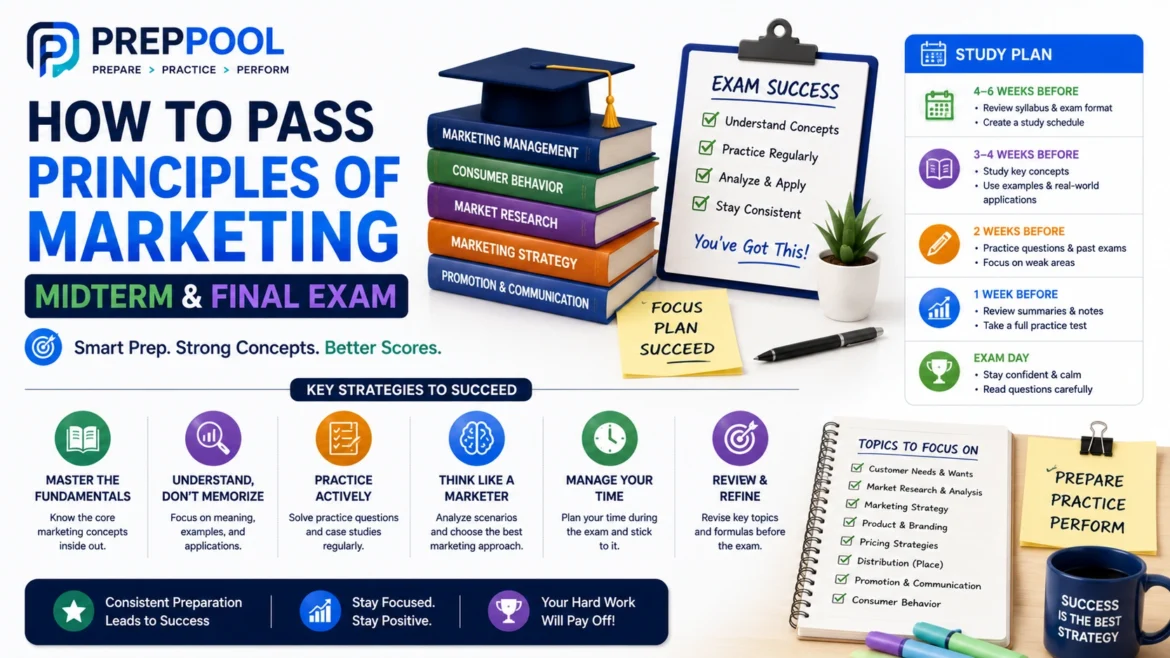
- Marketing Mix (4Ps)
- Consumer Behavior
- Market Segmentation
- Target Marketing
- Positioning Strategies
- Marketing Research
- Branding and Brand Equity
- Pricing Strategies
- Promotion and Advertising
- Relationship Marketing
These topics form the foundation of most Principles of Marketing courses and frequently appear in multiple-choice, short-answer, and case-based questions.
Create a Study Schedule Before the Midterm or Final
One of the most effective ways to improve exam performance is developing a structured study schedule.
Students who spread their preparation across several weeks generally retain information better than those who attempt to study everything in a few days.
A simple study schedule might look like this:
| Study Period | Primary Focus |
|---|---|
| Week 1 | Marketing fundamentals and terminology |
| Week 2 | Consumer behavior and segmentation |
| Week 3 | Marketing mix and positioning |
| Week 4 | Practice questions and review |
Breaking preparation into smaller sections reduces stress and improves long-term retention.
Use Active Learning Instead of Passive Reading
A common mistake students make is repeatedly reading notes without testing their understanding.
While reading can be helpful, active learning methods often produce better results.
Examples include:
- Creating flashcards
- Answering practice questions
- Teaching concepts to classmates
- Analyzing real marketing campaigns
- Creating concept maps
- Summarizing chapters in your own words
These techniques force your brain to retrieve information rather than simply recognize it.
Research consistently shows that retrieval practice improves retention and recall during exams.
How to Study the Marketing Mix More Effectively
The marketing mix is one of the most important topics in Principles of Marketing.
Many students memorize Product, Price, Place, and Promotion but struggle to apply these concepts during exams.
A better approach is to analyze real companies.
For example:
- What products does Apple offer?
- How does Starbucks price its products?
- How does Amazon distribute products?
- How does Nike promote its brand?
Examining real businesses makes abstract concepts easier to understand and remember.
Master Consumer Behavior Before Exam Day
Consumer behavior is another topic that frequently appears on marketing exams.
Students should understand how factors such as culture, social influences, personal preferences, and psychological motivations affect purchasing decisions.
When reviewing consumer behavior, focus on real examples.
Ask yourself why consumers choose one brand over another or why certain products appeal to specific audiences.
This practical approach can improve both understanding and exam performance.
Why Real-World Examples Help Students Learn Faster
Marketing is fundamentally about understanding how businesses interact with customers.
As a result, real-world examples often provide valuable context.
Instead of memorizing a definition of brand positioning, consider how companies such as Tesla, Rolex, Walmart, or Volvo position themselves within the marketplace.
Real examples make concepts easier to visualize and apply during scenario-based questions.
Build a Strong Foundation Before Practicing Questions
Many students rush directly into practice questions without fully understanding the underlying concepts.
While practice questions are valuable, they are most effective when built upon a solid conceptual foundation.
Students who need additional support often benefit from reviewing a comprehensive Principles of Marketing study guide before focusing heavily on exam simulations. Strengthening your understanding of core topics first makes it easier to recognize patterns and answer scenario-based questions accurately.
Once the fundamentals are clear, practice questions become much more useful as a preparation tool.
Learn How to Approach Scenario-Based Marketing Questions
One of the biggest differences between high-performing students and struggling students is their ability to handle scenario-based questions.
Many Principles of Marketing exams include business situations that require students to apply concepts rather than recall definitions.
For example, an instructor may describe a company launching a premium product aimed at affluent consumers and ask students to identify the positioning strategy being used.
Rather than searching for keywords, focus on understanding the business objective behind the scenario.
When answering scenario-based questions:
- Identify the business problem.
- Determine which marketing concept applies.
- Evaluate the available options.
- Select the answer that best aligns with marketing principles.
This approach helps students analyze situations more effectively and reduces the likelihood of choosing answers based solely on memorization.
How to Recognize Marketing Concepts in Exam Questions
Professors often disguise familiar concepts within realistic business situations.
A question may never directly mention terms such as segmentation, positioning, or relationship marketing.
Instead, students must recognize these concepts based on context.
For example:
- Different customer groups may indicate market segmentation.
- A focus on customer loyalty may indicate relationship marketing.
- Premium pricing may suggest a luxury positioning strategy.
- Customer surveys often relate to marketing research.
Developing this skill requires practice and exposure to a variety of marketing scenarios.
Prioritize Understanding Over Memorization
Many students spend hours memorizing definitions but struggle when questions require deeper analysis.
Marketing is not simply about remembering terminology. It is about understanding how organizations create value, satisfy customer needs, and achieve business objectives.
Consider the concept of market segmentation.
Memorizing the definition may help answer a straightforward question, but understanding why businesses segment markets helps students solve more complex problems.
This deeper level of understanding often leads to higher exam scores.
Review the Most Frequently Tested Marketing Concepts
While every instructor designs exams differently, some concepts appear consistently across Principles of Marketing courses.
Students should dedicate extra attention to:
- Marketing Mix (4Ps)
- Consumer Behavior
- Market Segmentation
- Target Marketing
- Positioning Strategies
- Brand Equity
- Marketing Research
- Pricing Strategies
- Digital Marketing
- Customer Relationship Management
These topics often serve as the foundation for more advanced exam questions and business scenarios.
Use Practice Questions to Identify Weak Areas
Practice questions can reveal weaknesses that might otherwise remain unnoticed.
For example, a student may feel confident about branding concepts but consistently miss questions related to pricing strategies or marketing research.
Identifying these weaknesses early allows students to adjust their study plans before the exam.
After completing practice questions, spend time reviewing:
- Why the correct answer is correct
- Why other options are incorrect
- Which concepts need further review
- Recurring mistakes and patterns
This process transforms practice questions into powerful learning opportunities.
How to Manage Your Time During the Exam
Time management is often overlooked during exam preparation.
Many students know the material but lose valuable points because they spend too much time on difficult questions.
Effective time-management strategies include:
- Reading questions carefully before answering
- Answering easier questions first
- Marking difficult questions for review
- Avoiding excessive time on a single problem
- Leaving time for a final review
Following these strategies can improve both accuracy and efficiency during the exam.
Common Mistakes Students Make Before Marketing Exams
Even well-prepared students sometimes make avoidable mistakes.
Common issues include:
- Waiting until the last minute to begin studying
- Focusing only on memorization
- Ignoring practice questions
- Skipping difficult topics
- Overlooking real-world examples
- Studying without a clear plan
Avoiding these mistakes can significantly improve preparation quality and overall exam performance.
Connect Marketing Concepts Together
Marketing concepts rarely operate independently in real organizations.
A company may use market segmentation to identify a target audience, positioning to differentiate its brand, pricing to communicate value, and promotion to attract customers.
Because these concepts are interconnected, professors often design questions that combine multiple topics.
Students who understand these relationships are better equipped to handle complex exam scenarios.
Study Smarter with a Structured Marketing Review Strategy
One effective technique is organizing topics into categories rather than reviewing chapters individually.
For example:
| Category | Topics |
|---|---|
| Customer Analysis | Consumer Behavior, Segmentation, Target Marketing |
| Strategy Development | Positioning, Branding, Competitive Advantage |
| Marketing Mix | Product, Price, Place, Promotion |
| Performance Evaluation | Marketing Research, Customer Satisfaction, Loyalty |
This approach helps students see how concepts fit together within the broader marketing process.
Strengthen Weak Areas Before Exam Week
Many students repeatedly review topics they already understand while avoiding concepts they find challenging.
Unfortunately, this strategy often leads to disappointing results.
The greatest score improvements usually come from addressing weaknesses directly.
If topics such as consumer behavior, market segmentation, or pricing strategies remain confusing, dedicate extra study time to those areas.
Students looking for a more detailed review of foundational concepts often benefit from revisiting a comprehensive marketing concepts review guide. Strengthening core knowledge before exam week can make practice questions and business scenarios much easier to analyze.
Develop Confidence Through Consistent Preparation
Confidence is rarely the result of luck. It is usually the outcome of consistent preparation and repeated exposure to marketing concepts.
Students who follow a structured study plan, complete practice questions, and actively engage with course material often approach exams with greater confidence and less stress.
The goal is not simply to memorize information for test day. The goal is to understand how marketing principles operate in real business environments and apply that knowledge effectively during the exam.
Create a Final Week Study Plan Before the Exam
The final week before a Principles of Marketing midterm or final exam should focus on review and reinforcement rather than learning entirely new material.
Many students make the mistake of trying to cover every chapter repeatedly during the last few days. This often leads to information overload and unnecessary stress.
A more effective approach is to focus on high-priority concepts and identified weak areas.
A sample final-week review plan may include:
- Day 1: Consumer Behavior and Market Segmentation
- Day 2: Target Marketing and Positioning
- Day 3: Marketing Mix (4Ps)
- Day 4: Branding and Relationship Marketing
- Day 5: Marketing Research and Digital Marketing
- Day 6: Practice Questions and Scenario Analysis
- Day 7: Light Review and Exam Preparation
This structured approach helps maintain focus while ensuring balanced coverage of important topics.
How to Use Practice Questions the Right Way
Practice questions are most effective when used as learning tools rather than score-tracking exercises.
Many students complete large numbers of questions but spend very little time reviewing their mistakes.
To maximize learning:
- Read explanations carefully.
- Identify why incorrect answers were wrong.
- Review related concepts.
- Track recurring mistakes.
- Focus on understanding patterns.
Students who analyze mistakes often improve much faster than those who simply complete more questions.
If you want additional examples of how professors structure marketing assessments, reviewing common Principles of Marketing exam question formats can help you become more comfortable with scenario-based and application-focused questions.
Prepare for Multiple-Choice Questions Strategically
Most Principles of Marketing midterms and finals include multiple-choice questions.
Although these questions may appear straightforward, they often contain answer choices that seem similar.
When answering multiple-choice questions:
- Read every answer option carefully.
- Look for key marketing concepts.
- Eliminate clearly incorrect choices.
- Focus on the business objective in the question.
- Avoid selecting answers based solely on familiar terminology.
Many incorrect answers are designed to appear plausible. Careful analysis is often more important than speed.
Use Real Companies to Improve Memory Retention
One of the easiest ways to remember marketing concepts is connecting them to companies you already know.
For example:
- Apple demonstrates strong product differentiation.
- Starbucks illustrates relationship marketing.
- Walmart emphasizes value-based positioning.
- Nike showcases powerful branding strategies.
- Amazon highlights distribution and customer convenience.
These real-world examples help transform abstract concepts into memorable business situations.
During exams, recalling actual companies often makes it easier to identify the correct marketing principle being tested.
What to Do the Night Before the Exam
The night before your exam is not the time for marathon study sessions.
At this stage, your goal should be reinforcing confidence and maintaining focus.
Recommended activities include:
- Reviewing summary notes
- Reading key definitions
- Reviewing major frameworks
- Completing a small number of practice questions
- Preparing materials for exam day
- Getting adequate rest
Students who arrive rested and focused often perform better than those who stay awake trying to memorize additional information.
Exam-Day Strategies That Can Improve Performance
How you approach the exam can influence your results almost as much as your preparation.
On exam day:
- Read instructions carefully.
- Manage your time effectively.
- Answer easy questions first.
- Mark difficult questions for review.
- Stay calm when encountering unfamiliar scenarios.
- Review answers if time permits.
Maintaining composure allows you to think more clearly and apply marketing concepts effectively.
How to Handle Difficult Marketing Scenarios
Occasionally, you may encounter a question that seems confusing or unfamiliar.
Instead of panicking, break the scenario into smaller components.
Ask yourself:
- What business objective is being described?
- Which marketing concept appears most relevant?
- What customer need is being addressed?
- Which answer aligns with marketing principles?
This systematic approach often helps reveal the correct answer even when the scenario initially appears challenging.
Why Consistency Beats Last-Minute Cramming
One of the most important lessons students can learn is that effective exam preparation is built through consistency.
Studying for short periods over several weeks generally produces better results than attempting to learn everything at once.
Consistent preparation:
- Improves retention
- Reduces stress
- Builds confidence
- Strengthens understanding
- Supports long-term learning
These benefits often extend beyond the classroom and contribute to stronger business knowledge overall.
Why Marketing Knowledge Matters Beyond the Exam
Although passing the midterm or final exam may be your immediate goal, the concepts learned in Principles of Marketing have practical value far beyond the classroom.
Marketing knowledge supports careers in:
- Business Management
- Advertising
- Sales
- Entrepreneurship
- Digital Marketing
- Public Relations
- Consulting
- Business Development
Understanding how organizations attract customers, create value, and build relationships remains valuable in almost every industry.
Final Thoughts
Passing a Principles of Marketing midterm or final exam is achievable for students who approach preparation strategically.
Rather than relying solely on memorization, focus on understanding how marketing concepts apply in real-world business situations.
Develop a study schedule, review key topics consistently, practice with realistic questions, and learn from your mistakes.
By combining conceptual understanding with practical application, students can improve exam performance while developing marketing knowledge that remains useful long after the course is complete.
For students seeking additional preparation, many find it helpful to combine concept review with realistic practice materials. The Principles of Marketing practice exam resource provides exam-style questions designed to reinforce important topics and improve confidence before test day.
Frequently Asked Questions
What is the best way to study for a Principles of Marketing exam?
The most effective approach combines concept review, real-world examples, practice questions, and consistent study sessions spread over several weeks.
Which topics appear most often on Principles of Marketing midterms and finals?
Marketing Mix (4Ps), consumer behavior, segmentation, targeting, positioning, branding, pricing, promotion, marketing research, and relationship marketing are among the most frequently tested topics.
Are marketing exams based more on memorization or application?
Most Principles of Marketing exams emphasize application. Students are often asked to analyze business scenarios and apply marketing concepts rather than simply recall definitions.
How important are practice questions for marketing exam preparation?
Practice questions help students identify weak areas, understand question formats, improve critical thinking, and become more comfortable with scenario-based assessments.
Can I pass a Principles of Marketing final exam without prior marketing experience?
Yes. Most Principles of Marketing courses are designed for students learning marketing concepts for the first time. Consistent preparation and effective study strategies can lead to strong exam performance.