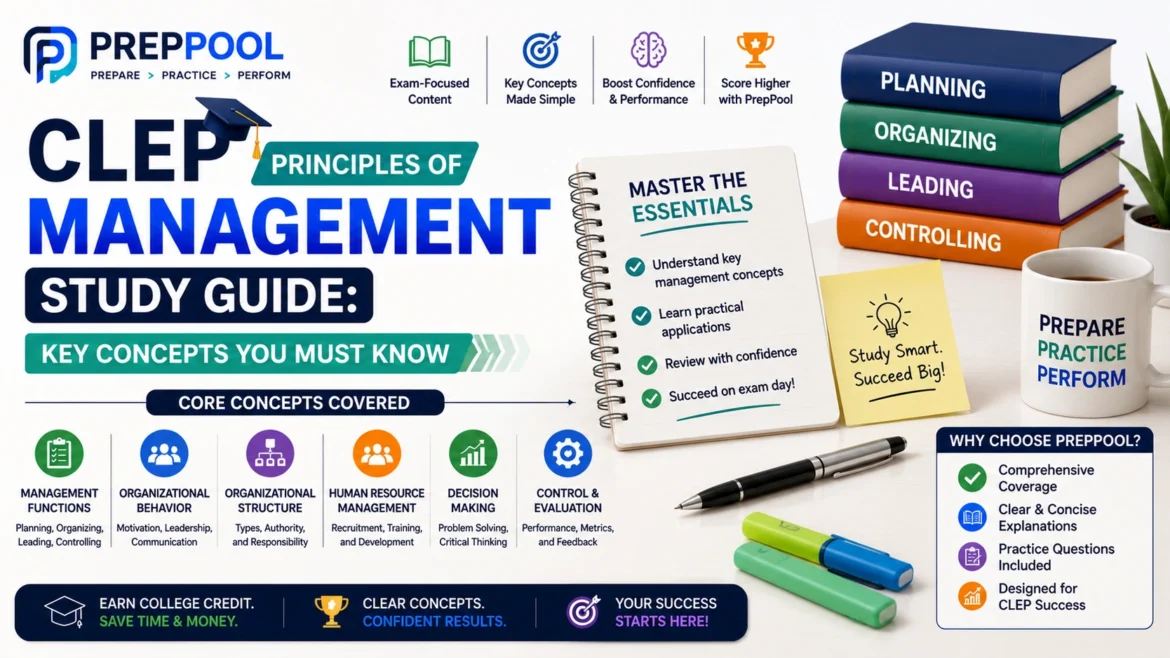

Management plays a critical role in every successful organization. Whether leading a small startup, managing a multinational corporation, or coordinating a nonprofit organization, effective managers help businesses achieve goals, solve problems, and adapt to changing environments.
For students preparing for the CLEP Principles of Management exam, understanding management concepts is essential. The exam evaluates knowledge of key management theories, organizational structures, leadership principles, planning processes, and decision-making strategies commonly taught in introductory management courses.
Many candidates mistakenly believe management is simply about supervising employees. In reality, management involves coordinating resources, motivating teams, making strategic decisions, and ensuring organizational objectives are achieved efficiently and effectively.
This study guide explores the most important Principles of Management concepts, explains how they apply in real organizations, and helps students build a strong foundation before exam day.
- The four primary functions of management
- Management roles and responsibilities
- Planning and organizational strategies
- Decision-making processes
- Leadership and motivation concepts
- Organizational structures and management theories
- Key management topics frequently tested on exams
What Is Management?
Management is the process of planning, organizing, leading, and controlling resources to achieve organizational goals.
Resources can include people, finances, technology, information, equipment, and physical assets. Managers are responsible for coordinating these resources in ways that maximize productivity and support organizational success.
Effective management helps organizations:
- Improve efficiency
- Increase productivity
- Achieve strategic objectives
- Adapt to change
- Maintain competitiveness
- Develop employee performance
Management principles apply across virtually every industry, including healthcare, technology, education, manufacturing, retail, government, and nonprofit organizations.
Why Management Matters in Modern Organizations
Organizations face increasingly complex challenges. Global competition, technological innovation, changing consumer expectations, and economic uncertainty require businesses to make informed decisions quickly and effectively.
Managers help organizations navigate these challenges by coordinating activities, allocating resources, and guiding employees toward common objectives.
Without effective management, organizations often experience:
- Poor communication
- Reduced productivity
- Inefficient operations
- Employee dissatisfaction
- Missed business opportunities
- Strategic confusion
This is one reason management remains a foundational subject in business education and a core topic on the CLEP Principles of Management exam.
The Four Functions of Management
One of the most important concepts students must understand is the four functions of management. These functions form the foundation of management theory and frequently appear on CLEP exams.
| Management Function | Purpose |
|---|---|
| Planning | Establish goals and determine actions needed to achieve them |
| Organizing | Arrange resources and assign responsibilities |
| Leading | Motivate and guide employees toward objectives |
| Controlling | Monitor performance and make adjustments when necessary |
Understanding how these functions interact is essential because many exam questions involve applying them to business scenarios.
Planning: The Foundation of Effective Management
Planning is often considered the most important management function because it establishes direction for the entire organization.
Managers use planning to define goals, evaluate alternatives, allocate resources, and prepare for future challenges.
Effective planning helps organizations:
- Reduce uncertainty
- Improve decision-making
- Coordinate activities
- Increase efficiency
- Identify opportunities and threats
For example, a company planning to expand into international markets must evaluate customer demand, regulatory requirements, competition, and financial resources before launching operations.
Questions involving planning often appear on management exams because planning influences nearly every organizational activity.
Types of Organizational Planning
Managers use different planning approaches depending on organizational needs and time horizons.
Strategic Planning
Strategic planning focuses on long-term organizational goals and overall direction.
Senior managers typically develop strategic plans that guide major business decisions.
Tactical Planning
Tactical planning translates strategic objectives into specific departmental actions.
Middle managers frequently use tactical plans to support broader organizational goals.
Operational Planning
Operational planning addresses day-to-day activities and short-term objectives.
Front-line managers often rely on operational plans to coordinate routine operations.
Students should understand the differences among these planning levels because exam questions frequently compare them.
Organizing: Turning Plans into Action
Once goals have been established, managers must organize resources to achieve them.
Organizing involves determining how work will be divided, who will perform specific tasks, and how resources will be allocated.
Key organizing activities include:
- Assigning responsibilities
- Creating departments
- Defining reporting relationships
- Allocating resources
- Establishing workflows
Effective organizing ensures employees understand their roles and responsibilities while supporting efficient operations.
Organizational Structures Every Student Should Know
Organizations use various structural designs to coordinate activities and support business objectives.
The most common organizational structures include:
- Functional Structure
- Divisional Structure
- Matrix Structure
- Team-Based Structure
- Flat Structure
Each structure offers advantages and disadvantages depending on organizational size, strategy, and operating environment.
For example, a functional structure groups employees according to specialized areas such as marketing, finance, human resources, and operations.
Understanding these structures is important because management exams frequently include questions about organizational design and reporting relationships.
Decision-Making: A Core Management Responsibility
Managers make decisions every day. Some decisions involve routine operational issues, while others influence the future direction of entire organizations.
Effective decision-making requires gathering information, evaluating alternatives, and selecting the most appropriate course of action.
A typical decision-making process includes:
- Identifying a problem or opportunity.
- Collecting relevant information.
- Generating possible solutions.
- Evaluating alternatives.
- Selecting and implementing a solution.
- Monitoring results.
Many CLEP Principles of Management questions present business situations and ask candidates to identify the most effective management response.
Students preparing for management-related exams often benefit from combining concept review with realistic practice questions. Resources such as the CLEP Principles of Management practice exam resources can help reinforce key management topics while improving familiarity with exam-style questions.
Real-World Example: Management in Action
Consider a growing technology company preparing to launch a new software platform.
Managers begin by planning product development timelines, organizing project teams, leading employees throughout implementation, and monitoring performance metrics after launch.
This example demonstrates how the four management functions work together in real business environments.
Understanding these practical applications can make management concepts easier to remember and apply during exam scenarios.
Leading: Inspiring Employees to Achieve Organizational Goals
While planning and organizing establish direction and structure, leading focuses on motivating employees and guiding them toward organizational success.
Leadership is one of the most visible responsibilities of management because it directly influences employee performance, engagement, and workplace culture.
Effective leaders help employees:
- Understand organizational goals
- Stay motivated
- Develop new skills
- Collaborate effectively
- Adapt to change
- Maintain high performance standards
Many CLEP Principles of Management questions explore how managers use leadership techniques to address workplace challenges and improve team effectiveness.
Common Leadership Styles Every Student Should Know
Different situations often require different leadership approaches. Managers must understand how leadership styles influence employee behavior and organizational outcomes.
| Leadership Style | Characteristics |
|---|---|
| Autocratic | Manager makes decisions with minimal employee input |
| Democratic | Employees participate in decision-making processes |
| Laissez-Faire | Employees receive substantial autonomy and independence |
| Transformational | Leaders inspire employees through vision and innovation |
| Transactional | Performance is managed through rewards and consequences |
Students should understand when each leadership style may be effective and the advantages and disadvantages associated with each approach.
Transformational vs. Transactional Leadership
Modern management courses frequently emphasize transformational and transactional leadership because these approaches remain highly relevant in today’s organizations.
Transformational Leadership
Transformational leaders motivate employees by communicating a compelling vision, encouraging innovation, and fostering personal development.
Characteristics include:
- Inspiration
- Creativity
- Employee empowerment
- Long-term organizational growth
Transactional Leadership
Transactional leaders focus on performance, accountability, and clearly defined expectations.
Characteristics include:
- Performance monitoring
- Rewards and incentives
- Structured supervision
- Short-term objectives
Exam questions often compare these leadership approaches and ask students to identify which style best fits a particular organizational situation.
Motivation: Why Employees Perform at Different Levels
Understanding employee motivation is one of the most important areas of management study.
Organizations invest significant resources in motivating employees because motivation influences productivity, job satisfaction, retention, and overall performance.
Managers who understand motivation can create environments that encourage employees to contribute their best efforts.
Several motivation theories frequently appear on management exams.
Maslow’s Hierarchy of Needs
Abraham Maslow proposed that human needs exist in a hierarchy, with lower-level needs generally requiring satisfaction before higher-level needs become important.
| Need Level | Examples |
|---|---|
| Physiological Needs | Food, water, shelter |
| Safety Needs | Security, stability, protection |
| Social Needs | Friendship, belonging, teamwork |
| Esteem Needs | Recognition, achievement, status |
| Self-Actualization | Personal growth, fulfillment, creativity |
Students should understand how organizations address these needs through compensation, workplace culture, recognition programs, and career development opportunities.
Herzberg’s Two-Factor Theory
Frederick Herzberg suggested that job satisfaction and dissatisfaction are influenced by different factors.
According to Herzberg:
- Hygiene Factors prevent dissatisfaction.
- Motivators increase job satisfaction.
Examples of hygiene factors include salary, working conditions, and company policies.
Examples of motivators include achievement, recognition, responsibility, and opportunities for advancement.
Many management exam questions require students to distinguish between these categories.
Human Resource Management and Employee Development
Human resource management (HRM) focuses on attracting, developing, and retaining employees.
Because employees are often an organization’s most valuable asset, HRM plays a crucial role in long-term success.
Key HRM activities include:
- Recruitment
- Selection
- Training
- Performance evaluation
- Compensation management
- Employee relations
Students should understand how HRM supports organizational goals by ensuring the right people are placed in the right positions.
Communication in Organizations
Effective communication is essential for successful management.
Without clear communication, organizations often experience misunderstandings, reduced productivity, and employee frustration.
Managers communicate information in multiple directions.
Downward Communication
Information flows from managers to employees.
Examples include:
- Instructions
- Policies
- Performance expectations
Upward Communication
Information flows from employees to management.
Examples include:
- Feedback
- Suggestions
- Status reports
Horizontal Communication
Information flows between employees or departments operating at similar levels.
This type of communication supports collaboration and coordination.
Questions involving communication barriers and organizational communication methods frequently appear on management exams.
Managing Teams in Modern Organizations
Most organizations rely heavily on teams to complete projects and solve problems.
As a result, managers must understand how teams function and how to improve team performance.
Characteristics of effective teams include:
- Clear objectives
- Defined roles
- Open communication
- Mutual trust
- Collaboration
- Accountability
Team management questions often focus on conflict resolution, communication challenges, and leadership responsibilities.
Organizational Culture: The Invisible Force That Shapes Behavior
Organizational culture refers to the shared values, beliefs, norms, and behaviors that influence how employees interact and perform within an organization.
A strong organizational culture can:
- Improve employee engagement
- Increase productivity
- Support strategic goals
- Enhance customer experiences
- Strengthen employee retention
Companies such as Google, Southwest Airlines, and Disney are often cited as examples of organizations with strong cultures that contribute to business success.
Because culture influences leadership, communication, motivation, and decision-making, it remains an important topic in management education.
Real-World Example: Leadership During Organizational Change
Imagine a retail company implementing a new technology platform across hundreds of locations.
Managers must communicate the reasons for change, train employees, address concerns, maintain morale, and monitor performance throughout the transition.
Success depends not only on technical implementation but also on leadership, communication, motivation, and team management.
This example demonstrates how management concepts often work together in real organizations, which is why exam questions frequently combine multiple topics within a single scenario.
Students who understand how these concepts connect are typically better prepared for management-related assessments and business decision-making situations.
Controlling: Measuring Performance and Achieving Goals
The final function of management is controlling. While planning establishes goals, organizing allocates resources, and leading motivates employees, controlling ensures that organizational activities remain aligned with objectives.
Managers use controlling processes to evaluate performance, identify deviations from plans, and implement corrective actions when necessary.
Effective control systems help organizations:
- Maintain quality standards
- Improve productivity
- Reduce waste
- Monitor progress toward goals
- Identify operational problems
- Support continuous improvement
Without effective controls, organizations may struggle to achieve desired outcomes even when planning and leadership efforts are strong.
The Control Process Explained
Most management textbooks describe controlling as a systematic process involving several key steps.
- Establish performance standards.
- Measure actual performance.
- Compare results with standards.
- Identify variances.
- Take corrective action when needed.
Managers use this process to evaluate everything from employee productivity and customer satisfaction to financial performance and operational efficiency.
Questions involving performance measurement and corrective action frequently appear on Principles of Management exams.
Classical Management Theory
To understand modern management practices, students should first understand the historical theories that shaped management thinking.
Classical management theory emerged during the Industrial Revolution when organizations sought more efficient ways to manage growing workforces and production systems.
Several influential thinkers contributed to classical management theory.
Frederick Taylor and Scientific Management
Frederick Winslow Taylor is often referred to as the father of scientific management.
Taylor believed organizations could improve productivity by analyzing work processes scientifically and identifying the most efficient methods for completing tasks.
Scientific management emphasizes:
- Efficiency improvement
- Standardized procedures
- Performance measurement
- Worker productivity
- Task specialization
Although modern organizations have evolved significantly since Taylor’s era, his ideas continue to influence management practices today.
Henri Fayol and Administrative Management
Henri Fayol focused on the broader responsibilities of managers rather than individual worker productivity.
He introduced many concepts that remain important in contemporary management education.
Fayol identified management activities such as:
- Planning
- Organizing
- Commanding
- Coordinating
- Controlling
Many modern management frameworks build upon Fayol’s foundational ideas.
Max Weber and Bureaucratic Management
Max Weber proposed a bureaucratic model of management based on formal rules, clearly defined responsibilities, and hierarchical authority structures.
Characteristics of bureaucratic organizations include:
- Clearly defined roles
- Formal procedures
- Structured authority relationships
- Objective decision-making
- Consistency and predictability
While bureaucracy is sometimes criticized for being rigid, many organizations continue to use bureaucratic principles to ensure fairness and consistency.
Modern Management Approaches
Management theories have evolved considerably over time.
Modern organizations operate in dynamic environments that require flexibility, innovation, and adaptability.
Contemporary management approaches often emphasize:
- Employee involvement
- Teamwork
- Innovation
- Continuous improvement
- Customer focus
- Organizational learning
Students should understand how management theory has progressed from highly structured systems toward more collaborative and adaptive approaches.
Strategic Management and Organizational Success
Strategic management focuses on developing long-term plans that help organizations achieve competitive advantages.
Managers must continuously evaluate both internal capabilities and external environmental factors when making strategic decisions.
Strategic management often involves:
- Goal setting
- Environmental analysis
- Resource allocation
- Competitive positioning
- Performance evaluation
Many management exam questions involve strategic thinking and require students to evaluate organizational decisions from a long-term perspective.
Understanding SWOT Analysis
One of the most widely used strategic management tools is SWOT analysis.
SWOT helps organizations evaluate internal and external factors that influence performance.
| SWOT Element | Description |
|---|---|
| Strengths | Internal advantages and capabilities |
| Weaknesses | Internal limitations and challenges |
| Opportunities | External factors that may support growth |
| Threats | External factors that may create risks |
Students frequently encounter SWOT-related questions because the framework provides a simple way to evaluate strategic situations.
Global Management in Today’s Business Environment
Many organizations operate across multiple countries and cultures.
As a result, managers must understand how globalization influences business operations.
Global management challenges include:
- Cultural differences
- International regulations
- Communication barriers
- Economic conditions
- Political environments
- Global competition
Managers who understand global business dynamics are often better equipped to lead organizations in an increasingly interconnected world.
How Management Concepts Work Together
One of the biggest challenges students face is viewing management topics as separate concepts.
In reality, effective management requires integrating multiple principles simultaneously.
Consider a company launching a new product.
Managers must:
- Develop strategic plans.
- Organize teams and resources.
- Lead employees throughout implementation.
- Monitor performance results.
- Communicate effectively.
- Motivate employees.
- Adapt to changing market conditions.
Understanding these relationships can significantly improve performance on scenario-based CLEP questions.
Building Confidence Before the CLEP Principles of Management Exam
Successful preparation requires both conceptual understanding and familiarity with exam-style questions.
Students should review major management theories, practice applying concepts to real-world situations, and identify areas that require additional study.
Many candidates strengthen their preparation by combining concept review with realistic practice materials. Resources such as the CLEP Principles of Management practice questions and answers can help reinforce key topics while improving confidence before exam day.
Final Thoughts
The CLEP Principles of Management exam covers a broad range of topics, from planning and organizing to leadership, motivation, communication, strategic management, and organizational theory.
Students who understand how these concepts connect together are often better prepared than those who rely solely on memorization.
By focusing on practical applications, reviewing major management theories, and studying real-world examples, candidates can build the knowledge and confidence needed to perform well on the exam.
Management principles remain relevant far beyond the classroom. Whether pursuing careers in business, entrepreneurship, healthcare, technology, government, or nonprofit organizations, understanding effective management practices can provide lasting professional value.
Frequently Asked Questions
What topics are most important for the CLEP Principles of Management exam?
The most important topics include planning, organizing, leading, controlling, leadership theories, motivation theories, communication, organizational structures, strategic management, and management theory.
What are the four functions of management?
The four functions are planning, organizing, leading, and controlling. These functions form the foundation of management practice and frequently appear on CLEP exam questions.
Why are leadership theories important in management?
Leadership theories help explain how managers influence employees, improve performance, motivate teams, and achieve organizational objectives.
What is SWOT analysis in management?
SWOT analysis is a strategic planning tool used to evaluate an organization’s strengths, weaknesses, opportunities, and threats.
How can I prepare effectively for the CLEP Principles of Management exam?
Review management concepts thoroughly, study leadership and motivation theories, analyze business scenarios, and practice with exam-style questions to strengthen understanding and confidence.