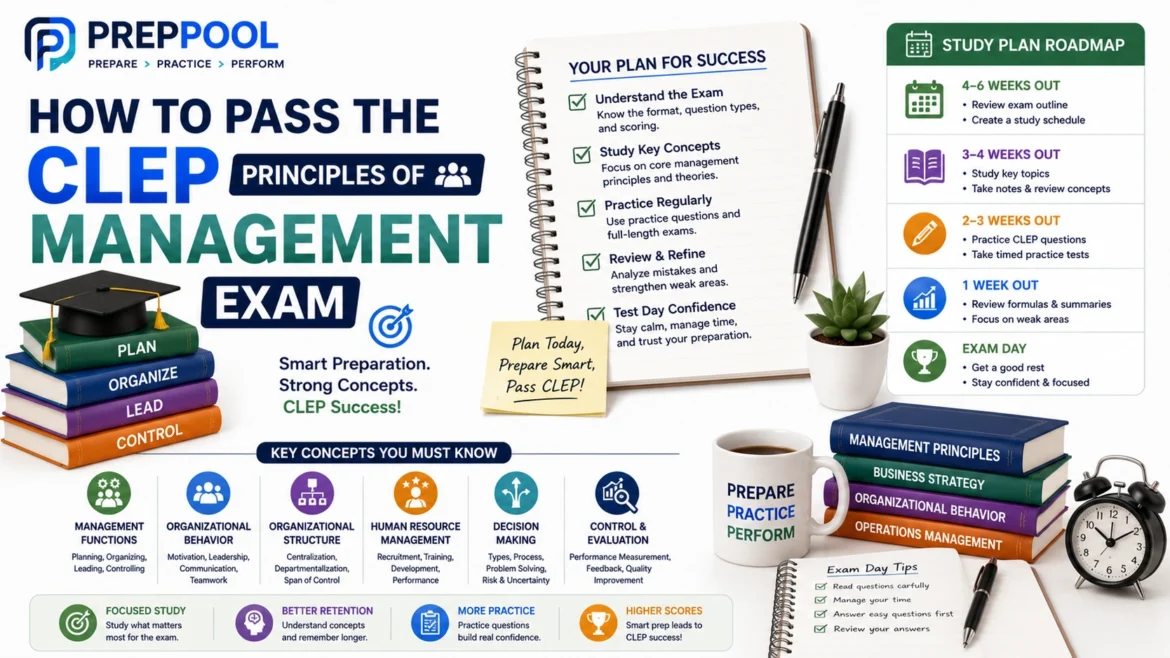

Preparing for the CLEP Principles of Management exam can feel overwhelming, especially for students balancing work, family responsibilities, college courses, or other commitments. The exam covers a broad range of management topics, including planning, organizing, leadership, motivation, communication, decision-making, organizational structures, and strategic management.
Many candidates are attracted to CLEP exams because they provide an opportunity to earn college credit while saving both time and money. However, success requires more than simply reading a textbook or reviewing a few management definitions.
The most successful candidates approach preparation strategically. They focus on understanding core management concepts, practicing exam-style questions, and developing effective study habits long before exam day.
This guide explores proven preparation strategies that can help students improve confidence, strengthen management knowledge, and increase their chances of passing the CLEP Principles of Management exam.
- How the CLEP Principles of Management exam is structured
- The most important topics to study
- How to create an effective study plan
- Common mistakes candidates make
- How to use practice questions effectively
- Time-management techniques
- Exam-day success strategies
Why Students Choose the CLEP Principles of Management Exam
The College-Level Examination Program (CLEP) allows students to demonstrate knowledge acquired through work experience, independent study, military service, professional development, or previous coursework.
For many individuals, CLEP exams provide a faster route toward earning college credit without completing a traditional semester-long course.
Benefits often include:
- Saving tuition costs
- Accelerating degree completion
- Receiving recognition for existing knowledge
- Reducing overall academic workload
- Creating more flexible educational pathways
Because of these advantages, thousands of students take CLEP exams each year as part of their academic plans.
Understand What the Exam Is Really Testing
One of the biggest mistakes candidates make is assuming the exam focuses solely on memorization.
While understanding key management terminology is important, the CLEP Principles of Management exam also evaluates whether candidates can apply concepts to realistic business situations.
Questions often require students to:
- Analyze management scenarios
- Evaluate leadership approaches
- Interpret organizational challenges
- Apply management theories
- Recommend effective solutions
Students who understand how management concepts work in practice are often better prepared than those who focus exclusively on definitions.
Start with the Most Important Management Topics
Not all topics carry equal importance during preparation.
While candidates should aim for comprehensive coverage, certain concepts consistently appear throughout management courses and CLEP exam content.
High-priority study areas include:
- The Four Functions of Management
- Leadership Theories
- Motivation Theories
- Organizational Structures
- Decision-Making Processes
- Strategic Management
- Communication in Organizations
- Human Resource Management
- Team Management
- Organizational Culture
Developing a strong understanding of these concepts creates a foundation for answering more complex scenario-based questions.
Create a Study Schedule That Fits Your Lifestyle
One reason many candidates struggle is inconsistency.
Studying intensely for a few days and then taking long breaks often produces weaker results than shorter, consistent study sessions.
A realistic study schedule should match your available time and learning preferences.
| Week | Primary Focus |
|---|---|
| Week 1 | Management Functions and Planning |
| Week 2 | Organizing and Organizational Structures |
| Week 3 | Leadership and Motivation |
| Week 4 | Communication and Human Resources |
| Week 5 | Strategic Management and Decision-Making |
| Week 6 | Review and Practice Questions |
This type of structured approach helps prevent information overload while ensuring adequate coverage of major topics.
Build a Strong Foundation Before Taking Practice Tests
Many candidates immediately begin taking practice exams before they fully understand management concepts.
Although practice questions are valuable, they are most effective when supported by a strong conceptual foundation.
Before focusing heavily on exam simulations, students should understand:
- Management terminology
- Leadership principles
- Organizational structures
- Motivation theories
- Communication processes
- Strategic planning concepts
A solid foundation makes it easier to recognize patterns and apply concepts during more challenging questions.
Use Active Learning Techniques
Passive reading often creates the illusion of learning without producing long-term retention.
Active learning strategies generally help students remember information more effectively.
Examples include:
- Creating flashcards
- Teaching concepts to others
- Answering practice questions
- Summarizing chapters in your own words
- Analyzing real-world management situations
- Building concept maps
These methods encourage deeper engagement with management concepts and improve recall during the exam.
Learn Management Through Real-World Examples
Management concepts become easier to understand when connected to actual organizations.
For example:
- Apple demonstrates strategic leadership and innovation.
- Amazon showcases operational efficiency and organizational scalability.
- Southwest Airlines is often cited for strong organizational culture.
- Toyota is known for continuous improvement and quality management.
Studying real organizations can help candidates understand how management principles operate in practice.
Focus on Understanding, Not Memorization
Many exam questions require candidates to apply concepts to unfamiliar situations.
This means understanding why management principles work is often more important than memorizing isolated facts.
For example, understanding why transformational leadership motivates employees is generally more useful than memorizing a textbook definition.
When reviewing material, ask yourself:
- Why is this concept important?
- How would a manager use it?
- What problem does it solve?
- What would happen if it were ignored?
These questions promote deeper understanding and better exam performance.
Strengthen Your Foundation with Concept Review
Before moving into intensive exam practice, candidates should ensure they understand the core management principles covered throughout the exam.
Students seeking a comprehensive overview of planning, organizing, leadership, motivation, communication, and strategic management often benefit from reviewing a detailed CLEP Principles of Management study guide. Building a strong conceptual foundation first makes practice questions and management scenarios much easier to analyze accurately.
Once the fundamentals are clear, exam preparation becomes significantly more efficient.
Understand How Scenario-Based Questions Work
One of the most important skills for CLEP Principles of Management candidates is the ability to analyze management scenarios.
Many exam questions are written as short business situations rather than direct definition questions.
For example, a question may describe a manager attempting to improve employee performance, resolve a workplace conflict, or implement organizational change. Candidates must identify which management principle, leadership approach, or decision-making strategy is most appropriate.
These questions evaluate practical understanding rather than simple memorization.
When approaching scenario-based questions, focus on:
- The problem being described
- The manager’s objective
- The employees involved
- The organizational context
- The management concept that best applies
This process can help candidates identify the correct answer more consistently.
How to Analyze Management Questions More Effectively
Many candidates rush through questions and immediately search for familiar keywords.
Unfortunately, this approach often leads to avoidable mistakes.
A better strategy involves carefully evaluating the situation before selecting an answer.
Try asking yourself:
- What challenge is the organization facing?
- What is the manager attempting to accomplish?
- Which management concept best addresses the situation?
- Which answer aligns most closely with effective management principles?
This structured approach can improve accuracy, particularly on complex questions.
Focus on Leadership and Motivation Concepts
Leadership and motivation are among the most frequently tested areas within management education.
Candidates should understand:
- Leadership styles
- Transformational leadership
- Transactional leadership
- Maslow’s Hierarchy of Needs
- Herzberg’s Two-Factor Theory
- Employee motivation strategies
Exam questions often require students to identify which leadership approach or motivational technique would be most effective in a particular workplace situation.
Understanding how these concepts influence employee behavior can significantly improve performance on management-related questions.
Practice Applying the Four Functions of Management
The four functions of management—planning, organizing, leading, and controlling—form the foundation of many exam questions.
Candidates should be able to recognize these functions in realistic business situations.
For example:
| Situation | Management Function |
|---|---|
| Developing company goals | Planning |
| Assigning employee responsibilities | Organizing |
| Motivating team members | Leading |
| Monitoring performance results | Controlling |
Questions often require candidates to identify which management function is being performed within a given scenario.
Use Practice Questions to Improve Decision-Making Skills
Practice questions do more than measure knowledge. They help candidates learn how management concepts are tested.
Each practice question presents an opportunity to:
- Apply management theories
- Strengthen decision-making skills
- Identify weak areas
- Improve confidence
- Become familiar with exam language
After completing practice questions, spend time reviewing explanations carefully.
Understanding why an answer is correct often provides more value than simply knowing whether it was correct.
Common Mistakes CLEP Principles of Management Candidates Make
Many candidates lose points because of preventable mistakes rather than a lack of knowledge.
Common preparation mistakes include:
- Waiting too long to begin studying
- Focusing only on memorization
- Ignoring leadership theories
- Neglecting organizational structure concepts
- Skipping practice questions
- Failing to review incorrect answers
Recognizing these mistakes early can help candidates create a more effective study strategy.
Strengthen Weak Areas Before Exam Week
Many students spend most of their time reviewing topics they already understand.
While this may feel productive, it often limits overall improvement.
Greater progress usually comes from focusing on areas that remain difficult.
If concepts such as organizational structures, motivation theories, communication processes, or strategic management remain challenging, dedicate additional review time to those subjects.
Addressing weaknesses before exam week can significantly improve overall readiness.
How to Organize Your Management Notes Efficiently
Management courses cover a wide range of topics. Organizing information into logical categories can make studying more efficient.
One useful approach is grouping concepts into major management themes.
| Category | Topics |
|---|---|
| Management Functions | Planning, Organizing, Leading, Controlling |
| People Management | Leadership, Motivation, Communication |
| Organizational Design | Structures, Culture, Teams |
| Strategic Management | Decision-Making, SWOT, Long-Term Planning |
This method helps candidates see how management concepts connect together rather than viewing them as isolated topics.
Review Core Concepts Before Intensive Practice Testing
Practice exams are most effective when candidates already understand the underlying management principles.
Students who need additional reinforcement often benefit from revisiting a comprehensive management concepts review resource before increasing the number of practice questions they complete. A stronger conceptual foundation usually leads to better performance on application-based and scenario-driven questions.
Build Confidence Through Repetition and Consistency
Confidence does not come from last-minute cramming. It develops through repeated exposure to management concepts, regular review sessions, and consistent practice.
Candidates who follow a structured study plan and gradually build their knowledge often feel more comfortable approaching unfamiliar scenarios during the exam.
The goal is not simply to memorize information long enough to pass a test. The goal is to understand management principles well enough to apply them effectively in both exam situations and real organizational environments.
Create a Final Review Plan Before Exam Day
The final week before the CLEP Principles of Management exam should focus on reinforcing knowledge rather than attempting to learn entirely new material.
Many candidates make the mistake of reviewing every topic repeatedly during the final few days. This approach often creates stress and information overload.
Instead, focus on high-priority concepts and areas where you still feel uncertain.
A practical final-week review plan may look like this:
- Day 1: Management Functions and Planning
- Day 2: Organizing and Organizational Structures
- Day 3: Leadership Theories
- Day 4: Motivation and Human Resource Management
- Day 5: Communication and Team Management
- Day 6: Strategic Management and Decision-Making
- Day 7: Practice Questions and Light Review
This structure helps ensure balanced coverage while reducing last-minute stress.
Use Practice Exams Strategically
Practice exams are among the most valuable preparation tools available to management students.
However, simply completing practice questions is not enough.
The greatest learning often occurs during review.
After completing a practice exam:
- Review incorrect answers carefully.
- Identify weak concepts.
- Analyze recurring mistakes.
- Revisit related management theories.
- Track improvement over time.
Students who actively learn from mistakes often improve more quickly than those who focus only on scores.
Many candidates strengthen their readiness by incorporating realistic CLEP Principles of Management practice exam into their study routine. Exposure to exam-style questions can improve familiarity with management scenarios and reduce uncertainty on test day.
Manage Your Time During the Exam
Strong time management can significantly influence overall performance.
Even candidates who understand the material may struggle if they spend too much time on difficult questions.
Effective exam-day time-management strategies include:
- Reading questions carefully before answering.
- Answering easier questions first.
- Marking difficult questions for later review.
- Avoiding excessive time on a single item.
- Leaving time to review answers before submitting.
Maintaining a steady pace can help reduce stress and improve accuracy.
How to Handle Difficult Management Questions
Most candidates encounter a few questions that seem unfamiliar or confusing.
When this happens, avoid panic and focus on the underlying management principles.
Ask yourself:
- What organizational challenge is being described?
- Which management function is involved?
- What would an effective manager do in this situation?
- Which answer best supports organizational goals?
This method often helps narrow answer choices and identify the most logical response.
Learn From Real Organizations
Management concepts become easier to understand when connected to actual business examples.
Many successful organizations illustrate management principles in action.
Examples include:
- Google’s emphasis on innovation and leadership.
- Toyota’s commitment to continuous improvement.
- Amazon’s focus on operational efficiency.
- Southwest Airlines’ strong organizational culture.
- Microsoft’s approach to organizational transformation.
Exam questions often mirror real-world business situations, making practical examples useful study tools.
Why Consistency Outperforms Cramming
One of the most important lessons candidates can learn is that effective preparation happens gradually.
Short, consistent study sessions generally produce stronger long-term retention than marathon study sessions completed immediately before the exam.
Consistent preparation helps:
- Improve recall
- Reduce stress
- Strengthen understanding
- Increase confidence
- Support better decision-making
These benefits often translate directly into improved exam performance.
What to Do the Night Before the Exam
The night before the exam should be dedicated to review and preparation rather than intensive studying.
Recommended activities include:
- Reviewing summary notes.
- Reading major management frameworks.
- Reviewing leadership and motivation theories.
- Completing a small number of practice questions.
- Preparing testing materials.
- Getting sufficient sleep.
Arriving rested and focused often contributes more to success than attempting to memorize additional information at the last minute.
How Management Knowledge Benefits Your Career
The value of management education extends beyond earning college credit.
Management principles are used across virtually every industry and professional field.
Understanding management concepts can support careers in:
- Business Administration
- Project Management
- Entrepreneurship
- Human Resources
- Operations Management
- Healthcare Administration
- Retail Management
- Corporate Leadership
Even professionals who never hold formal management positions often benefit from stronger communication, leadership, and decision-making skills.
Final Thoughts
Passing the CLEP Principles of Management exam requires more than memorization. Success comes from understanding how management concepts apply within real organizations and learning how to analyze business situations effectively.
By following a structured study plan, focusing on high-priority topics, reviewing mistakes carefully, and practicing with realistic management scenarios, candidates can significantly improve their chances of success.
The knowledge gained while preparing for the exam can also provide lasting value in future academic and professional endeavors.
Management remains one of the most important disciplines in business, and developing a strong understanding of management principles can create opportunities long after the exam has been completed.
Frequently Asked Questions
How difficult is the CLEP Principles of Management exam?
The difficulty varies by individual background, but candidates with a solid understanding of management functions, leadership, motivation, organizational structures, and decision-making concepts are generally well positioned for success.
How long should I study for the CLEP Principles of Management exam?
Many candidates prepare over four to six weeks, although the ideal study period depends on prior knowledge and available study time.
What topics appear most frequently on the CLEP Principles of Management exam?
Common topics include planning, organizing, leading, controlling, leadership theories, motivation theories, communication, organizational behavior, strategic management, and human resource management.
Are practice exams useful for CLEP Principles of Management preparation?
Yes. Practice exams help candidates identify weak areas, become familiar with exam formats, improve decision-making skills, and build confidence.
What is the best way to pass the CLEP Principles of Management exam?
The most effective strategy combines concept review, consistent study sessions, real-world business examples, scenario-based practice, and realistic exam-style questions.