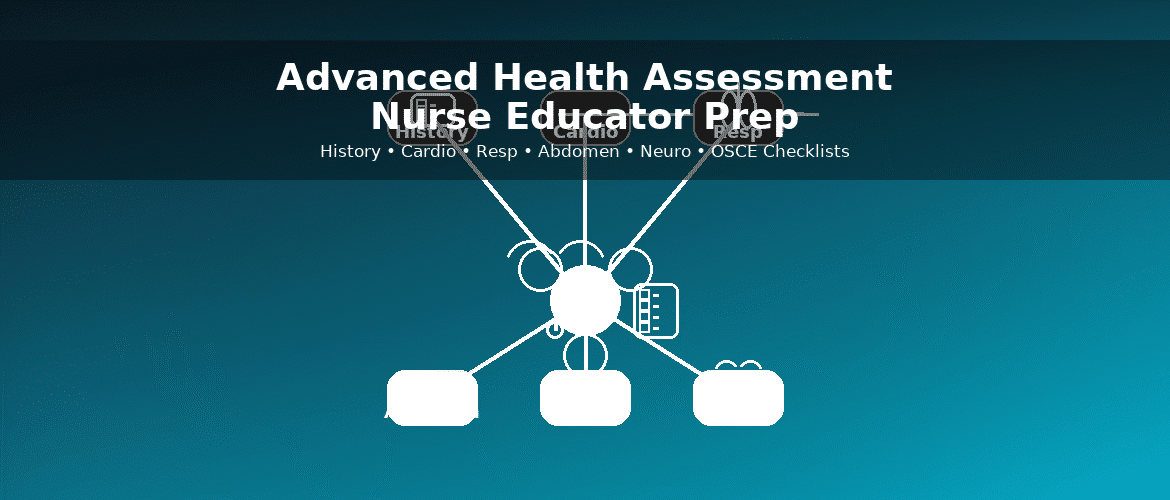

Advanced Health Assessment: Nurse Educator Prep
Nurse educators carry a dual responsibility: perform accurate, system-based assessments and teach others to do the same with consistency and clinical judgment. This guide focuses on the skills, frameworks, and exam-style thinking that matter for educator roles—so you can model expert technique, coach learners, and evaluate performance with confidence. When you’re ready to test your knowledge with case vignettes and rationales, try the educator-focused advanced assessment practice test from PrepPool.com (realistic items, timed mode, and detailed explanations).
What “advanced health assessment” means for educators
As a nurse educator, assessment goes beyond collecting findings. You must:
- Demonstrate accurate technique and pacing for each system.
- Explain why each maneuver is done and what a normal vs. abnormal result suggests.
- Teach diagnostic reasoning—linking subjective cues and objective signs to high-yield differentials.
- Evaluate learners fairly with rubrics and standardized criteria.
- Document succinctly using defensible, reproducible language.
Think of your role as equal parts examiner, coach, and validator. You model the gold standard, then scaffold learners to that standard.
Exam blueprint: topics you’ll be tested on
Use this as a checklist while you study and teach:
- Comprehensive Health History
- Chief complaint (OLDCARTS); symptom analysis and prioritization
- Past medical/surgical history; medications/allergies; family history
- Social determinants (occupation, housing, nutrition, sleep, stress, substance use)
- Review of systems (concise, targeted to the complaint)
- Culturally responsive interviewing; trauma-informed communication
- Core Physical Exam Techniques
- Inspection → Palpation → Percussion → Auscultation (with exceptions, e.g., abdomen: inspect → auscultate → percuss → palpate)
- Hand dominance and patient positioning; lighting and exposure; infection prevention
- Validating normal vs. variant findings; documenting negative findings correctly
- System-Specific Assessment
- HEENT: visual fields, fundoscopic basics, ear exam, oral/pharyngeal inspection, lymph nodes, thyroid
- Cardiovascular: precordial landmarks, S1/S2 vs. S3/S4, murmurs (timing, location, radiation), JVP, peripheral pulses, edema grading
- Respiratory: chest shape, expansion, tactile fremitus, percussion notes, vesicular/bronchial/bronchovesicular sounds, crackles/wheezes/stridor
- Abdomen: contour, bowel sounds, percussion for tympany/dullness, liver span, splenic percussion, rebound/guarding, CVA tenderness
- Neuro: mental status, cranial nerves, motor strength/ tone, reflexes, sensation, cerebellar tests, gait, Romberg
- MSK: inspection, range of motion, special tests (e.g., Phalen/Tinel, Lachman, straight leg raise), joint line tenderness
- Skin: ABCDE for lesions, turgor, hydration, pressure injury staging
- Breast/GU (as scope allows): chaperone policies, privacy, clinical sensitivity
- Special Populations
- Pediatric: growth parameters, developmental milestones, pediatric vitals and norms, otoscopy technique, dehydration assessment
- Geriatric: atypical presentations (e.g., silent MI, delirium vs. dementia), polypharmacy, fall risk, functional status, frailty
- Pregnancy: fundal height by weeks, fetal heart tones, common physiologic changes vs. red flags
- Diagnostic Reasoning & Differential Diagnosis
- Hypothesis generation, rule-in/rule-out logic
- Pretest probability and red flags
- Choosing targeted exams and point-of-care tests; when to escalate or refer
- Documentation & Communication
- SOAP notes; defensible language; normal-negative phrasing
- SBAR handoffs; interprofessional clarity
- Rubrics for OSCEs and simulation; feedback that’s specific, behavioral, and actionable
Study plan: 10 days to sharper assessment (60–90 min/day)
Daily flow:
- 10 min: Review yesterday’s two biggest pearls.
- 40–50 min: Timed practice questions or a focused system review.
- 10–15 min: Write a mini SOAP or checklist from memory.
- 5–10 min: Teach-back aloud (pretend you’re instructing a student).
Day-by-day
- History Mastery: OLDCARTS, red flags, cultural/trauma-informed techniques.
- Technique Fundamentals: IPPA sequence nuances; hygiene; patient positioning hacks.
- Cardio: Murmur timing/shape/radiation; edema grades; JVP; pulses.
- Resp: Fremitus, percussion, adventitious sounds; hypoxia red flags.
- Abdomen: Order of exam, ascites vs. obesity clues, rebound/guarding, CVA tenderness.
- Neuro: Cranial nerves, reflex grading, cerebellar tests; stroke and meningitis red flags.
- MSK & Skin: Special tests by joint; pressure injury staging; dermatologic descriptors.
- Special Populations: Peds, OB, geriatrics—normal variations vs. emergencies.
- Diagnostic Reasoning: Build and prune differentials; choose high-yield maneuvers.
- Simulation Day: Two SOAP notes from vignettes; one OSCE checklist; reflect on gaps.
High-yield pearls educators should model
- Name what you’re doing and why. “I’m percussing the liver span to estimate size; dullness suggests….”
- Demonstrate one clean maneuver at a time. Learners copy your sequence.
- Normalize silence. Give students 3–5 quiet seconds to listen for a murmur or crackle.
- Use consistent grading scales. Pulses (0–4+), edema (1+–4+), reflexes (0–4+), muscle strength (0–5).
- Document negatives efficiently. “No JVD. RRR, no murmurs/rubs/gallops. Lungs clear bilaterally, no wheeze/crackle/stridor.”
- Red flags prompt escalation. Chest pain with diaphoresis, focal neuro deficits, rigid abdomen with rebound, stridor, hypoxia, sudden worst headache.
Diagnostic reasoning: from complaint to plan
- Chief complaint: 62-year-old with exertional dyspnea.
- Key positives/negatives: Orthopnea, mild edema; no fever/cough; remote MI.
- Exam targets: JVP, S3, basal crackles, pitting edema, displaced PMI.
- Likely differentials: Heart failure, COPD, anemia, deconditioning.
- Next steps: Prioritize cardio-pulmonary exam, consider labs/imaging per scope, safety netting and referral indications.
Teaching tip: have learners verbalize why each step matters. You’re building a thinking pathway, not just a checklist.
Sample questions with rationales
1) Sequencing the abdominal exam
Which is the correct order for a focused abdominal assessment?
A. Palpation → Percussion → Auscultation → Inspection
B. Inspection → Auscultation → Percussion → Palpation
C. Inspection → Palpation → Auscultation → Percussion
D. Auscultation → Inspection → Percussion → Palpation
Answer: B. Auscultate before percussion/palpation to avoid altering bowel sounds.
2) Cardiac auscultation
A low-pitched extra sound early in diastole at the apex suggests:
A. Opening snap
B. S3
C. S4
D. Pericardial knock
Answer: B. S3 occurs just after S2 (early diastole), low-pitched at the apex; often associated with volume overload or decreased compliance.
3) Respiratory percussion
Dullness to percussion with increased fremitus most strongly suggests:
A. Emphysema
B. Pleural effusion
C. Consolidation
D. Pneumothorax
Answer: C. Consolidation transmits vibrations (↑ fremitus) and reduces air (dullness).
4) Neuro red flags
Which finding requires immediate escalation?
A. Tension-type headache improved with rest
B. Gradual peripheral neuropathy
C. Acute “worst headache” with neck stiffness
D. Benign positional vertigo pattern
Answer: C. Thunderclap headache with meningismus is an emergency.
5) Pediatric ear exam
For an infant under 1 year, the best technique is to:
A. Pull auricle up and back; use adult speculum
B. Pull auricle down and back; use small speculum
C. Pull auricle forward; use adult speculum
D. Avoid canal visualization
Answer: B. Down-and-back straightens the infant canal; size down the speculum.
 As you are here, you may want to check out the following Nursing Practice Materials:
Supporting Workflow in Healthcare Systems Exam Prep
Quality Assurance and Regulatory Compliance Exam Prep
Advanced Pathophysiology and Pharmacology for Nurse Educators Exam Prep
Mini OSCE checklists (use for labs/simulations)
Cardio Focus (2–3 min)
- Hand hygiene; identifies patient; explains exam; raises bed, 30–45°.
- Inspects chest; palpates PMI; auscultates APTM with diaphragm and bell.
- Assesses JVP; palpates carotids one at a time; grades pulses.
- States findings succinctly (e.g., “RRR, no murmurs/rubs/gallops; JVP 6–7 cm”).
Respiratory Focus (2–3 min)
- Inspects chest expansion; counts RR.
- Palpates chest expansion and fremitus (posterior).
- Percusses posterior fields (ladder pattern).
- Auscultates posterior and lateral fields; names any adventitious sounds.
Abdominal Focus (2–3 min)
- Patient supine, knees flexed; draping for privacy.
- Inspect → Auscultate (four quadrants) → Percuss → Palpate (light then deep).
- Assess CVA tenderness; describe any guarding or rebound.
Documentation that protects you (and helps learners)
SOAP example (concise):
- S: 45-y/o with intermittent RUQ pain after fatty meals, N/V, no jaundice/fever.
- O: Vitals stable; Abd: soft, nondistended; RUQ tenderness, +Murphy sign; no rebound/guarding. Skin no jaundice.
- A: Biliary colic vs. acute cholecystitis (less likely without fever/jaundice).
- P: Education on red flags; targeted labs/imaging per scope; diet guidance; follow-up with strict return precautions.
Teaching move: After your SOAP, ask learners to rewrite the O and A sections in their own words. This cements precision.
Feedback that actually changes behavior
- Behavioral and specific: “Your stethoscope hovered above the skin at the mitral area; contact improves low-frequency sound detection.”
- One thing to keep, one thing to change: Builds confidence and focus.
- Demonstrate → Practice → Debrief: Micro-drills (e.g., two-minute lung ladder) beat long, unfocused sessions.
- Use a rubric consistently: Same criteria across students improves fairness and reliability.
Common pitfalls (and how to avoid them)
- Rushing the sequence: Learners mimic your speed. Slow down on subtle maneuvers.
- Vague documentation: “Normal lungs” is weaker than “Clear to auscultation bilaterally; no wheeze/crackle/stridor.”
- Skipping red flags: Always call out what would change urgency.
- Inconsistent grading: Adopt and share scales early.
- Teaching without measurement: Add a micro-OSCE or short quiz weekly; track progress.
How to pass: fast strategies that work
- Anchor to sequence. If stuck, return to IPPA (or abdominal exception).
- Think in differentials. Each finding should move a diagnosis up or down your list.
- Name the red flags aloud. This habit keeps you and learners escalation-ready.
- Document cleanly. Precise negatives save time and protect care quality.
- Practice under time: Short, timed sets simulate OSCE pressure and sharpen judgment.
Ready for exam-style practice?
Convert knowledge into confident performance with educator-specific cases, checklists, and rationales. Open the advanced assessment practice test for nurse educators on PrepPool to drill high-yield maneuvers, sharpen diagnostic reasoning, and measure progress session by session.