
The student has studied terminology, reviewed procedures, and memorized important healthcare concepts — but suddenly real patient interactions, communication, safety awareness, and clinical decision-making feel much more real.
This is often the moment students begin understanding why fundamentals of nursing matter so much.
Many nursing students initially assume fundamentals courses are only introductory requirements before “real nursing” begins later.
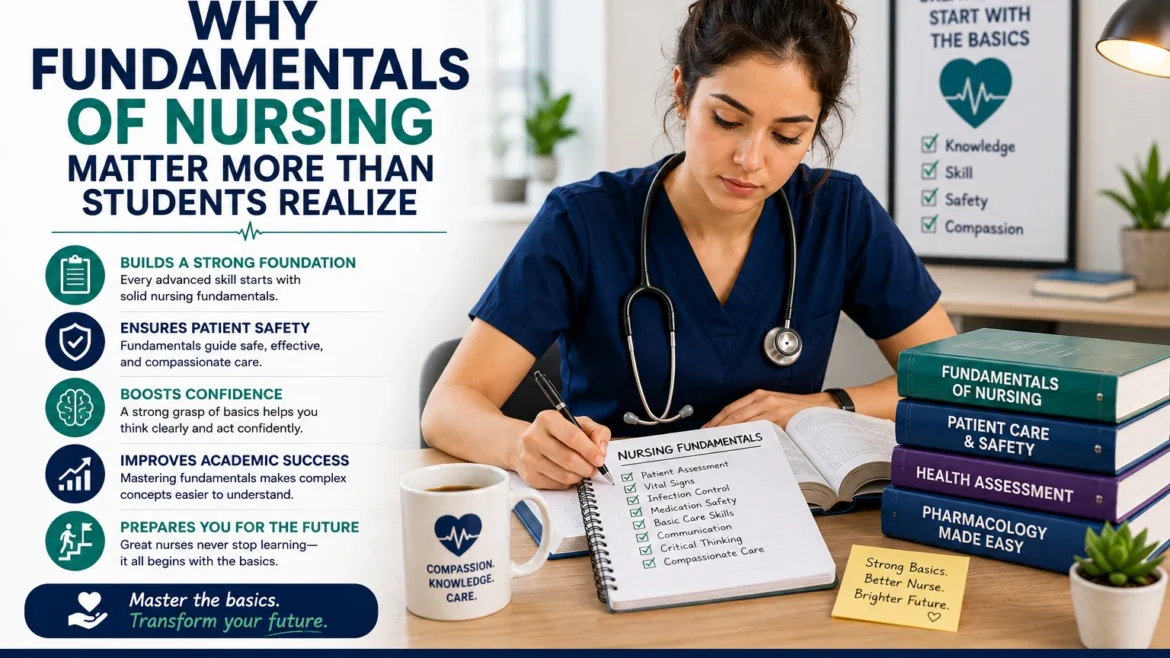
In reality, nursing fundamentals shape nearly every aspect of patient care throughout a nurse’s career.
What Nursing Fundamentals Usually Teach
- Patient communication skills
- Basic patient-care procedures
- Clinical safety awareness
- Nursing ethics and professionalism
- Documentation principles
- Clinical thinking and observation
Why Fundamentals Affect Every Nursing Specialty
Whether a nurse later works in emergency care, pediatrics, surgery, critical care, or long-term care, strong nursing fundamentals remain important throughout clinical practice.
Foundational nursing skills often support:
- Patient safety
- Clinical communication
- Medication administration
- Patient observation
- Healthcare teamwork
- Documentation accuracy
Without strong fundamentals, more advanced nursing responsibilities become significantly harder to manage safely and confidently.
Clinical Reality:
Experienced nurses often rely on foundational nursing habits every day — especially communication, patient observation, safety awareness, and organized clinical thinking.
Why Communication Matters So Much in Nursing
Many students focus heavily on procedures and technical skills while underestimating how important communication becomes in real healthcare environments.
Nurses communicate constantly with:
- Patients
- Families
- Doctors
- Other nurses
- Healthcare staff
Clear communication helps reduce confusion, improve patient understanding, and support safer healthcare coordination across departments.
Even simple communication mistakes can affect patient comfort, workflow organization, or treatment coordination.
| Nursing Fundamental | Why It Matters in Real Clinical Settings |
|---|---|
| Patient Communication | Supports patient understanding and healthcare coordination |
| Safety Awareness | Helps reduce preventable clinical mistakes and patient risks |
| Documentation Skills | Supports organized healthcare communication and continuity of care |
| Clinical Observation | Helps nurses recognize patient changes and healthcare concerns early |
Source: General nursing education principles and foundational clinical nursing practices.
Why Students Sometimes Underestimate Nursing Fundamentals
Some students become impatient during fundamentals courses because they want to move quickly into advanced clinical procedures or specialized nursing topics.
However, experienced nurses often understand that:
- Strong clinical habits begin early
- Patient safety starts with fundamentals
- Organization matters in healthcare
- Communication affects patient outcomes
- Clinical thinking develops gradually
Students who take fundamentals seriously often feel more prepared and confident later during clinical rotations and advanced nursing coursework.
Why Clinical Thinking Begins in Fundamentals Courses
Nursing is not simply about memorizing procedures.
Strong nurses constantly evaluate:
- Patient conditions
- Safety risks
- Communication needs
- Changes in symptoms
- Healthcare priorities
Fundamentals courses often introduce students to the beginning stages of clinical judgment and organized patient-care thinking.
Many nursing students improve confidence using realistic nursing fundamentals clinical-style scenarios questions because exposure to patient-care situations helps nursing concepts feel more practical and easier to apply in clinical environments.
Why Patient Safety Starts With Fundamentals
One of the most important goals of nursing fundamentals is helping students develop safer patient-care habits early.
Even basic nursing responsibilities can directly affect patient well-being when performed incorrectly or carelessly.
Nurses regularly help monitor:
- Patient conditions
- Medication safety
- Infection prevention
- Patient mobility
- Communication accuracy
Strong fundamentals help students develop organized habits that support safer healthcare environments throughout clinical practice.
Important Clinical Perspective:
Many patient-safety problems in healthcare begin with small communication mistakes, missed observations, or inconsistent clinical habits — all areas strongly connected to nursing fundamentals.
How Fundamentals Help Students Build Confidence
Many nursing students feel nervous during their first patient-care experiences.
Students may worry about:
- Making mistakes
- Communicating with patients
- Remembering procedures
- Handling clinical responsibilities
- Working in healthcare environments
Fundamentals courses help students gradually become more comfortable with clinical routines, patient interaction, and organized nursing workflows.
Confidence usually develops slowly through repeated exposure to realistic patient-care situations rather than instant perfection.
| Fundamental Nursing Skill | Long-Term Clinical Benefit |
|---|---|
| Communication Skills | Improves patient interaction and healthcare teamwork |
| Clinical Observation | Supports early recognition of patient concerns |
| Documentation Habits | Improves healthcare communication and continuity of care |
| Safety Awareness | Helps reduce preventable patient-care risks |
Source: General nursing education principles and foundational clinical nursing practices.
Why Clinical Observation Is So Important
Experienced nurses constantly monitor patients for changes in condition, comfort, communication, and safety concerns.
Strong observation skills help nurses recognize:
- Changes in patient behavior
- Signs of discomfort or distress
- Potential safety concerns
- Communication difficulties
- Early warning signs of complications
Fundamentals courses often begin teaching students how to think critically about patient situations instead of simply following routines mechanically.
Healthcare Reality:
Strong nurses do much more than perform tasks. They continuously observe, communicate, prioritize, and respond to changing patient needs throughout clinical care.
Why Nursing Fundamentals Feel Emotionally Challenging
For many students, fundamentals courses are the first time healthcare responsibilities begin feeling emotionally real.
Students may experience:
- Fear of making mistakes
- Stress during clinical practice
- Anxiety about patient interaction
- Pressure to perform correctly
- Emotional adjustment to healthcare environments
These feelings are extremely common among nursing students and often improve gradually through clinical experience and consistent practice.
Why Fundamentals Continue Helping Nurses Years Later
Even experienced nurses continue relying on many habits first introduced during fundamentals training.
Core nursing behaviors such as:
- Organized communication
- Patient safety awareness
- Clinical observation
- Professional behavior
- Documentation accuracy
remain important throughout nearly every nursing specialty and healthcare environment.
Why Fundamentals Help Nurses Handle Real Clinical Pressure
Healthcare environments can become fast-paced, emotionally demanding, and highly unpredictable.
Nurses often manage:
- Multiple patient responsibilities
- Communication between healthcare teams
- Unexpected patient changes
- Documentation requirements
- Patient and family concerns
Strong nursing fundamentals help students develop organized habits and calmer clinical thinking during stressful situations.
Clinical Insight:
Experienced nurses often rely on foundational nursing habits automatically during stressful situations because strong clinical organization improves patient safety and workflow efficiency.
Why Professionalism Begins Early in Nursing Education
Fundamentals courses also introduce students to professional healthcare behavior and responsibility.
Nursing professionalism often includes:
- Respectful patient communication
- Confidentiality awareness
- Reliable documentation habits
- Ethical decision-making
- Professional teamwork
These professional behaviors become increasingly important as students transition into more advanced clinical environments.
| Foundational Nursing Habit | Why It Remains Important Long-Term |
|---|---|
| Organized Communication | Supports safer healthcare coordination and teamwork |
| Patient Observation | Helps nurses identify concerns and patient changes earlier |
| Clinical Safety Habits | Reduces preventable patient-care risks |
| Documentation Consistency | Supports healthcare communication and continuity of care |
Source: General nursing education principles and foundational patient-care practices.
Why Nursing Fundamentals Support Better Clinical Judgment
Strong nurses continuously evaluate patient situations rather than simply following instructions mechanically.
Clinical judgment often involves:
- Recognizing patient priorities
- Identifying safety concerns
- Responding to patient changes
- Communicating effectively with healthcare teams
- Making organized patient-care decisions
Fundamentals courses begin helping students develop this type of clinical thinking long before advanced nursing specialization begins.
Important Perspective:
Nursing fundamentals are not “basic” in the sense of being unimportant. They form the clinical foundation that supports patient safety, communication, professionalism, and nursing judgment throughout an entire nursing career.
Why Strong Foundations Help Students Later in Nursing School
Students with stronger fundamentals often adapt more confidently during:
- Clinical rotations
- Medication administration training
- Advanced nursing coursework
- Patient-care responsibilities
- Healthcare teamwork situations
Because advanced nursing concepts build on foundational patient-care skills, strong fundamentals usually make later learning feel more manageable and organized.
Final Thoughts
Fundamentals of nursing matter because they help students develop the clinical habits, communication skills, patient-safety awareness, and organized thinking needed throughout real healthcare environments.
Although many students initially underestimate fundamentals courses, experienced nurses often understand that strong patient care begins with strong foundational habits.
As healthcare environments become more complex and fast-paced, organized communication, patient observation, professionalism, safety awareness, and clinical judgment remain essential throughout every nursing specialty.
For nursing students, strong fundamentals do much more than help pass exams — they help build the foundation for safer, more confident, and more effective patient care throughout an entire nursing career.