
When most people hear the word “management,” they immediately think of supervisors, department heads, or executives leading large organizations. While management certainly involves leadership positions, the skills associated with effective management extend far beyond formal job titles.
Management skills influence how individuals solve problems, communicate with others, organize projects, make decisions, and achieve goals. Whether someone is leading a multinational corporation, managing a healthcare team, launching a startup, coordinating volunteers, or supervising a small project, strong management skills can significantly improve outcomes.
In today’s fast-changing business environment, organizations increasingly value employees who can think strategically, collaborate effectively, and guide teams toward success.
This is one reason management remains one of the most widely studied and practical subjects in business education.
Understanding management principles not only helps students perform well academically but also prepares them for leadership opportunities throughout their careers.
What You’ll Learn
- Why management skills are important
- How management influences organizational success
- The most valuable leadership skills for future managers
- Real-world management examples
- Why employers value management knowledge
- How management skills support career growth
- Lessons future leaders can apply immediately
What Are Management Skills?
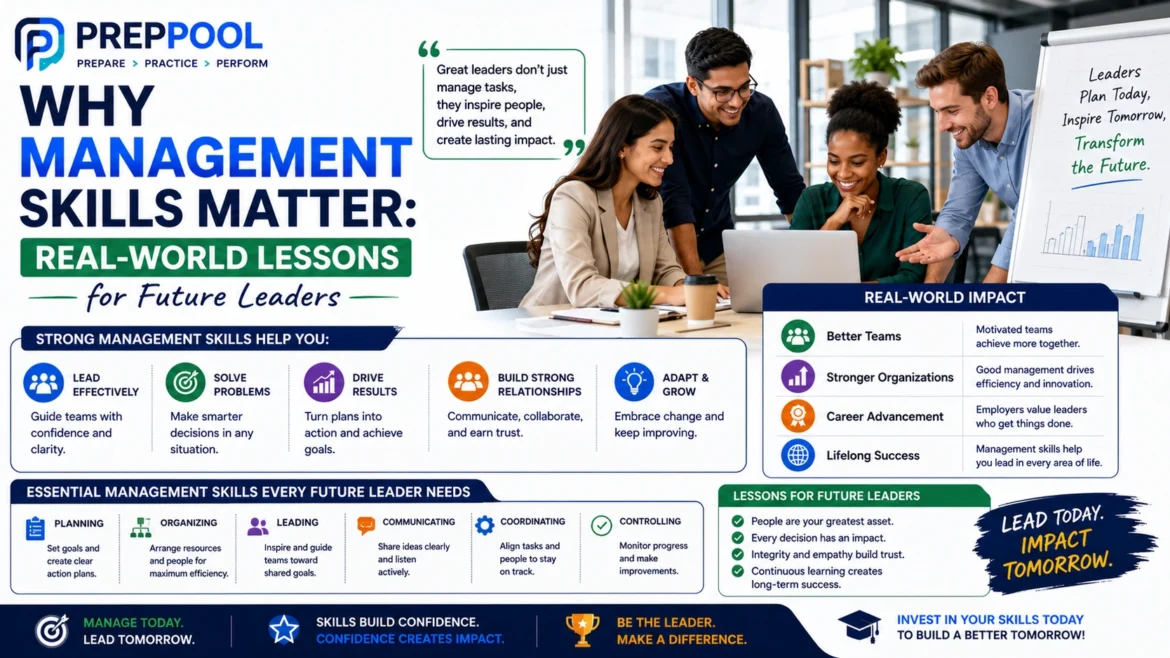
Management skills are the abilities that help individuals coordinate resources, guide people, solve problems, and achieve objectives efficiently.
These skills combine technical knowledge, communication abilities, leadership qualities, decision-making capabilities, and strategic thinking.
Effective managers must balance multiple responsibilities while helping teams perform at their highest level.
Examples of important management skills include:
- Leadership
- Communication
- Decision-making
- Problem-solving
- Time management
- Strategic thinking
- Conflict resolution
- Team development
- Adaptability
- Emotional intelligence
These abilities are valuable in virtually every industry and profession.
Why Management Skills Are More Important Than Ever
Modern organizations operate in environments that are increasingly complex and competitive.
Technological change, globalization, remote work, shifting customer expectations, and economic uncertainty all create challenges that require effective leadership and management.
Organizations need individuals who can:
- Adapt to change
- Lead diverse teams
- Communicate clearly
- Make informed decisions
- Manage resources efficiently
- Maintain organizational focus
Employees who possess these skills often become valuable contributors and future leaders within their organizations.
The Connection Between Management and Organizational Success
Every successful organization depends on effective management.
Even companies with excellent products, talented employees, and strong financial resources can struggle without capable management.
Management influences:
- Employee performance
- Customer satisfaction
- Operational efficiency
- Innovation
- Profitability
- Long-term growth
When managers establish clear goals, communicate effectively, and support employees, organizations are often better positioned to achieve success.
Conversely, poor management can lead to confusion, low morale, high turnover, and missed opportunities.
Leadership: The Most Visible Management Skill
Leadership is often considered the cornerstone of effective management.
Although leadership and management are not identical concepts, they are closely connected.
Managers use leadership skills to motivate employees, communicate vision, build trust, and guide teams toward organizational objectives.
Strong leaders help employees understand:
- What needs to be accomplished
- Why goals matter
- How their work contributes to success
- What standards are expected
Leadership becomes especially important during periods of change, uncertainty, or organizational growth.
Decision-Making: A Skill Every Future Leader Needs
Managers make decisions every day.
Some decisions involve routine operational matters, while others affect the future direction of entire organizations.
Effective decision-making requires:
- Gathering information
- Evaluating alternatives
- Assessing risks
- Considering consequences
- Selecting appropriate actions
Individuals who develop strong decision-making abilities often become valuable leaders because organizations rely on sound judgment to navigate challenges and opportunities.
Communication: The Foundation of Effective Management
Communication is one of the most important skills managers can develop.
Even the best plans can fail if expectations are unclear or information is misunderstood.
Effective communication helps managers:
- Share goals
- Provide feedback
- Resolve conflicts
- Coordinate activities
- Build trust
- Strengthen collaboration
Employees often cite communication quality as one of the most influential factors affecting workplace satisfaction and performance.
Problem-Solving in Real Business Environments
Every organization encounters obstacles.
Managers must identify problems, evaluate possible solutions, and implement effective responses.
Problem-solving may involve:
- Operational challenges
- Customer complaints
- Resource limitations
- Employee conflicts
- Market changes
- Strategic decisions
Strong problem-solving skills allow managers to respond proactively rather than reactively.
This capability often separates successful leaders from those who struggle under pressure.
Time Management and Prioritization
Managers frequently juggle multiple responsibilities simultaneously.
Without effective time management, important tasks may be delayed while less important activities consume valuable resources.
Successful managers prioritize tasks based on:
- Urgency
- Importance
- Organizational goals
- Available resources
- Potential impact
Developing strong prioritization skills helps individuals remain productive and focused even in demanding environments.
Leadership InsightMany organizations promote employees based on technical expertise. However, long-term success often depends on management skills such as communication, leadership, adaptability, and decision-making.
Management Skills Benefit More Than Managers
One common misconception is that management skills are useful only for supervisors and executives.
In reality, professionals at every level can benefit from understanding management principles.
Project coordinators, team members, entrepreneurs, healthcare professionals, educators, and business owners all rely on management skills to achieve goals and collaborate effectively.
Individuals interested in developing a deeper understanding of management principles often begin by reviewing foundational concepts through a comprehensive management fundamentals study guide. Learning how planning, organizing, leadership, and decision-making work together provides a strong foundation for future leadership growth.
Real-World Example: Leadership During Rapid Growth
Imagine a startup company that experiences rapid success and doubles its workforce within a year.
Without effective management, communication problems, role confusion, and operational inefficiencies could quickly emerge.
Managers must establish structure, clarify responsibilities, support employee development, and maintain organizational focus during periods of expansion.
This example illustrates why management skills remain essential regardless of industry or organizational size.
Emotional Intelligence: A Leadership Skill That Drives Results
Technical expertise may help someone earn a leadership position, but emotional intelligence often determines long-term success.
Emotional intelligence refers to the ability to recognize, understand, and manage emotions while effectively interacting with others.
Managers with strong emotional intelligence are often better equipped to:
- Build trust
- Handle workplace challenges
- Communicate effectively
- Resolve conflicts
- Motivate employees
- Develop strong relationships
Modern organizations increasingly value emotional intelligence because successful leadership depends heavily on human interactions.
Team Management: Bringing People Together to Achieve Goals
Few organizational achievements occur through individual effort alone.
Most business objectives require collaboration among employees with different skills, experiences, and perspectives.
Effective managers understand how to create environments where teams can thrive.
Strong team management involves:
- Establishing clear objectives
- Defining responsibilities
- Encouraging communication
- Supporting collaboration
- Providing feedback
- Recognizing achievements
When teams work effectively together, organizations often experience higher productivity, stronger innovation, and better overall performance.
Conflict Resolution in the Workplace
Conflict is a natural part of organizational life.
Employees may disagree about priorities, processes, responsibilities, or resource allocation.
While unmanaged conflict can create problems, constructive conflict can lead to better decisions and stronger outcomes.
Effective managers help resolve conflicts by:
- Listening actively
- Understanding multiple perspectives
- Encouraging open discussion
- Focusing on solutions
- Maintaining professionalism
Organizations often value leaders who can address disagreements without damaging relationships or team morale.
Strategic Thinking: Looking Beyond Daily Operations
Management involves more than handling immediate tasks and solving short-term problems.
Successful leaders must also think strategically about the future.
Strategic thinking helps managers:
- Identify opportunities
- Anticipate challenges
- Allocate resources effectively
- Support long-term goals
- Create competitive advantages
Managers who develop strategic thinking skills often play an important role in organizational growth and long-term success.
Adaptability in a Changing Business Environment
Businesses today operate in environments characterized by rapid change.
Technological innovation, shifting consumer preferences, economic uncertainty, and global competition require organizations to adapt continuously.
Managers who embrace adaptability are often better prepared to:
- Respond to change
- Lead transformation initiatives
- Support innovation
- Guide employees through uncertainty
- Maintain organizational resilience
Adaptability has become one of the most sought-after leadership traits in modern organizations.
Why Strong Managers Build Strong Organizational Cultures
Organizational culture influences how employees behave, communicate, and collaborate.
Managers play a major role in shaping culture through their actions, decisions, and leadership styles.
A positive organizational culture often promotes:
- Employee engagement
- Trust
- Accountability
- Innovation
- Customer focus
- Continuous improvement
Organizations with healthy cultures frequently experience stronger retention rates and higher employee satisfaction.
Innovation and Leadership Go Hand in Hand
Innovation rarely occurs by accident.
It often develops within environments where leaders encourage creativity, experimentation, and continuous learning.
Effective managers support innovation by:
- Encouraging new ideas
- Reducing fear of failure
- Supporting collaboration
- Providing resources
- Recognizing contributions
Companies known for innovation typically have leaders who create conditions that allow employees to think creatively and solve problems effectively.
Real-World Example: Satya Nadella and Microsoft
One frequently cited example of leadership transformation involves Microsoft under CEO Satya Nadella.
After assuming leadership, Nadella emphasized collaboration, learning, innovation, and organizational culture.
His leadership approach helped reshape the company’s culture while supporting significant business growth.
This example demonstrates how leadership extends beyond operational management and influences long-term organizational success.
Real-World Example: Starbucks and Employee Engagement
Starbucks has often been recognized for its emphasis on employee development and workplace culture.
The company invests in training, communication, and employee support programs designed to strengthen engagement and customer service.
This approach highlights how management decisions can directly influence both employee satisfaction and business performance.
Career Development TipOrganizations frequently promote individuals who demonstrate leadership potential, communication skills, accountability, and strong decision-making abilities. Developing management skills early can create long-term career advantages.
Building Management Skills Through Continuous Learning
Management abilities are not developed overnight.
Strong leaders continuously learn from experience, education, mentorship, and practical application.
Students seeking to strengthen their understanding of planning, organizing, leadership, communication, and strategic management often benefit from reviewing a comprehensive management principles learning resource. Building a deeper understanding of these foundational concepts can support both academic success and future leadership opportunities.
Leadership Growth Requires Consistent Practice
Reading about management is valuable, but true leadership development requires practical application.
Future leaders can strengthen their skills by:
- Leading projects
- Participating in team activities
- Seeking feedback
- Practicing communication skills
- Developing decision-making abilities
- Taking on new responsibilities
Consistent practice allows individuals to transform management knowledge into leadership capability.
Preparing for Leadership and Management Challenges
Many people first encounter management concepts while preparing for business courses, certification exams, or professional development opportunities.
Students who want to strengthen both their understanding of management principles and their exam readiness often combine concept learning with structured preparation strategies. Reviewing practical guidance such as CLEP Principles of Management exam preparation techniques can help reinforce key concepts while developing the analytical thinking skills required in both academic and professional settings.
The strongest leaders are often lifelong learners who continuously improve their knowledge, skills, and ability to support others.
Management Skills Employers Look for Most
Organizations consistently seek professionals who can contribute beyond their technical responsibilities.
While industry-specific knowledge remains important, employers often place equal value on management and leadership capabilities.
Many hiring managers look for candidates who demonstrate:
- Strong communication skills
- Problem-solving abilities
- Leadership potential
- Critical thinking
- Adaptability
- Collaboration skills
- Decision-making confidence
- Professional accountability
These competencies help organizations operate more effectively and position employees for future advancement opportunities.
Why Leadership Skills Matter Even Without a Management Title
Leadership is not limited to executives or department managers.
Employees at every level often influence projects, support colleagues, solve problems, and contribute to organizational success.
For example, a project coordinator may lead cross-functional teams, a healthcare professional may guide patient-care initiatives, or an entrepreneur may oversee business operations without holding a traditional management title.
In each case, management and leadership skills play a critical role in achieving objectives.
This is why leadership development remains valuable regardless of current job position or career stage.
The Relationship Between Management and Career Growth
Many career advancement opportunities require individuals to take on increasing levels of responsibility.
As employees progress professionally, organizations often expect them to:
- Manage projects
- Coordinate teams
- Train new employees
- Resolve workplace challenges
- Support organizational goals
- Contribute to strategic planning
Individuals who develop management skills early often find themselves better prepared for these opportunities when they arise.
This preparation can create a significant advantage in competitive workplaces.
Lessons Future Leaders Can Learn from Successful Organizations
Many of the world’s most successful organizations demonstrate the importance of strong management practices.
Although industries differ, several common themes frequently emerge.
Successful organizations often:
- Communicate clear goals
- Invest in employee development
- Promote accountability
- Encourage innovation
- Adapt to changing conditions
- Focus on long-term growth
Future leaders can apply these principles within organizations of any size.
The Importance of Ethical Leadership
Modern organizations increasingly recognize the value of ethical leadership.
Ethical leaders make decisions based not only on business outcomes but also on fairness, integrity, transparency, and responsibility.
Ethical leadership can contribute to:
- Stronger employee trust
- Improved organizational reputation
- Better decision-making
- Reduced workplace conflicts
- Higher employee engagement
Organizations that maintain strong ethical standards often develop stronger relationships with employees, customers, and stakeholders.
How Management Skills Support Entrepreneurship
Entrepreneurs rely heavily on management skills when building and growing businesses.
Launching a successful company requires more than a good idea.
Business owners must:
- Develop plans
- Manage resources
- Lead teams
- Make strategic decisions
- Monitor performance
- Adapt to market conditions
Many entrepreneurial challenges can be addressed more effectively when founders possess strong management capabilities.
As a result, management education often benefits aspiring entrepreneurs as much as future corporate leaders.
Why Communication Remains a Competitive Advantage
Communication continues to be one of the most important skills in professional environments.
Managers spend a significant portion of their time communicating with employees, customers, stakeholders, vendors, and leadership teams.
Strong communicators are often able to:
- Build trust more quickly
- Reduce misunderstandings
- Improve collaboration
- Resolve conflicts efficiently
- Influence positive outcomes
Because communication affects nearly every aspect of organizational performance, it remains one of the most valuable management skills individuals can develop.
Preparing for Future Leadership Opportunities
Leadership opportunities often appear unexpectedly.
Employees may be asked to lead projects, supervise teams, coordinate initiatives, or contribute to strategic decisions with little advance notice.
Individuals who have invested in developing management skills are often better prepared to step into these roles confidently.
Preparation may include:
- Continuous learning
- Professional development
- Leadership training
- Mentorship
- Practical experience
The earlier these skills are developed, the more opportunities individuals may be able to pursue throughout their careers.
Leadership ReminderGreat leaders are not defined solely by authority. They are often recognized by their ability to communicate effectively, solve problems, support others, and guide organizations toward meaningful goals.
Management Skills in Everyday Life
One of the most overlooked aspects of management education is its relevance outside traditional business settings.
Management skills can help individuals:
- Organize personal projects
- Manage time effectively
- Coordinate community activities
- Lead volunteer efforts
- Make informed decisions
- Improve productivity
This versatility explains why management principles remain valuable regardless of profession or career path.
Building a Foundation for Long-Term Success
Developing management skills is an ongoing process rather than a one-time achievement.
Successful professionals continuously refine their leadership abilities, communication techniques, strategic thinking, and decision-making capabilities throughout their careers.
Whether pursuing opportunities in business, healthcare, education, technology, government, or entrepreneurship, management knowledge can provide a strong foundation for long-term success.
Understanding how organizations function, how people work together, and how leaders guide teams toward objectives remains valuable in virtually every professional environment.
Final Thoughts
Management skills influence far more than workplace performance. They shape how individuals communicate, solve problems, make decisions, lead others, and respond to challenges.
As organizations continue to evolve, the demand for capable leaders and effective managers is likely to remain strong.
Individuals who invest in developing management skills often position themselves for greater professional opportunities, stronger workplace relationships, and long-term career growth.
Whether your goal is academic success, leadership development, entrepreneurship, or career advancement, understanding management principles can provide valuable benefits that extend well beyond the classroom.
For individuals seeking to strengthen their management knowledge further, combining foundational concept review with practical application and exam-style learning resources can help build both confidence and long-term understanding of effective management practices.
Many future leaders strengthen their understanding of management concepts by combining leadership development, real-world business examples, and structured exam preparation. For those looking to test their knowledge and gain additional exposure to management scenarios, comprehensive CLEP Principles of Management practice materials can provide valuable opportunities to apply key concepts in realistic exam-style situations.
Frequently Asked Questions
Why are management skills important in the workplace?
Management skills help individuals communicate effectively, solve problems, lead teams, make informed decisions, and contribute to organizational success.
What are the most valuable management skills for future leaders?
Leadership, communication, decision-making, problem-solving, emotional intelligence, adaptability, strategic thinking, and team management are among the most valuable skills.
Can management skills help career advancement?
Yes. Employers often seek individuals who can lead projects, coordinate teams, manage responsibilities, and contribute to organizational goals.
How can someone improve their management skills?
Management skills can be developed through education, mentorship, practical experience, leadership opportunities, continuous learning, and professional development activities.
Are management skills useful outside business careers?
Absolutely. Management skills support effective decision-making, communication, organization, and leadership in many personal, academic, community, and professional situations.