
The mortgage industry plays a critical role in helping individuals and families achieve homeownership. Behind every successful mortgage transaction is a licensed Mortgage Loan Originator (MLO) who guides borrowers through the lending process, explains financing options, and ensures compliance with federal and state regulations.
For aspiring Mortgage Loan Originators, passing the Nationwide Multistate Licensing System (NMLS) exam is one of the most important steps toward entering the profession. The exam evaluates knowledge of mortgage lending practices, federal laws, ethics, consumer protection regulations, and loan origination concepts that professionals encounter in real-world mortgage transactions.
Many candidates quickly discover that the NMLS exam covers far more than simple definitions. Success requires understanding how mortgage concepts work together throughout the lending process and how regulations protect both borrowers and lenders.
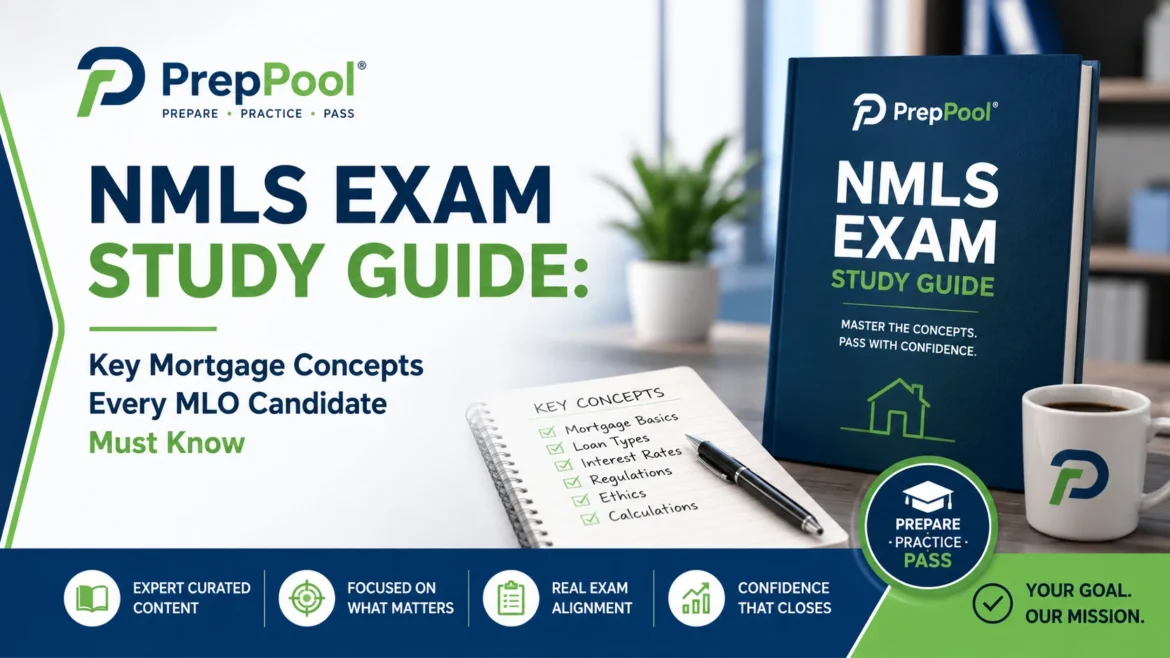
This study guide explores the most important mortgage concepts every NMLS candidate should understand before exam day. Whether you are beginning your preparation journey or reviewing key topics, mastering these concepts can help build a stronger foundation for exam success.
- The role of a Mortgage Loan Originator
- How the mortgage lending process works
- Key federal mortgage regulations
- Consumer protection requirements
- Ethics and professional responsibilities
- Mortgage products and loan types
- Important NMLS exam concepts candidates must know
What Is the NMLS Exam?
The Nationwide Multistate Licensing System (NMLS) exam is a licensing examination required for individuals seeking to become Mortgage Loan Originators in the United States.
The exam is designed to ensure that mortgage professionals possess the knowledge necessary to serve consumers responsibly while complying with federal and state mortgage laws.
Candidates are tested on several major content areas, including:
- Federal mortgage-related laws
- General mortgage knowledge
- Mortgage loan origination activities
- Ethics and consumer protection
- Uniform state content
Understanding these areas is essential because questions often combine multiple concepts within realistic lending scenarios.
Why Mortgage Knowledge Matters Beyond the Exam
Many candidates focus exclusively on passing the NMLS exam, but the concepts tested have practical value far beyond licensing requirements.
Mortgage Loan Originators help consumers make significant financial decisions that may affect them for decades.
As a result, professionals must understand:
- Loan products
- Interest rates
- Mortgage disclosures
- Federal regulations
- Borrower qualifications
- Consumer protection requirements
Strong mortgage knowledge supports both exam success and long-term professional performance.
The Role of a Mortgage Loan Originator (MLO)
Mortgage Loan Originators serve as a bridge between borrowers and lenders.
They help consumers navigate the mortgage process while ensuring regulatory compliance and ethical lending practices.
Typical responsibilities include:
- Evaluating borrower needs
- Explaining mortgage options
- Collecting financial information
- Assisting with loan applications
- Communicating with borrowers
- Maintaining compliance with lending regulations
Because MLOs play such an important role in the lending process, the NMLS exam places significant emphasis on professional responsibilities and consumer protection.
Understanding the Mortgage Lending Process
One of the most important topics for NMLS candidates is the mortgage lending process itself.
Questions frequently test a candidate’s understanding of how loans move from application to closing.
A simplified mortgage process typically includes:
- Prequalification
- Loan application
- Document collection
- Loan processing
- Underwriting
- Approval decision
- Closing and funding
Understanding the purpose of each stage helps candidates answer scenario-based exam questions more effectively.
Prequalification vs. Preapproval
Many new candidates confuse prequalification and preapproval.
Although these terms are related, they represent different stages of the mortgage process.
| Prequalification | Preapproval |
|---|---|
| Based on preliminary information | Requires financial verification |
| Less formal assessment | More comprehensive evaluation |
| Provides a general estimate | Provides stronger purchasing credibility |
Questions involving these concepts often appear because they illustrate important differences in borrower qualification processes.
Key Participants in a Mortgage Transaction
Mortgage transactions involve multiple parties working together to complete the loan process.
NMLS candidates should understand the responsibilities of each participant.
- Borrower
- Mortgage Loan Originator
- Lender
- Loan Processor
- Underwriter
- Appraiser
- Title Company
- Closing Agent
Many exam questions require candidates to identify which participant performs specific functions during the lending process.
Federal Mortgage Laws Every Candidate Should Know
Federal regulations form one of the most heavily tested portions of the NMLS exam.
These laws were developed to protect consumers, promote transparency, and ensure fair lending practices.
Major regulations include:
- Truth in Lending Act (TILA)
- Real Estate Settlement Procedures Act (RESPA)
- Equal Credit Opportunity Act (ECOA)
- Fair Housing Act (FHA)
- Home Mortgage Disclosure Act (HMDA)
- Secure and Fair Enforcement for Mortgage Licensing Act (SAFE Act)
Candidates should understand the purpose and requirements of each law because regulatory compliance questions appear frequently throughout the exam.
The Truth in Lending Act (TILA)
The Truth in Lending Act promotes transparency by requiring lenders to disclose important credit terms clearly and consistently.
TILA helps consumers compare financing options and understand the true cost of borrowing.
Key disclosures include:
- Annual Percentage Rate (APR)
- Finance charges
- Total payments
- Payment schedules
- Loan costs
Understanding TILA is important because many NMLS questions focus on consumer disclosure requirements.
The Real Estate Settlement Procedures Act (RESPA)
RESPA was created to protect consumers during the mortgage settlement process.
The law promotes transparency and prohibits certain abusive practices.
Key RESPA objectives include:
- Providing settlement cost disclosures
- Reducing unnecessary costs
- Preventing kickbacks and referral fees
- Improving consumer awareness
Questions involving RESPA often require candidates to identify prohibited activities or disclosure requirements.
Students preparing for licensing exams often benefit from combining concept review with realistic exam-style questions. Resources such as the NMLS practice exam materials can help reinforce mortgage concepts while improving familiarity with the types of scenarios commonly encountered on the licensing exam.
Real-World Example: Helping a First-Time Homebuyer
Imagine a first-time homebuyer applying for a mortgage.
The Mortgage Loan Originator explains available loan options, collects financial documents, reviews disclosure requirements, and guides the borrower through the approval process.
Throughout the transaction, federal laws such as TILA and RESPA help ensure transparency and consumer protection.
This example demonstrates why mortgage professionals must understand both lending concepts and regulatory requirements.
The Equal Credit Opportunity Act (ECOA)
The Equal Credit Opportunity Act (ECOA) is one of the most important consumer protection laws in the mortgage industry.
ECOA prohibits lenders from discriminating against applicants based on protected characteristics during the credit evaluation process.
The law promotes fairness and equal access to credit opportunities.
Protected factors include:
- Race
- Color
- Religion
- National origin
- Sex
- Marital status
- Age (with certain limitations)
- Receipt of public assistance income
NMLS exam questions often present lending scenarios and require candidates to identify whether a lender’s actions comply with ECOA requirements.
The Fair Housing Act and Mortgage Lending
The Fair Housing Act is another major federal law that Mortgage Loan Originators must understand.
The law prohibits discrimination in housing-related transactions and promotes equal housing opportunities.
Protected classes include:
- Race
- Color
- Religion
- National origin
- Sex
- Familial status
- Disability
Mortgage professionals must ensure that borrowers are treated fairly throughout the lending process regardless of protected status.
Questions involving fair lending practices are common because consumer protection is a central theme of the NMLS exam.
Understanding the Home Mortgage Disclosure Act (HMDA)
The Home Mortgage Disclosure Act (HMDA) was designed to improve transparency within the mortgage lending industry.
HMDA requires certain lenders to collect and report mortgage lending data.
The law helps regulators:
- Monitor lending patterns
- Identify potential discrimination
- Evaluate community credit needs
- Support fair lending enforcement
Candidates should understand the purpose of HMDA and how reporting requirements contribute to industry oversight.
The SAFE Act and Mortgage Licensing
The Secure and Fair Enforcement for Mortgage Licensing Act (SAFE Act) established national standards for Mortgage Loan Originator licensing.
The SAFE Act helps ensure that mortgage professionals meet minimum competency and ethical standards before serving consumers.
Key objectives include:
- Enhancing consumer protection
- Improving accountability
- Creating licensing standards
- Supporting industry professionalism
Because the NMLS exam exists as part of the SAFE Act framework, candidates should thoroughly understand its purpose and requirements.
Ethics and Professional Responsibilities
Ethics is one of the most heavily tested areas of the NMLS exam.
Mortgage professionals regularly handle sensitive financial information and help consumers make significant borrowing decisions.
As a result, ethical conduct is essential.
Professional responsibilities include:
- Honesty
- Integrity
- Transparency
- Compliance with regulations
- Protection of consumer interests
- Accurate disclosure practices
NMLS questions frequently evaluate whether candidates can identify ethical and unethical lending behaviors.
Recognizing Mortgage Fraud
Mortgage fraud remains a major concern within the lending industry.
Mortgage professionals must recognize suspicious activities and understand how fraud affects consumers, lenders, and financial markets.
Examples may include:
- Income misrepresentation
- Occupancy fraud
- Identity fraud
- Property value manipulation
- Document falsification
Exam questions often require candidates to identify fraudulent situations or recognize compliance violations.
Understanding Conventional Mortgage Loans
Conventional loans are among the most common mortgage products available to borrowers.
These loans are not insured or guaranteed by federal government programs.
Characteristics often include:
- Specific credit requirements
- Down payment requirements
- Debt-to-income considerations
- Private mortgage insurance requirements in certain situations
Mortgage candidates should understand how conventional financing differs from government-backed loan programs.
Government-Backed Mortgage Programs
Government-backed loan programs play an important role in expanding access to homeownership.
Major programs include:
| Program | Primary Purpose |
|---|---|
| FHA Loans | Support borrowers with flexible qualification requirements |
| VA Loans | Serve eligible veterans and military families |
| USDA Loans | Promote homeownership in eligible rural areas |
Candidates should understand the general characteristics and objectives of each loan program because mortgage product questions frequently appear on licensing exams.
Fixed-Rate vs. Adjustable-Rate Mortgages
Mortgage professionals must understand the differences between fixed-rate and adjustable-rate products.
| Fixed-Rate Mortgage | Adjustable-Rate Mortgage (ARM) |
|---|---|
| Interest rate remains constant | Interest rate may change over time |
| Predictable payments | Potential payment fluctuations |
| Long-term stability | May offer lower initial rates |
Questions often compare the advantages, risks, and borrower suitability of these mortgage options.
Nontraditional Mortgage Products
NMLS candidates should also understand nontraditional mortgage products and the risks associated with them.
Examples may include:
- Interest-only loans
- Payment-option ARMs
- Balloon mortgages
These products can create unique borrower risks, making disclosure and suitability considerations especially important.
How Mortgage Knowledge Connects to the Broader Real Estate Industry
Mortgage lending and real estate transactions are closely connected. Mortgage Loan Originators frequently work alongside real estate professionals, title companies, appraisers, and closing agents throughout the homebuying process.
Candidates interested in expanding their understanding of property transactions may also benefit from reviewing broader real estate licensing concepts. Resources such as the California real estate exam preparation materials provide additional insight into property transactions, disclosures, and industry practices that often intersect with mortgage lending activities.
Real-World Example: Evaluating Borrower Options
Imagine a borrower comparing multiple mortgage products while purchasing a first home.
The Mortgage Loan Originator must explain available options, review disclosure requirements, discuss potential risks, and ensure the borrower understands the long-term financial implications of each choice.
This scenario demonstrates why mortgage professionals need both product knowledge and a strong understanding of regulatory responsibilities.
Individuals pursuing careers in lending often find it useful to explore how mortgage and real estate industries work together. Exam resources such as Florida real estate licensing practice questions can provide additional exposure to concepts commonly encountered throughout residential property transactions.
Loan-to-Value (LTV) Ratio
The Loan-to-Value (LTV) ratio is one of the most important calculations used in mortgage lending.
LTV compares the loan amount to the property’s appraised value or purchase price.
Lenders use this ratio to evaluate lending risk.
Generally speaking:
- Lower LTV ratios indicate lower lending risk.
- Higher LTV ratios indicate higher lending risk.
- Higher LTV loans may require mortgage insurance.
For example, if a borrower purchases a home for $300,000 and borrows $240,000, the LTV ratio is 80%.
Questions involving LTV calculations and lending decisions frequently appear on licensing exams.
Debt-to-Income (DTI) Ratio
The Debt-to-Income (DTI) ratio measures a borrower’s monthly debt obligations relative to monthly income.
DTI helps lenders evaluate a borrower’s ability to manage mortgage payments alongside existing financial responsibilities.
Common obligations included in DTI calculations may include:
- Mortgage payments
- Auto loans
- Student loans
- Credit card obligations
- Personal loans
Understanding DTI is important because it plays a significant role in underwriting and borrower qualification decisions.
Interest Rate vs. Annual Percentage Rate (APR)
Many borrowers confuse the interest rate with the Annual Percentage Rate (APR).
Mortgage professionals must understand the distinction clearly.
| Interest Rate | Annual Percentage Rate (APR) |
|---|---|
| Cost of borrowing money | Broader measure of borrowing costs |
| Reflects loan interest only | Includes certain fees and costs |
| Used for payment calculations | Helps consumers compare loan offers |
The Truth in Lending Act requires APR disclosures because they provide consumers with a more comprehensive picture of financing costs.
Understanding Mortgage Underwriting
Underwriting is the process lenders use to evaluate mortgage applications and determine whether loans meet lending guidelines.
Underwriters assess risk by reviewing multiple factors.
Common considerations include:
- Income verification
- Employment history
- Credit history
- Debt obligations
- Property value
- Available assets
Questions involving underwriting frequently appear because underwriters play a critical role in loan approval decisions.
Credit Scores and Mortgage Qualification
Credit scores provide lenders with insight into a borrower’s credit management history.
Although specific lending requirements vary, credit history often influences:
- Loan eligibility
- Interest rates
- Loan terms
- Mortgage insurance requirements
MLO candidates should understand how credit risk affects lending decisions and borrower qualifications.
Closing Costs and Settlement Expenses
Mortgage transactions involve various fees and costs beyond the loan amount itself.
Examples may include:
- Appraisal fees
- Title insurance
- Recording fees
- Credit report fees
- Attorney fees
- Escrow-related expenses
Federal disclosure regulations help ensure that borrowers receive clear information regarding these costs before closing.
Consumer Protection Remains the Core of Mortgage Lending
While candidates often focus on loan products and calculations, consumer protection remains one of the central themes of the NMLS exam.
Federal mortgage laws were developed to:
- Promote transparency
- Prevent discrimination
- Reduce abusive practices
- Protect consumers
- Support fair lending standards
Many exam questions require candidates to evaluate lending situations from both a compliance and consumer-protection perspective.
How Mortgage Concepts Work Together
One of the most important lessons for NMLS candidates is that mortgage concepts rarely operate independently.
Consider a typical borrower applying for a mortgage.
The Mortgage Loan Originator may need to:
- Review credit history.
- Calculate debt-to-income ratios.
- Explain loan products.
- Provide federal disclosures.
- Ensure regulatory compliance.
- Communicate loan terms clearly.
This is why the NMLS exam frequently presents realistic lending scenarios that combine multiple topics within a single question.
How to Study More Effectively for the NMLS Exam
Many candidates make the mistake of relying solely on memorization.
While terminology is important, the exam often evaluates whether candidates can apply concepts to real-world mortgage situations.
Effective preparation strategies include:
- Reviewing federal laws regularly
- Studying mortgage products thoroughly
- Understanding lending calculations
- Practicing compliance scenarios
- Completing realistic practice questions
- Reviewing incorrect answers carefully
Students who focus on application rather than memorization often perform better on scenario-based questions.
Build Confidence with Realistic Mortgage Scenarios
One of the most effective ways to prepare for the licensing exam is by practicing with questions that reflect real mortgage situations.
Many successful candidates combine concept review with structured exam preparation. Resources such as the NMLS practice questions and answer explanations can help reinforce key lending concepts while improving familiarity with the types of situations Mortgage Loan Originators encounter during the exam.
Final Thoughts
The NMLS exam evaluates a broad range of mortgage knowledge, from federal regulations and ethics to loan products, underwriting, consumer protection, and lending calculations.
Candidates who understand how these concepts connect throughout the mortgage process are often better prepared than those who rely solely on memorization.
By focusing on real-world applications, reviewing major federal laws, understanding borrower qualification factors, and practicing with realistic lending scenarios, aspiring Mortgage Loan Originators can build both confidence and competence before exam day.
The knowledge gained while preparing for the NMLS exam extends well beyond licensing requirements and serves as a valuable foundation for a successful career in mortgage lending.
Frequently Asked Questions
What topics are most important for the NMLS exam?
The most important topics include federal mortgage laws, ethics, consumer protection, mortgage loan origination activities, mortgage products, underwriting, and lending calculations.
What is the difference between APR and interest rate?
The interest rate reflects the cost of borrowing money, while APR includes certain fees and costs, providing a broader view of the total borrowing expense.
Why is the SAFE Act important for Mortgage Loan Originators?
The SAFE Act established national licensing standards designed to improve professionalism, accountability, and consumer protection within the mortgage industry.
What is a debt-to-income ratio in mortgage lending?
Debt-to-income ratio measures a borrower’s monthly debt obligations relative to monthly income and helps lenders evaluate repayment ability.
How can I prepare effectively for the NMLS exam?
Focus on understanding federal laws, mortgage products, lending calculations, ethics, consumer protection requirements, and realistic mortgage scenarios while regularly practicing exam-style questions.