
Guide for Indiana learners who want more than answer lists. Understand the exam, compare study methods objectively, and use an explanation-first plan that holds up when wording changes on test day.
What the Indiana BMV Knowledge Exam Actually Tests
The Indiana learner’s permit exam checks that you can read the road and behave predictably in traffic. It’s split into two scored parts that you must pass separately: Road Signs (16 questions) and Rules of the Road (34 questions). The signs portion emphasizes recognition of shapes, colors, symbols, and signals; the rules portion tests judgment—right-of-way, speed control, stopping distances, school and work zones, railroad crossings, emergency vehicles, seat belts and child restraints, and impaired-driving laws. Because the test includes straightforward recall and scenario questions, the most efficient preparation trains both content memory and decision-making under varied wording.
Expect phrasing to shift. Two questions may test the same rule differently—one with a definition (“What does a pentagon sign indicate?”) and another with a scenario (“Yellow, five-sided sign appears; what action is appropriate?”). Learners who rely on answer keys alone often slow down or second-guess when the sentence isn’t an exact match. Learners who understand the rule answer with confidence regardless of phrasing.
Why “Answer Lists” Alone Can Cost You Points
- Wording changes, rules don’t. The same principle (e.g., right-hand rule at four-way stops) can appear in different language. If memory is tied to one sentence, a small rephrase can break recall.
- Explanations create transferable knowledge. A one-line rationale—why the pentagon means school areas or why you yield when turning left—turns a letter choice into a reusable pattern.
- Speed follows understanding. On a timed exam, hesitation drains minutes. When you know the rule, you eliminate distractors quickly and preserve time for trickier items.
Quick tools still help. Flashcards and checklists shine for fast repetition of facts (shapes, colors, distances). The reliable plan is to anchor your prep with exam-style questions and explanations, then layer flashcards to keep simple facts fresh.
Quizlet vs. Structured Indiana Practice — What Each Does Well
Quizlet hosts thousands of community-created flashcard decks. For Indiana prep, you’ll find sets on sign names, color meanings, and brief rules. They’re excellent for quick, mobile-friendly review and basic term→definition recall. An example deck many learners browse is Indiana BMV Practice Permit Test — Flash Cards. The trade-off: quality and alignment vary by author, rationales are rare, and decks may blend general DMV content from multiple states.
Structured Indiana practice organizes learning to match how the exam is scored. You’ll see sign drills, rules drills, and realistic mixed sets with concise explanations. Items use test-like wording and plausible distractors (e.g., two answers technically true but only one is situationally correct). Many providers also include a printable PDF for offline review and a simple progression from topic drills to simulated tests. If you prefer this approach, an Indiana-specific pack such as the Full Indiana permit Test Bank is a straightforward anchor; you can still add short Quizlet sessions near the end for quick refreshers.
Side-by-Side Comparison
| Criteria | Structured Indiana Practice (with explanations) | Quizlet Flashcards |
|---|---|---|
| Alignment to Indiana topics | Mapped to the Driver’s Manual; separates signs and rules like the exam. | Varies by deck; some are generic or multi-state. |
| Answer explanations | Brief rationales clarify rules and edge cases. | Mostly definition-only; rationales uncommon. |
| Question style | Exam-like multiple choice; realistic wording and distractors. | Term→definition recall; not a simulation. |
| Learning workflow | Topic drills → mixed sets → timed practice; spaced repetition ready. | Rapid skimming; harder to mirror two-part scoring and pacing. |
| Offline readiness | Often includes a printable, mobile-friendly PDF. | PDF not standard; depends on platform features. |
| Best use case | Primary method for first-time passers. | Supplemental fact review in short bursts. |
Core Domains You’ll Be Tested On (and How to Master Them)
1) Road Signs — Shapes, Colors, and Meaning
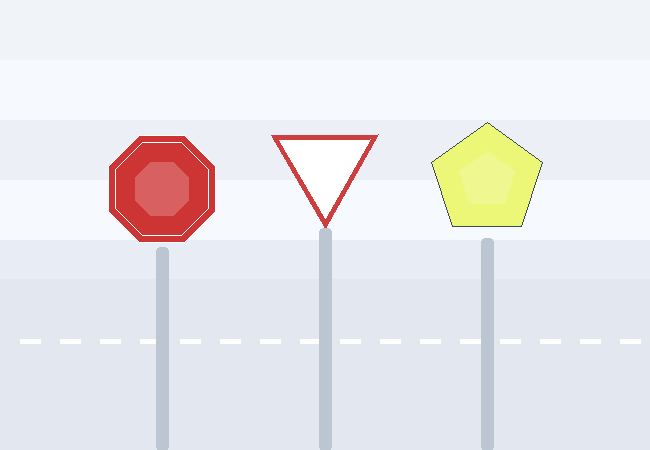
- Shapes: Octagon = Stop; Triangle (point down) = Yield; Diamond = Warning; Rectangle = Regulatory/Guide; Pentagon = School zone/crossing; Circle = Railroad warning; Pennant = No passing zone.
- Colors: Red = Stop/Prohibited; Yellow = General warnings; Fluorescent yellow-green = School/pedestrian/bicycle warnings; White = Regulatory; Orange = Work zones; Green/Blue/Brown = Guide, services, recreation.
- Mastery drill: Cover the text, identify meaning from shape & color alone, then state the safe action (“yield and be prepared to stop,” “reduce speed, expect crossing”).
2) Right-of-Way & Intersections
Memorize the sequence: first to arrive proceeds first; if simultaneous, the driver on the right goes first; turning left yields to oncoming traffic; at T-intersections, through traffic has priority. Train yourself to say the rule out loud as you choose an answer—this anchors the rationale and speeds selection.
3) Speed, Space, and Stopping Distance
Speed limits depend on roadway type and signs. Spacing follows the three-second rule (increase in rain, snow, or poor visibility). Stopping distance grows quickly with speed; anticipate longer braking in heavy vehicles or downhill grades. Practice converting these ideas into actions (“increase following distance,” “cover the brake near pedestrian areas”).
4) Special Situations
- School buses on undivided roads: Stop for flashing red lights from both directions until the arm retracts.
- Railroad crossings: Stop when flashing lights are active; proceed only when signals stop and tracks are clear.
- Emergency vehicles: Yield right-of-way; pull to the right edge and stop when safe.
- Work zones: Slow down, obey flaggers, and expect sudden stops; fines may be higher.
How to Study so the Rules Stick (Cognitive-Science Basics)
- Retrieval practice beats rereading. Test yourself first, then read explanations. The “struggle” to recall strengthens memory more than passive review.
- Spacing > cramming. Five short sessions across a week outperform one marathon the night before.
- Elaboration. After each question, explain why the correct answer wins and why each distractor loses. Two sentences are enough.
- Interleaving. Mix signs and rules in later sessions to mimic exam conditions and prevent context-dependent memory.
- Error log. Keep a short list of rules you miss. Review it briefly for two days—most errors will vanish.
A Practical 7-Day Plan (30–35 Minutes per Day)
| Day | Focus | What to Do | Checkpoint |
|---|---|---|---|
| 1 | Signs Mastery | Shapes & colors → meaning → action; 40-item drill with explanations. | ≥ 80% accuracy on shapes/colors without text hints. |
| 2 | Right-of-Way Logic | Four-way stops, left turns, roundabouts, T-intersections; 35-item drill. | State the rule before selecting; log any hesitations. |
| 3 | Speed & Space | Limits, following distance, stopping distance; add railroad & work zones. | Explain why an answer is safest in one sentence. |
| 4 | Mixed Set #1 | 50-item mixed practice (signs + rules); read all rationales. | Identify your bottom-two topics for extra reps. |
| 5 | Weak-Area Repair | Targeted drill on weakest topics; mini mixed set (20 items). | ≥ 85% on targeted items; error log shrinking. |
| 6 | Mixed Set #2 (Timed) | Another 50-item set. Pace yourself; practice elimination strategy. | Finish with 3–5 minutes to spare and ≥ 85% accuracy. |
| 7 | Calm Review | Light repetitions of signs and any lingering trouble rules; short quiz. | Confident on both sections; sleep well. |
Tip: If time is tight, compress Days 1–3 into two sessions by pairing signs with right-of-way, then do mixed sets on Days 3–4.
Smart Tactics for Multiple-Choice Questions
- Read the stem once, the answers twice. Many distractors restate part of the stem without addressing the action required.
- Eliminate confidently. Cross out anything illegal, unsafe, or inconsistent with signage. Reducing to two choices raises accuracy dramatically.
- Prefer rules over recall. When torn between two answers, apply the governing rule (“vehicle on the right proceeds first,” “yield when turning left”).
- Don’t over-weight rare edge cases. The safest, most lawful choice usually wins unless a sign or signal modifies it.
Five Indiana-Style Items with Explanations
A yellow, five-sided sign appears ahead. What should you anticipate?
Correct: A school zone or school crossing. Why: The pentagon shape is reserved for school areas; reduce speed and watch for pedestrians.
Two vehicles arrive at a four-way stop simultaneously; the one on the left intends to turn left.
Correct: The driver on the right proceeds. Why: With simultaneous arrival, the right-hand rule applies; a left turn yields to oncoming/priority traffic.
Flashing red lights activate at a railroad crossing.
Correct: Stop and proceed only when lights stop and the track is clear. Why: State law requires a full stop while warnings are active.
You’re traveling 45 mph on a clear day. What following distance is recommended?
Correct: At least three seconds. Why: Time-based spacing scales with speed; increase the interval for rain, snow, or poor visibility.
Approaching a stopped school bus with flashing red lights on an undivided roadway.
Correct: Stop and remain stopped until the lights stop and the arm retracts. Why: On undivided roads, traffic in both directions must stop.
Measure Progress the Way the Exam Scores You
Track two lines on paper or a phone note—one for Signs, one for Rules. Record accuracy for each session and the two biggest error themes (“misread yield vs. stop,” “hesitated at left-turn scenarios”). Improvement is obvious when both lines trend up and the error themes repeat less often.
| Session | Signs Accuracy | Rules Accuracy | Top Error Theme |
|---|---|---|---|
| 1 | 72% | 68% | Four-way stops |
| 2 | 85% | 74% | Railroad procedures |
| 3 | 92% | 81% | Following distance |
| 4 (mixed) | 94% | 86% | Speed in school zones |
Test-Day Readiness: Pacing, Calm, and Practicalities
- Pacing: If a question stalls you, eliminate two, choose with the governing rule, and move on. Bank time for scenarios that truly need rereads.
- Mindset: Treat each item as a fresh decision. If you miss one, reset attention—don’t let a prior mistake leak into the next question.
- Logistics: Bring required identification and arrive early. Policies may change; always check current official guidance before your appointment.
Where Quizlet Fits in a High-Yield Plan
Use flashcards for short bursts of repetition—sign shapes/colors, straightforward definitions, simple numbers. Keep structured practice for comprehension, exam-style wording, and mixed-topic pacing. Many learners anchor with an Indiana-specific explanation-based pack (for online and printable study) and add brief Quizlet sessions during commutes or breaks.
If you want a single, Indiana-specific resource in that style, review the Realistic Indiana permit questions bank. Then, keep Quizlet handy for quick refreshers during the last 2–3 days.
FAQs
How many questions are on the Indiana learner’s permit test?
The test has 50 questions total: 16 on road signs and 34 on rules of the road. You must pass both sections to earn your permit.
Are practice questions identical to the real exam?
No resource reproduces the exact live questions. Because wording can change, explanations are crucial—they train you to apply the rule even when the sentence is new.
Is memorizing answer keys a good strategy?
Answer keys are fine for quick checks, but unreliable alone. Pair them with exam-style practice and rationales so you can transfer knowledge to new phrasing and scenarios.
Can I study offline with a printable handout?
Yes. Many structured resources provide a printable, mobile-friendly PDF. If that fits your style, pick a provider that includes a clear study plan and mixed sets.
Where should I check for official updates?
Always consult the latest Indiana Driver’s Manual and official BMV announcements for current rules, signs, and procedures.
Final Thoughts: Learn the Rule, Then Practice the Wording
Passing the Indiana permit test is less about collecting letters and more about recognizing patterns. When you know why the right-hand rule decides a tie, why a pentagon signals a school zone, or why following distance changes with weather, you’ll answer confidently even when the question is phrased in a new way. Use structured, explanation-based practice to build understanding, add flashcards for quick refreshers, and keep sessions short and consistent. That combination reliably turns study time into a first-time pass.