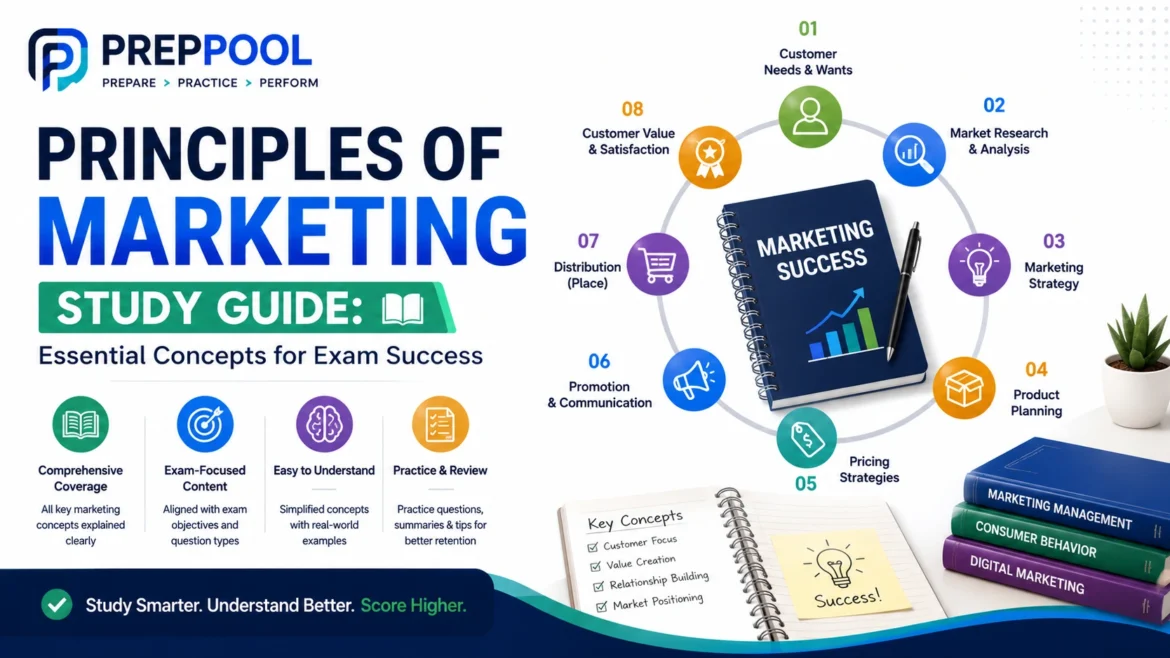

Marketing is one of the most important subjects in business education because it connects products, services, and organizations with the people who need them. Whether a company is launching a new smartphone, promoting a healthcare service, or expanding into international markets, marketing plays a critical role in its success.
For students, Principles of Marketing is often a foundational course that introduces core business concepts, consumer behavior, market research, branding, pricing strategies, promotion, and distribution channels. While the subject is fascinating, preparing for a marketing midterm or final exam can feel challenging due to the wide range of topics covered throughout the semester.
Many students make the mistake of focusing only on memorization. However, marketing exams often test your ability to apply concepts to real-world business scenarios rather than simply recall definitions.
This study guide explores the most important Principles of Marketing concepts, explains how they connect to real businesses, and provides practical insights that can help students prepare more effectively for midterm and final exams.
- The purpose and role of marketing in business
- Core marketing concepts frequently tested on exams
- The marketing environment and market analysis
- Target markets and customer segmentation
- Consumer buying behavior
- The foundations of the marketing mix
- Exam preparation strategies for marketing students
What Is Principles of Marketing?
Principles of Marketing is a business course that introduces students to the strategies organizations use to identify customer needs, create value, and build long-term relationships with consumers.
At its core, marketing is not simply about advertising. It involves understanding customers, developing products and services, setting prices, creating promotional campaigns, and delivering value through effective distribution channels.
The subject helps students understand how businesses attract, satisfy, and retain customers in competitive markets.
Most Principles of Marketing courses cover:
- Marketing fundamentals
- Consumer behavior
- Market segmentation
- Target marketing
- Positioning strategies
- Marketing research
- Product development
- Pricing strategies
- Promotion and advertising
- Distribution channels
- Digital marketing fundamentals
These concepts form the foundation of modern marketing practices and frequently appear on midterm and final examinations.
Why Marketing Matters in Today’s Business World
Every successful organization relies on marketing to connect with customers and generate revenue.
Without marketing, even excellent products may struggle to gain visibility or attract buyers.
Consider companies such as Apple, Nike, Coca-Cola, and Amazon. While their products are important, their ability to understand customer needs and communicate value effectively has played a significant role in their success.
Marketing helps organizations:
- Identify customer needs
- Build brand awareness
- Create customer loyalty
- Increase sales and revenue
- Gain competitive advantages
- Expand into new markets
Understanding these objectives is important because marketing exam questions often focus on how specific strategies support business goals.
The Marketing Concept: The Foundation of Modern Marketing
One of the first concepts students encounter in Principles of Marketing is the marketing concept.
The marketing concept suggests that organizations achieve success by identifying and satisfying customer needs better than competitors.
Rather than focusing solely on selling products, businesses should prioritize creating value for customers.
This customer-centered philosophy influences nearly every marketing decision.
For example, a fitness company launching a new workout app would first research customer preferences before designing features, pricing the product, and developing promotional campaigns.
This approach increases the likelihood of meeting market demand and achieving business objectives.
Understanding Customer Value and Customer Satisfaction
Customer value refers to the perceived benefits customers receive compared to the costs they incur when purchasing a product or service.
Consumers evaluate factors such as:
- Product quality
- Convenience
- Brand reputation
- Customer service
- Price
- Overall experience
When customers believe the benefits outweigh the costs, they are more likely to make a purchase.
Customer satisfaction occurs when a product or service meets or exceeds expectations.
Many exam questions ask students to distinguish between customer value, customer satisfaction, and customer loyalty, making these concepts important study topics.
The Marketing Environment: Internal and External Influences
No business operates in isolation. Organizations must constantly adapt to changing environmental factors that influence marketing decisions.
The marketing environment consists of internal and external forces that affect an organization’s ability to serve customers.
Internal Environment
Internal factors originate within the organization.
Examples include:
- Company culture
- Financial resources
- Management decisions
- Employee capabilities
- Operational processes
External Environment
External factors exist outside the organization’s direct control.
These factors often create opportunities and threats.
- Economic conditions
- Technological changes
- Political regulations
- Social trends
- Competitive pressures
- Demographic shifts
Marketing exams frequently include scenario-based questions requiring students to identify environmental influences affecting business decisions.
Market Segmentation: Reaching the Right Customers
One of the most important principles in marketing is understanding that not all customers have identical needs.
Market segmentation involves dividing a broad market into smaller groups with similar characteristics, preferences, or behaviors.
By segmenting markets, organizations can develop more effective marketing strategies.
Common segmentation approaches include:
| Segmentation Type | Example |
|---|---|
| Demographic | Age, gender, income, education |
| Geographic | Country, region, climate |
| Psychographic | Lifestyle, interests, values |
| Behavioral | Usage patterns, loyalty, benefits sought |
For example, a luxury automobile manufacturer may target affluent professionals, while a budget-friendly vehicle brand focuses on cost-conscious consumers.
Understanding segmentation helps businesses allocate resources more efficiently and create messages that resonate with specific audiences.
Target Marketing and Positioning Strategies
Once a market has been segmented, organizations must decide which segments to pursue.
This process is known as target marketing.
Target marketing allows businesses to focus their efforts on customers who are most likely to purchase their products or services.
After selecting a target market, the next step is positioning.
Positioning refers to how a brand wants customers to perceive its products relative to competitors.
Examples include:
- Volvo positioning itself around safety
- Rolex emphasizing luxury and prestige
- Walmart focusing on affordability
- Tesla promoting innovation and sustainability
Positioning is a common topic in marketing exams because it directly influences branding, messaging, and competitive strategy.
Consumer Buying Behavior: Why Customers Make Purchasing Decisions
Understanding consumer behavior is essential for effective marketing.
Businesses want to know what influences purchasing decisions and how customers evaluate alternatives.
Several factors affect consumer behavior:
- Cultural influences
- Social influences
- Personal factors
- Psychological factors
For example, family recommendations, social media reviews, lifestyle preferences, and personal motivations can all influence purchasing decisions.
Marketers use this knowledge to design products, pricing strategies, and promotional campaigns that appeal to specific audiences.
Because consumer behavior influences nearly every marketing activity, it remains one of the most heavily tested areas in Principles of Marketing courses.
Students preparing for comprehensive assessments often benefit from reviewing realistic marketing scenarios and practice questions. Resources such as the Principles of Marketing midterm and final exam preparation materials can help reinforce key concepts and improve confidence before test day.
The Marketing Mix: Understanding the 4Ps of Marketing
No Principles of Marketing study guide would be complete without discussing the marketing mix. The marketing mix is one of the most important concepts in marketing and appears frequently on midterm and final exams.
The marketing mix consists of four key elements commonly known as the 4Ps:
- Product
- Price
- Place
- Promotion
These elements work together to help organizations create value and achieve marketing objectives.
Successful companies carefully balance all four components rather than focusing on only one area.
| Marketing Mix Element | Purpose |
|---|---|
| Product | Provides value and satisfies customer needs |
| Price | Determines customer cost and company revenue |
| Place | Ensures products reach target customers |
| Promotion | Communicates value and encourages purchases |
Many marketing exam questions ask students to analyze how businesses use the marketing mix to achieve specific goals.
Product Strategy: Creating Value for Customers
The product is the foundation of every marketing strategy. A company cannot succeed if its product or service fails to meet customer expectations.
Products can be physical goods, services, experiences, ideas, or combinations of these elements.
When developing products, marketers consider:
- Quality
- Features
- Design
- Branding
- Packaging
- Customer benefits
For example, Apple consistently focuses on product design, innovation, and user experience. These characteristics help differentiate its products from competitors.
Students should understand that customers often purchase benefits rather than products themselves. A customer buying a fitness tracker may actually be seeking improved health, motivation, and convenience.
Understanding the Product Life Cycle
Another frequently tested concept is the product life cycle.
The product life cycle describes the stages a product experiences from introduction to decline.
| Stage | Characteristics |
|---|---|
| Introduction | Product launch and market awareness building |
| Growth | Rapid sales growth and increasing market acceptance |
| Maturity | Sales stabilize and competition intensifies |
| Decline | Demand decreases and sales begin to fall |
Companies often adjust pricing, promotion, and distribution strategies as products move through these stages.
Understanding how marketing strategies evolve throughout the product life cycle is important for exam success.
Pricing Strategy: More Than Just Setting a Price
Pricing decisions directly affect profitability, market positioning, and customer perceptions.
Many students mistakenly assume pricing simply involves calculating costs and adding a profit margin. In reality, pricing is a strategic decision influenced by multiple factors.
Organizations consider:
- Customer demand
- Production costs
- Competitive pricing
- Brand positioning
- Market conditions
- Business objectives
Luxury brands often use premium pricing to reinforce exclusivity, while discount retailers compete through lower prices.
Marketing exams frequently include scenarios where students must identify the most appropriate pricing strategy for a particular business situation.
Common Pricing Strategies Students Should Know
Several pricing approaches appear regularly in Principles of Marketing courses.
- Penetration Pricing: Setting low initial prices to gain market share.
- Price Skimming: Charging high initial prices before gradually lowering them.
- Competitive Pricing: Pricing based on competitors’ actions.
- Value-Based Pricing: Setting prices according to perceived customer value.
- Psychological Pricing: Using pricing tactics that influence consumer perceptions.
Real-world examples often help students remember these strategies more effectively than memorizing textbook definitions.
Place Strategy: Delivering Products to Customers
Even the best products may fail if customers cannot access them conveniently.
The “Place” component of the marketing mix focuses on distribution channels and how products move from producers to consumers.
Distribution decisions involve:
- Retail locations
- Online marketplaces
- Wholesalers
- Direct sales channels
- Logistics systems
- Inventory management
For example, Amazon’s success depends heavily on its distribution network and ability to deliver products quickly and efficiently.
Questions involving distribution channels often require students to evaluate which approach best serves customer needs and business objectives.
Direct vs. Indirect Distribution Channels
Marketing students should understand the difference between direct and indirect distribution channels.
Direct Distribution
Products are sold directly from the producer to the customer.
Examples include:
- Company websites
- Brand-owned retail stores
- Direct sales representatives
Indirect Distribution
Products pass through intermediaries before reaching consumers.
Examples include:
- Retail stores
- Wholesalers
- Distributors
- Online marketplaces
Understanding the advantages and disadvantages of each channel is important because these topics frequently appear in marketing assessments.
Promotion: Communicating Value to Customers
Promotion includes all activities used to inform, persuade, and remind customers about products and services.
Many people mistakenly believe promotion and marketing are the same thing. In reality, promotion is only one component of the broader marketing process.
Common promotional tools include:
- Advertising
- Public relations
- Sales promotions
- Personal selling
- Social media marketing
- Email marketing
The goal is to communicate value effectively while encouraging customer engagement and purchases.
The Promotional Mix Explained
The promotional mix refers to the combination of communication methods used by an organization.
Each element serves a different purpose.
| Promotional Tool | Primary Purpose |
|---|---|
| Advertising | Create awareness and interest |
| Public Relations | Build positive brand reputation |
| Sales Promotion | Encourage short-term purchases |
| Personal Selling | Develop direct customer relationships |
| Digital Marketing | Reach audiences through online channels |
Marketing exams often ask students to identify which promotional tools are most effective in specific situations.
Marketing Research: The Foundation of Smart Decisions
Successful marketing decisions are rarely based on guesswork.
Organizations conduct marketing research to gather information about customers, competitors, market trends, and business opportunities.
Marketing research helps companies:
- Understand customer preferences
- Measure customer satisfaction
- Evaluate new product ideas
- Identify market opportunities
- Monitor competitors
- Reduce business risks
Without accurate information, organizations may make costly mistakes that negatively affect performance.
Primary and Secondary Research Methods
Students should understand the difference between primary and secondary research.
Primary Research
Information collected directly for a specific purpose.
Examples include:
- Surveys
- Interviews
- Focus groups
- Observations
Secondary Research
Information gathered from existing sources.
Examples include:
- Industry reports
- Government publications
- Academic journals
- Market research databases
Marketing professors frequently include questions that require students to distinguish between these two research approaches.
Real-World Example: How Starbucks Uses Marketing Principles
Starbucks provides an excellent example of marketing concepts in action.
The company carefully segments its market, targets customers seeking premium coffee experiences, and positions itself as a lifestyle brand rather than simply a coffee retailer.
Its marketing mix reflects this strategy:
- Premium-quality products
- Strategic pricing
- Convenient store locations
- Strong promotional campaigns
- Customer loyalty programs
Exam questions often present similar business scenarios and ask students to identify which marketing principles are being applied.
Understanding how concepts operate in real organizations can make studying more engaging and improve retention.
Branding and Brand Equity: Building Long-Term Customer Loyalty
One of the most valuable assets a company can possess is a strong brand. A brand is much more than a logo, slogan, or product name. It represents the perceptions, emotions, and experiences customers associate with a business.
Strong brands help organizations stand out in competitive markets and create lasting customer relationships.
Examples of globally recognized brands include:
- Apple
- Nike
- Coca-Cola
- McDonald’s
- Amazon
These companies have invested heavily in creating consistent customer experiences and delivering value over time.
Brand equity refers to the value a brand adds to a product or service. High brand equity often allows companies to charge premium prices, attract loyal customers, and maintain competitive advantages.
Marketing exams frequently include questions that require students to identify branding strategies and explain how brand equity influences purchasing decisions.
Digital Marketing Fundamentals Every Student Should Understand
The marketing landscape has changed dramatically over the past two decades. While traditional marketing channels remain important, digital marketing now plays a central role in many organizations’ strategies.
Digital marketing involves using online platforms and technologies to reach target audiences.
Common digital marketing channels include:
- Search engine optimization (SEO)
- Content marketing
- Social media marketing
- Email marketing
- Pay-per-click advertising (PPC)
- Influencer marketing
- Video marketing
Businesses use these channels to increase visibility, generate leads, engage customers, and drive sales.
Because digital marketing continues to grow in importance, many Principles of Marketing courses include questions covering online marketing strategies and consumer engagement.
Relationship Marketing: Creating Long-Term Customer Connections
Modern businesses increasingly recognize that retaining existing customers is often more cost-effective than constantly acquiring new ones.
Relationship marketing focuses on building long-term customer satisfaction, trust, and loyalty.
Instead of emphasizing one-time transactions, organizations invest in ongoing customer relationships.
Examples of relationship marketing include:
- Customer loyalty programs
- Personalized recommendations
- Excellent customer service
- Membership benefits
- Customer engagement initiatives
Companies such as Amazon Prime, Starbucks Rewards, and airline frequent flyer programs demonstrate how relationship marketing can strengthen customer retention.
This concept is frequently tested because it highlights the long-term value of customer-focused strategies.
Marketing Ethics and Social Responsibility
Marketing decisions can significantly influence consumers and society. As a result, ethical behavior and social responsibility have become increasingly important considerations.
Ethical marketing involves honesty, transparency, fairness, and respect for consumers.
Examples of ethical concerns include:
- Misleading advertising
- False product claims
- Privacy violations
- Deceptive pricing practices
- Unfair targeting practices
Social responsibility extends beyond legal compliance and involves considering how business activities affect communities, employees, customers, and the environment.
Organizations that demonstrate strong ethical standards often build greater trust and stronger customer relationships.
How Marketing Concepts Connect Together
One challenge students face during exams is viewing marketing topics as isolated concepts.
In reality, marketing functions as an interconnected system.
For example, a company may:
- Conduct marketing research to understand customer needs.
- Segment the market into distinct groups.
- Select a target audience.
- Position its brand strategically.
- Develop a product that creates value.
- Set an appropriate price.
- Choose distribution channels.
- Launch promotional campaigns.
- Build long-term customer relationships.
Understanding how these concepts work together can significantly improve performance on scenario-based exam questions.
Common Principles of Marketing Exam Mistakes Students Make
Many students struggle on marketing exams not because they lack knowledge, but because they make avoidable mistakes during preparation.
Common issues include:
- Memorizing definitions without understanding applications
- Ignoring real-world examples
- Cramming shortly before the exam
- Failing to review key models and frameworks
- Neglecting consumer behavior concepts
- Overlooking segmentation and positioning strategies
Marketing professors frequently use business scenarios that require critical thinking rather than simple recall.
Students who understand how concepts apply in real organizations generally perform better than those who focus solely on memorization.
Best Study Strategies for a Principles of Marketing Midterm or Final Exam
Effective preparation involves more than reading lecture notes repeatedly.
Successful students often combine multiple study methods.
- Review chapter summaries regularly.
- Create concept maps connecting major topics.
- Analyze real-world marketing campaigns.
- Practice applying theories to business situations.
- Study key terminology and frameworks.
- Complete practice questions and mock exams.
Breaking study sessions into smaller, focused periods can improve retention and reduce stress before major exams.
Why Understanding Marketing Benefits Future Careers
Marketing knowledge extends far beyond classroom exams.
Professionals in sales, management, entrepreneurship, consulting, advertising, public relations, digital marketing, and business development all benefit from understanding marketing principles.
Even individuals who never work directly in marketing often use these concepts when communicating value, influencing decisions, and understanding customer needs.
Employers value candidates who can think strategically about customers, markets, and business growth.
This makes Principles of Marketing one of the most practical and widely applicable business courses students encounter during their education.
Final Thoughts
Principles of Marketing provides the foundation for understanding how organizations create value, attract customers, and achieve business success.
From market segmentation and consumer behavior to branding, pricing, promotion, and digital marketing, the concepts covered in this course influence nearly every aspect of modern business.
Students who focus on understanding how these ideas work together—not just memorizing definitions—will be better prepared for both midterm and final exams.
For additional preparation, many students find it helpful to reinforce their knowledge with realistic exam-style questions and comprehensive review materials. Resources such as the Principles of Marketing Midterm and Final Exam with Answers study package can provide valuable practice and help build confidence before test day.
Frequently Asked Questions
What topics are most important for a Principles of Marketing exam?
The most frequently tested topics include the marketing mix (4Ps), consumer behavior, market segmentation, target marketing, positioning, branding, marketing research, pricing strategies, and promotional methods.
Is Principles of Marketing difficult to learn?
Most students find the course manageable when they focus on understanding concepts and applying them to real-world business situations rather than relying solely on memorization.
What is the marketing mix in Principles of Marketing?
The marketing mix consists of Product, Price, Place, and Promotion. These four elements help businesses create value and achieve marketing objectives.
Why is consumer behavior important in marketing?
Consumer behavior helps organizations understand how customers make purchasing decisions, allowing businesses to develop more effective products, pricing strategies, and promotional campaigns.
How can I prepare effectively for a Principles of Marketing?
Review key concepts regularly, analyze real-world examples, practice applying theories to business scenarios, and complete exam-style questions to strengthen your understanding and confidence.