
Preparing for the AWS Certified Data Analytics certification can feel overwhelming at first. Candidates quickly discover that the exam covers multiple domains, numerous AWS services, security concepts, architecture design principles, data processing workflows, and analytics best practices.
Without a structured plan, many professionals end up jumping randomly between topics, watching endless training videos, and reviewing documentation without a clear direction. This often leads to inefficient study sessions and unnecessary frustration.
The good news is that successful candidates rarely rely on motivation alone. Instead, they follow a roadmap that breaks the preparation process into manageable steps.
This guide provides a practical week-by-week AWS Data Analytics study plan designed to help candidates build knowledge progressively, strengthen weak areas, and prepare confidently for exam day.
What This Study Plan Covers
- How to organize your preparation
- Weekly learning objectives
- Core AWS analytics services
- Hands-on learning recommendations
- Practice exam strategy
- Final review techniques
- Exam readiness milestones
Why Most Candidates Need a Structured AWS Data Analytics Study Plan
Many professionals begin studying with enthusiasm but soon encounter a common problem: too much information.
AWS offers a broad ecosystem of services, and candidates often struggle to determine which topics deserve the most attention.
Some spend weeks studying advanced services while neglecting foundational concepts. Others repeatedly review familiar topics and avoid weaker areas altogether.
A structured study plan solves these problems by creating a logical progression from fundamental concepts to advanced analytics architectures.
Rather than studying everything at once, candidates focus on mastering one layer of knowledge before moving to the next.
Who Can Benefit from This Roadmap?
This preparation strategy is designed for multiple types of learners.
- Data Analysts transitioning to AWS
- Cloud Engineers expanding into analytics
- Business Intelligence Professionals
- Data Engineers preparing for certification
- Solutions Architects seeking analytics expertise
- IT Professionals entering cloud data roles
Whether you already work with AWS or are relatively new to cloud analytics, a structured approach can improve both efficiency and retention.
Before You Begin: Assess Your Current Knowledge
Before creating a study schedule, it is important to establish a baseline.
Ask yourself the following questions:
- Do I understand core cloud computing concepts?
- Have I worked with AWS services before?
- Do I have experience with SQL and databases?
- Am I familiar with ETL workflows?
- Do I understand analytics architectures?
- Have I used business intelligence tools?
Your answers will help determine how much time you should allocate to various topics.
For example, a database administrator may require less time studying data storage concepts but more time learning AWS-specific analytics services.
How Long Should You Study for the AWS Certified Data Analytics Exam?
The ideal preparation timeline depends on your experience level.
| Experience Level | Recommended Study Timeline |
|---|---|
| Beginner | 10–12 Weeks |
| Intermediate | 8–10 Weeks |
| Experienced AWS Professional | 6–8 Weeks |
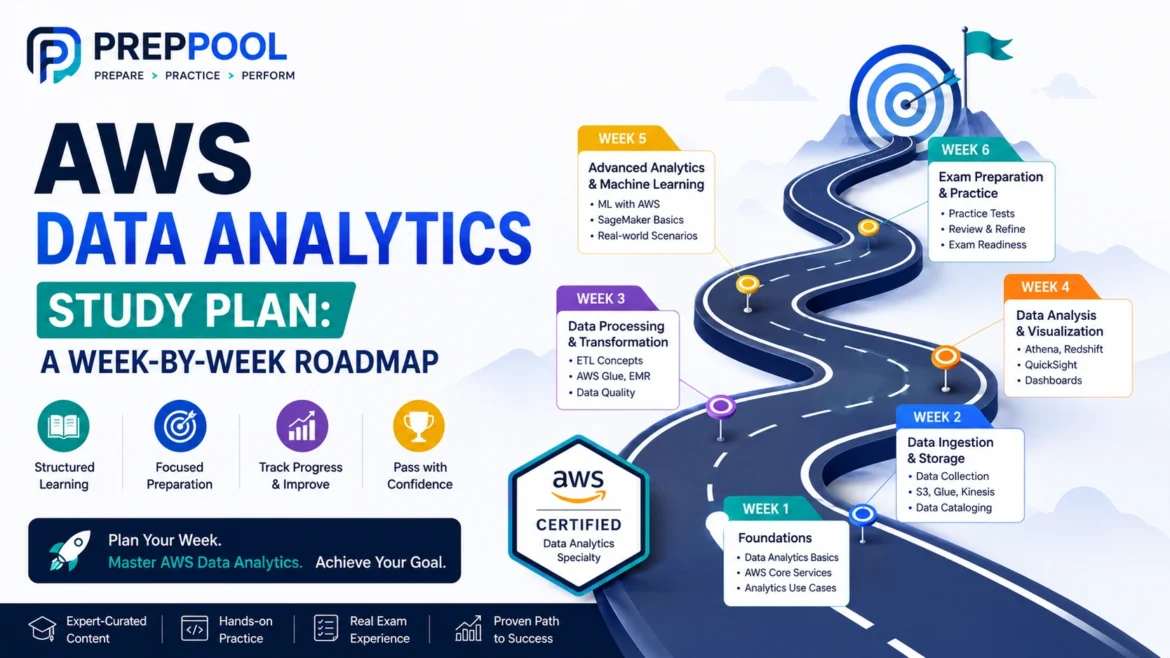
This roadmap follows an eight-week framework because it works well for most candidates while providing sufficient time for learning, review, and practice testing.
Week 1: Build Your AWS Analytics Foundation
The first week should focus on understanding the overall AWS analytics ecosystem rather than diving immediately into advanced services.
Your objective is to understand how data moves through modern cloud environments.
Focus on learning:
- Cloud analytics fundamentals
- Data lifecycle concepts
- Analytics architecture basics
- AWS global infrastructure
- Storage fundamentals
- Core security principles
At this stage, avoid memorizing service features.
Instead, concentrate on understanding the big picture and how organizations use analytics to solve business problems.
Week 2: Master Data Storage and Data Lake Concepts
Modern analytics architectures often begin with data storage.
During Week 2, focus on understanding how organizations collect, organize, and manage large volumes of information.
Key study areas include:
- Data lake principles
- Structured and unstructured data
- Storage architecture design
- Lifecycle management concepts
- Data durability and availability
- Storage optimization strategies
This week is particularly important because storage decisions influence nearly every downstream analytics process.
Candidates who understand data lake architecture often perform better on scenario-based questions later in their preparation journey.
Week 3: Learn Data Collection and Ingestion Workflows
Once data storage concepts are clear, the next step is understanding how data enters analytics environments.
Organizations collect data from a wide variety of sources, including applications, devices, websites, business systems, and third-party platforms.
Study topics should include:
- Batch ingestion workflows
- Streaming data concepts
- Data integration patterns
- Event-driven architectures
- Scalable ingestion strategies
- Reliability considerations
Understanding ingestion workflows helps candidates visualize the beginning stages of the analytics lifecycle.
Study TipAt the end of each week, create a one-page summary of everything learned. These summaries become incredibly valuable during your final review phase.
The Importance of Hands-On Learning During the First Three Weeks
Many candidates make the mistake of spending their entire preparation period consuming content passively.
Reading documentation and watching training videos are useful, but practical experience helps reinforce concepts far more effectively.
Whenever possible, experiment with AWS services and observe how data flows through various analytics processes.
Even simple projects can help transform abstract concepts into practical knowledge.
Candidates who combine theory with hands-on learning often develop stronger problem-solving skills and greater confidence during the exam.
How to Measure Progress During Early Preparation
The first three weeks should focus on learning rather than testing.
However, you should still monitor progress regularly.
Signs that your preparation is moving in the right direction include:
- You can explain major analytics workflows.
- You understand the purpose of key AWS services.
- You recognize common architecture patterns.
- You can identify data lifecycle stages.
- You understand foundational security concepts.
If these concepts still feel confusing after Week 3, spend additional time strengthening your foundation before moving to more advanced topics.
Week 4: Master Data Processing and Transformation Workflows
By Week 4, candidates should have a solid understanding of how data is collected and stored. The next step is learning how organizations transform raw information into usable datasets.
Data processing sits at the center of modern analytics environments. Without proper transformation, even high-quality data can become difficult to analyze and interpret.
This week should focus on:
- ETL and ELT methodologies
- Data transformation pipelines
- Data quality management
- Schema design concepts
- Data cleansing strategies
- Workflow automation principles
Many exam questions involve choosing the most efficient way to process and prepare data for downstream analytics workloads.
As you study, pay close attention to how processing decisions affect scalability, performance, cost, and operational complexity.
Week 5: Understand Analytics, Querying, and Visualization Concepts
Once data has been collected, stored, and transformed, organizations need ways to extract value from it.
Week 5 focuses on analytics and business intelligence capabilities that help stakeholders make informed decisions.
During this phase, candidates should explore:
- Data querying concepts
- Business intelligence workflows
- Dashboard design principles
- Reporting architectures
- Data visualization best practices
- Performance optimization techniques
Many certification questions present situations where business users require fast access to insights. Understanding how analytics systems support these needs is essential.
Rather than simply memorizing service capabilities, think about how executives, analysts, and operational teams use data to drive decisions.
Week 6: Focus on Security, Governance, and Compliance
Security remains one of the most important domains within cloud analytics environments.
Organizations handling customer information, financial records, healthcare data, and operational intelligence must implement strong governance controls.
This week should be dedicated to understanding:
- Identity and access management concepts
- Data encryption strategies
- Compliance requirements
- Data governance frameworks
- Monitoring and auditing principles
- Security best practices
Many candidates underestimate this area and focus primarily on technical analytics workflows. However, AWS certification exams frequently incorporate security requirements into architecture scenarios.
The best answer is not always the fastest or most scalable solution. Often, security and governance considerations influence the correct decision.
Midpoint Preparation Checkpoint
- Can you explain the complete analytics lifecycle?
- Do you understand data lake architecture?
- Can you identify common ingestion patterns?
- Are security concepts becoming familiar?
- Can you recognize when different analytics approaches should be used?
How to Study AWS Architecture Scenarios Effectively
One of the biggest differences between average candidates and high-performing candidates is their ability to evaluate architecture scenarios.
The AWS Certified Data Analytics exam rarely focuses on isolated technical facts. Instead, questions often describe business requirements and ask candidates to identify the most appropriate solution.
To improve architectural thinking:
- Study complete analytics workflows
- Analyze data movement across systems
- Review scalability considerations
- Compare multiple solution approaches
- Understand operational trade-offs
- Evaluate security implications
Developing architecture-focused thinking helps candidates navigate complex scenario-based questions with greater confidence.
Creating a Weekly Study Schedule That Actually Works
One reason candidates fall behind is unrealistic planning.
Many professionals balance certification preparation with full-time jobs, family responsibilities, and personal commitments.
A sustainable study schedule often produces better results than an aggressive plan that becomes impossible to maintain.
| Day | Recommended Activity |
|---|---|
| Monday | Learn new concepts and review documentation |
| Tuesday | Hands-on practice and architecture review |
| Wednesday | Deep dive into weak topics |
| Thursday | Scenario-based learning exercises |
| Friday | Review notes and summarize key lessons |
| Saturday | Practice questions and knowledge assessment |
| Sunday | Weekly review and preparation planning |
Consistency matters far more than occasional marathon study sessions.
When Should You Start Taking Practice Exams?
A common question among candidates is whether practice exams should be used early or later in the preparation process.
For most learners, the ideal time to begin serious practice testing is after establishing a strong foundation.
By the end of Week 6, candidates should have enough knowledge to benefit from realistic exam simulations.
Practice exams help identify:
- Knowledge gaps
- Weak domains
- Time-management issues
- Architecture weaknesses
- Misunderstood concepts
The goal is not simply achieving a high score. The goal is understanding why certain answers are correct and why others are not.
How This Certification Fits Into Long-Term Career Development
While passing the exam is the immediate objective, candidates should remember that certification preparation can deliver benefits beyond the credential itself.
Learning cloud analytics concepts helps professionals understand how modern organizations manage data, support business intelligence initiatives, and scale analytics operations.
For those evaluating the broader professional advantages of certification, our detailed guide on career opportunities in cloud-based analytics explores how AWS Data Analytics certification aligns with industry demand, emerging technologies, and long-term growth in the U.S. job market.
Common Challenges During Weeks 4–6
Many candidates experience a motivation dip during the middle of their preparation journey.
The excitement of getting started has faded, but exam day still feels distant.
This is completely normal.
Common challenges during this stage include:
- Information overload
- Difficulty retaining technical details
- Balancing work and study responsibilities
- Uncertainty about readiness
- Frustration with practice questions
The best way to overcome these challenges is by focusing on steady progress rather than perfection.
Every study session contributes to building a stronger understanding of AWS analytics concepts.
Preparing for the Final Phase of Your Study Plan
By the end of Week 6, candidates should possess a strong understanding of analytics workflows, architecture principles, governance requirements, and core AWS concepts.
The final stage of preparation shifts from learning new material to refining knowledge, strengthening weak areas, and developing exam-day confidence.
The next phase is where many successful candidates separate themselves from the competition.
Strategic practice testing, targeted reviews, and effective revision techniques often produce the largest gains in exam readiness during the final weeks before certification.
Week 7: Practice Exam Analysis and Targeted Improvement
By Week 7, the majority of your learning should already be complete. At this stage, your focus should shift from acquiring new information to evaluating how effectively you can apply what you have learned.
This is where full-length practice exams become especially valuable.
Rather than treating practice tests as simple score checks, use them as diagnostic tools that reveal weaknesses in your preparation.
After each practice exam, categorize missed questions into specific areas such as:
- Data storage and data lakes
- Data ingestion workflows
- Data transformation and processing
- Analytics and visualization
- Security and governance
- Performance optimization
- Cost management strategies
Patterns often emerge quickly. Some candidates discover they consistently struggle with architecture questions, while others identify gaps in security or optimization concepts.
The objective is not merely increasing practice scores. The objective is eliminating weaknesses before exam day.
How to Review Incorrect Answers Effectively
One of the most productive study activities during Week 7 is reviewing incorrect answers in depth.
Many candidates simply note the correct option and move on. Unfortunately, this approach misses an important learning opportunity.
For every incorrect answer, ask yourself:
- Why was my choice wrong?
- What requirement did I overlook?
- Why is the correct answer better?
- What AWS best practice applies here?
- How would I approach a similar question next time?
This process strengthens analytical thinking and improves decision-making under exam conditions.
It also helps candidates recognize recurring themes that frequently appear throughout AWS certification exams.
Week 8: Final Review and Exam Readiness
The final week should focus on reinforcement rather than intensive learning.
Attempting to absorb large amounts of new information immediately before the exam often creates confusion and reduces confidence.
Instead, use Week 8 to revisit key concepts and strengthen existing knowledge.
Priority review areas should include:
- Analytics architecture patterns
- Data lifecycle concepts
- Security and compliance principles
- Cost optimization strategies
- Data lake design fundamentals
- Performance and scalability considerations
Short, focused review sessions are typically more effective than lengthy cramming sessions during the final week.
Final Week Success Formula
- Review summaries created throughout your study journey
- Focus on weak areas identified through practice exams
- Avoid learning completely new topics
- Maintain consistent study habits
- Prioritize quality over quantity
- Stay confident and avoid burnout
Exam-Day Preparation Tips
Preparation does not end when your study plan is complete.
How you approach exam day can significantly influence performance.
Successful candidates often follow several simple practices:
- Get adequate sleep the night before
- Arrive prepared and organized
- Read every question carefully
- Identify business requirements first
- Eliminate obviously incorrect options
- Manage time consistently throughout the exam
Remaining calm and methodical can improve accuracy, particularly on complex scenario-based questions.
How to Avoid Common Last-Minute Mistakes
Many candidates undermine months of preparation by making avoidable mistakes during the final days before the exam.
Common examples include:
- Studying for excessively long hours
- Attempting to memorize every service feature
- Switching study resources repeatedly
- Ignoring weak areas out of frustration
- Taking too many practice exams back-to-back
If you want a deeper understanding of the preparation pitfalls that frequently prevent candidates from passing, our guide on common AWS Data Analytics certification mistakes explains the most frequent errors and how to avoid them.
Learning from the experiences of other candidates can help you refine your own preparation strategy.
Building Confidence Before Exam Day
Confidence is often misunderstood.
True confidence does not come from believing the exam will be easy. It comes from knowing you have prepared systematically and thoroughly.
By Week 8, you should be able to:
- Explain major analytics workflows
- Understand architecture trade-offs
- Recognize AWS best practices
- Identify security requirements
- Evaluate cost and performance considerations
- Analyze business-driven scenarios
If you can consistently perform these tasks, you are likely much closer to exam readiness than you realize.
A Real-World Example of Structured Preparation Success
Consider a business intelligence analyst who had limited cloud experience but wanted to expand into data engineering and analytics architecture roles.
Rather than attempting to learn everything at once, she followed a structured eight-week roadmap similar to the one outlined in this guide.
Each week focused on a specific domain. She combined documentation review, hands-on practice, architecture analysis, and practice exams.
Whenever weaknesses appeared, she adjusted her study schedule rather than ignoring difficult topics.
By exam day, she not only passed the certification but also developed a much deeper understanding of cloud analytics systems that proved valuable in her professional role.
Her success illustrates the importance of consistency and strategic preparation.
Why Structured Study Plans Produce Better Results
Certification preparation can quickly become overwhelming without direction.
A roadmap helps candidates organize information, track progress, and maintain focus throughout the learning process.
Structured preparation offers several advantages:
- Improved knowledge retention
- Better time management
- Reduced stress and uncertainty
- Balanced coverage of exam domains
- More efficient review sessions
- Greater confidence approaching exam day
These benefits often translate into stronger exam performance and a more rewarding learning experience.
As candidates move into the practice-testing phase of their preparation, it becomes important to evaluate not only overall knowledge but also readiness for real exam scenarios. Working through realistic questions can help identify weak domains, improve decision-making skills, and build confidence before exam day. Many candidates supplement their study schedules with comprehensive AWS Certified Data Analytics exam preparation resources that closely reflect the structure and style of certification questions.
Final Thoughts
The AWS Certified Data Analytics certification requires more than technical knowledge alone. Success depends on understanding analytics architectures, data workflows, security principles, governance requirements, and AWS best practices.
A structured study plan transforms a complex certification journey into a series of achievable milestones.
By following a week-by-week roadmap, candidates can build knowledge progressively, strengthen weak areas, develop practical skills, and approach exam day with confidence.
Whether you are transitioning into cloud analytics, advancing your current role, or pursuing professional growth, a disciplined preparation strategy remains one of the most effective investments you can make in your certification success.
Frequently Asked Questions
How many weeks should I study for the AWS Certified Data Analytics exam?
Most candidates benefit from six to twelve weeks of preparation depending on their AWS experience, analytics background, and available study time.
When should I start taking AWS Data Analytics practice exams?
Practice exams are often most effective after building a strong foundation. Many candidates begin serious practice testing around Weeks 6 or 7 of their study plan.
Is hands-on AWS experience necessary for passing the exam?
While not mandatory, hands-on experience helps candidates understand real-world workflows, service interactions, and architecture decisions that frequently appear in exam questions.
What should I focus on during the final week before the exam?
The final week should emphasize review, architecture analysis, security concepts, weak-domain improvement, and confidence building rather than learning entirely new material.
What is the biggest advantage of following a structured AWS Data Analytics study plan?
A structured roadmap improves organization, reduces information overload, strengthens retention, and helps candidates cover all major exam domains efficiently.