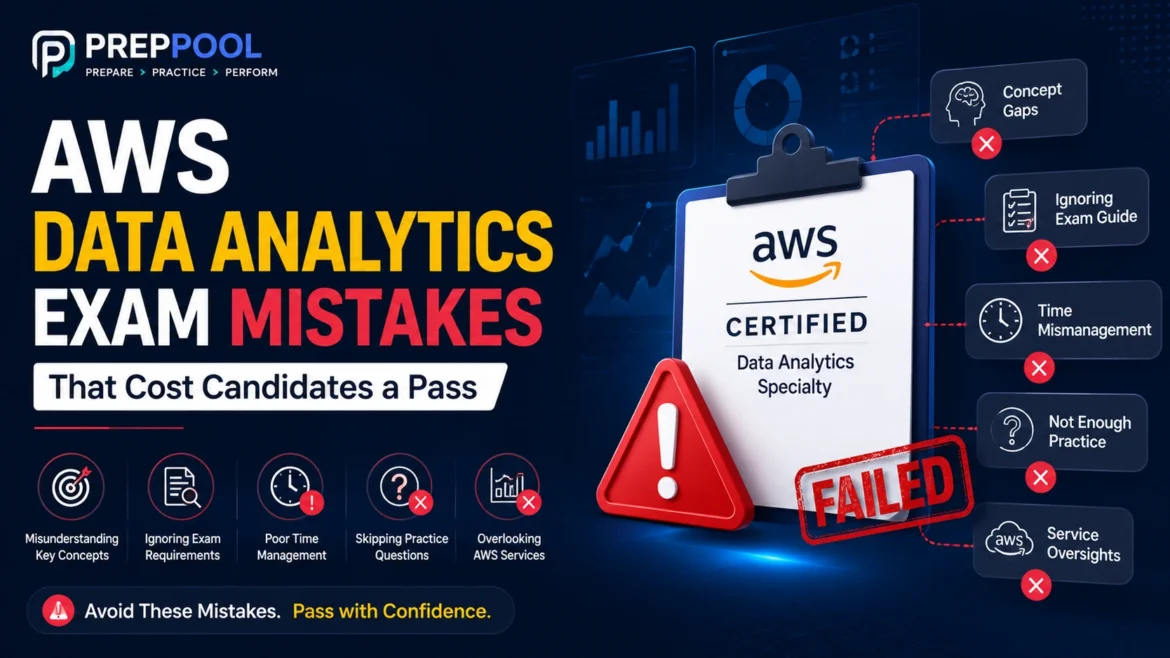

Thousands of candidates prepare for the AWS Certified Data Analytics certification every year. Many spend weeks or even months studying AWS services, reviewing documentation, and taking practice tests. Yet despite investing significant time and effort, some candidates still fail to achieve a passing score.
What often surprises these candidates is that failure rarely occurs because they completely lack technical knowledge. More commonly, it results from avoidable mistakes during preparation or poor decision-making during the exam itself.
The AWS Certified Data Analytics exam is designed to assess how well candidates can apply analytics concepts within real-world AWS environments. Success requires more than memorization. Candidates must understand business requirements, architecture decisions, security considerations, data processing workflows, and service integrations.
In many cases, highly skilled professionals struggle because they prepare for the wrong things or overlook critical exam expectations.
- The most common reasons candidates fail
- Study habits that hurt exam performance
- Technical topics frequently misunderstood
- Time-management mistakes during the exam
- Last-week preparation strategies
- Practical ways to improve your passing chances
Why Smart Candidates Still Fail the AWS Data Analytics Exam
One of the biggest misconceptions about certification exams is that intelligence alone guarantees success. In reality, many capable professionals fail because they underestimate the exam’s structure.
A candidate may have years of SQL experience, strong reporting skills, and a solid understanding of business intelligence tools. However, if they lack familiarity with AWS-specific analytics architectures, they may struggle to identify the best solution in scenario-based questions.
The exam evaluates decision-making within AWS environments rather than general analytics knowledge alone.
This distinction is important because many candidates focus heavily on concepts they already know while neglecting AWS services that appear frequently throughout the exam.
Mistake #1: Memorizing Services Instead of Understanding Use Cases
This is arguably the most common preparation mistake.
Many candidates create flashcards containing AWS service names and definitions. While understanding service functionality is important, the certification exam rarely asks simple definition questions.
Instead, questions typically present a business challenge and ask which solution best satisfies technical requirements.
For example, candidates may need to determine:
- Which service best supports real-time analytics?
- Which architecture minimizes operational overhead?
- Which storage solution reduces costs while maintaining performance?
- Which approach improves security and compliance?
Candidates who only memorize definitions often struggle because multiple answer choices may appear technically correct.
The challenge is selecting the most appropriate AWS solution for the specific scenario presented.
Mistake #2: Ignoring Architecture-Based Thinking
The AWS Certified Data Analytics exam frequently evaluates architectural decision-making.
Rather than focusing on individual services in isolation, candidates must understand how services interact throughout a complete analytics pipeline.
A typical analytics architecture may involve:
- Data ingestion
- Data storage
- Data transformation
- Data cataloging
- Data querying
- Visualization and reporting
- Monitoring and governance
Candidates who study services independently often miss the broader architectural relationships that drive many exam questions.
Understanding end-to-end data workflows can significantly improve performance on scenario-based questions.
Mistake #3: Relying Entirely on Video Courses
Video training can be extremely valuable, especially when learning unfamiliar services. However, many candidates make the mistake of relying exclusively on video content.
Passive learning often creates a false sense of confidence.
Watching an instructor explain Amazon Redshift, AWS Glue, or Amazon Kinesis does not necessarily mean you can apply those services in a complex business scenario.
Successful candidates typically combine multiple learning methods, including:
- Hands-on labs
- Architecture reviews
- AWS documentation
- Scenario analysis
- Practice questions
- Performance reviews
Active learning generally produces stronger retention than passive content consumption alone.
Mistake #4: Avoiding Difficult Topics
Every candidate has strengths and weaknesses.
A database professional may feel comfortable with data warehousing concepts but struggle with streaming analytics. Meanwhile, a cloud engineer may understand infrastructure design yet lack confidence in business intelligence tools.
Many candidates repeatedly study familiar topics because it feels productive.
Unfortunately, this approach leaves major knowledge gaps unresolved.
The most effective preparation plans allocate extra time to weaker areas rather than continuously reviewing existing strengths.
Exam performance often improves dramatically when candidates confront difficult topics directly instead of postponing them.
The Hidden Cost of Skipping Practice Exams
Some candidates avoid practice tests because they fear disappointing scores.
Ironically, this decision often hurts performance on the actual exam.
Practice exams provide valuable insights into:
- Knowledge gaps
- Question structure
- Time management
- Decision-making patterns
- Technical weaknesses
They also help candidates become familiar with the style of scenario-based questions commonly found on certification exams.
Many successful candidates use realistic practice questions throughout their preparation journey. Resources such as the AWS Certified Data Analytics practice exam materials can help identify weak areas before exam day and improve overall readiness.
How Overconfidence Causes Unexpected Failures
Experienced IT professionals occasionally assume their industry background alone will carry them through the certification process.
While professional experience is certainly valuable, AWS certification exams test platform-specific knowledge and best practices.
An architect with years of experience designing on-premises systems may still struggle if they are unfamiliar with AWS-native analytics services.
Similarly, data analysts with strong reporting backgrounds may find cloud architecture questions challenging if they have not invested time learning AWS analytics workflows.
The most successful candidates approach the exam with confidence balanced by preparation.
Early Warning Signs Your Preparation Strategy Needs Adjustment
Several indicators may suggest that your current study plan requires improvement:
- Practice exam scores remain stagnant
- You consistently miss architecture questions
- You struggle to differentiate similar AWS services
- You rely heavily on memorization
- You avoid reviewing incorrect answers
- You cannot explain why one answer is better than another
Recognizing these warning signs early allows candidates to make meaningful adjustments before exam day arrives.
Mistake #5: Underestimating Security and Data Governance Topics
Many candidates focus almost exclusively on data processing, storage, and analytics services while overlooking security-related concepts. This can be a costly mistake.
In real-world environments, security is not treated as a separate function. It is integrated throughout every stage of the analytics lifecycle. AWS follows this same philosophy, which is reflected in certification exams.
Candidates should understand how security influences:
- Data access controls
- Encryption strategies
- Identity and permissions management
- Compliance requirements
- Data governance frameworks
- Audit and monitoring processes
Questions often require candidates to balance performance, scalability, and security requirements simultaneously. Choosing the technically fastest solution may not always be the correct answer if it introduces unnecessary security risks.
Mistake #6: Misunderstanding Cost Optimization Scenarios
Cloud environments offer incredible flexibility, but organizations still care about budgets.
A common theme throughout AWS certification exams involves selecting solutions that meet business requirements while minimizing costs.
Many candidates automatically choose the most powerful architecture without considering cost implications.
However, AWS best practices often emphasize finding the most efficient solution rather than the most expensive one.
When reviewing questions, always consider:
- Operational expenses
- Storage costs
- Data transfer charges
- Maintenance overhead
- Scalability requirements
- Long-term resource utilization
Cost-awareness is an important skill for both certification success and real-world cloud operations.
Mistake #7: Failing to Distinguish Similar AWS Services
One challenge many candidates encounter is differentiating services that appear similar on the surface.
For example, multiple AWS services may support analytics, storage, querying, or data processing.
The exam frequently evaluates your ability to identify the most appropriate service for a specific use case.
Instead of memorizing feature lists, focus on understanding:
- Primary use cases
- Performance strengths
- Operational complexity
- Scalability characteristics
- Integration capabilities
- Cost considerations
This deeper understanding makes it easier to evaluate answer choices during scenario-based questions.
Mistake #8: Ignoring Real-Time Analytics Concepts
Modern organizations increasingly depend on real-time insights. Customer interactions, financial transactions, application events, and IoT devices continuously generate streams of data.
As a result, streaming analytics has become an important component of cloud data architectures.
Candidates who focus solely on traditional batch processing workflows may struggle with questions involving:
- Event-driven architectures
- Streaming data ingestion
- Near real-time reporting
- Continuous data processing
- Low-latency analytics solutions
Understanding the differences between batch and streaming analytics can help candidates answer architecture-focused questions more confidently.
Mistake #9: Reading Questions Too Quickly
This mistake affects candidates at every experience level.
Certification questions often include subtle details that dramatically change the correct answer.
Words and phrases such as:
- Most cost-effective
- Lowest operational overhead
- Highly available
- Near real-time
- Most secure
- Minimal administrative effort
may completely alter which solution AWS considers the best practice.
Candidates who rush through questions sometimes select answers that are technically correct but fail to satisfy the specific business requirement being evaluated.
Reading carefully can improve scores more than many candidates realize.
Mistake #10: Spending Too Much Time on Difficult Questions
Time management plays a significant role in certification success.
Some candidates become trapped on challenging questions and spend several minutes analyzing every answer option.
This creates two problems:
- It increases stress levels.
- It reduces time available for remaining questions.
Successful candidates often follow a simple strategy:
- Answer easy questions immediately.
- Mark difficult questions for review.
- Return to challenging questions later.
- Use remaining time strategically.
This approach helps maximize scoring opportunities across the entire exam.
Why Candidates Misinterpret Scenario-Based Questions
Scenario-based questions represent one of the most challenging aspects of the AWS Certified Data Analytics exam.
Instead of asking direct technical questions, these scenarios describe business objectives and operational constraints.
For example, a question may involve:
- A rapidly growing e-commerce company
- Large volumes of streaming data
- Strict security requirements
- Budget limitations
- Minimal administrative overhead
The correct answer requires understanding how these requirements interact rather than simply identifying a familiar AWS service.
Candidates who think like solution architects generally perform better on these questions than those relying purely on memorization.
The Problem with Last-Minute Cramming
Many candidates become anxious during the final week before the exam.
In response, they attempt to review every service, every feature, and every architecture pattern in a short period of time.
This often leads to information overload.
Instead of improving performance, excessive cramming can reduce confidence and increase stress.
A more effective strategy focuses on reinforcing existing knowledge while addressing remaining weaknesses.
- Review weak domains
- Analyze missed practice questions
- Study architecture patterns
- Refresh security concepts
- Review cost optimization strategies
- Practice time management techniques
A Real Candidate Example: Learning from Failure
Consider a cloud administrator who had several years of AWS experience and believed certification would be straightforward.
Confident in his technical background, he spent most of his preparation reviewing service definitions and watching video courses.
Unfortunately, his first exam attempt resulted in a failing score.
After reviewing his preparation strategy, he discovered several weaknesses:
- Limited exposure to analytics-specific architectures
- Minimal practice exam experience
- Poor understanding of business-focused scenarios
- Insufficient review of security requirements
Over the following weeks, he shifted his approach toward hands-on learning, architecture analysis, and scenario-based practice questions.
When he retook the exam, his performance improved significantly.
This example illustrates an important lesson: failing an exam often reflects preparation gaps rather than a lack of ability.
Building an Effective 30-Day Recovery Plan
If your practice exam scores remain below your target range, a focused 30-day improvement plan can make a substantial difference.
Week 1 should focus on identifying weak domains and reviewing core concepts.
Week 2 should emphasize hands-on practice and architecture understanding.
Week 3 should concentrate on advanced scenarios, governance topics, and optimization strategies.
Week 4 should involve full-length practice exams and targeted review sessions.
This structured approach helps candidates strengthen weaknesses without becoming overwhelmed.
The Psychology of Exam Success
Technical knowledge is essential, but mindset also matters.
Candidates who approach preparation strategically tend to outperform those who study reactively.
Effective preparation involves:
- Consistent study habits
- Realistic expectations
- Regular self-assessment
- Continuous improvement
- Adaptability when weaknesses emerge
Certification success often results from disciplined preparation rather than last-minute effort.
Mistake #11: Neglecting Data Lake Architecture Concepts
Data lakes have become a foundational component of modern analytics ecosystems. Yet many candidates spend far more time studying individual AWS services than understanding how those services work together within a complete data lake architecture.
The exam frequently presents scenarios involving large-scale data storage, governance requirements, multiple data sources, and long-term analytics objectives.
Candidates should understand:
- Data lake design principles
- Data ingestion patterns
- Metadata management
- Data cataloging strategies
- Security controls
- Query and analytics workflows
A strong understanding of data lake architecture often helps candidates answer multiple question types across different exam domains.
Mistake #12: Focusing on Features Instead of Business Outcomes
A common trap during preparation is becoming obsessed with technical features while ignoring business objectives.
Real organizations invest in analytics solutions because they want measurable outcomes such as faster reporting, improved customer experiences, reduced costs, enhanced operational efficiency, or better decision-making.
The certification exam often reflects this reality.
Questions frequently ask candidates to select solutions that achieve business goals while balancing performance, scalability, security, and operational simplicity.
When reviewing practice questions, ask yourself:
- What business problem is being solved?
- Which requirement matters most?
- What trade-offs exist?
- Which solution aligns with AWS best practices?
This mindset can dramatically improve performance on scenario-driven questions.
Mistake #13: Not Reviewing Incorrect Practice Questions
Many candidates focus exclusively on their practice test scores.
While scores provide useful benchmarks, the real value comes from analyzing mistakes.
Every incorrect answer represents an opportunity to strengthen understanding.
Instead of simply noting the correct option, investigate why your answer was wrong and why AWS considers another solution more appropriate.
Over time, this habit improves architectural thinking and reduces the likelihood of repeating similar mistakes on the actual exam.
Creating a Winning Exam-Day Strategy
Even well-prepared candidates can struggle if they enter the exam without a clear strategy.
The goal is not merely to answer questions but to manage time, maintain focus, and make sound decisions under pressure.
Successful candidates often follow a process similar to the following:
- Read each question carefully.
- Identify the primary business requirement.
- Eliminate obviously incorrect options.
- Compare remaining answers against AWS best practices.
- Mark difficult questions for review.
- Maintain steady pacing throughout the exam.
This structured approach reduces stress and helps candidates avoid careless mistakes.
The Final 72 Hours Before Your Exam
The last three days before the exam should focus on reinforcement rather than intensive studying.
Attempting to learn entirely new topics at the last minute often creates confusion and unnecessary anxiety.
Instead, focus on:
- Reviewing architecture diagrams
- Refreshing key analytics concepts
- Analyzing previously missed questions
- Reviewing security and governance topics
- Strengthening cost optimization knowledge
- Improving confidence through targeted revision
A calm and focused approach is generally more effective than marathon study sessions.
- Understand major AWS analytics services
- Review data lake architectures
- Know security and governance principles
- Understand cost optimization strategies
- Practice scenario-based decision-making
- Take at least one full-length practice exam
- Review weak areas before exam day
- Develop a time-management plan
What Successful Candidates Do Differently
After speaking with certified professionals and reviewing common success patterns, several habits consistently appear among high-performing candidates.
They focus on understanding rather than memorization.
They regularly practice with realistic scenarios.
They review mistakes thoroughly.
They dedicate extra time to weak areas.
Most importantly, they approach certification preparation as professional development rather than simply a test to pass.
This mindset often produces benefits that extend well beyond exam day.
How Avoiding These Mistakes Can Accelerate Your Career
The value of certification preparation extends beyond earning a credential.
By mastering AWS analytics concepts, professionals improve their ability to design solutions, participate in cloud initiatives, and contribute to data-driven business decisions.
Organizations increasingly seek individuals who can bridge the gap between business requirements and technical implementation.
Developing this capability can strengthen your professional profile and create opportunities for advancement across analytics, engineering, architecture, and consulting roles.
If you’re also evaluating the long-term career benefits of certification, our guide on building a data-driven career with AWS Data Analytics certification explores how this credential supports professional growth, industry demand, and future opportunities in the U.S. technology market.
Final Thoughts
Most AWS Certified Data Analytics exam failures are not caused by a lack of intelligence or technical potential. Instead, they result from avoidable preparation mistakes, weak exam strategies, or misunderstandings about how AWS evaluates analytics knowledge.
By recognizing these common pitfalls early, candidates can develop a more effective study plan and significantly improve their chances of success.
Focus on understanding use cases rather than memorizing definitions. Learn how AWS services work together within complete analytics architectures. Practice scenario-based thinking, review mistakes carefully, and approach preparation with consistency.
These habits not only improve exam performance but also help build the practical skills required in modern cloud analytics roles.
Frequently Asked Questions
What is the most common reason candidates fail the AWS Certified Data Analytics exam?
The most common reason is relying on memorization instead of understanding real-world AWS analytics scenarios. The exam emphasizes decision-making, architecture design, and business requirements.
Are practice exams important for AWS Data Analytics certification preparation?
Yes. Practice exams help identify knowledge gaps, improve time management, and familiarize candidates with the scenario-based format commonly used in certification exams.
How many weeks should I study before taking the AWS Certified Data Analytics exam?
The ideal timeline varies by experience level, but many candidates benefit from a structured study plan lasting six to twelve weeks, including hands-on practice and mock exams.
Should I focus more on AWS services or analytics concepts?
Both are important. Candidates should understand analytics principles while also knowing when and why specific AWS services are used within modern cloud architectures.
Can experienced AWS professionals still fail the AWS Certified Data Analytics exam?
Yes. Many experienced professionals underestimate the exam and focus too heavily on general AWS knowledge rather than analytics-specific architectures, governance, optimization, and business-focused scenarios.