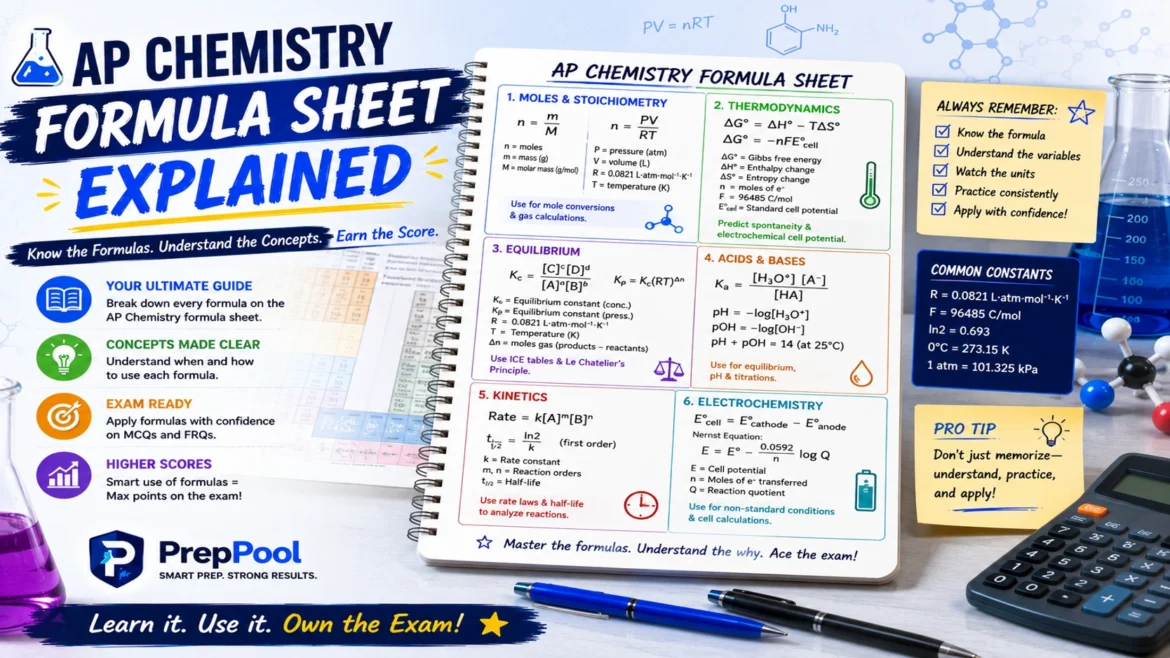

However, the AP Chemistry formula sheet is not designed to confuse students. Instead, it acts as a reference tool that supports calculations and scientific reasoning throughout the exam.
Students who understand when and how to use the formula sheet correctly often feel far more confident during difficult chemistry questions.
- Equilibrium equations
- Gas law formulas
- Electrochemistry formulas
- Thermodynamics equations
- Constants and conversion values
- Acid-base relationships
Why the AP Chemistry Formula Sheet Matters
The AP Chemistry exam tests scientific reasoning and conceptual understanding more than memorization alone. Because of this, students are provided with a formula sheet to support calculations and analysis during the exam.
However, many students mistakenly assume the formula sheet eliminates the need to study chemistry concepts deeply. In reality, students must still understand:
- When formulas should be used
- How variables relate scientifically
- What chemical systems represent
- How equations connect to laboratory behavior
Students who understand the meaning behind formulas usually perform much better than students who only memorize equation patterns.
Why Memorizing Formulas Alone Is Not Enough
Many AP Chemistry students spend large amounts of time memorizing equations without fully understanding how those formulas apply to real chemistry problems.
AP Chemistry questions often require students to:
- Interpret scientific situations
- Select the correct formula independently
- Analyze laboratory data
- Apply concepts logically
- Explain scientific reasoning clearly
This is why strong conceptual understanding is far more important than memorization alone.
| Weak Formula Strategy | Better Chemistry Strategy |
|---|---|
| Memorizing equations mechanically | Understanding scientific relationships |
| Ignoring variable meaning | Connecting formulas to chemistry concepts |
| Relying only on memorization | Practicing realistic chemistry problems |
| Skipping conceptual review | Studying formulas in context |
Understanding Gas Law Formulas in AP Chemistry
Gas law equations are some of the most recognizable formulas on the AP Chemistry formula sheet. These equations help students analyze pressure, temperature, volume, and moles in chemical systems.
Students commonly use gas laws during:
- Stoichiometry problems
- Laboratory analysis
- Reaction calculations
- Thermodynamics questions
- Conceptual reasoning scenarios
Many students struggle with gas law problems because they focus only on plugging numbers into formulas without understanding how gas variables interact physically.
Why Equilibrium Formulas Confuse Many Students
Equilibrium equations are often considered some of the hardest formulas in AP Chemistry because they combine calculations with scientific reasoning.
Students must understand:
- Equilibrium constants
- Reaction direction
- Concentration changes
- Reaction shifts
- Le Châtelier’s Principle
Many students initially memorize equilibrium expressions without understanding what equilibrium systems actually represent chemically.
Strong equilibrium performance usually comes from repeated practice and conceptual understanding rather than formula memorization alone.
How Thermodynamics Formulas Are Used in AP Chemistry
Thermodynamics formulas help students analyze energy transfer, spontaneity, entropy, and enthalpy changes in chemical reactions.
Students often struggle with thermodynamics because the formulas involve abstract scientific concepts that are less visually intuitive than other chemistry topics.
Thermodynamics equations commonly appear in:
- Reaction energy analysis
- Heat transfer calculations
- Spontaneity predictions
- Laboratory interpretation
Students who connect thermodynamics equations to real chemical behavior usually understand these formulas much more effectively.
Why Acid-Base Formulas Matter So Much
Acid-base chemistry appears repeatedly throughout AP Chemistry, making these formulas extremely important for overall exam performance.
Students commonly use acid-base equations during:
- pH calculations
- Titration analysis
- Buffer systems
- Equilibrium questions
- Laboratory experiments
Many acid-base problems become easier when students understand the relationships between hydrogen ion concentration, pH, equilibrium, and reaction behavior.
How Electrochemistry Formulas Work in AP Chemistry
Electrochemistry formulas often confuse AP Chemistry students because they involve oxidation-reduction reactions, electron transfer, electrochemical cells, and electrical potential calculations simultaneously.
Many students struggle because electrochemistry combines chemistry reasoning with mathematical interpretation and reaction analysis.
Electrochemistry formulas are commonly used during:
- Galvanic cell calculations
- Oxidation-reduction analysis
- Electrochemical potential questions
- Reaction spontaneity interpretation
Why AP Chemistry Constants Matter
The AP Chemistry formula sheet also includes important scientific constants that support calculations throughout the exam. These constants help students work efficiently during chemistry problems involving energy, pressure, temperature, and reaction systems.
However, students should still understand:
- What constants represent scientifically
- How units affect calculations
- When constants should be applied
- How formulas connect together logically
Strong chemistry students usually focus on understanding scientific relationships instead of trying to memorize every number mechanically.
Why Formula Sheet Familiarity Improves Exam Confidence
Many students waste valuable time during the AP Chemistry exam because they are unfamiliar with the organization of the formula sheet itself.
Students who practice using the formula sheet regularly often:
- Locate equations faster
- Reduce exam stress
- Improve calculation efficiency
- Feel calmer during difficult questions
- Make fewer formula-selection mistakes
Practicing with the formula sheet before exam day helps students focus more on scientific reasoning instead of searching for equations under pressure.
| Weak Exam Habit | Better Formula Sheet Strategy |
|---|---|
| Searching randomly for equations | Learning formula sheet organization |
| Memorizing without understanding | Connecting formulas to chemistry concepts |
| Ignoring units during calculations | Checking dimensional consistency carefully |
| Using formulas mechanically | Analyzing scientific relationships logically |
How Practice Questions Improve Formula Sheet Understanding
The best way to become comfortable with AP Chemistry formulas is through realistic chemistry practice. Students who repeatedly solve calculations and scientific reasoning problems gradually learn when formulas apply naturally.
Many students improve formula usage significantly by solving structured AP Chemistry review problems and exam-style questions throughout the school year.
Regular chemistry practice helps students:
- Recognize formula patterns
- Improve calculation speed
- Strengthen conceptual understanding
- Reduce careless equation mistakes
- Build exam confidence gradually
Common Formula Sheet Mistakes AP Chemistry Students Make
Many students lose points because they misuse formulas or misunderstand what equations actually represent scientifically.
Common formula-related mistakes include:
- Using incorrect variables
- Ignoring unit conversions
- Choosing the wrong equation
- Memorizing formulas without understanding
- Skipping scientific reasoning steps
Students wanting to improve chemistry study habits and reduce avoidable errors can also review these detailed insights about frequent AP Chemistry learning mistakes that affect exam performance.
Why Difficult AP Chemistry Topics Depend on Formula Understanding
Some of the most challenging AP Chemistry units rely heavily on strong formula interpretation and scientific reasoning.
Students often struggle with:
- Equilibrium equations
- Thermodynamics formulas
- Acid-base relationships
- Electrochemistry calculations
- Kinetics analysis
Many students preparing for advanced chemistry concepts also review these explanations covering complex AP Chemistry concepts students often find difficult during exam preparation.
How High-Scoring Students Use the Formula Sheet Differently
Students who earn strong AP Chemistry scores rarely depend entirely on memorization. Instead, they learn how formulas connect to scientific principles and reaction behavior.
High-performing AP Chemistry students usually:
- Practice formulas regularly
- Understand variable relationships deeply
- Apply equations logically
- Review weak calculation areas consistently
- Practice timed chemistry problems
Many ambitious students also study advanced preparation methods used by students exploring top-scoring AP Chemistry study strategies before exam season.
Why AP Chemistry Formula Skills Matter Beyond the Exam
Formula interpretation and scientific reasoning skills remain valuable long after AP Chemistry ends. College STEM courses frequently require students to apply equations logically while interpreting scientific systems and experimental data.
Students preparing for medicine, engineering, pharmacy, biotechnology, environmental science, and research often benefit greatly from strong chemistry problem-solving abilities before college.
Many students interested in long-term science education also explore how advanced chemistry preparation strengthens future STEM readiness and supports university-level scientific learning.
Final Thoughts on the AP Chemistry Formula Sheet
The AP Chemistry formula sheet is designed to support scientific reasoning and problem solving throughout the exam, but students still need strong conceptual understanding to apply formulas correctly.
Students who practice chemistry actively, review formulas consistently, and focus on understanding scientific relationships usually become much more confident with calculations and advanced chemistry topics over time.
AP Chemistry formulas may initially seem intimidating, but with consistent practice and deeper conceptual learning, students can use the formula sheet effectively while building stronger long-term STEM skills.
Frequently Asked Questions About the AP Chemistry Formula Sheet
Do students receive a formula sheet on the AP Chemistry exam?
Yes, students receive an official AP Chemistry formula sheet that includes equations, constants, and scientific reference information during the exam.
Should students memorize AP Chemistry formulas?
Students should understand formulas conceptually, but memorization alone is not enough. Strong performance requires applying equations logically to scientific situations.
What formulas are most important in AP Chemistry?
Equilibrium formulas, gas laws, thermodynamics equations, acid-base relationships, and electrochemistry formulas are among the most important AP Chemistry equations.
Why do students struggle with AP Chemistry formulas?
Many students struggle because they memorize equations mechanically without understanding how formulas connect to chemical systems and scientific reasoning.
How can students improve AP Chemistry formula usage?
Students usually improve through repeated chemistry practice, realistic problem solving, conceptual review, and regular exposure to exam-style calculations.
Why Formula Understanding Improves AP Chemistry FRQ Scores
Many AP Chemistry free-response questions require students to apply formulas while also explaining scientific reasoning clearly. Students who only memorize equations often struggle when FRQs combine calculations with conceptual analysis.
Strong FRQ performance usually requires students to:
- Select appropriate formulas independently
- Show calculations step-by-step
- Interpret scientific meaning correctly
- Explain chemical relationships logically
- Analyze laboratory scenarios accurately
Students working to strengthen written chemistry responses often review these detailed strategies for improving AP Chemistry FRQ performance and scientific explanation skills.
How Busy Students Can Learn AP Chemistry Formulas Efficiently
Many students balancing sports, extracurricular activities, advanced coursework, and part-time jobs feel overwhelmed trying to memorize large numbers of chemistry formulas quickly.
However, efficient learning strategies often work much better than long repetitive memorization sessions.
| Less Effective Formula Habit | Smarter Learning Strategy |
|---|---|
| Memorizing equations randomly | Grouping formulas by chemistry topic |
| Cramming formulas before exams | Reviewing formulas weekly |
| Ignoring conceptual meaning | Connecting formulas to reactions |
| Passive rereading | Practicing calculations actively |
Students managing demanding schedules often benefit from these practical time-saving AP Chemistry study approaches that improve consistency and long-term retention.
Why Repeated Practice Improves Formula Confidence
Many AP Chemistry students initially feel intimidated by long equations and scientific constants. However, repeated exposure to realistic chemistry problems gradually builds familiarity and confidence.
Students who practice consistently often:
- Recognize formulas faster
- Improve equation selection accuracy
- Reduce careless mistakes
- Strengthen scientific reasoning
- Feel calmer during timed exams
Formula confidence usually develops through active chemistry application rather than memorization alone.
How Practice Tests Improve Formula Sheet Skills
Practice exams are one of the best ways to improve formula sheet usage because they expose students to realistic chemistry scenarios under time pressure.
During practice tests, students learn how to:
- Locate formulas quickly
- Interpret variables accurately
- Manage calculation timing
- Analyze chemistry problems logically
- Apply equations efficiently
Many students strengthen calculation speed and formula familiarity by working through these effective AP Chemistry exam practice methods before exam season.
Why Formula Relationships Matter More Than Memorization
AP Chemistry formulas are not isolated equations. Many formulas connect together across multiple chemistry topics, including equilibrium, thermodynamics, kinetics, electrochemistry, and acid-base systems.
Students who understand these relationships often solve chemistry problems more efficiently because they recognize broader scientific patterns instead of treating every equation separately.
Conceptual understanding also helps students adapt formulas correctly during unfamiliar exam questions.
How Formula Skills Support Future STEM Education
Strong chemistry calculation and scientific reasoning skills remain valuable far beyond the AP Chemistry exam itself. College science courses frequently require students to apply formulas while analyzing experiments, interpreting data, and solving complex technical problems.
Students planning careers in medicine, engineering, pharmacy, biotechnology, nursing, and environmental science often benefit greatly from advanced chemistry preparation before entering university STEM programs.
Formula interpretation teaches students how to think scientifically, organize information logically, and apply analytical reasoning under pressure.
Why Confidence With Formulas Improves Overall Exam Performance
Students who feel comfortable using chemistry formulas usually perform more confidently across the entire AP Chemistry exam. Reduced stress often improves:
- Calculation accuracy
- Time management
- Scientific reasoning
- FRQ organization
- Problem-solving efficiency
Confidence becomes especially important during difficult chemistry sections because panic can increase careless mistakes even when students understand the material correctly.
Final Takeaway on the AP Chemistry Formula Sheet
The AP Chemistry formula sheet is an extremely valuable exam tool, but success depends on much more than memorizing equations alone. Students must understand how formulas connect to scientific reasoning, chemical systems, and laboratory analysis.
Students who practice calculations consistently, apply formulas actively, and focus on conceptual understanding often become far more confident with difficult chemistry topics over time.
AP Chemistry formulas may seem overwhelming initially, but disciplined practice and deeper scientific understanding can help students use the formula sheet effectively while preparing for long-term STEM success.