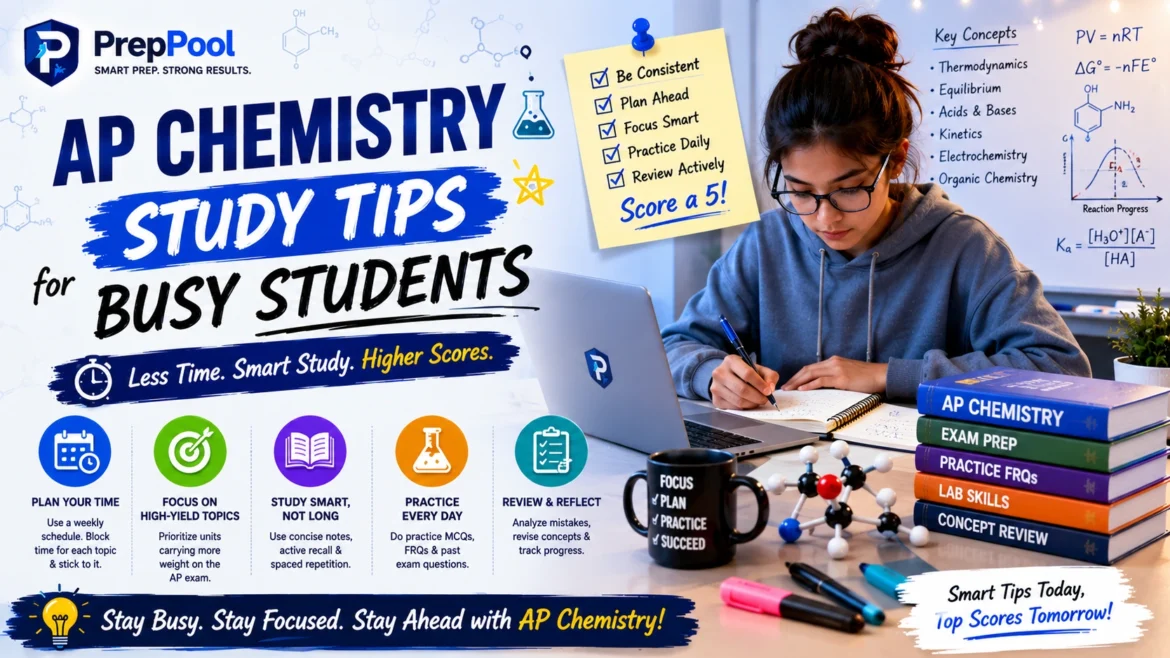

Success in AP Chemistry is not always about studying for endless hours every day. In many cases, efficient study routines, active learning methods, and consistent practice matter much more than long, exhausting study sessions.
Biggest Challenges Busy AP Chemistry Students Face:
- Limited daily study time
- Difficulty balancing multiple responsibilities
- Stress during exam season
- Falling behind on difficult topics
- Burnout from overloaded schedules
- Inconsistent chemistry review habits
Why AP Chemistry Feels Difficult for Busy Students
AP Chemistry moves quickly throughout the school year. Topics such as equilibrium, thermodynamics, stoichiometry, acids and bases, kinetics, and laboratory analysis build upon one another continuously.
Students who miss review sessions or postpone studying for several weeks often struggle later because advanced chemistry concepts depend heavily on earlier foundational understanding.
Busy students sometimes feel trapped in a cycle where they fall behind temporarily and then become overwhelmed trying to catch up quickly.
Why Consistency Matters More Than Long Study Sessions
One of the biggest misconceptions about AP Chemistry is that students must study for many hours every day to succeed. In reality, shorter and more consistent study sessions are often far more effective.
Chemistry understanding develops gradually through repetition and active problem solving. Students who review chemistry concepts consistently throughout the week usually retain information much better than students who rely on last-minute cramming.
| Study Method | Long-Term Effectiveness |
|---|---|
| Weekly short review sessions | Strong memory retention |
| Daily chemistry practice | Improves calculation speed |
| Last-minute cramming | Weak long-term understanding |
| Passive rereading | Limited problem-solving improvement |
Busy students often improve much faster once they focus on consistency rather than perfection.
How to Build an Efficient AP Chemistry Study Routine
Busy students benefit greatly from structured study routines because predictable schedules reduce stress and improve long-term consistency.
Instead of trying to study randomly whenever time becomes available, students should create realistic chemistry review blocks throughout the week.
Efficient AP Chemistry Routine Example:
- 20–30 minutes of chemistry review daily
- One longer weekly problem-solving session
- Timed FRQ practice every weekend
- Quick review of weak topics before quizzes
- Weekly laboratory concept review
Even small daily chemistry sessions can produce major improvements when students stay consistent over several months.
Why Active Learning Saves Time for Busy Students
Busy students cannot afford to waste hours using ineffective study methods. Passive review strategies like rereading notes repeatedly often consume large amounts of time without improving chemistry problem-solving ability significantly.
Active learning methods usually produce much faster improvement because students engage directly with calculations, scientific reasoning, and chemistry applications.
- Solve chemistry problems actively
- Practice free-response questions
- Explain concepts in your own words
- Review incorrect answers carefully
- Practice calculations repeatedly
Students who use active learning strategies often study more efficiently while building stronger long-term understanding.
How to Study AP Chemistry When You Feel Overwhelmed
Many students experience periods where AP Chemistry feels mentally exhausting, especially during difficult units or heavy exam seasons.
When students feel overwhelmed, trying to study everything at once often increases stress and confusion. A better approach is to focus on smaller goals and manageable study tasks.
Helpful Strategy:Instead of saying “I need to master all of equilibrium tonight,” focus on smaller goals such as reviewing equilibrium constants or practicing one type of calculation at a time.
Breaking large chemistry topics into smaller sections often makes difficult material feel far less intimidating.
Why Time Management Is Critical in AP Chemistry
Busy students often struggle not because of lack of intelligence, but because poor time management creates inconsistent preparation habits.
AP Chemistry requires repeated exposure to calculations, laboratory concepts, and scientific reasoning. Students who delay studying too long often feel overwhelmed later when multiple topics begin overlapping.
Time management becomes especially important before quizzes, laboratory assignments, and major AP review periods.
How Small Daily Habits Improve AP Chemistry Scores
Many successful AP Chemistry students improve through small daily habits rather than dramatic overnight changes.
- Reviewing notes for 15 minutes daily
- Practicing one chemistry calculation each day
- Correcting mistakes immediately after quizzes
- Reviewing laboratory vocabulary regularly
- Completing short timed practice sessions weekly
These small habits may seem simple, but over time they build stronger chemistry understanding and confidence gradually.
How Busy Students Can Study AP Chemistry More Efficiently
Busy students often assume they need several uninterrupted hours to study chemistry effectively. In reality, shorter focused sessions can be extremely productive when students use efficient learning strategies consistently.
Students who study with clear goals usually improve faster than students who review chemistry randomly without structure.
| Inefficient Study Habit | More Efficient Alternative |
|---|---|
| Reading notes passively for hours | Solving timed chemistry problems |
| Studying without goals | Targeting one weak topic at a time |
| Ignoring difficult concepts | Practicing small sections repeatedly |
| Cramming before tests | Weekly chemistry review sessions |
Students who build efficient routines often feel less stressed while improving chemistry performance steadily throughout the year.
Why Practice Questions Help Busy Students Learn Faster
Busy students need study methods that maximize learning in limited time. One of the fastest ways to improve chemistry understanding is through realistic practice questions because they combine calculations, reasoning, and application simultaneously.
Instead of spending hours rereading chemistry chapters, students can often improve faster by practicing structured AP Chemistry exam preparation questions regularly throughout the school year.
Benefits of Chemistry Practice Questions:
- Improves scientific reasoning
- Strengthens calculation accuracy
- Builds confidence under time pressure
- Reveals weak chemistry topics early
- Improves long-term retention
How to Avoid Burnout While Studying AP Chemistry
Many busy students try to compensate for limited time by overloading themselves with exhausting study sessions. Unfortunately, burnout often reduces productivity and makes difficult chemistry concepts even harder to understand.
Students preparing for AP Chemistry should maintain balanced schedules that include:
- Regular sleep
- Short mental breaks
- Consistent review sessions
- Reasonable study goals
- Healthy routines outside school
Balanced preparation usually produces stronger long-term performance than extreme study schedules.
How to Catch Up Quickly in AP Chemistry
Busy students sometimes fall behind after difficult units, extracurricular activities, illness, or heavy exam periods. When this happens, many students panic and attempt to review entire chemistry chapters all at once.
A better strategy is to prioritize the most important chemistry foundations first before moving into advanced topics.
Catch-Up Strategy:
- Review foundational chemistry concepts first
- Focus on high-value AP topics
- Practice calculations daily
- Use smaller study goals
- Review mistakes immediately
Students who rebuild chemistry foundations gradually often recover much faster than expected.
Why Understanding Mistakes Improves Chemistry Scores
Many students repeatedly solve chemistry problems without analyzing why they answered incorrectly. However, reviewing mistakes carefully is one of the fastest ways to improve AP Chemistry performance.
Mistakes often reveal:
- Weak chemistry concepts
- Calculation errors
- Poor time management
- Scientific reasoning confusion
- Laboratory interpretation problems
Students who want to strengthen study habits and avoid inefficient preparation patterns can also review these detailed explanations about frequent AP Chemistry preparation mistakes.
How Busy Students Can Improve FRQ Performance
Free-response questions often feel especially difficult for busy students because FRQs require written explanations, organized calculations, and scientific reasoning under time pressure.
However, even short weekly FRQ sessions can improve performance significantly over time.
Students should practice:
- Writing scientific explanations clearly
- Showing calculation steps carefully
- Interpreting laboratory data
- Managing time during written responses
Regular FRQ exposure helps students feel more comfortable during difficult AP Chemistry exam sections.
Why AP Chemistry Preparation Supports Future STEM Goals
AP Chemistry develops valuable scientific thinking skills that remain useful long after the exam itself. Students planning careers in medicine, engineering, nursing, biotechnology, pharmacy, environmental science, or research often benefit greatly from strong chemistry preparation before college.
Many students interested in long-term STEM success also explore how advanced chemistry preparation supports future STEM education and strengthens college readiness.
The discipline, reasoning, and analytical skills developed through AP Chemistry can help students transition more confidently into university science programs later.
How High-Scoring AP Chemistry Students Manage Busy Schedules
Many students assume top AP Chemistry scorers study endlessly every day. In reality, many successful students simply use their available time more efficiently and remain consistent throughout the school year.
Students aiming for stronger AP Chemistry scores often:
- Study chemistry in shorter focused sessions
- Review weak concepts consistently
- Practice chemistry calculations regularly
- Use realistic timed practice
- Stay organized during busy weeks
Many ambitious students also study advanced preparation habits used by students learning strategies for earning a 5 on AP Chemistry.
Final Thoughts on AP Chemistry Study Tips for Busy Students
Busy students can absolutely succeed in AP Chemistry without sacrificing every hour of free time. Strong performance usually comes from efficient study methods, consistency, active learning, and smart time management rather than endless study hours.
Students who focus on gradual improvement, realistic schedules, and regular chemistry practice often build stronger confidence and long-term understanding over time.
AP Chemistry may feel demanding, but with disciplined preparation and balanced routines, busy students can still achieve impressive academic success while preparing for future STEM opportunities.
Frequently Asked Questions About AP Chemistry Study Tips
Can busy students succeed in AP Chemistry?
Yes, busy students can succeed by using efficient study strategies, maintaining consistent review habits, and practicing chemistry actively throughout the school year.
How much should students study for AP Chemistry daily?
Even 20–30 minutes of focused chemistry review daily can produce strong results when students remain consistent over time.
What is the best study method for AP Chemistry?
Active learning methods such as solving practice questions, reviewing mistakes, and practicing FRQs are usually much more effective than passive rereading.
Why do students fall behind in AP Chemistry?
Many students fall behind because AP Chemistry concepts build on one another, making missed review sessions or inconsistent study habits more damaging later.
How can students reduce AP Chemistry stress?
Students often reduce stress by using realistic study schedules, practicing consistently, balancing responsibilities, and avoiding last-minute cramming.
Why Difficult Chemistry Topics Feel Harder for Busy Students
Busy students often struggle more with advanced AP Chemistry units because they have less uninterrupted study time available for reviewing complex concepts carefully.
Topics like equilibrium, thermodynamics, electrochemistry, kinetics, and acids and bases usually require repeated exposure and active problem solving before students feel fully comfortable.
Students who want additional support with advanced chemistry concepts often review these explanations covering challenging AP Chemistry topics and concepts that commonly appear throughout the course and exam.
Most Time-Consuming AP Chemistry Topics:
- Chemical equilibrium
- Thermodynamics
- Acid-base calculations
- Kinetics and rate laws
- Electrochemistry
- Laboratory data analysis
Breaking difficult topics into smaller learning sections often helps busy students avoid feeling overwhelmed.
How to Use Small Time Blocks for AP Chemistry Review
Busy students may not always have long uninterrupted study periods available, but smaller time blocks can still be highly effective when used consistently.
Short chemistry review sessions during lunch breaks, after school, or between activities can help reinforce concepts gradually throughout the week.
| Available Time | Helpful Chemistry Activity |
|---|---|
| 10 Minutes | Review formulas or reaction trends |
| 20 Minutes | Solve short calculation problems |
| 30 Minutes | Practice one FRQ section |
| 45 Minutes | Complete a focused review session |
Students who consistently use small study sessions often build stronger long-term retention compared to students relying only on occasional marathon review sessions.
Why Scientific Writing Skills Matter in AP Chemistry
Many busy students focus heavily on calculations while underestimating the importance of scientific writing and explanation skills.
AP Chemistry exams frequently require students to justify reasoning, explain reaction behavior, interpret laboratory data, and communicate scientific conclusions clearly.
Students who practice organized written chemistry responses regularly often perform much better during free-response sections under time pressure.
Helpful Writing Habits:
- Use chemistry vocabulary accurately
- Explain reasoning clearly and directly
- Show calculations step-by-step
- Practice timed written responses
- Review scoring expectations carefully
Students working to improve scientific writing and free-response performance often benefit from reviewing these detailed AP Chemistry FRQ preparation strategies and exam-writing techniques.
How Busy Students Can Stay Motivated During AP Chemistry
AP Chemistry preparation can sometimes feel mentally exhausting, especially for students balancing demanding schedules and multiple responsibilities simultaneously.
Motivation usually becomes easier to maintain when students focus on gradual progress rather than expecting immediate perfection.
- Celebrate small chemistry improvements
- Track progress over time
- Focus on consistency instead of perfection
- Use realistic weekly study goals
- Take healthy breaks when needed
Students who remain patient during difficult periods often notice major improvements later in the school year.
Why Sleep and Balance Affect AP Chemistry Performance
Many busy students sacrifice sleep while trying to keep up with chemistry assignments, extracurricular activities, and exams. Unfortunately, exhaustion can reduce concentration, memory retention, and calculation accuracy significantly.
Balanced routines often improve chemistry performance because students think more clearly and retain information more effectively when mentally rested.
Healthy schedules support:
- Better focus during chemistry practice
- Improved scientific reasoning
- Stronger memory retention
- Reduced stress during exams
- More consistent study habits
How Consistency Builds Long-Term AP Chemistry Confidence
Confidence in AP Chemistry usually develops gradually through repeated practice and concept exposure. Students who remain consistent often realize that difficult chemistry topics become more manageable over time.
Small daily improvements eventually create stronger calculation skills, faster problem solving, and better scientific reasoning.
Important Reminder:AP Chemistry success rarely comes from one perfect study session. Strong performance usually develops through months of small consistent improvements.
Why AP Chemistry Preparation Matters Beyond High School
AP Chemistry does much more than prepare students for one exam. The course helps students build analytical thinking, scientific reasoning, time management, and problem-solving skills that remain valuable in college and future careers.
Students interested in medicine, engineering, biotechnology, nursing, pharmacy, environmental science, and research often benefit greatly from strong chemistry foundations before entering university STEM programs.
Even busy students balancing multiple responsibilities can build these valuable academic skills through disciplined and efficient preparation habits.
Final Takeaway for Busy AP Chemistry Students
Busy students can absolutely succeed in AP Chemistry without studying endlessly every day. Strong results usually come from efficient learning strategies, consistent practice, realistic scheduling, and active engagement with chemistry concepts.
Students who remain organized, review concepts regularly, and avoid passive study habits often improve steadily throughout the school year even while managing demanding schedules.
AP Chemistry may feel challenging at times, but disciplined preparation and balanced routines can help busy students build confidence, improve scores, and prepare successfully for future STEM opportunities.