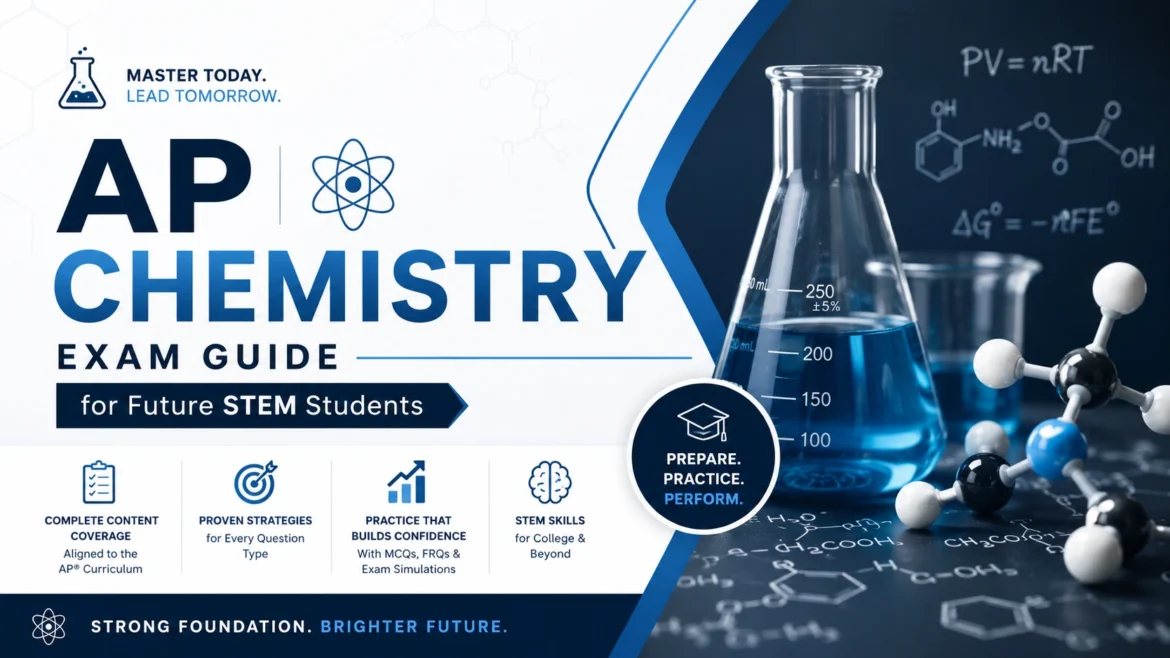

Quick Highlights:
- College-level chemistry curriculum
- Recognized by universities across the United States
- Useful for medical, engineering, and science majors
- Can help students earn college credit
- Builds analytical and problem-solving skills
What Exactly Is the AP Chemistry Exam?
The AP Chemistry Exam is administered by the College Board and is designed to measure a student’s understanding of introductory college-level chemistry. The exam evaluates both theoretical concepts and practical applications through multiple-choice questions and free-response sections.
Students are tested on chemical reactions, atomic structure, thermodynamics, kinetics, equilibrium, acids and bases, intermolecular forces, and laboratory analysis. The exam is not simply about memorizing formulas. It focuses heavily on reasoning, interpretation, and scientific thinking.
| Exam Section | Question Type | Skills Measured |
|---|---|---|
| Section I | Multiple Choice | Conceptual understanding and calculations |
| Section II | Free Response | Problem solving and written explanations |
| Lab-Based Questions | Experimental Analysis | Data interpretation and scientific reasoning |
Why Students Across the USA Choose AP Chemistry
In the United States, competition for top universities continues to increase every year. Admissions officers often look for students who challenge themselves academically. AP Chemistry is considered one of the strongest indicators of academic readiness for science-related college programs.
Students pursuing careers in medicine, dentistry, pharmacy, nursing, chemical engineering, biochemistry, environmental science, and biotechnology frequently choose AP Chemistry because it prepares them for demanding university coursework.
Many students also take the course because earning a strong AP exam score may help them skip introductory chemistry classes in college. This can save both time and tuition costs.
Real Student Scenario:Sarah, a high school student from Texas, planned to major in biomedical engineering. She decided to take AP Chemistry during her junior year because she wanted exposure to rigorous scientific concepts before college. After earning a high AP score, she received college credit and entered university with greater confidence in laboratory work and advanced chemistry topics.
How AP Chemistry Builds Long-Term Academic Advantages
One reason AP Chemistry holds significant value is that it develops academic discipline. The course trains students to manage complex material, analyze experiments, and apply logical reasoning under time pressure.
Universities across America recognize that students who complete AP Chemistry often adapt more successfully to college science programs. They are already familiar with advanced terminology, laboratory safety, structured calculations, and scientific writing.
This preparation becomes especially valuable for students entering competitive STEM fields where foundational chemistry knowledge is essential.
Career Opportunities Connected to Chemistry Knowledge
Chemistry is connected to countless industries in the modern economy. Students who develop strong chemistry skills early often discover broader educational and career opportunities later.
| Career Field | How Chemistry Is Used |
|---|---|
| Medicine | Drug interactions, human biology, diagnostics |
| Pharmacy | Medication development and chemical compounds |
| Chemical Engineering | Industrial production systems and materials |
| Environmental Science | Pollution control and sustainability research |
| Forensic Science | Chemical evidence analysis |
| Biotechnology | Research and product innovation |
Even students who eventually pursue healthcare administration, nutrition, public health, or veterinary medicine often benefit from a strong chemistry foundation.
Why AP Chemistry Matters More in Modern Education
Over the last decade, science and technology industries have expanded rapidly in the United States. Employers increasingly value candidates with analytical thinking abilities, quantitative reasoning, and laboratory experience.
AP Chemistry introduces these foundational skills at an early stage. Students learn how to evaluate evidence, interpret scientific data, and solve unfamiliar problems logically.
These are not only academic skills. They are workplace skills that remain useful in engineering firms, healthcare organizations, research institutions, and pharmaceutical companies.
Understanding the Difficulty Level of AP Chemistry
Many students hear that AP Chemistry is one of the hardest AP courses available. While the course is definitely challenging, much of its difficulty comes from poor preparation habits rather than impossible material.
Students who stay consistent, review concepts weekly, practice calculations regularly, and complete laboratory exercises carefully often perform much better than expected.
The exam rewards understanding and application more than memorization. This means students who truly understand concepts usually outperform students who only memorize definitions.
Important Study Reminder:AP Chemistry requires active learning. Reading alone is rarely enough. Students should solve practice problems, review laboratory data, analyze equations, and apply concepts repeatedly throughout the school year.
Common Reasons Students Struggle With AP Chemistry
- Waiting too long before starting exam preparation
- Memorizing formulas without understanding concepts
- Ignoring laboratory-based questions
- Skipping practice calculations
- Poor time management during the exam
- Not reviewing mistakes from practice tests
One of the smartest ways students improve their confidence is by working through realistic exam-style questions consistently. Many students preparing for the AP Chemistry exam use structured practice question resources to strengthen weak areas and become more familiar with exam patterns.
What Makes AP Chemistry Different From Regular Chemistry Classes?
Traditional high school chemistry often focuses on introductory concepts and simple reactions. AP Chemistry goes significantly deeper by emphasizing scientific reasoning, advanced calculations, equilibrium systems, experimental design, and conceptual analysis.
Students are expected to explain why reactions occur, predict chemical behavior, analyze laboratory outcomes, and apply mathematical reasoning to scientific situations.
This higher level of academic rigor is one reason universities respect strong AP Chemistry performance during admissions evaluations.
Most Important AP Chemistry Topics Students Must Master
One of the biggest mistakes students make is treating every AP Chemistry topic equally. While every unit matters, some concepts appear repeatedly throughout the course and exam. Building a strong understanding of these core areas can dramatically improve overall performance.
| High-Value Topic | Why It Matters |
|---|---|
| Chemical Bonding | Foundation for molecular structure and reactions |
| Stoichiometry | Essential for calculations and balancing equations |
| Acids and Bases | Frequently tested in conceptual and calculation questions |
| Thermodynamics | Important for energy transfer and reaction analysis |
| Chemical Equilibrium | Critical for advanced chemistry reasoning |
| Kinetics | Focuses on reaction rates and influencing factors |
Students who build strong conceptual understanding in these areas usually perform much better on both multiple-choice and free-response sections.
How to Prepare for the AP Chemistry Exam Effectively
Successful AP Chemistry preparation is rarely about studying for long hours at the last minute. Strong students typically follow consistent routines over several months.
Instead of memorizing random facts, effective preparation focuses on understanding patterns, applying concepts, and practicing under realistic exam conditions.
Effective Preparation Habits:
- Review notes weekly instead of cramming
- Solve calculation-based problems regularly
- Practice free-response writing
- Study laboratory procedures and data interpretation
- Track recurring mistakes
- Use timed practice exams
One reason many top-performing students improve rapidly is because they expose themselves to different question styles repeatedly. This builds familiarity and reduces anxiety during the actual exam.
Why Practice Tests Are Essential for AP Chemistry Success
Reading textbooks alone is not enough for AP Chemistry. Students need active exam experience. Practice tests help students understand timing, identify weak areas, and improve analytical thinking under pressure.
Real exam questions often combine multiple chemistry concepts into one problem. Students who only study isolated definitions may struggle when concepts are integrated together.
Practice exams also help students become more comfortable with multi-step calculations and scientific reasoning tasks.
Real-World Example:Michael, a senior from California, initially struggled with equilibrium and thermodynamics questions. After completing weekly timed practice sessions and reviewing every incorrect answer carefully, his confidence improved significantly. By exam day, he was solving complex problems much faster and with greater accuracy.
How AP Chemistry Supports Future Medical and Engineering Careers
Students interested in healthcare or engineering careers often discover that AP Chemistry gives them an early academic advantage. Many first-year university science courses move extremely fast, and students without strong foundational chemistry knowledge may struggle to keep up.
AP Chemistry introduces students to scientific reasoning, experimental analysis, and technical problem solving before college even begins.
This can make future coursework in biology, biochemistry, pharmacology, nursing, chemical engineering, and medicine far less overwhelming.
Why Colleges Respect Strong AP Chemistry Scores
Admissions officers understand that AP Chemistry requires discipline, persistence, and intellectual maturity. A strong exam score demonstrates that a student can handle advanced academic material.
Competitive universities often view AP Chemistry as one of the most rigorous AP science courses available in high school. Students who perform well may stand out during the admissions process, especially when applying for STEM-related majors.
In some colleges, strong AP Chemistry scores may also help students skip introductory chemistry classes and move directly into higher-level coursework.
Best Study Techniques for Difficult Chemistry Concepts
Certain chemistry topics feel overwhelming at first because they involve both mathematics and conceptual reasoning simultaneously. However, difficult topics become easier when students approach them strategically.
1. Break Complex Topics Into Smaller Sections
Instead of trying to master an entire unit in one session, divide topics into smaller learning blocks. For example, when studying equilibrium, focus separately on equilibrium constants, Le Châtelier’s Principle, and reaction shifts.
2. Use Visual Learning Methods
Chemistry contains many abstract concepts that become easier through diagrams, molecular models, reaction maps, and charts.
3. Practice Calculations Repeatedly
Chemistry calculations improve through repetition. Students should solve stoichiometry, molarity, gas law, and thermodynamic problems regularly until processes become familiar.
4. Review Mistakes Carefully
Many students only focus on correct answers. Stronger students spend time analyzing why mistakes happened and how to avoid repeating them.
Biggest AP Chemistry Exam Mistakes to Avoid
Some students understand chemistry concepts well but still lose valuable points because of avoidable exam mistakes.
- Ignoring units during calculations
- Rushing through free-response explanations
- Skipping laboratory interpretation questions
- Not showing calculation steps clearly
- Spending too much time on difficult questions
- Failing to practice under timed conditions
Time management becomes especially important during free-response sections because students must explain reasoning clearly while solving calculations accurately.
How Laboratory Skills Impact AP Chemistry Performance
AP Chemistry is not only theoretical. Laboratory understanding plays a major role throughout the course and exam.
Students are expected to understand experimental procedures, identify variables, analyze data tables, interpret graphs, and evaluate scientific results.
Many free-response questions involve laboratory scenarios where students must explain observations or predict outcomes based on chemical principles.
Important Reminder:Students who ignore lab-based preparation often struggle with application questions, even if they memorize textbook definitions successfully.
Why AP Chemistry Builds Strong Critical Thinking Skills
One reason AP Chemistry remains valuable beyond academics is because it develops analytical thinking. Students learn how to evaluate evidence, interpret patterns, and solve unfamiliar problems logically.
These problem-solving abilities are useful in many careers beyond chemistry itself. Engineers, physicians, researchers, pharmacists, and data analysts all rely on structured reasoning and scientific thinking.
Even students who eventually pursue business or technology careers often benefit from the discipline and reasoning skills developed during AP Chemistry preparation.
How AP Chemistry Helps Students Prepare for College Science Courses
Many first-year college students are surprised by the pace and complexity of university science classes. AP Chemistry helps reduce that shock by introducing college-level expectations earlier.
Students learn how to:
- Analyze scientific data independently
- Manage demanding coursework schedules
- Handle advanced laboratory concepts
- Apply formulas to unfamiliar scenarios
- Write detailed scientific explanations
This preparation often gives AP Chemistry students greater confidence when transitioning into university STEM programs.
How to Create a Smart AP Chemistry Study Schedule
One of the biggest differences between average students and top-performing students is organization. AP Chemistry contains a large amount of material, and trying to study everything randomly often leads to stress and confusion.
A structured study schedule helps students stay consistent while avoiding burnout. Instead of studying for long hours occasionally, successful students usually study chemistry in shorter, focused sessions several times per week.
| Study Activity | Recommended Frequency |
|---|---|
| Concept Review | 3–4 times weekly |
| Practice Calculations | Daily short sessions |
| Free-Response Practice | 1–2 times weekly |
| Timed Practice Exams | Biweekly before exam season |
| Laboratory Review | Weekly review sessions |
Students who maintain consistent routines often retain information more effectively and feel calmer during exam season.
How Time Management Impacts AP Chemistry Scores
Time pressure is one of the biggest challenges during the AP Chemistry exam. Many students know the material but lose points because they spend too long on difficult questions early in the test.
Smart time management involves recognizing when to move forward temporarily and return later if necessary.
Time Management Strategies:
- Answer easier questions first
- Avoid spending excessive time on one calculation
- Practice with timed exams regularly
- Read free-response prompts carefully before solving
- Leave time to review calculations and units
Students who practice under realistic timing conditions usually perform more confidently during the actual exam.
The Role of Scientific Reasoning in AP Chemistry
AP Chemistry is designed to test more than memorization. Students must apply scientific reasoning to unfamiliar situations and explain chemical behavior logically.
This means students should focus on understanding why reactions occur instead of only memorizing equations. The strongest students are often those who can explain concepts clearly in their own words.
Scientific reasoning also becomes important in laboratory-based questions where students analyze data, identify trends, and evaluate experimental outcomes.
How AP Chemistry Connects to Real-World Industries
Many students do not initially realize how deeply chemistry influences everyday life. AP Chemistry concepts are connected to medicine, agriculture, renewable energy, manufacturing, food science, environmental protection, and pharmaceutical research.
For example, pharmaceutical companies rely heavily on chemical analysis to develop medications safely. Environmental scientists use chemistry to monitor pollution and improve water quality. Biomedical engineers apply chemical principles when developing medical technologies.
Students who understand these real-world applications often become more motivated while studying difficult concepts.
Why AP Chemistry Is Valuable for Future STEM Majors
STEM programs in American universities are becoming increasingly competitive. Students entering science, technology, engineering, and mathematics fields are expected to handle advanced analytical work early in college.
AP Chemistry introduces many of the same thinking patterns students will encounter in university-level STEM courses. It teaches problem solving, quantitative reasoning, scientific writing, and laboratory interpretation.
This early exposure can make future coursework feel far more manageable.
Signs a Student Is Improving in AP Chemistry
Improvement in AP Chemistry is not always immediate. However, students often begin noticing progress through small changes over time.
- Calculations become faster and more accurate
- Chemical reactions feel easier to predict
- Laboratory questions become less intimidating
- Scientific vocabulary becomes more familiar
- Confidence improves during timed practice exams
- Complex concepts start connecting together logically
Students should remember that chemistry mastery develops gradually through repetition and active learning.
How Parents Can Support AP Chemistry Students
Parents often want to help but may feel unfamiliar with advanced chemistry topics themselves. Fortunately, support does not always require scientific expertise.
Encouraging healthy routines, providing quiet study environments, and supporting consistent schedules can significantly improve student performance.
Emotional support also matters. AP Chemistry can feel overwhelming at times, especially during heavy testing periods. Students who feel supported often manage stress more effectively.
Helpful Parent Support Ideas:
- Encourage consistent study habits
- Help students maintain balanced schedules
- Reduce distractions during study sessions
- Celebrate small academic improvements
- Support healthy sleep and nutrition routines
Why Consistency Matters More Than Last-Minute Cramming
AP Chemistry contains interconnected concepts that build on one another throughout the year. Students who ignore earlier topics often struggle later because advanced units rely heavily on foundational understanding.
Consistent review allows students to strengthen memory gradually while reducing stress before the exam.
Last-minute cramming may temporarily improve memorization, but it rarely develops the deep understanding required for high-level chemistry reasoning.
The Future Value of Strong Chemistry Skills
Chemistry knowledge continues to play a major role in scientific innovation across the United States. Industries focused on healthcare, sustainability, renewable energy, biotechnology, and pharmaceuticals all rely on professionals with strong scientific foundations.
Students who build chemistry skills early may discover broader educational and career opportunities in the future.
Even beyond science careers, AP Chemistry develops discipline, persistence, and analytical thinking abilities that remain valuable in many professions.
Final Thoughts on Preparing for AP Chemistry Success
AP Chemistry is challenging, but it is also one of the most rewarding academic experiences available to motivated high school students. The course teaches far more than formulas and reactions. It develops critical thinking, scientific reasoning, discipline, and problem-solving abilities that support long-term academic growth.
Students who prepare consistently, practice actively, review mistakes carefully, and focus on understanding concepts deeply often perform much better than expected.
Whether a student plans to pursue medicine, engineering, pharmacy, biotechnology, environmental science, or another STEM-related field, AP Chemistry can provide a powerful academic foundation for future success.
Frequently Asked Questions About AP Chemistry
Is AP Chemistry harder than regular high school chemistry?
Yes, AP Chemistry is significantly more advanced than standard high school chemistry because it includes college-level concepts, analytical reasoning, laboratory interpretation, and complex calculations.
How long should students study for the AP Chemistry exam?
Most students benefit from several months of consistent preparation rather than last-minute cramming. Weekly review sessions and regular practice questions are highly recommended.
Can AP Chemistry help with college admissions?
Yes, strong AP Chemistry performance can strengthen college applications, especially for students applying to STEM, healthcare, or engineering programs.
What is the best way to improve AP Chemistry problem-solving skills?
The best approach is consistent practice with calculations, free-response questions, laboratory analysis, and timed practice exams.
Why do many STEM students choose AP Chemistry?
AP Chemistry helps students build scientific reasoning, analytical thinking, and foundational chemistry knowledge that supports future studies in medicine, engineering, pharmacy, biotechnology, and other science-related careers.