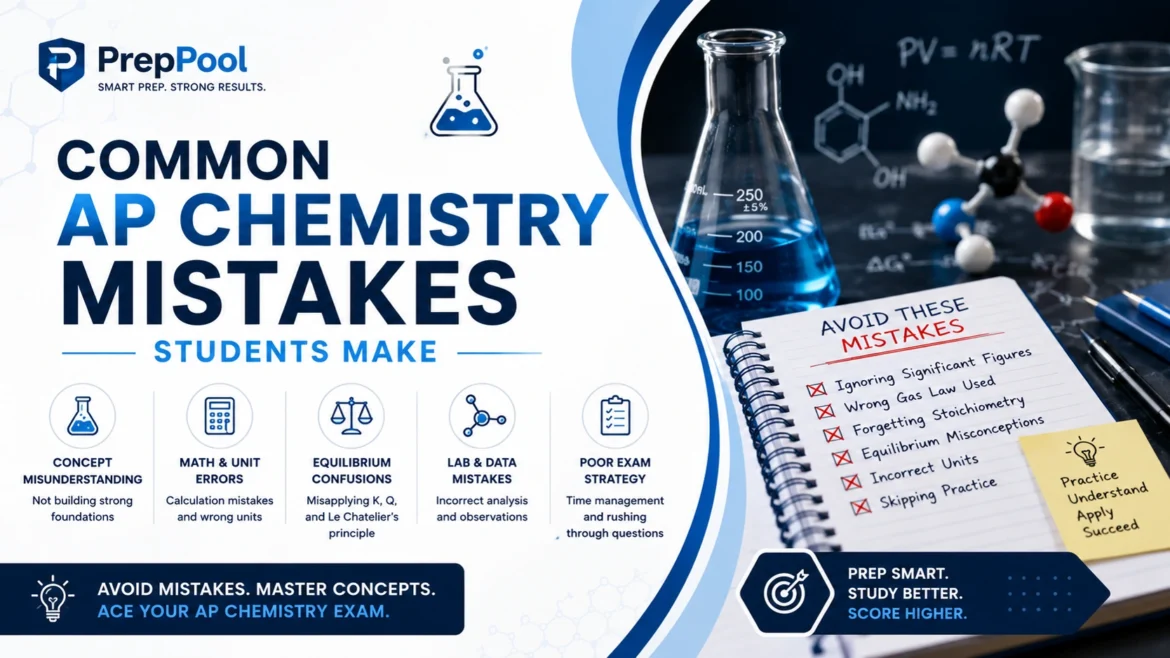

While AP Chemistry can absolutely feel challenging, many students struggle not because they lack intelligence, but because they make avoidable preparation mistakes throughout the school year.
The good news is that most AP Chemistry mistakes can be corrected early with the right strategies, practice routines, and study techniques.
- AP Chemistry rewards understanding over memorization
- Consistency matters more than last-minute cramming
- Practice questions are essential for improvement
- Laboratory analysis plays a major role on the exam
- Time management can significantly impact scores
Why So Many Students Struggle With AP Chemistry
AP Chemistry combines mathematical reasoning, scientific analysis, conceptual understanding, and laboratory interpretation into one course. Unlike many high school classes, students cannot rely entirely on memorization.
The course also moves quickly. Topics such as thermodynamics, equilibrium, stoichiometry, acids and bases, and kinetics build upon one another throughout the year. Missing foundational concepts early often creates confusion later.
Students who perform well usually approach AP Chemistry as a long-term learning process rather than a short-term memorization challenge.
Mistake #1: Memorizing Formulas Without Understanding Concepts
One of the most common AP Chemistry mistakes is focusing entirely on memorization. Many students attempt to memorize formulas, reaction patterns, and definitions without understanding the scientific reasoning behind them.
Unfortunately, AP Chemistry questions are designed to test application and interpretation rather than simple recall.
For example, students may memorize an equilibrium equation but struggle when asked to predict how temperature or concentration changes affect the reaction system.
Mistake #2: Ignoring Stoichiometry Practice Problems
Stoichiometry is one of the most important foundations in AP Chemistry. Yet many students avoid practicing it consistently because calculations can feel repetitive or frustrating initially.
This becomes a major problem later because stoichiometry concepts appear throughout multiple AP Chemistry units.
| Stoichiometry Skill | Why It Matters |
|---|---|
| Mole Conversions | Required for reaction calculations |
| Balancing Equations | Foundation for chemical reactions |
| Limiting Reactants | Common AP Chemistry exam topic |
| Percent Yield | Frequently tested in calculations |
| Dimensional Analysis | Essential for calculation accuracy |
Students who regularly practice chemistry calculations usually gain speed and confidence over time.
Mistake #3: Waiting Too Long to Start AP Chemistry Preparation
Many students delay serious AP Chemistry preparation until a few weeks before the exam. This often creates unnecessary stress because AP Chemistry contains too much material to review effectively through cramming alone.
Strong AP Chemistry performance usually comes from consistent review over several months rather than short periods of intense memorization.
Students who review concepts weekly often retain information more effectively and feel far more confident during exam season.
Mistake #4: Spending Too Much Time on Difficult Questions
Time management is one of the most overlooked AP Chemistry skills. Some students become stuck on one difficult question and lose valuable time that could have been used to answer easier problems correctly.
AP Chemistry exams often contain questions with varying difficulty levels. Successful students learn how to move forward strategically and return to difficult questions later if necessary.
- Answer easier questions first
- Mark difficult questions temporarily
- Avoid panic during complex calculations
- Practice timed exams before test day
- Leave time to review units and answers
Timed practice sessions can dramatically improve pacing and reduce exam anxiety.
Mistake #5: Avoiding Free Response Questions (FRQs)
Many students prefer multiple-choice questions because they feel safer and faster. However, avoiding free-response questions is one of the biggest AP Chemistry preparation mistakes.
FRQs require students to explain reasoning clearly, show calculation steps, interpret laboratory data, and justify scientific conclusions.
Students who rarely practice FRQs often struggle to organize explanations effectively during the actual exam.
Mistake #6: Not Reviewing Incorrect Answers Carefully
Some students focus only on how many questions they answered correctly during practice sessions. However, the most effective learning often happens when students carefully analyze their mistakes.
Reviewing incorrect answers helps students identify weak areas, calculation errors, conceptual misunderstandings, and repeated patterns.
Keeping a “mistake journal” can be extremely useful for tracking difficult concepts and preventing repeated errors.
Mistake #7: Ignoring Laboratory-Based Chemistry Questions
AP Chemistry is not only theoretical. Laboratory interpretation and experimental analysis are major components of the course and exam.
Some students spend so much time memorizing formulas that they neglect laboratory concepts entirely.
This can create major problems because AP Chemistry exams frequently include:
- Experimental procedure questions
- Graph interpretation
- Data analysis
- Error analysis
- Scientific reasoning tasks
Students who understand laboratory methods often perform much better on application-based questions.
Mistake #8: Depending Only on Notes Instead of Practice Questions
Reading class notes repeatedly may feel productive, but passive studying alone is rarely enough for AP Chemistry success. Many students understand concepts while reviewing notes but struggle when applying those concepts to unfamiliar exam-style questions.
AP Chemistry requires active problem solving. Students must practice calculations, interpret scientific scenarios, analyze reactions, and apply reasoning under timed conditions.
One of the most effective ways to improve confidence is through consistent exposure to realistic chemistry problems. Students preparing for the exam often strengthen weak areas by working through structured AP Chemistry practice questions and answers throughout the school year.
- Timed chemistry practice sessions
- Solving free-response questions
- Reviewing incorrect answers carefully
- Teaching concepts aloud
- Analyzing laboratory scenarios
- Repeating weak calculation topics
Mistake #9: Poor Time Management During the AP Chemistry Exam
Time pressure affects many AP Chemistry students, especially during difficult calculation sections. Some students spend excessive time checking one problem repeatedly while losing opportunities to complete easier questions later.
Strong time management strategies can improve overall exam performance significantly.
| Time Management Mistake | Better Strategy |
|---|---|
| Overthinking one question | Move forward and revisit later |
| Ignoring exam pacing | Practice with timers regularly |
| Skipping review time | Leave final minutes for checking units |
| Panicking during calculations | Break problems into smaller steps |
Students who practice under realistic exam timing conditions often feel calmer and more prepared on test day.
Mistake #10: Studying AP Chemistry Passively
Passive studying is one of the biggest hidden reasons students struggle in AP Chemistry. Watching videos endlessly, rereading notes, or highlighting textbooks without active engagement often creates a false sense of confidence.
Chemistry understanding develops through participation and repetition. Students improve much faster when they actively solve problems and explain concepts in their own words.
Active learning methods force the brain to retrieve information, which strengthens long-term retention and improves analytical thinking.
- Passive: rereading notes repeatedly
- Active: solving chemistry calculations independently
- Passive: memorizing formulas without application
- Active: applying formulas to new scenarios
Mistake #11: Focusing Only on Easy Chemistry Topics
Many students repeatedly review topics they already understand because it feels comfortable and rewarding. Unfortunately, this often leaves difficult topics completely underdeveloped before the exam.
AP Chemistry rewards balanced preparation across all major units. Avoiding difficult topics such as equilibrium, thermodynamics, kinetics, and acids and bases can hurt scores significantly.
Students should spend extra study time strengthening weaker areas rather than repeatedly reviewing easy material.
Mistake #12: Ignoring Concept Connections Between Units
AP Chemistry topics are highly interconnected. Concepts from earlier chapters often reappear later in more advanced forms.
For example, students use stoichiometry in thermodynamics, equilibrium, acid-base reactions, and laboratory calculations. Weak foundational understanding can create confusion across multiple units later.
Successful students continuously review older concepts while learning new material throughout the year.
Mistake #13: Becoming Discouraged Too Quickly
AP Chemistry can feel overwhelming at times, especially when students encounter difficult calculations or lower-than-expected quiz scores. Some students lose confidence early and assume they are simply “bad at chemistry.”
In reality, improvement in chemistry often happens gradually through repetition and persistence. Many strong AP Chemistry students struggled initially before building confidence over time.
How Successful AP Chemistry Students Avoid These Mistakes
High-performing AP Chemistry students are not necessarily the smartest students in the classroom. In many cases, they simply develop stronger habits and more consistent preparation routines.
- They review chemistry concepts consistently
- They solve practice questions regularly
- They analyze mistakes carefully
- They focus on conceptual understanding
- They practice under timed conditions
- They strengthen weak areas early
Students who build these habits often experience steady improvement throughout the academic year.
Why AP Chemistry Preparation Requires Long-Term Consistency
AP Chemistry success rarely comes from one week of intense studying. Strong performance usually develops through months of gradual improvement, repeated practice, and disciplined review.
Students who want a deeper understanding of how the AP Chemistry exam works, why the course matters for STEM careers, and how college-level chemistry preparation helps future academic success can also explore this detailed AP Chemistry exam guide for future STEM students.
Building chemistry confidence takes patience, but steady effort often produces major academic growth over time.
Final Thoughts on Avoiding AP Chemistry Mistakes
AP Chemistry is challenging because it combines scientific reasoning, analytical thinking, laboratory interpretation, and mathematical problem solving into one advanced course. However, many common student struggles come from avoidable habits rather than lack of ability.
Students who focus on active learning, regular practice, conceptual understanding, and long-term consistency often improve far more than they initially expect.
Whether a student plans to pursue medicine, engineering, pharmacy, biotechnology, nursing, or another STEM-related field, mastering AP Chemistry study habits can provide valuable academic preparation for future success.
Frequently Asked Questions About AP Chemistry Mistakes
What is the biggest mistake students make in AP Chemistry?
One of the biggest mistakes is memorizing formulas without understanding the scientific concepts behind them. AP Chemistry focuses heavily on application and reasoning.
Why do students struggle with AP Chemistry calculations?
Many students avoid consistent calculation practice. Topics like stoichiometry, equilibrium, and thermodynamics require repeated problem solving to build confidence and accuracy.
Are AP Chemistry free-response questions difficult?
Free-response questions can feel challenging because they require detailed explanations, calculations, and scientific reasoning. Regular FRQ practice usually improves performance significantly.
How can students improve AP Chemistry scores faster?
Students often improve faster by practicing realistic exam questions regularly, reviewing mistakes carefully, and focusing on weaker chemistry topics consistently.
How often should students practice AP Chemistry problems?
Short daily practice sessions are usually more effective than occasional long study sessions. Consistent repetition helps strengthen both conceptual understanding and calculation accuracy.
How AP Chemistry Mistakes Affect College Readiness
Many students underestimate how closely AP Chemistry connects to future college science courses. The habits students develop during AP Chemistry preparation often carry directly into university STEM programs.
Poor study habits, weak time management, and passive learning strategies that hurt AP Chemistry performance can also create major challenges later in college biology, biochemistry, engineering, and medical coursework.
On the other hand, students who correct these mistakes early usually transition into university science programs more confidently.
| AP Chemistry Skill | Future College Benefit |
|---|---|
| Scientific reasoning | Improves STEM problem solving |
| Laboratory interpretation | Supports university lab courses |
| Time management | Helps with heavy college workloads |
| Calculation accuracy | Important for engineering and science majors |
| Critical thinking | Useful across medical and research careers |
How Social Media Study Habits Hurt AP Chemistry Performance
Modern students face constant distractions from phones, social media notifications, short-form videos, and multitasking. Unfortunately, chemistry learning requires concentration and deep thinking.
Many students believe they are studying effectively while frequently switching between apps, messages, and chemistry notes. This often reduces retention and weakens problem-solving focus.
Focused 45-minute chemistry sessions are often far more productive than several distracted hours of studying.
Why Comparing Yourself to Other AP Chemistry Students Can Be Harmful
AP Chemistry classrooms often contain highly motivated students, which can sometimes create unhealthy comparison habits. Some students lose confidence because classmates appear to understand concepts more quickly.
However, chemistry learning is highly individual. Some students grasp calculations faster, while others improve gradually through repetition and practice.
Comparing progress constantly can increase stress and reduce motivation. Students usually perform better when they focus on steady personal improvement instead of classroom competition.
How Sleep and Burnout Impact AP Chemistry Scores
Many students sacrifice sleep while preparing for AP Chemistry exams, especially during finals season. Unfortunately, exhaustion can reduce concentration, memory retention, and calculation accuracy.
Burnout is another major issue among high-achieving STEM students. Overloading study schedules without breaks often leads to frustration and declining productivity.
- Sleep supports long-term memory retention
- Rest improves scientific reasoning
- Balanced schedules reduce mental fatigue
- Short breaks improve focus during calculations
- Healthy routines support exam performance
Students who maintain healthier study routines often perform more consistently throughout the school year.
The Importance of Confidence During the AP Chemistry Exam
Confidence plays a surprisingly important role during difficult exams. Students who panic during challenging questions often make avoidable mistakes, even when they understand the material.
Confidence in AP Chemistry usually develops from preparation and repetition. The more students practice calculations, free-response questions, and laboratory interpretation, the more comfortable they become under pressure.
What Teachers Often Notice About Successful AP Chemistry Students
AP Chemistry teachers frequently observe similar habits among students who improve the most throughout the year.
- They ask questions when concepts feel unclear
- They review mistakes instead of ignoring them
- They practice chemistry calculations regularly
- They stay consistent even after difficult quizzes
- They focus on understanding instead of memorization
- They remain patient during complex topics
These habits often matter more than natural talent alone.
Why AP Chemistry Challenges Can Become Long-Term Strengths
Although AP Chemistry can feel difficult, the challenges students face often help build valuable academic skills that continue benefiting them long after the exam ends.
Students learn how to analyze information carefully, solve unfamiliar problems logically, manage pressure, and think scientifically. These abilities are useful not only in chemistry but also in medicine, engineering, healthcare, research, and technology careers.
Many students later realize that the discipline they developed during AP Chemistry preparation helped them succeed in future university STEM courses.
Final Takeaway for AP Chemistry Students
Every AP Chemistry student makes mistakes at some point during preparation. The difference between struggling students and improving students is usually the willingness to recognize weaknesses and adjust study habits early.
Students who practice actively, manage time effectively, review errors carefully, and stay consistent throughout the school year often see major improvements in both confidence and performance.
AP Chemistry may be demanding, but with smart preparation and the right mindset, students can build strong scientific foundations that support future academic and career success.