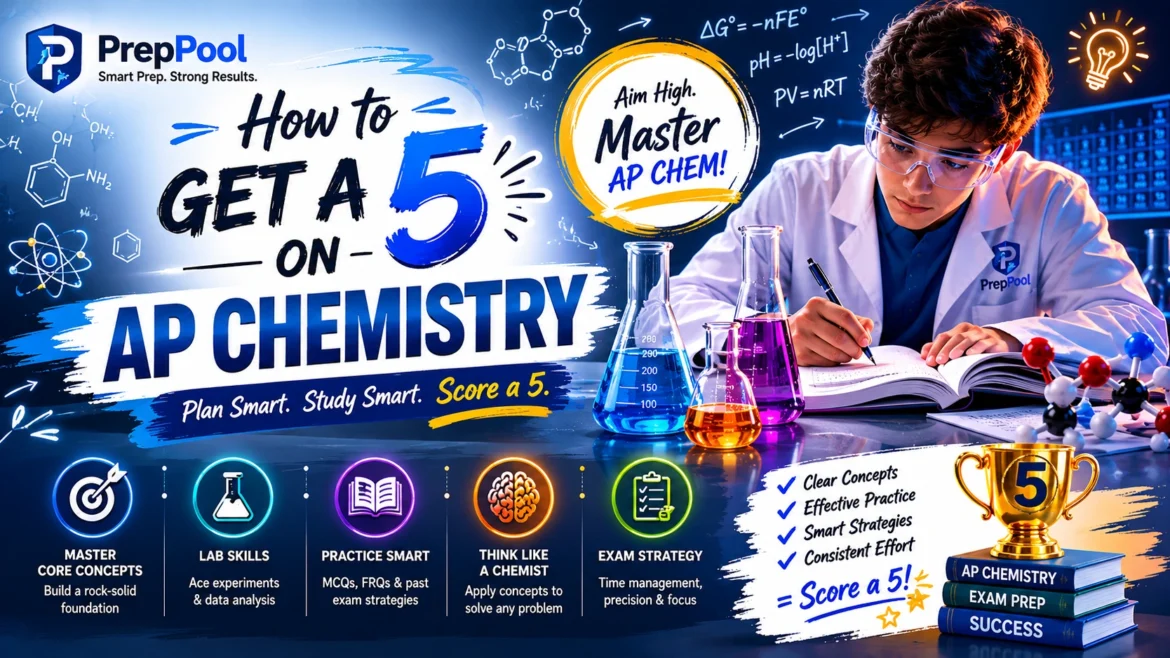

Every year, thousands of students across the United States take AP Chemistry hoping to strengthen their college applications and prepare for advanced university coursework. While the exam can feel difficult, students who study strategically and practice consistently often perform far better than they initially expect.
Getting a 5 on AP Chemistry is not about being naturally gifted in science. In many cases, it comes down to preparation habits, active learning, smart time management, and consistent practice over time.
- Strong conceptual understanding
- Consistent chemistry practice
- Timed exam preparation
- Free-response writing skills
- Laboratory data interpretation
- Effective study routines
Is It Hard to Get a 5 on AP Chemistry?
AP Chemistry is widely known for its rigorous content and challenging exam structure. Students must understand scientific concepts deeply while also solving calculations accurately under time pressure.
However, the exam is very manageable for students who prepare consistently throughout the school year. One of the biggest misconceptions is that only “genius” students earn a 5. In reality, many successful students simply build stronger study habits and avoid common preparation mistakes.
Students who actively practice chemistry concepts, review weak areas regularly, and develop strong time management skills often improve steadily over several months.
What a 5 Score Means on the AP Chemistry Exam
A score of 5 represents extremely strong understanding of college-level introductory chemistry. Universities across the United States recognize AP Chemistry as one of the more academically demanding AP science courses.
Strong AP Chemistry scores may help students:
- Strengthen college applications
- Demonstrate STEM readiness
- Earn college credit at some universities
- Skip introductory chemistry courses
- Prepare for engineering and medical programs
For students planning careers in healthcare, pharmacy, engineering, or biotechnology, strong AP Chemistry performance can create an important academic advantage before college even begins.
Study Habits of Students Who Score a 5
High-scoring AP Chemistry students usually follow similar preparation habits. They focus less on memorization and more on understanding how chemistry concepts connect together.
Instead of waiting until exam season, successful students review material consistently throughout the academic year. They also spend time solving realistic chemistry problems instead of only rereading notes.
| Strong Study Habit | Why It Helps |
|---|---|
| Weekly review sessions | Improves long-term retention |
| Practicing calculations regularly | Builds speed and confidence |
| Reviewing mistakes carefully | Prevents repeated errors |
| Timed practice exams | Improves pacing and stamina |
| Studying difficult topics early | Reduces exam stress later |
Best AP Chemistry Topics to Master First
Some AP Chemistry topics appear repeatedly throughout the course and exam. Students who build strong understanding in these foundational areas often perform much better overall.
- Stoichiometry
- Chemical bonding
- Acids and bases
- Chemical equilibrium
- Thermodynamics
- Kinetics
- Intermolecular forces
Many advanced chemistry concepts build on earlier material, which is why weak foundational understanding can create larger problems later.
Students should focus on understanding concepts deeply rather than rushing through chapters too quickly.
Why Active Learning Is Critical for AP Chemistry Success
Passive studying is one of the biggest reasons students struggle on AP Chemistry exams. Watching videos continuously or rereading notes may feel productive, but chemistry mastery requires active engagement.
Students improve much faster when they:
- Solve chemistry problems independently
- Explain concepts in their own words
- Practice free-response questions
- Review incorrect answers carefully
- Apply concepts to unfamiliar scenarios
Active learning strengthens long-term memory and improves scientific reasoning skills that are heavily tested throughout the AP Chemistry exam.
How to Improve AP Chemistry Free-Response Scores
Free-response questions, often called FRQs, are one of the most important sections of the AP Chemistry exam. Many students lose valuable points because they avoid practicing written responses regularly.
FRQs require students to explain scientific reasoning clearly, show calculations step-by-step, analyze laboratory scenarios, and interpret chemical data accurately.
- Write explanations clearly and logically
- Show every calculation step
- Practice laboratory interpretation questions
- Review scoring guidelines carefully
- Use scientific vocabulary accurately
Students who consistently practice FRQs often become more confident and organized during the actual exam.
Best Multiple Choice Strategies for AP Chemistry
Multiple-choice questions in AP Chemistry are designed to test conceptual understanding, analytical thinking, and calculation accuracy. Some questions contain distracting answer choices that look correct initially.
Successful students often improve their multiple-choice performance by learning how to eliminate incorrect answers systematically instead of guessing randomly.
- Read every question carefully
- Underline important information mentally
- Eliminate obviously incorrect choices first
- Avoid spending too much time on one problem
- Practice under timed conditions regularly
Time management becomes especially important because difficult chemistry calculations can consume valuable exam minutes quickly.
Why Practice Questions Matter for a 5 Score
One of the biggest differences between average AP Chemistry students and top scorers is the amount of active practice they complete before exam day. Reading notes and watching videos can help introduce concepts, but real improvement usually happens when students apply chemistry knowledge through realistic exam-style questions.
Practice questions train students to recognize patterns, manage time pressure, apply formulas correctly, and solve unfamiliar chemistry scenarios with confidence.
Many students preparing for top AP scores strengthen their understanding by working through structured AP Chemistry exam-style practice questions consistently throughout the school year.
- Improves calculation accuracy
- Strengthens scientific reasoning
- Builds exam confidence
- Improves speed during timed sections
- Identifies weak chemistry topics early
- Reduces test anxiety
How to Study AP Chemistry Without Burnout
Many ambitious students push themselves too hard while preparing for AP Chemistry. Long study hours without breaks can lead to exhaustion, frustration, and declining productivity.
Students aiming for a 5 score should focus on consistency rather than perfection. Short, focused study sessions are often more effective than exhausting marathon study days.
| Unhealthy Study Habit | Better Alternative |
|---|---|
| Studying 8 hours without breaks | Focused study blocks with short breaks |
| Cramming before exams | Weekly review sessions |
| Ignoring sleep | Balanced rest and recovery |
| Only reviewing easy topics | Prioritizing weak areas consistently |
Maintaining energy and motivation over several months is extremely important for long-term AP Chemistry success.
Common Habits That Prevent Students From Getting a 5
Some students work hard throughout the year but still struggle to reach top AP Chemistry scores because of ineffective preparation habits.
- Memorizing formulas without understanding concepts
- Avoiding difficult chemistry topics
- Ignoring laboratory-based questions
- Not practicing FRQs consistently
- Studying passively instead of actively solving problems
- Poor time management during practice exams
Students who want to understand these preparation problems more deeply can also explore these detailed insights about common AP Chemistry mistakes students make and how to avoid them effectively.
How to Handle Difficult AP Chemistry Topics
Every AP Chemistry student eventually encounters difficult concepts that feel overwhelming at first. Topics like equilibrium, thermodynamics, kinetics, and electrochemistry often require extra practice and patience.
Instead of avoiding difficult chapters, successful students break complex material into smaller sections and review concepts repeatedly over time.
Asking teachers questions early and reviewing weak areas regularly can make difficult units feel far more manageable.
Why Laboratory Questions Matter More Than Students Expect
Many AP Chemistry students focus heavily on calculations while underestimating the importance of laboratory interpretation questions.
The AP Chemistry exam frequently tests:
- Experimental design
- Graph interpretation
- Data analysis
- Error analysis
- Scientific reasoning
Students who understand laboratory procedures and scientific analysis usually perform better on higher-level chemistry questions.
How Time Management Can Improve AP Chemistry Scores
Time pressure becomes a major challenge during AP Chemistry exams because some calculations require multiple steps and careful reasoning.
Students who practice timed chemistry sessions regularly often become more efficient and less anxious during the actual exam.
- Do not spend excessive time on one question
- Answer easier questions first when possible
- Leave time to review calculations and units
- Practice pacing before exam day
Smart pacing strategies can help students collect more points consistently across the entire exam.
What Top AP Chemistry Students Do Differently
Students who earn a 5 on AP Chemistry often develop habits that separate them from average test takers. They approach chemistry as a process of understanding rather than memorization.
High-performing students usually:
- Review concepts consistently throughout the year
- Practice chemistry calculations frequently
- Analyze mistakes carefully
- Study weak areas instead of avoiding them
- Practice under realistic exam conditions
- Stay patient during difficult topics
Many successful students also spend time understanding the broader value of AP Chemistry preparation for STEM education and future scientific careers through resources focused on college-level chemistry preparation for future STEM students.
Final Month Strategy Before the AP Chemistry Exam
The final month before the AP Chemistry exam should focus more on review and application rather than learning completely new material.
- Take timed practice exams
- Review weak chemistry topics
- Practice FRQs regularly
- Review laboratory concepts
- Strengthen calculation speed
- Improve pacing strategies
Students should avoid overwhelming themselves with excessive study hours during the final weeks. Confidence and consistency often matter more than panic-driven cramming.
Final Thoughts on Getting a 5 on AP Chemistry
Earning a 5 on AP Chemistry is absolutely possible for students who prepare strategically and remain consistent throughout the school year. Success comes from active learning, realistic practice, conceptual understanding, and smart time management rather than memorization alone.
AP Chemistry is demanding because it prepares students for real college-level scientific thinking. However, students who stay disciplined and continue improving gradually often develop stronger confidence, analytical reasoning, and long-term academic skills.
Whether a student plans to pursue medicine, engineering, pharmacy, biotechnology, nursing, or another STEM field, strong AP Chemistry preparation can provide valuable academic advantages for future success.
Frequently Asked Questions About Getting a 5 on AP Chemistry
1. Is it difficult to get a 5 on AP Chemistry?
AP Chemistry is considered challenging, but students who study consistently, practice actively, and manage time effectively can absolutely achieve a 5 score.
2. How many hours should students study for AP Chemistry?
Most students benefit from regular weekly study sessions throughout the school year instead of short periods of intense cramming before the exam.
3. What AP Chemistry topics are most important?
Stoichiometry, equilibrium, thermodynamics, acids and bases, kinetics, and chemical bonding are among the most important AP Chemistry topics.
4. Are AP Chemistry FRQs harder than multiple-choice questions?
Many students find FRQs more challenging because they require written explanations, calculations, laboratory interpretation, and scientific reasoning.
5. Can students self-study for AP Chemistry successfully?
Yes, motivated students can self-study AP Chemistry successfully with strong discipline, active practice, quality study resources, and consistent review habits.
Why Confidence Plays a Major Role in AP Chemistry Success
Many students underestimate how much confidence affects performance during difficult science exams. Even students with strong chemistry knowledge sometimes lose points because they panic under pressure or second-guess correct answers.
Confidence in AP Chemistry usually develops through preparation, repetition, and familiarity with exam-style questions. Students who practice consistently often become calmer and more focused during timed exams.
Confidence does not mean knowing every answer perfectly. It means trusting preparation habits and approaching difficult questions logically instead of emotionally.
- Completing regular practice exams
- Reviewing mistakes without frustration
- Tracking gradual improvement over time
- Strengthening weak chemistry topics consistently
- Practicing under realistic time conditions
How AP Chemistry Develops Real STEM Skills
One reason colleges and universities value AP Chemistry so highly is because the course develops practical scientific thinking skills that extend far beyond the exam itself.
Students learn how to:
- Analyze scientific data carefully
- Solve unfamiliar technical problems
- Interpret laboratory results logically
- Apply mathematical reasoning in science
- Think critically under pressure
These skills become extremely valuable in engineering, healthcare, medicine, biotechnology, pharmacy, environmental science, and research careers.
How Students Can Stay Motivated During AP Chemistry Preparation
AP Chemistry preparation can feel exhausting at times, especially during difficult units or heavy exam periods. Many students experience moments where progress feels slow or frustrating.
Staying motivated often requires focusing on long-term improvement rather than short-term perfection. Chemistry mastery usually develops gradually over months of repetition and active learning.
| Motivation Challenge | Helpful Solution |
|---|---|
| Low quiz scores | Focus on improvement patterns |
| Difficult chemistry topics | Break concepts into smaller sections |
| Exam stress | Practice timed questions regularly |
| Burnout | Maintain balanced study schedules |
| Loss of confidence | Track progress over time |
Students who remain patient and consistent usually notice significant improvement by exam season.
Why AP Chemistry Preparation Should Start Early
Students who earn top AP Chemistry scores rarely rely on last-minute cramming. The exam covers many interconnected scientific concepts that require gradual understanding over time.
Starting preparation early allows students to:
- Review concepts more deeply
- Strengthen weak areas slowly
- Practice FRQs consistently
- Improve chemistry calculations gradually
- Reduce stress before exam season
Consistency almost always produces better long-term results than short periods of intense memorization.
The Importance of Reviewing Mistakes Carefully
One of the smartest habits high-scoring AP Chemistry students develop is reviewing incorrect answers carefully instead of ignoring them.
Mistakes often reveal:
- Weak chemistry concepts
- Calculation errors
- Misunderstood scientific reasoning
- Laboratory interpretation problems
- Time management issues
Students who analyze mistakes regularly usually improve much faster because they correct learning gaps early.
How AP Chemistry Helps Students Beyond High School
AP Chemistry is valuable not only because of exam scores or college credit opportunities, but also because it teaches discipline, persistence, and scientific thinking.
Students who complete AP Chemistry often enter college STEM programs with stronger academic confidence and better study habits.
Many future physicians, engineers, pharmacists, nurses, and researchers first developed advanced scientific reasoning skills during challenging high school chemistry courses.
What Teachers Often Notice About Students Who Earn a 5
AP Chemistry teachers frequently observe similar characteristics among students who achieve top scores.
- They stay consistent throughout the year
- They ask questions when confused
- They practice difficult topics repeatedly
- They remain calm during challenging problems
- They review laboratory concepts carefully
- They focus on understanding instead of memorization
These habits often matter more than raw intelligence alone.
Final Takeaway for Students Aiming for a 5
Earning a 5 on AP Chemistry requires discipline, patience, and consistent preparation, but it is absolutely achievable for motivated students willing to practice actively and improve gradually.
The students who perform best are usually not those who memorize the fastest. Instead, they are the students who stay organized, review concepts consistently, solve realistic chemistry problems regularly, and remain persistent through difficult topics.
AP Chemistry is designed to challenge students academically while preparing them for college-level scientific thinking. Students who embrace that challenge often develop stronger confidence, analytical skills, and long-term academic readiness for future STEM success.