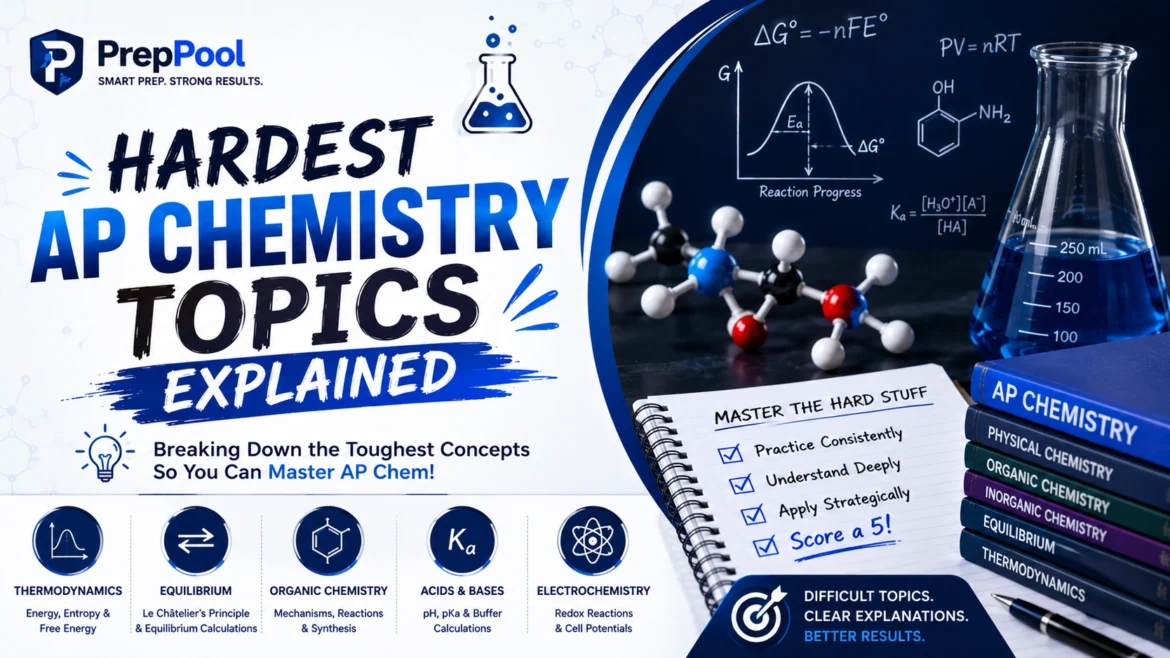

Many students struggle not because AP Chemistry is impossible, but because certain topics demand patience, repetition, and active problem solving. Understanding which concepts are considered the hardest can help students prepare more effectively and avoid unnecessary frustration later.
The good news is that difficult AP Chemistry topics usually become much easier once students understand the underlying logic behind chemical systems and reactions.
- Heavy conceptual reasoning
- Complex multi-step calculations
- Fast classroom pacing
- Weak chemistry foundations
- Passive study habits
- Limited problem-solving practice
Why Some AP Chemistry Topics Feel More Difficult Than Others
Not all AP Chemistry units require the same type of thinking. Some topics focus mostly on memorization and basic understanding, while others demand analytical reasoning, mathematical accuracy, and the ability to apply concepts to unfamiliar situations.
Difficult AP Chemistry units often combine multiple scientific ideas together. Students may need to understand formulas, reaction behavior, equilibrium systems, molecular interactions, and laboratory interpretation simultaneously.
This is why students sometimes feel confident during early chapters but become overwhelmed later when advanced units begin connecting together.
Equilibrium: One of the Most Challenging AP Chemistry Units
Chemical equilibrium is widely considered one of the hardest AP Chemistry topics because it requires both conceptual understanding and mathematical reasoning.
Students must understand how reversible reactions behave, how concentration changes affect chemical systems, and how equilibrium constants predict reaction direction.
Many students struggle because equilibrium questions rarely follow simple memorization patterns. Instead, students must analyze changing systems logically.
| Equilibrium Challenge | Why Students Struggle |
|---|---|
| Le Châtelier’s Principle | Requires predicting reaction shifts logically |
| Equilibrium Constants | Involves complex calculations |
| ICE Tables | Multi-step setup and algebra confusion |
| Reaction Direction | Requires conceptual analysis |
Students often improve equilibrium performance by practicing reaction-shift reasoning repeatedly instead of memorizing isolated rules.
Why Thermodynamics Confuses Many AP Chemistry Students
Thermodynamics introduces concepts involving energy transfer, enthalpy, entropy, and spontaneity. Many students find this difficult because the topic combines chemistry concepts with abstract scientific reasoning.
Students are expected to understand how chemical reactions absorb or release energy and how these changes influence reaction behavior.
- Confusing endothermic and exothermic reactions
- Misunderstanding entropy trends
- Difficulty interpreting energy diagrams
- Mixing up thermodynamic equations
Thermodynamics becomes easier when students focus on understanding energy movement visually instead of memorizing definitions alone.
Kinetics and Reaction Rates Explained
Kinetics focuses on how quickly chemical reactions occur and what factors influence reaction speed. While the topic sounds simple initially, students often struggle once reaction mechanisms and rate laws become more advanced.
AP Chemistry kinetics questions may require students to analyze experimental data, determine reaction orders, interpret graphs, and predict how variables affect reaction speed.
Many students struggle because kinetics combines calculations with conceptual interpretation simultaneously.
Acids and Bases: A Major AP Chemistry Challenge
Acids and bases appear throughout multiple AP Chemistry units, making them extremely important for overall exam performance.
Students must understand pH calculations, acid-base reactions, buffers, titrations, equilibrium relationships, and molecular behavior.
The topic becomes difficult because many acid-base concepts are interconnected. Weak understanding in one area often creates confusion in another.
Why Stoichiometry Still Causes Problems for Advanced Students
Stoichiometry is introduced early in chemistry education, yet it continues causing problems for many AP Chemistry students because it appears repeatedly throughout advanced units.
Students use stoichiometry in:
- Thermodynamics calculations
- Gas law problems
- Reaction yield calculations
- Equilibrium analysis
- Laboratory interpretation
Weak stoichiometry skills can create larger difficulties later because AP Chemistry calculations often build on mole relationships and dimensional analysis.
Electrochemistry and Why Students Find It Difficult
Electrochemistry introduces oxidation-reduction reactions, galvanic cells, electron flow, and electrochemical potentials. Many students struggle because the topic feels less intuitive than other chemistry units.
Students must visualize electron movement, understand oxidation states, and apply chemical reasoning to unfamiliar systems.
Electrochemistry questions often become easier when students use diagrams and visual learning methods instead of relying entirely on memorization.
How Laboratory Questions Increase AP Chemistry Difficulty
Many students focus heavily on chemistry calculations while underestimating laboratory-based questions. However, AP Chemistry exams frequently test experimental design, graph analysis, data interpretation, and scientific reasoning.
Laboratory questions feel difficult because students must apply chemistry knowledge in realistic scientific situations rather than solving isolated textbook problems.
Students who regularly review laboratory procedures and experimental analysis often perform much better on application-based questions.
Why AP Chemistry Calculations Feel Overwhelming
One reason students consider AP Chemistry difficult is because many problems require multiple calculation steps combined with conceptual reasoning. Unlike simple math exercises, chemistry calculations often require students to interpret scientific information before even deciding which formula or process to use.
Students may need to:
- Analyze chemical reactions
- Convert units correctly
- Apply mole relationships
- Interpret laboratory data
- Use equilibrium expressions
- Explain scientific reasoning
This combination of mathematics and conceptual understanding can initially feel intimidating, especially during timed exams.
Many students improve difficult AP Chemistry concepts much faster when they regularly solve realistic exam-style problems using structured AP Chemistry practice resources throughout the school year.
Why AP Chemistry Requires More Than Memorization
Many students enter AP Chemistry expecting to memorize formulas and definitions the same way they approach other classes. However, AP Chemistry focuses heavily on applying scientific principles to unfamiliar situations.
Students are expected to predict reaction behavior, interpret chemical systems, explain experimental outcomes, and solve problems using logical reasoning.
This is one reason passive studying methods often fail in AP Chemistry. Simply rereading notes rarely develops the analytical thinking needed for difficult exam questions.
How Difficult AP Chemistry Topics Connect Together
One of the biggest challenges in AP Chemistry is that advanced units are highly interconnected. Students cannot treat chapters as isolated topics because many concepts continue appearing throughout the course.
| Chemistry Topic | Connected Concepts |
|---|---|
| Equilibrium | Acids, bases, thermodynamics |
| Stoichiometry | Gas laws, reactions, thermochemistry |
| Kinetics | Reaction mechanisms, equilibrium |
| Thermodynamics | Spontaneity, equilibrium systems |
| Acids and Bases | Equilibrium, titrations, buffers |
Students who review earlier concepts consistently often handle advanced chemistry topics more effectively later in the school year.
Why Equilibrium Questions Are So Important on the AP Chemistry Exam
Equilibrium concepts appear repeatedly throughout AP Chemistry because they represent higher-level scientific reasoning. These questions test whether students truly understand how chemical systems respond to changes in concentration, temperature, and pressure.
Many students initially struggle with equilibrium because the topic feels less predictable than straightforward chemistry calculations.
However, students who practice reaction-shift analysis regularly usually become much more comfortable interpreting equilibrium systems over time.
How to Make Difficult AP Chemistry Topics Easier
Difficult chemistry concepts become much more manageable when students change how they study. Instead of trying to memorize entire chapters quickly, students should focus on building understanding gradually.
- Break difficult units into smaller sections
- Practice calculations repeatedly
- Use diagrams and visual explanations
- Review mistakes carefully
- Study consistently throughout the year
- Practice free-response questions regularly
Students who remain patient during difficult units usually notice major improvement after repeated exposure and practice.
Why AP Chemistry Free-Response Questions Feel Challenging
Free-response questions, also called FRQs, are difficult for many students because they require more than selecting an answer choice. Students must explain reasoning clearly, organize calculations, interpret laboratory data, and justify scientific conclusions.
Many students understand chemistry concepts mentally but struggle to communicate their reasoning effectively under exam pressure.
Regular FRQ practice is one of the best ways to improve confidence and strengthen scientific writing skills before the actual exam.
The Role of Scientific Reasoning in Difficult Chemistry Topics
AP Chemistry is designed to measure scientific thinking rather than memorization alone. This means students must learn how to analyze information logically and apply concepts in unfamiliar situations.
Scientific reasoning becomes especially important in:
- Equilibrium systems
- Laboratory interpretation
- Thermodynamics analysis
- Kinetics questions
- Experimental design scenarios
Students who strengthen analytical thinking skills often perform much better on advanced AP Chemistry questions.
How Strong Chemistry Foundations Improve Difficult Topics
Many advanced AP Chemistry struggles actually begin with weak foundational understanding from earlier units. Students who rush through introductory concepts often become confused when advanced chapters require those same skills later.
Strong understanding of:
- Mole relationships
- Balancing equations
- Chemical bonding
- Reaction behavior
- Dimensional analysis
can make advanced chemistry units significantly easier.
Why AP Chemistry Matters for Future STEM Students
Although AP Chemistry feels difficult for many students, the course develops valuable scientific thinking skills that support future STEM education and careers.
Students interested in medicine, engineering, biotechnology, pharmacy, nursing, environmental science, and research often benefit greatly from strong chemistry preparation before college.
Many students exploring the long-term value of advanced chemistry education also review this detailed guide about how AP Chemistry supports future STEM students and college-level scientific preparation.
Why Time Pressure Makes Difficult AP Chemistry Topics Harder
Many AP Chemistry students understand concepts reasonably well during homework sessions but struggle during timed exams. Time pressure often makes advanced chemistry topics feel even more difficult because students must solve problems quickly while avoiding calculation errors.
Topics like equilibrium, thermodynamics, kinetics, and electrochemistry frequently require multiple reasoning steps, careful unit analysis, and scientific interpretation under strict timing conditions.
- Practice timed chemistry sessions weekly
- Break large calculations into smaller steps
- Skip extremely difficult questions temporarily
- Review units carefully during calculations
- Build calculation speed gradually over time
Students who regularly practice under realistic timing conditions often become much calmer and more efficient during the actual AP Chemistry exam.
How Weak Study Habits Make Difficult Topics Worse
Some AP Chemistry students unknowingly create larger learning problems because of ineffective study habits. Passive review methods may feel comfortable initially, but they rarely build the deep understanding needed for advanced chemistry concepts.
Difficult topics become far more manageable when students actively solve problems, review mistakes carefully, and practice scientific reasoning consistently.
| Ineffective Habit | Better Alternative |
|---|---|
| Only rereading notes | Solving chemistry problems actively |
| Ignoring weak topics | Reviewing difficult concepts consistently |
| Memorizing without understanding | Learning scientific reasoning |
| Cramming before exams | Weekly chemistry review sessions |
Students struggling with inefficient preparation habits can also explore these deeper explanations about common AP Chemistry study mistakes and how to avoid them during exam preparation.
Why AP Chemistry Requires Patience and Repetition
One reason difficult AP Chemistry topics feel frustrating is because mastery rarely happens immediately. Chemistry understanding usually develops gradually through repeated exposure and active problem solving.
Students often become discouraged after difficult quizzes or confusing chapters, especially when advanced units introduce unfamiliar scientific reasoning. However, repeated practice typically improves understanding much faster than students expect.
Many strong AP Chemistry students struggled heavily with topics like equilibrium or thermodynamics before eventually becoming comfortable through consistent review and practice.
How Students Can Build Confidence With Difficult Chemistry Topics
Confidence in AP Chemistry usually comes from preparation rather than natural talent alone. Students become more comfortable when difficult concepts start feeling familiar through repetition and application.
Building chemistry confidence often involves:
- Practicing calculations regularly
- Reviewing difficult concepts weekly
- Using active learning methods
- Completing timed chemistry sessions
- Tracking gradual improvement
Confidence becomes especially important during the AP Chemistry exam because stress and panic can increase careless mistakes even when students understand the material.
Why Difficult AP Chemistry Topics Matter for STEM Careers
Many students wonder why AP Chemistry focuses so heavily on analytical reasoning and challenging problem solving. The reason is that scientific careers require these same thinking skills regularly.
Engineers, physicians, pharmacists, researchers, and biotechnology professionals constantly analyze data, interpret systems, solve unfamiliar problems, and evaluate scientific evidence.
AP Chemistry helps students begin developing those abilities before entering college STEM programs.
How Top AP Chemistry Students Approach Difficult Concepts
Students who earn high AP Chemistry scores often approach difficult topics differently from struggling students. Instead of rushing through material or avoiding confusion, they focus on building long-term understanding gradually.
- They review foundational concepts consistently
- They practice difficult topics repeatedly
- They ask questions early when confused
- They review laboratory interpretation carefully
- They stay patient during challenging chapters
Many students aiming for stronger AP Chemistry performance also study advanced preparation strategies used by high scorers through resources explaining how students successfully earn a 5 on AP Chemistry.
Why Consistency Is More Important Than Perfection
Some AP Chemistry students become discouraged because they expect immediate mastery of difficult concepts. In reality, even strong STEM students often struggle with advanced chemistry topics initially.
Long-term improvement usually comes from consistent effort rather than perfect performance on every quiz or assignment.
Students who continue practicing despite confusion often improve dramatically over time because chemistry understanding builds gradually through repetition and application.
Final Takeaway on the Hardest AP Chemistry Topics
Difficult AP Chemistry topics challenge students because they combine scientific reasoning, calculations, laboratory interpretation, and analytical thinking into one advanced academic course. However, these same challenges also help students build valuable STEM skills for future college and career success.
Students who remain patient, practice consistently, review weak areas carefully, and focus on understanding concepts deeply often overcome chemistry difficulties far more successfully than they expect.
AP Chemistry may feel demanding, but mastering difficult topics can build stronger confidence, problem-solving abilities, and long-term academic readiness for future STEM opportunities.