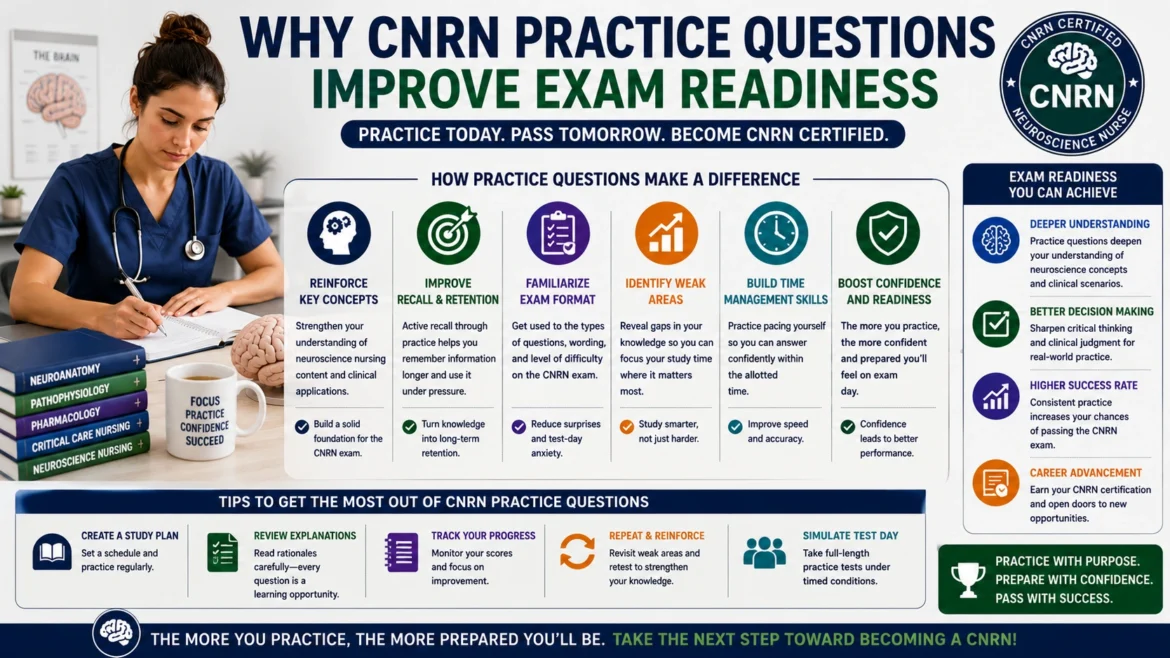

Why Practice Questions Matter for the CNRN Exam
Preparing for the Certified Neuroscience Registered Nurse (CNRN) exam requires more than reading textbooks and reviewing notes. Neuroscience nursing involves complex patient care decisions, rapid clinical judgment, and advanced neurological assessment skills. Because of this, many nurses discover that passive studying alone is not enough to feel fully prepared for the certification exam.
One of the most effective ways to improve readiness for the CNRN exam is through consistent practice questions and realistic exam-style scenarios. Practice testing helps nurses apply neurological knowledge in ways that closely resemble actual clinical decision-making situations.
Instead of simply memorizing facts, candidates begin learning how to think critically under pressure — an essential skill in neuroscience nursing.
Key Insight:Practice questions help bridge the gap between theoretical neuroscience knowledge and real-world neurological patient care situations.
How Active Recall Strengthens Neuroscience Knowledge
Many nurses spend hours highlighting textbooks or rereading study materials, believing repetition alone will improve retention. However, research in learning psychology consistently shows that active recall methods are significantly more effective for long-term memory development.
Practice questions force the brain to retrieve information actively instead of passively reviewing it. This retrieval process strengthens neural memory pathways and improves the ability to recall information during stressful testing environments.
For neuroscience nursing candidates, this is especially important because the exam often tests:
- Clinical reasoning skills
- Neurological prioritization
- Emergency response judgment
- Assessment interpretation
- Patient safety decisions
- Rapid neurological analysis
By repeatedly working through practice scenarios, candidates become more comfortable applying neurological concepts under realistic conditions.
The Difference Between Reading and Applying Knowledge
Understanding neuroscience theory is important, but certification exams evaluate how well candidates apply that knowledge in practical situations.
For example, a nurse may memorize the signs of increased intracranial pressure. However, the actual exam may present a complex patient scenario requiring interpretation of symptoms, prioritization of interventions, and identification of the safest clinical action.
This is where practice questions become extremely valuable.
Scenario-based questions train candidates to:
- Recognize subtle neurological changes
- Prioritize patient care correctly
- Interpret assessment findings
- Identify dangerous complications
- Select evidence-based interventions
- Think critically under time pressure
Over time, repeated exposure to neurological case-style questions improves confidence and clinical reasoning speed.
Why Neuroscience Nursing Requires Critical Thinking
Neurological patients can deteriorate rapidly. Small assessment changes may signal life-threatening complications requiring immediate intervention.
In real hospital environments, neuroscience nurses frequently make rapid decisions involving:
- Stroke symptom progression
- Seizure emergencies
- Brain injury complications
- Changes in consciousness
- Post-operative neurological decline
- Intracranial pressure concerns
The CNRN exam reflects these real-world responsibilities. Questions are designed to evaluate whether candidates can apply neuroscience principles safely and effectively in high-pressure situations.
Practice testing strengthens these decision-making abilities by exposing candidates to realistic neurological care challenges repeatedly.
Real-World Example: Why Practice Questions Build Confidence
A neuro ICU nurse preparing for certification initially struggled with complex stroke management questions. Although the nurse understood stroke theory, applying the concepts during timed scenarios felt overwhelming.
After several weeks of consistent practice testing, the nurse noticed major improvements in recognizing intervention priorities and interpreting neurological assessment data.
By exam day, the candidate reported feeling significantly more comfortable managing difficult scenario-based questions because repeated practice reduced uncertainty and improved response speed.
This experience is common among neuroscience nurses preparing for advanced certification exams.
How Practice Exams Simulate Real Testing Conditions
One of the biggest challenges candidates face during certification exams is pressure. Time limits, difficult clinical scenarios, and testing anxiety can affect performance even when candidates possess strong knowledge.
Practice exams help reduce this pressure by creating familiarity with:
- Question structure
- Testing pace
- Clinical scenario wording
- Answer analysis techniques
- Time management strategies
- Mental endurance
The more familiar candidates become with exam-style questions, the less intimidating the actual exam environment feels.
Preparation Tip:Timed practice sessions help candidates improve focus, reduce hesitation, and strengthen endurance for long certification exams.
Why Rationales Matter as Much as Correct Answers
Many candidates focus only on whether they answered a practice question correctly. However, one of the most valuable parts of practice testing is reviewing answer explanations and rationales.
Strong rationales help candidates understand:
- Why the correct answer is appropriate
- Why other options are unsafe or incorrect
- How neurological priorities are determined
- What clinical clues should be recognized
- How patient safety affects decision-making
This deeper understanding strengthens critical thinking far more effectively than memorizing isolated facts.
For neuroscience nursing, understanding clinical reasoning pathways is essential because neurological care often involves multiple competing priorities.
Common Weak Areas Practice Questions Can Reveal
Many nurses discover hidden knowledge gaps only after beginning structured practice testing. These weaknesses may not appear during passive studying because reading alone often creates false confidence.
Practice exams can reveal difficulties in areas such as:
| Weak Area | Why It Matters |
|---|---|
| Stroke Interventions | Critical for emergency neurological care decisions. |
| Cranial Nerve Assessment | Important for accurate neurological evaluation. |
| Seizure Management | Essential for patient stabilization and safety. |
| Intracranial Pressure | Vital for recognizing dangerous neurological decline. |
| Neuro Pharmacology | Supports safe medication administration. |
| Prioritization Questions | Tests rapid clinical decision-making ability. |
Identifying weak areas early allows candidates to focus study time more efficiently instead of reviewing already-mastered topics repeatedly.
Why Consistency Beats Last-Minute Cramming
Neuroscience certification preparation is most effective when candidates study consistently over time. Last-minute cramming may temporarily improve short-term memory, but it rarely supports deep clinical understanding.
Practice questions encourage consistent engagement with neuroscience concepts and help reinforce learning gradually.
Even short daily practice sessions can significantly improve:
- Knowledge retention
- Clinical reasoning speed
- Testing confidence
- Question interpretation
- Neurological assessment recognition
Many successful candidates dedicate small blocks of focused study time several days each week instead of attempting exhausting marathon study sessions.
Nurses preparing for neuroscience certification often improve readiness faster when using realistic CNRN practice test questions that mirror the complexity and structure of actual neurological nursing scenarios. High-quality practice tests can help strengthen critical thinking, identify weak topics, and build greater confidence before exam day.
How Practice Questions Improve Clinical Judgment
Clinical judgment is one of the most important skills in neuroscience nursing. Patients with neurological conditions often experience rapid status changes, and nurses must recognize subtle warning signs before complications become life-threatening.
The CNRN exam evaluates how candidates analyze information, prioritize interventions, and make safe patient care decisions under pressure. Practice questions help strengthen these abilities by exposing candidates to realistic neurological situations repeatedly.
Over time, nurses begin developing faster recognition patterns for:
- Neurological deterioration
- Stroke progression symptoms
- Seizure complications
- Post-operative neurological changes
- Increased intracranial pressure indicators
- Emergency intervention priorities
This repeated exposure trains the brain to process neurological information more efficiently during both exams and real clinical practice.
Clinical Advantage:Strong clinical judgment helps neuroscience nurses respond faster during emergencies while improving patient safety and communication with healthcare teams.
Why Scenario-Based Questions Are So Effective
Many neuroscience certification questions are built around patient scenarios because neurological care rarely follows simple textbook patterns. Patients often present with multiple symptoms, changing neurological findings, and overlapping complications.
Scenario-based practice questions prepare candidates for these complex situations by requiring them to:
- Analyze patient symptoms carefully
- Interpret neurological findings
- Prioritize interventions logically
- Identify dangerous complications
- Apply evidence-based nursing care
This approach strengthens deeper understanding rather than surface-level memorization.
For example, instead of asking candidates to simply define intracranial pressure, a scenario-based question may require recognizing subtle assessment changes that suggest worsening brain swelling in a trauma patient.
That level of critical thinking closely reflects real neuroscience nursing responsibilities.
The Psychological Benefits of Practice Testing
Practice testing does more than improve knowledge retention. It also helps reduce anxiety and increase mental readiness before exam day.
Certification exams can feel intimidating because candidates often fear unexpected questions or difficult clinical scenarios. Repeated exposure to realistic practice exams helps reduce uncertainty and builds familiarity with the testing process.
Candidates who practice consistently often experience:
- Improved confidence
- Lower test anxiety
- Better concentration
- Reduced panic during difficult questions
- Stronger pacing strategies
- Greater emotional control
This psychological preparation can significantly influence overall performance during the actual exam.
How Practice Questions Improve Time Management
One common challenge during certification exams is balancing accuracy with speed. Some candidates spend too much time analyzing difficult questions, leaving insufficient time for remaining sections.
Practice exams help nurses develop stronger pacing strategies by teaching them how to:
- Recognize high-priority information quickly
- Avoid overanalyzing questions
- Manage difficult scenarios calmly
- Maintain steady testing rhythm
- Improve decision-making efficiency
Timed practice sessions are especially useful because they simulate real testing pressure while helping candidates build endurance for longer exams.
As nurses become more familiar with neurological question patterns, response times often improve naturally.
The Connection Between Practice Questions and Patient Safety
At its core, neuroscience certification preparation is ultimately about improving patient care quality and safety. Practice questions strengthen the clinical reasoning skills nurses rely on during real neurological emergencies.
In hospital settings, neuroscience nurses frequently care for patients experiencing:
- Acute strokes
- Severe traumatic brain injuries
- Status epilepticus
- Post-neurosurgical complications
- Neurological deterioration
- Spinal cord emergencies
Fast, accurate decision-making during these situations can directly affect patient outcomes.
Practice testing helps nurses recognize dangerous patterns earlier and apply safer interventions with greater confidence.
That is one reason specialty-certified nurses are often highly valued within neurocritical care environments and stroke centers throughout the United States.
Building a Smarter CNRN Study Routine
Many candidates study inefficiently without realizing it. Reading large volumes of information without active engagement can lead to poor retention and mental fatigue.
Integrating practice questions into a structured study routine creates a more balanced and effective preparation strategy.
A strong neuroscience study routine often includes:
| Study Activity | Purpose |
|---|---|
| Content Review | Strengthens foundational neuroscience knowledge. |
| Practice Questions | Improves critical thinking and application skills. |
| Rationale Analysis | Builds deeper understanding of clinical reasoning. |
| Weak Area Review | Targets knowledge gaps efficiently. |
| Timed Exams | Improves pacing and mental endurance. |
This balanced approach usually produces stronger long-term retention compared to passive studying alone.
How Consistent Practice Builds Long-Term Professional Growth
The benefits of practice testing often extend beyond certification preparation. Neuroscience nurses who actively engage in scenario-based learning frequently strengthen their everyday clinical performance as well.
Repeated exposure to neurological patient scenarios can improve:
- Assessment confidence
- Communication with providers
- Intervention prioritization
- Emergency response skills
- Clinical documentation accuracy
- Patient education abilities
These improvements contribute to long-term professional growth and stronger patient care outcomes.
Many nurses pursuing specialty certification also benefit from understanding the broader certification journey itself, including career opportunities, exam expectations, and neuroscience specialization pathways. Resources like this CNRN certification roadmap for nurses can help candidates build a clearer long-term strategy while preparing for advanced neuroscience nursing roles.
Why High-Quality Practice Questions Matter
Not all practice questions provide equal educational value. Poorly written questions may encourage memorization without strengthening true clinical reasoning skills.
High-quality neuroscience practice questions should:
- Reflect realistic neurological scenarios
- Test critical thinking abilities
- Include detailed answer rationales
- Mirror certification exam structure
- Challenge prioritization skills
- Reinforce evidence-based care principles
Well-designed questions help candidates think like neuroscience nurses rather than simply memorize isolated facts.
Study Reminder:The goal is not just getting questions right. The real objective is understanding why specific neurological decisions are safest and most appropriate for patients.
Final Thoughts
Preparing for the CNRN exam requires more than reviewing neuroscience content passively. Success depends heavily on the ability to apply neurological knowledge in realistic patient care situations.
Practice questions strengthen active recall, improve clinical judgment, reduce anxiety, and help candidates develop the confidence needed for advanced neuroscience nursing responsibilities.
For many nurses, consistent practice testing becomes one of the most valuable tools during certification preparation because it transforms theoretical knowledge into practical decision-making ability.
As neuroscience nursing continues growing across the United States, nurses who strengthen critical thinking skills through structured practice and realistic clinical scenarios will remain better prepared for both certification success and high-quality patient care.
Why Repetition Improves Neurological Decision-Making
Neuroscience nursing requires rapid recognition of subtle patient changes that may indicate life-threatening complications. In many neurological emergencies, delays in intervention can lead to permanent damage or poor patient outcomes.
This is why repetition through practice questions becomes so powerful during certification preparation.
Repeated exposure to neurological scenarios helps nurses recognize patterns more quickly and respond with greater confidence. Over time, the brain becomes more efficient at identifying critical assessment findings and connecting them with appropriate interventions.
For example, after practicing multiple stroke-related scenarios, candidates often become faster at recognizing:
- Changes in level of consciousness
- Signs of neurological deterioration
- Abnormal pupil responses
- Early intracranial pressure symptoms
- Priority emergency interventions
This repeated neurological pattern recognition benefits both exam performance and real patient care environments.
How Practice Questions Strengthen Neuro Assessment Skills
Neurological assessment is one of the most essential responsibilities in neuroscience nursing. Small assessment changes may indicate worsening brain injury, seizure activity, stroke progression, or dangerous complications.
The CNRN exam frequently evaluates assessment interpretation because accurate neurological monitoring directly affects patient outcomes.
Practice questions help nurses strengthen their understanding of:
- Glasgow Coma Scale interpretation
- Cranial nerve assessment
- Motor response evaluation
- Sensory assessment findings
- Pupil reaction changes
- Neurological baseline comparison
Through repeated practice, candidates become more comfortable identifying important assessment abnormalities quickly and accurately.
Important Clinical Skill:Strong neurological assessment abilities help nurses detect patient deterioration earlier, improving response times and patient safety during neurological emergencies.
The Role of Practice Questions in Memory Retention
Many candidates worry about forgetting large amounts of neuroscience information during exam preparation. Because neuroscience nursing includes anatomy, pharmacology, diagnostics, emergency care, and rehabilitation concepts, the volume of information can feel overwhelming.
Practice questions help improve long-term retention because they engage active memory retrieval repeatedly.
Instead of rereading information passively, candidates must:
- Recall neurological concepts actively
- Apply information under pressure
- Interpret patient data
- Analyze intervention priorities
- Evaluate clinical safety decisions
This deeper cognitive engagement improves retention significantly more effectively than passive reading alone.
Many neuroscience nurses discover they remember information more clearly after working through realistic case scenarios compared to traditional study methods.
Why Confidence Matters During the CNRN Exam
Knowledge alone does not always guarantee strong exam performance. Anxiety, hesitation, and self-doubt can negatively affect even highly experienced nurses during certification testing.
Consistent practice testing helps build confidence by creating familiarity with the exam process and reinforcing clinical reasoning abilities.
Candidates who practice regularly often become more comfortable with:
- Difficult neurological scenarios
- Prioritization questions
- Complex answer choices
- Time pressure
- Critical thinking challenges
As confidence improves, candidates often experience clearer thinking and better focus during the actual exam.
This psychological readiness becomes especially important in long certification exams where mental fatigue and stress may affect concentration.
Common Signs a Candidate Needs More Practice Questions
Many nurses can identify preparation gaps by paying attention to specific warning signs during studying.
Signs that additional practice testing may be necessary include:
| Warning Sign | Possible Issue |
|---|---|
| Difficulty prioritizing interventions | Weak clinical reasoning skills |
| Second-guessing answers constantly | Low confidence or limited application practice |
| Running out of time during quizzes | Pacing and efficiency problems |
| Forgetting concepts quickly | Passive studying without active recall |
| Struggling with scenario questions | Limited exposure to clinical application questions |
Recognizing these signs early allows candidates to adjust study methods before exam day.
How Practice Testing Supports Career Growth
The value of practice testing extends beyond passing the certification exam. Nurses who consistently strengthen clinical reasoning skills often perform more confidently in real neuroscience care environments.
Improved neurological decision-making can support career advancement in areas such as:
- Neurocritical care
- Stroke coordination
- Trauma nursing
- Neurosurgical recovery
- Clinical leadership
- Nurse education
Employers frequently value nurses who demonstrate strong neurological assessment abilities and advanced specialty knowledge because these skills contribute directly to patient safety and healthcare quality.
Specialty certification combined with strong clinical judgment can help nurses stand out in highly competitive healthcare environments.
Building Long-Term Neuroscience Expertise
Preparing for the CNRN exam should not be viewed only as a short-term testing goal. The deeper purpose is developing advanced neuroscience expertise that improves patient care quality over an entire nursing career.
Every practice scenario, neurological assessment question, and critical thinking challenge contributes to stronger clinical understanding over time.
As nurses continue practicing and refining their skills, they often become:
- More confident during emergencies
- Better communicators with providers
- Stronger patient advocates
- More accurate in neurological assessments
- More efficient during critical interventions
This long-term professional growth is one reason many experienced neuroscience nurses strongly encourage certification preparation and consistent practice testing.
The Future of Certification Preparation
Modern certification preparation increasingly emphasizes realistic application-based learning instead of memorization alone. Healthcare environments continue evolving rapidly, and certification exams now focus heavily on clinical reasoning and patient safety.
As neurological care becomes more advanced, neuroscience nurses will continue needing strong analytical skills, rapid assessment abilities, and evidence-based decision-making knowledge.
Practice questions remain one of the most effective tools for developing these competencies because they simulate the complexity of real neurological patient care.
For nurses preparing for advanced neuroscience certification, structured practice testing can help transform uncertainty into confidence and theoretical knowledge into practical clinical expertise.
Frequently Asked Questions (FAQs)
Why are practice questions important for the CNRN exam?
Practice questions help candidates strengthen critical thinking, improve neurological decision-making, and become familiar with realistic exam-style scenarios.
Do practice exams reduce test anxiety?
Yes. Repeated exposure to timed exam-style questions often helps candidates feel more confident and less anxious during the actual certification exam.
How often should candidates use CNRN practice questions?
Many successful candidates include practice questions several times each week as part of a structured neuroscience study routine.
What topics should practice questions focus on?
Important areas include stroke care, neuro assessment, intracranial pressure, seizure management, neuro pharmacology, and neurological emergencies.
Can practice questions improve real clinical skills?
Yes. High-quality scenario-based questions help strengthen assessment interpretation, prioritization skills, and neurological clinical judgment used in real patient care settings.