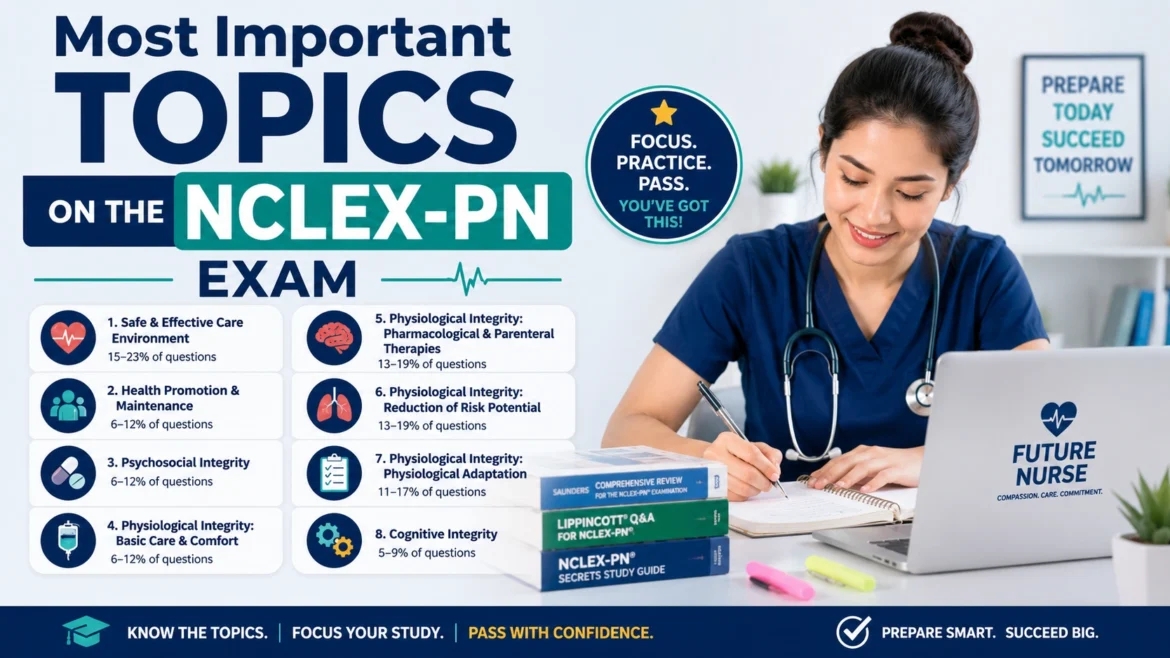

Understanding the Most Important NCLEX-PN Topics
The NCLEX-PN exam evaluates whether practical nursing students can apply patient-care knowledge safely within real healthcare environments. Because the exam focuses heavily on clinical judgment and patient safety, many candidates feel overwhelmed trying to determine which subjects deserve the most attention during preparation.
Although every nursing concept matters, certain high-yield topics appear consistently throughout NCLEX-PN scenarios because they directly affect patient wellbeing and safe nursing practice.
Strong preparation usually focuses heavily on:
- Patient safety
- Pharmacology
- Clinical judgment
- Prioritization
- Infection control
- Nursing fundamentals
- Communication skills
- Care planning
Understanding these core areas helps nursing students build stronger confidence while improving clinical reasoning during patient-care situations.
Nursing Insight:The NCLEX-PN focuses heavily on safe nursing decisions and practical patient-care application rather than memorization alone.
Patient Safety and Infection Control
Patient safety remains one of the most important concepts throughout the NCLEX-PN because nurses make decisions continuously that directly affect patient wellbeing.
The exam may evaluate whether candidates can recognize:
- Unsafe patient situations
- Medication administration risks
- Infection-control concerns
- Fall-prevention needs
- Communication breakdowns
- Emergency response priorities
Strong patient-safety awareness helps nurses protect patients while reducing preventable healthcare complications.
Infection control is also heavily emphasized because healthcare-associated infections remain a major concern across hospitals, clinics, rehabilitation facilities, and long-term care environments.
Important infection-control topics may include:
- Hand hygiene
- Isolation precautions
- Sterile procedures
- Personal protective equipment
- Cross-contamination prevention
Because patient safety and infection prevention are closely connected, these concepts often appear throughout multiple NCLEX-PN question types.
Pharmacology and Medication Safety
Pharmacology remains one of the most challenging areas for many nursing students preparing for the NCLEX-PN exam.
Nurses are directly involved in medication administration and patient monitoring, so medication safety is heavily emphasized throughout nursing education and licensure testing.
Important pharmacology concepts may include:
- Medication classifications
- Side effects
- Adverse reactions
- Dosage safety
- Patient teaching
- Medication administration precautions
Many students struggle because they attempt to memorize individual medications without understanding broader medication patterns and nursing responsibilities.
Strong pharmacology preparation focuses on understanding:
- Why medications are used
- How nurses monitor patient responses
- Which side effects create safety concerns
- What patient teaching is necessary
Medication Safety Reminder:Medication administration requires careful clinical judgment because even small nursing errors can affect patient safety significantly.
Clinical Judgment and Prioritization
Clinical judgment is one of the most important skills evaluated throughout the NCLEX-PN because practical nurses must continuously analyze patient situations and choose safe nursing actions.
The exam may include scenarios requiring candidates to:
- Recognize patient deterioration
- Prioritize nursing actions
- Respond to emergencies
- Identify urgent symptoms
- Choose safe interventions
- Determine which patient requires immediate attention
Many students initially struggle with prioritization questions because they focus too heavily on memorized disease information instead of evaluating patient stability and safety risk.
Strong prioritization skills improve gradually through repeated exposure to realistic patient-care scenarios and clinical reasoning exercises.
Nursing Fundamentals and Basic Patient Care
Although some nursing students focus heavily on advanced clinical concepts, nursing fundamentals remain extremely important throughout the NCLEX-PN.
Foundational nursing topics may include:
- Vital sign assessment
- Mobility assistance
- Patient positioning
- Basic hygiene care
- Nutrition support
- Documentation principles
- Communication techniques
Strong nursing fundamentals help practical nurses provide safer and more effective patient care across many healthcare environments.
These foundational skills also support stronger clinical reasoning during more complex patient situations.
Clinical Insight:Strong nursing fundamentals support safer patient care and improve long-term clinical confidence.
Psychosocial Integrity and Communication
Nursing involves much more than technical procedures and medication administration. Nurses also support patients emotionally during stressful healthcare situations.
The NCLEX-PN may evaluate whether candidates understand:
- Therapeutic communication
- Patient education
- Mental health support
- Cultural awareness
- Professional boundaries
- Emotional patient care
Strong communication skills help nurses:
- Reduce patient anxiety
- Improve patient trust
- Prevent misunderstandings
- Support healthcare teamwork
- Improve care coordination
Because communication directly affects patient outcomes, it remains an important area throughout nursing preparation and clinical practice.
Delegation and Teamwork in Nursing
Delegation is another important NCLEX-PN topic because nurses often work within healthcare teams involving nursing assistants, supervisors, physicians, and other professionals.
Candidates may need to understand:
- Which tasks can be delegated safely
- Which patients require direct nursing care
- How to communicate clearly with healthcare teams
- When nurses remain responsible for patient outcomes
Strong delegation awareness helps improve patient safety while supporting more efficient healthcare coordination.
Many nursing students preparing for licensure improve confidence and clinical reasoning by consistently working through realistic NCLEX-PN practice exam questions and answers focused on patient safety, pharmacology, prioritization, delegation, and modern nursing-care situations commonly encountered during clinical healthcare environments.
Care Planning and Nursing Interventions
Care planning is another important NCLEX-PN topic because nurses must continuously evaluate patient conditions and determine appropriate nursing interventions.
The exam may evaluate whether candidates can:
- Identify patient needs
- Choose safe interventions
- Monitor patient responses
- Adjust nursing actions appropriately
- Recognize worsening symptoms
- Support recovery goals
Strong care-planning skills help nurses provide more organized and patient-centered healthcare support.
Many NCLEX-PN scenarios involve analyzing which nursing intervention is safest or most appropriate based on patient symptoms and clinical priorities.
Nursing Reminder:Effective nursing interventions require both clinical judgment and strong patient-safety awareness.
Physiological Integrity and Patient Monitoring
Physiological integrity involves maintaining and supporting basic physical health functions during patient care.
This major NCLEX-PN category may include:
- Respiratory assessment
- Circulation monitoring
- Fluid balance
- Pain management
- Nutrition support
- Mobility assistance
- Vital sign interpretation
Nurses must recognize changes in patient condition quickly because delayed intervention may create serious health risks.
Strong patient-monitoring skills therefore remain essential throughout both the NCLEX-PN exam and real clinical practice.
Emergency Nursing Concepts and Response Priorities
Emergency response concepts are commonly tested because practical nurses frequently encounter urgent patient-care situations within healthcare environments.
Important emergency-related topics may include:
- Airway emergencies
- Breathing difficulties
- Circulation problems
- Changes in consciousness
- Seizure precautions
- Shock symptoms
- Rapid patient deterioration
Many prioritization questions require candidates to determine which patient situation creates the greatest immediate danger.
Strong emergency-awareness skills help nurses respond more safely during high-pressure healthcare situations.
Clinical Insight:Patient stability and immediate safety risks should remain major priorities during emergency nursing situations.
Why Prioritization Questions Matter So Much
Prioritization remains one of the most heavily tested NCLEX-PN skills because nurses continuously balance multiple patient needs throughout daily healthcare responsibilities.
Many NCLEX-style questions require students to determine:
- Which patient needs immediate attention
- Which symptom is most dangerous
- Which nursing action should occur first
- Which situation requires rapid intervention
Students often improve significantly once they begin focusing on:
- Airway stability
- Breathing concerns
- Circulation problems
- Mental-status changes
- Patient deterioration signs
This patient-stability mindset helps improve both clinical reasoning and exam performance.
Why Ethical Nursing Behavior Is Important
Professional nursing behavior and ethical responsibility remain important throughout both healthcare practice and NCLEX-PN preparation.
The exam may evaluate understanding of:
- Patient confidentiality
- Professional boundaries
- Accurate documentation
- Patient advocacy
- Ethical communication
- Professional accountability
Strong ethical awareness helps practical nurses provide safer and more respectful patient care.
Healthcare employers also highly value nurses who demonstrate responsibility, professionalism, and sound clinical judgment.
Professional Insight:Nursing professionalism involves both technical patient-care skills and ethical responsibility toward patient wellbeing.
How Active Learning Improves NCLEX-PN Preparation
Many nursing students spend too much time passively reviewing textbooks without actively applying nursing concepts.
Active learning methods are often much more effective because they require candidates to:
- Interpret patient-care situations
- Practice clinical reasoning
- Analyze safety concerns
- Apply prioritization logic
- Recognize medication risks
Examples of effective active learning strategies may include:
| Study Method | Main Benefit |
|---|---|
| Practice Questions | Improves clinical application. |
| Case Studies | Strengthens patient-care reasoning. |
| Pharmacology Drills | Builds medication safety awareness. |
| Prioritization Exercises | Improves emergency decision-making. |
| Weak-Area Review | Supports targeted improvement. |
Repeated patient-care application often improves long-term retention much more effectively than memorization alone.
Why Understanding the NCLEX-PN Structure Helps Students
Many nursing students improve preparation quality once they understand how the NCLEX-PN evaluates practical nursing judgment instead of simple textbook recall.
Helpful preparation often involves understanding:
- How nursing scenarios are structured
- Why patient safety matters so heavily
- How prioritization affects care decisions
- How clinical judgment guides interventions
- Why communication affects patient outcomes
Students seeking broader understanding of nursing licensure expectations and patient-care responsibilities may benefit from reviewing a complete practical nursing exam and career preparation guide while building stronger clinical confidence and healthcare reasoning skills.
Nursing students may also improve study efficiency by learning about frequent NCLEX-PN preparation problems that commonly affect prioritization accuracy, pharmacology confidence, patient-safety awareness, and long-term nursing retention.
How Consistent Preparation Builds Nursing Confidence
Many nursing students initially feel overwhelmed because the NCLEX-PN covers multiple patient-care topics, medication concepts, communication principles, and clinical judgment responsibilities.
Consistent preparation helps students strengthen:
- Clinical reasoning
- Patient-safety awareness
- Medication understanding
- Communication confidence
- Emergency prioritization
- Nursing professionalism
Over time, this steady improvement helps future practical nurses feel more prepared for both licensure testing and long-term patient-care responsibilities within modern healthcare environments.
Why Clinical Judgment Is Central to the NCLEX-PN
Clinical judgment remains one of the most important skills evaluated throughout the NCLEX-PN because practical nurses make patient-care decisions continuously during real healthcare situations.
Strong clinical judgment helps nurses:
- Recognize worsening symptoms
- Respond to emergencies safely
- Prioritize patient needs correctly
- Choose appropriate nursing interventions
- Protect patient wellbeing
Many NCLEX-PN questions are designed to test whether candidates can apply safe nursing reasoning instead of relying only on memorized textbook information.
Repeated exposure to realistic patient-care scenarios often improves clinical confidence and nursing decision-making significantly.
Nursing Insight:Strong clinical reasoning helps practical nurses make safer patient-care decisions within fast-paced healthcare environments.
How Communication Skills Affect Patient Outcomes
Communication plays a major role in patient safety because nurses interact constantly with patients, families, physicians, and healthcare teams.
Strong communication skills help nurses:
- Reduce patient anxiety
- Improve care coordination
- Prevent misunderstandings
- Support patient education
- Improve healthcare teamwork
The NCLEX-PN may include situations involving therapeutic communication, patient teaching, conflict management, and emotional support.
Because communication directly affects patient outcomes, it remains one of the most valuable nursing skills both during preparation and throughout professional healthcare practice.
Why Time Management Improves NCLEX-PN Preparation
Many nursing students preparing for licensure exams struggle because preparation becomes disorganized and emotionally exhausting.
Without structure, students may:
- Overfocus on weak areas
- Ignore important concepts
- Avoid practice questions
- Study inconsistently
- Experience unnecessary burnout
Organized study schedules often improve long-term retention and reduce stress significantly.
Many successful nursing students use balanced weekly review schedules involving:
- Practice questions
- Pharmacology review
- Patient-care scenarios
- Prioritization exercises
- Safety-focused learning
Consistent active learning usually improves confidence much more effectively than last-minute cramming.
Study Reminder:Smaller consistent study sessions often improve retention more effectively than exhausting marathon review sessions.
How Practice Questions Strengthen Nursing Confidence
Many nursing students initially feel anxious because the NCLEX-PN evaluates multiple patient-care responsibilities simultaneously.
Practice questions help students improve familiarity with:
- Prioritization scenarios
- Medication-safety situations
- Patient deterioration signs
- Emergency-response decisions
- Communication challenges
- Clinical judgment exercises
Repeated exposure to realistic nursing situations often helps candidates become more comfortable analyzing patient-care problems without excessive hesitation.
This gradual improvement can significantly reduce exam anxiety while strengthening long-term clinical confidence.
Why Nursing Fundamentals Remain Extremely Important
Although advanced healthcare topics receive significant attention during preparation, many NCLEX-PN questions still rely heavily on strong nursing fundamentals.
Important foundational areas often include:
- Vital signs
- Patient positioning
- Basic hygiene care
- Mobility assistance
- Nutrition support
- Documentation principles
- Patient observation skills
Strong nursing fundamentals help practical nurses provide safer and more effective care across hospitals, rehabilitation centers, long-term care facilities, clinics, and many other healthcare environments.
These foundational concepts also support stronger clinical judgment during more complex patient situations.
Clinical Insight:Strong nursing fundamentals support safer patient care and improve long-term healthcare confidence.
How NCLEX-PN Preparation Supports Long-Term Nursing Growth
Preparing for the NCLEX-PN often strengthens much more than exam performance alone.
The preparation process frequently improves:
- Patient-safety awareness
- Communication abilities
- Clinical reasoning
- Medication understanding
- Professional accountability
- Healthcare confidence
These skills continue supporting nurses throughout careers in hospitals, physician offices, rehabilitation centers, outpatient clinics, and long-term care facilities.
Many experienced nurses later realize that the habits developed during licensure preparation continued helping them throughout daily patient-care responsibilities.
Why Healthcare Demand Continues Growing
The demand for practical nurses continues growing throughout the United States because healthcare systems support large patient populations across multiple care settings.
Practical nurses remain important because they help provide:
- Direct patient care
- Medication administration
- Vital sign monitoring
- Patient education
- Care coordination
- Healthcare communication support
As healthcare demand continues increasing, practical nursing remains a meaningful and stable healthcare career path for many students pursuing long-term professional growth.
Building a Sustainable NCLEX-PN Study Routine
Many successful students create flexible but organized weekly study structures that fit realistically within nursing school schedules and clinical responsibilities.
For example:
| Study Day | Main Focus |
|---|---|
| Monday | Pharmacology review |
| Tuesday | Patient-safety scenarios |
| Wednesday | Prioritization exercises |
| Thursday | Communication and psychosocial care |
| Friday | Practice-question review |
| Weekend | Timed nursing simulations |
This type of structured preparation often helps students improve consistently while reducing stress and mental exhaustion.
Final Thoughts
The NCLEX-PN covers multiple patient-care responsibilities connected to safe nursing practice, clinical judgment, communication, pharmacology, and healthcare decision-making.
Some of the most important NCLEX-PN topics include:
- Patient safety
- Pharmacology
- Prioritization
- Clinical judgment
- Infection control
- Nursing fundamentals
- Communication skills
- Care planning
Strong preparation usually involves active learning, realistic patient-care scenarios, practice-question analysis, and consistent review of high-yield nursing concepts.
Over time, these habits help future practical nurses build the clinical confidence, patient-safety awareness, and professional judgment needed for both NCLEX-PN success and long-term nursing growth.
Frequently Asked Questions (FAQs)
What are the most important topics on the NCLEX-PN exam?
Important topics often include pharmacology, patient safety, prioritization, clinical judgment, infection control, and nursing fundamentals.
Why is prioritization important for the NCLEX-PN?
Prioritization helps nurses determine which patient needs immediate care and which nursing actions should occur first.
How can nursing students improve clinical judgment?
Repeated practice with patient-care scenarios and NCLEX-style questions often improves clinical reasoning significantly.
Why is pharmacology heavily tested on the NCLEX-PN?
Nurses are directly involved in medication administration and patient monitoring, making medication safety extremely important.
What is the best way to study for the NCLEX-PN?
Active learning methods such as practice questions, patient scenarios, prioritization drills, and safety-focused review are highly effective.