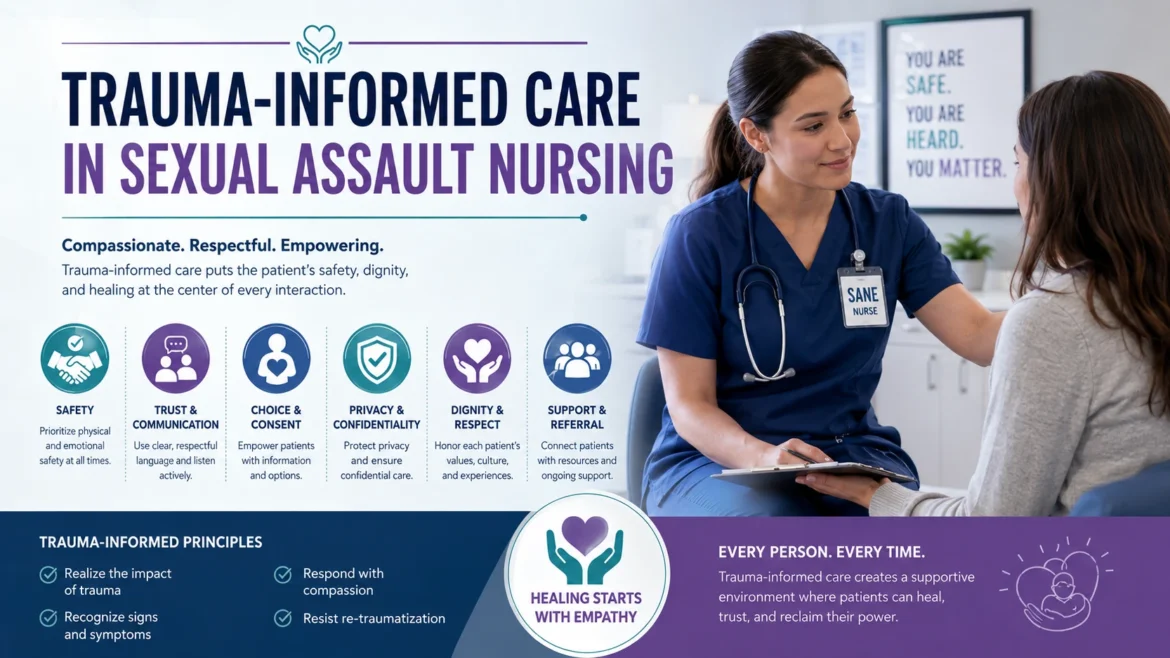

Trauma-informed care is an important part of sexual assault nursing because the way healthcare professionals communicate, assess, and provide care can affect a patient’s sense of safety and control. A person seeking care after sexual assault may experience fear, confusion, anxiety, physical discomfort, emotional distress, or other responses that are not always immediately visible.
For sexual assault nurses, providing appropriate clinical care involves more than completing an examination or documenting physical findings. The nurse must also create an environment that respects the patient’s dignity, autonomy, privacy, and individual experience.
Trauma-informed care provides a framework for doing this. It helps nurses recognize the potential effects of trauma and approach patients in a way that promotes safety, trust, choice, and respectful communication.
What Is Trauma-Informed Care?
Trauma-informed care is an approach to healthcare that recognizes how previous or current trauma can affect a person’s physical health, emotional responses, behavior, communication, and interactions with healthcare professionals.
In sexual assault nursing, trauma-informed care means considering the patient’s experience throughout the healthcare encounter rather than focusing only on the clinical procedure.
The nurse should consider:
- How the patient feels about the examination.
- Whether the patient understands what is happening.
- Whether the patient feels physically and emotionally safe.
- How much control the patient has over decisions about care.
- Whether procedures are explained before they occur.
- Whether privacy and dignity are being maintained.
- Whether communication is respectful and nonjudgmental.
Trauma-informed care does not mean assuming that every patient will respond to sexual assault in the same way. Instead, it means recognizing that trauma can affect individuals differently and avoiding assumptions about how a survivor should behave or communicate.
Why Trauma-Informed Care Matters in Sexual Assault Nursing
A medical forensic examination can involve sensitive questions, physical assessment, photographs, evidence collection, and other procedures. Some aspects of the examination may remind a patient of the traumatic experience or create feelings of vulnerability.
A trauma-informed approach can help reduce unnecessary distress while allowing the nurse to provide appropriate healthcare.
It can also support:
- Patient participation in care decisions.
- Clear communication.
- Trust between the patient and healthcare professional.
- Respect for patient autonomy.
- Improved understanding of procedures.
- Physical and emotional safety.
- More individualized care.
The goal is not to eliminate every difficult emotion. Rather, the nurse works to create a healthcare environment in which the patient is treated with respect and has appropriate information and choices throughout the encounter.
Core Principles of Trauma-Informed Care
Several principles can guide trauma-informed nursing practice. Although the exact terminology may vary among organizations and educational resources, common themes include safety, trust, collaboration, choice, empowerment, and respect.
Safety
Safety includes both physical and emotional considerations. The nurse should consider whether the patient feels safe in the environment and whether there are immediate medical or personal safety concerns.
Simple actions can support a greater sense of safety, such as explaining what will happen next, maintaining privacy, introducing members of the care team, and avoiding unnecessary interruptions.
Trust and Transparency
Patients should receive understandable information about what the nurse is doing and why. Unexpected actions can increase anxiety, particularly during an examination involving sensitive areas of the body.
Before performing a procedure, explain what will happen in language appropriate for the patient. Give the patient an opportunity to ask questions and clarify information when necessary.
Choice
Trauma can involve a profound loss of control. Providing appropriate choices during healthcare may help restore a sense of participation and control.
Depending on the situation, choices might involve how information is explained, when certain aspects of care occur, or whether the patient is ready to proceed with a particular part of an examination, subject to applicable clinical and legal requirements.
Collaboration
Trauma-informed care encourages collaboration between the patient and healthcare team. The nurse should not treat the patient as a passive recipient of care.
Instead, the patient should be given appropriate information and opportunities to participate in decisions about their care.
Empowerment
Empowerment involves supporting the patient’s ability to make informed decisions and participate in care. The nurse can reinforce this by listening carefully, answering questions, explaining options, and respecting appropriate choices.
Patient Autonomy and Control
Respecting autonomy is particularly important in sexual assault nursing. Patients may arrive for care after experiencing an event in which their personal boundaries or control were violated.
The healthcare encounter should therefore avoid unnecessarily taking control away from the patient.
The nurse can support autonomy by:
- Explaining procedures before beginning them.
- Using clear and understandable language.
- Allowing appropriate questions.
- Respecting the patient’s decisions within the applicable clinical and legal framework.
- Explaining what information or evidence collection may involve.
- Providing appropriate choices whenever possible.
- Avoiding pressure or judgment.
Autonomy does not mean that the nurse ignores medical emergencies or professional responsibilities. The patient’s wishes must be considered alongside applicable laws, clinical requirements, safety concerns, and professional standards.
Consent in Sexual Assault Nursing
Consent is a central consideration during medical forensic care. Patients should receive appropriate information about proposed examinations, procedures, and interventions and should be involved in decisions about their care according to applicable requirements.
Consent should not be treated as a single conversation that occurs at the beginning of the encounter. The nurse should continue communicating with the patient as care progresses.
Before a sensitive procedure, the nurse should explain:
- What is going to happen.
- Why the procedure is being considered.
- What the patient may experience.
- What information or findings may be collected.
- What questions the patient may have.
Clear communication can help the patient understand what to expect and can reduce uncertainty during an unfamiliar healthcare experience.
Explaining the Medical Forensic Examination
A medical forensic examination may involve several stages. Patients may not know what will happen or may have concerns about specific procedures.
The nurse should explain the examination in understandable language and avoid unnecessary medical jargon.
Instead of moving directly from one procedure to another, explain what is happening before each major step. This gives the patient an opportunity to understand the process and ask questions.
For example, before a physical examination, the nurse can explain what area will be assessed and why the assessment is relevant. Before evidence collection, the nurse can explain the general purpose of the process and what the patient can expect.
Communication With Sexual Assault Patients
Communication is one of the most important components of trauma-informed care. Patients may be hesitant to speak, may struggle to describe what happened, or may provide information in a different order than the nurse expects.
The nurse should listen without expressing disbelief, judgment, frustration, or surprise.
Helpful communication practices include:
- Use calm and respectful language.
- Ask clear questions.
- Give the patient enough time to respond.
- Avoid blaming language.
- Do not pressure the patient unnecessarily.
- Explain why sensitive questions are being asked.
- Clarify information without suggesting an expected answer.
- Allow appropriate pauses during difficult conversations.
The patient’s communication style should not be used as a measure of the validity or seriousness of their experience.
Avoiding Judgmental Questions
Questions about sexual assault can involve highly sensitive information. The nurse should avoid language that implies the patient caused the assault or should have behaved differently.
For example, questions that focus on blaming the patient’s clothing, alcohol use, relationship, or decision-making can create unnecessary shame and may interfere with communication.
Instead, questions should be clinically relevant, neutral, and focused on obtaining the information needed for appropriate care.
Understanding Different Trauma Responses
There is no single behavioral response to sexual assault. Patients may react in very different ways depending on their circumstances, previous experiences, support system, physical condition, and individual coping mechanisms.
Possible responses may include:
- Crying or visible distress.
- Fear or anxiety.
- Anger.
- Confusion.
- Silence.
- Emotional numbness.
- Difficulty concentrating.
- Difficulty remembering details.
- Withdrawal.
- Hypervigilance.
A patient may also appear calm or emotionally controlled. This does not mean that the experience was insignificant or that the patient is unaffected.
Nurses should focus on assessment and patient needs rather than judging whether a person’s emotional response appears appropriate.
Trauma Can Affect Communication and Memory
Stress and trauma can influence attention, memory, communication, and the way a person describes an event. A patient may remember certain details clearly while having difficulty recalling other information.
This is one reason nurses should avoid pressuring patients to provide information in a particular sequence simply because that sequence seems easier for the interviewer.
The nurse should follow appropriate assessment and forensic interviewing procedures while maintaining a respectful, patient-centered approach.
Creating a Safe Environment
The physical environment can influence how comfortable a patient feels during care. Privacy, noise level, interruptions, lighting, the number of people present, and the way equipment is introduced can all affect the experience.
Whenever possible and consistent with clinical requirements, the nurse should minimize unnecessary interruptions and protect the patient’s privacy.
Before allowing additional people into the examination area, consider whether their presence is necessary and appropriate. Explain their role to the patient when applicable.
Respecting Privacy and Dignity
Sexual assault examinations can involve highly personal information and sensitive physical assessments. Maintaining privacy and dignity should therefore remain a priority throughout the encounter.
Practical considerations may include:
- Using appropriate draping.
- Limiting unnecessary exposure.
- Explaining sensitive procedures beforehand.
- Protecting confidential information.
- Allowing the patient appropriate opportunities for questions.
- Maintaining a professional environment.
Small details can make a meaningful difference in how a patient experiences the examination.
Trauma-Informed Care Is Not the Same as Avoiding Difficult Care
A trauma-informed approach does not mean avoiding necessary assessment, asking clinically important questions, or failing to address urgent medical concerns.
Instead, it means providing necessary care in a way that is respectful, transparent, and attentive to the patient’s experience.
For example, a sensitive assessment may still be clinically necessary. The nurse can explain why it is needed, describe what will happen, answer questions, and maintain the patient’s dignity while completing the appropriate assessment.
Connecting Trauma-Informed Care With SANE-A Preparation
Trauma-informed care is an important concept for nurses preparing for specialized forensic nursing practice. Candidates should be able to recognize how communication, patient autonomy, safety, consent, assessment, and documentation influence the care of sexual assault patients.
For nurses preparing for certification, understanding these principles is more useful than memorizing isolated phrases. Scenario-based questions may require you to determine which nursing response best supports the patient’s safety, dignity, autonomy, and clinical needs.
Candidates who are already reviewing SANE-A exam preparation strategies can add trauma-informed care to their study plan and practice applying these principles to realistic patient situations.
Trauma-Informed Communication During the Examination
Communication becomes especially important when a patient is undergoing a sensitive medical forensic examination. The nurse may need to ask detailed questions, perform assessments, explain procedures, and discuss treatment or follow-up. Each interaction should be handled with clarity and respect.
A trauma-informed communication style does not require the nurse to avoid difficult topics. Instead, it focuses on how those topics are discussed.
Before asking a sensitive question, explain why the information is relevant when appropriate. This can help the patient understand that the question is related to their care rather than being asked out of curiosity.
Helpful communication practices include:
- Introduce yourself and explain your role.
- Explain what will happen before beginning a procedure.
- Use straightforward, respectful language.
- Allow reasonable time for the patient to respond.
- Listen without interrupting unnecessarily.
- Clarify information without suggesting an answer.
- Check whether the patient has questions.
- Explain changes in the examination process.
- Avoid judgmental or blaming language.
Explain Before You Touch
Physical contact can be particularly sensitive for a person who has experienced sexual assault. Explaining what you intend to do before touching the patient can reduce surprise and give the patient an opportunity to understand what is happening.
For example, rather than moving immediately into an examination, explain the general purpose of the assessment and what the patient should expect.
This approach supports transparency and can help the patient maintain a greater sense of control during care.
Use Clear and Understandable Language
Medical terminology can make an unfamiliar examination feel even more confusing. Nurses should communicate in language the patient can understand and adjust explanations based on the individual’s needs.
When technical terminology is necessary, explain what it means rather than assuming the patient already understands it.
Clear communication is especially important when discussing:
- Examination procedures.
- Evidence collection.
- Photographs.
- Laboratory testing.
- Medications or preventive treatment.
- Follow-up care.
- Available support services.
Allow the Patient to Ask Questions
Patients may have questions about what will happen, why something is being done, or what information will be documented. Providing appropriate opportunities for questions can help reduce uncertainty.
Do not assume that a patient understands simply because they did not ask a question. When appropriate, check understanding and invite the patient to clarify anything that remains confusing.
Supporting Psychological Safety
Physical safety is only one part of trauma-informed care. Psychological safety is also important because a patient may feel vulnerable during a medical forensic examination.
The nurse can support psychological safety by maintaining respectful communication, explaining procedures, protecting privacy, avoiding unnecessary interruptions, and allowing appropriate choices throughout the encounter.
Psychological safety does not mean promising that the patient will never experience distress. Some parts of care may naturally be difficult. The goal is to avoid unnecessary distress and help the patient understand and participate in the process.
Avoiding Re-Traumatization
Some healthcare experiences can unintentionally remind a patient of the original trauma or create feelings of helplessness. Trauma-informed nursing aims to reduce unnecessary experiences of loss of control.
Potentially helpful practices include:
- Explain procedures before they occur.
- Avoid unnecessary physical contact.
- Respect appropriate patient choices.
- Maintain privacy and dignity.
- Use nonjudgmental communication.
- Allow reasonable opportunities for questions.
- Avoid unnecessary repetition of sensitive questions.
- Coordinate communication among members of the care team.
The nurse should still complete clinically necessary assessments and follow appropriate forensic procedures. Trauma-informed care means performing necessary care thoughtfully rather than avoiding appropriate care.
Do Not Assume How a Survivor Should Behave
One of the most important principles of trauma-informed care is avoiding assumptions about how a person who has experienced sexual assault should look, speak, or behave.
A patient may cry, remain quiet, become angry, laugh nervously, appear emotionally detached, or show very little visible emotion. These responses can vary significantly between individuals.
The nurse should focus on what the patient reports, what can be assessed objectively, and what care the patient needs.
A patient’s emotional presentation should not be used as a measure of credibility.
Supporting Patient Choice During Care
Whenever clinically and legally appropriate, offering reasonable choices can help patients regain a sense of control.
Depending on the situation, choices may relate to aspects of communication, positioning, timing of certain activities, or other components of care. The nurse should remain within professional, clinical, and legal requirements while identifying opportunities for patient participation.
Even when the nurse cannot offer a particular choice, explaining why a procedure or action is necessary can make the process more transparent.
Patient-Centered Examination Practices
A patient-centered examination considers the individual’s physical and emotional needs while addressing the clinical and forensic requirements of care.
Before beginning, the nurse should ensure that the patient has appropriate information about the examination and understands what is expected.
During the examination, continue to communicate and observe the patient’s response. If the patient appears distressed or confused, consider whether the nurse needs to pause, explain something again, address an immediate need, or seek additional support according to the situation.
Managing Difficult Conversations
Sexual assault nursing often involves conversations about intimate or distressing experiences. Nurses should maintain a calm and professional manner even when the information is difficult to hear.
Useful approaches include:
- Listen carefully.
- Do not express shock or disbelief.
- Do not blame the patient.
- Allow appropriate pauses.
- Ask only clinically relevant questions.
- Clarify information respectfully.
- Recognize when the patient may need additional emotional support.
The nurse’s response can influence whether the patient feels respected and heard.
Trauma-Informed Documentation
Documentation is another area where trauma-informed practice matters. The medical record should accurately reflect relevant patient statements, assessment findings, care provided, and other required information.
Documentation should remain objective and avoid unnecessary judgmental language.
For example, documenting a patient’s statement directly and accurately is different from adding an unsupported interpretation of the patient’s behavior.
When documenting, consider:
- What did the patient report?
- What did the nurse observe?
- What was assessed?
- What care was provided?
- What did the patient agree to or decline when relevant?
- What was the patient’s response?
- What follow-up or communication occurred?
Document Patient Statements Carefully
When documenting information provided by a patient, preserve the meaning of the patient’s statement and follow the documentation standards of the clinical setting.
Avoid changing the meaning of what the patient said by adding assumptions or conclusions that the patient did not express.
Objective documentation is especially important in forensic nursing because records may have significance beyond the immediate healthcare encounter.
Maintaining Confidentiality and Privacy
Sexual assault involves highly sensitive personal information. Nurses must follow applicable privacy and confidentiality requirements when handling patient information.
Privacy considerations may include:
- Discussing patient information only with appropriate individuals.
- Protecting written and electronic records.
- Limiting unnecessary access to sensitive information.
- Maintaining privacy during physical examinations.
- Following organizational procedures for handling forensic documentation.
The exact legal requirements depend on the healthcare setting and jurisdiction, so nurses should follow current applicable policies and regulations.
Supporting Patients With Different Needs
Trauma-informed care should be individualized. Patients may have different communication preferences, cultural backgrounds, disabilities, language needs, ages, levels of health literacy, or support systems.
The nurse should avoid assuming that one communication approach will work for every patient.
When appropriate, consider whether the patient needs:
- Language assistance.
- Accessibility accommodations.
- Additional explanation.
- Support person involvement when appropriate.
- Referral to specialized services.
- Additional time to understand information.
Individualized care helps ensure that trauma-informed practice is more than a checklist.
Working With the Interdisciplinary Team
Sexual assault care may involve multiple professionals and support services. Depending on the setting and patient needs, the healthcare team may include nurses, physicians, advanced practice providers, social workers, advocates, mental health professionals, law enforcement personnel, and other appropriate professionals.
The nurse should understand their own role and communicate relevant information through appropriate channels.
Interdisciplinary collaboration can help address medical needs, psychological support, safety concerns, follow-up care, and other needs that extend beyond the forensic examination.
Trauma-Informed Care and Evidence Collection
Forensic evidence collection can involve procedures that patients may find uncomfortable or emotionally difficult. The nurse should explain the purpose of relevant procedures and follow established forensic protocols.
Trauma-informed care does not mean changing evidence procedures without authorization. Instead, it means communicating appropriately and maintaining patient dignity while carrying out the required process.
Important considerations include:
- Explain what will happen.
- Use appropriate consent procedures.
- Protect evidence from contamination.
- Maintain accurate documentation.
- Follow established collection procedures.
- Respect patient privacy.
- Communicate changes or concerns appropriately.
Balancing Patient Autonomy With Clinical Responsibilities
Nurses may sometimes need to balance a patient’s preferences with immediate medical concerns, professional responsibilities, and applicable legal requirements.
For example, a patient may be hesitant about an aspect of care while also presenting with a potentially serious medical condition. The nurse must recognize the immediate concern, communicate clearly, and follow the appropriate clinical process rather than treating patient autonomy and medical safety as completely separate issues.
This requires clinical judgment and an understanding of professional responsibilities.
Practical Scenario: A Patient Appears Emotionally Detached
Imagine a patient who provides information about an assault but appears calm and shows little visible emotion.
A trauma-informed nurse should not interpret the patient’s calm behavior as evidence that the event was unimportant or that the patient is not experiencing trauma.
The nurse should continue to provide respectful care, complete the appropriate assessment, explain procedures, maintain privacy, and assess the patient’s needs.
The key principle is to avoid judging the patient’s response based on expectations about how someone “should” behave after trauma.
Practical Scenario: A Patient Becomes Distressed During an Examination
Consider a patient who becomes visibly distressed during part of the examination.
The nurse should recognize the change, communicate with the patient, and determine the appropriate response based on the patient’s condition and the clinical circumstances.
The nurse may need to explain the procedure again, address questions, consider whether a pause is appropriate, or involve additional support according to established procedures.
The important clinical judgment principle is to notice the patient’s response rather than continuing automatically without considering what has changed.
Practical Scenario: A Patient Has Questions About Evidence Collection
A patient asks why certain evidence is being collected and what will happen to it.
A trauma-informed response would involve explaining the process in understandable language and addressing the patient’s questions within the nurse’s professional role.
The nurse should avoid making promises about legal outcomes or processes that are outside their role. Instead, provide accurate information and direct the patient to appropriate resources when necessary.
Common Mistakes in Trauma-Informed Nursing
Assuming All Trauma Survivors Respond the Same Way
Patients have different experiences and coping responses. Avoid judging the validity or seriousness of an experience based on emotional presentation.
Using Judgmental Language
Blaming or critical language can undermine trust. Questions should be relevant, neutral, and appropriate for the clinical situation.
Failing to Explain Procedures
Unexpected physical contact or procedures can increase anxiety. Explain what is going to happen before proceeding whenever possible.
Ignoring Patient Questions
Questions can indicate that the patient needs more information before continuing. Take reasonable opportunities to clarify information.
Forgetting Privacy
Sensitive examinations require careful attention to privacy, dignity, and confidentiality.
Confusing Trauma-Informed Care With Avoiding Care
Trauma-informed practice does not mean skipping clinically necessary assessment or forensic procedures. It means providing appropriate care respectfully and transparently.
How Trauma-Informed Care Supports SANE-A Preparation
For nurses preparing for the SANE-A certification examination, trauma-informed care should be studied as an applied clinical concept rather than a list of definitions.
When reviewing practice scenarios, ask yourself:
- Does this response respect patient autonomy?
- Does it protect safety and dignity?
- Is the communication nonjudgmental?
- Has the nurse explained the procedure?
- Is consent being addressed appropriately?
- Does the response avoid unnecessary retraumatization?
- Is the intervention appropriate for the patient’s current condition?
These questions can help connect trauma-informed principles with clinical judgment.
Final Thoughts on Trauma-Informed Sexual Assault Nursing
Trauma-informed care is an essential part of providing respectful and patient-centered care to people who have experienced sexual assault. It recognizes that the healthcare environment itself can affect a patient’s sense of safety, control, and dignity.
Sexual assault nurses must balance clinical responsibilities with compassionate communication, patient autonomy, privacy, consent, safety, and forensic requirements.
The most effective approach is not to assume what a patient needs based on stereotypes or expectations. Instead, listen carefully, explain what is happening, provide appropriate choices, respect boundaries, and adapt care to the individual’s circumstances.
For nurses preparing for SANE-A certification, understanding these principles can also strengthen clinical reasoning when working through patient-centered scenarios.
Trauma-Informed Care During the Medical Forensic Examination
The medical forensic examination requires careful attention to both clinical needs and the patient’s experience. A trauma-informed approach helps the nurse provide necessary assessment and forensic care while maintaining dignity, privacy, communication, and appropriate patient involvement.
Before beginning an examination, the nurse should explain what will happen and make sure the patient has an opportunity to ask questions. Throughout the process, communication should continue rather than treating the initial explanation as the only conversation about consent and comfort.
Important practices include:
- Explain procedures before they occur.
- Use clear and respectful language.
- Protect the patient’s privacy.
- Maintain appropriate draping and dignity.
- Respect appropriate patient choices.
- Monitor the patient’s physical and emotional response.
- Follow applicable clinical and forensic procedures.
Give the Patient a Sense of Control
Sexual assault can involve a serious loss of personal control. A healthcare examination can unintentionally create similar feelings if the patient does not understand what is happening or feels unable to participate in decisions.
Whenever clinically and legally appropriate, nurses can support a sense of control by explaining the next step, answering questions, and providing reasonable choices.
For example, instead of moving directly from one part of an examination to another, explain what is coming next and why it is being performed. This gives the patient an opportunity to understand the process rather than being surprised by it.
Respect Boundaries During Physical Assessment
Physical assessment may involve sensitive areas of the body. The nurse should approach these assessments professionally and explain the purpose of the examination.
Trauma-informed care does not mean avoiding necessary assessment. It means carrying out appropriate assessment in a way that is respectful, transparent, and attentive to the patient’s response.
If a patient appears uncomfortable or distressed, the nurse should recognize the change and respond according to the patient’s circumstances and applicable clinical procedures.
Patient Advocacy in Sexual Assault Nursing
Patient advocacy is an important part of trauma-informed nursing. Advocacy involves helping patients understand their options, supporting appropriate participation in care, and communicating concerns when necessary.
A nurse may advocate for a patient by:
- Ensuring that information is explained clearly.
- Supporting appropriate patient choices.
- Protecting privacy.
- Communicating relevant patient concerns to the healthcare team.
- Helping connect the patient with appropriate support services.
- Recognizing safety concerns.
- Promoting respectful and nonjudgmental care.
Advocacy does not mean making decisions for the patient. The nurse supports informed decision-making while working within professional responsibilities and applicable requirements.
Connecting Patients With Appropriate Support
Sexual assault care may involve needs that continue beyond the medical forensic examination. Depending on the patient’s circumstances and available resources, follow-up may involve medical care, mental health support, advocacy services, social services, or other appropriate resources.
The nurse should understand the resources available within the healthcare setting and follow applicable referral procedures.
When discussing follow-up, consider:
- Ongoing medical needs.
- Psychological support.
- Safety concerns.
- Follow-up appointments.
- Medication or preventive care instructions.
- Available advocacy resources.
- Community support services.
Follow-up planning should be individualized rather than assuming that every patient needs the same type of support.
Trauma-Informed Discharge Education
Discharge information should be clear and understandable. Patients may have difficulty processing large amounts of information after a stressful experience, so important instructions should be communicated carefully.
When providing education, explain:
- What follow-up care may be needed.
- Which symptoms require medical attention.
- How prescribed or recommended medications should be used according to instructions.
- When follow-up appointments are needed.
- Where the patient can obtain additional support.
- Who to contact if questions or concerns arise.
Use appropriate teaching methods and confirm understanding when necessary.
Trauma-Informed Care and Forensic Documentation
Documentation is particularly important in forensic nursing because the record may contain clinical information as well as details relevant to the medical forensic encounter.
Documentation should remain accurate, objective, and consistent with applicable professional and organizational requirements.
When reviewing a scenario, distinguish between:
- What the patient reports.
- What the nurse observes.
- What is measured.
- What procedures are performed.
- What evidence-related actions occur.
- How the patient responds.
Avoid adding unsupported conclusions or judgmental descriptions of the patient’s behavior.
Why Objective Documentation Matters
Objective documentation helps create an accurate record of the healthcare encounter. The nurse should document relevant findings and patient statements according to the standards and procedures of the clinical setting.
For SANE-A preparation, practice identifying which information belongs in objective documentation and which statements represent assumptions or interpretations.
When faced with a documentation question, ask whether the answer accurately reflects information that the nurse could directly observe, measure, or appropriately report from the patient.
Trauma-Informed Care and Evidence Preservation
Forensic evidence must be handled according to established procedures. A trauma-informed approach does not permit the nurse to change evidence-handling requirements simply to make the process more comfortable.
Instead, the nurse can make the experience more understandable by explaining what is happening, answering appropriate questions, maintaining privacy, and treating the patient respectfully while following the required forensic process.
Important concepts to review include:
- Evidence integrity.
- Contamination prevention.
- Proper labeling.
- Packaging requirements.
- Documentation.
- Chain of custody.
- Secure handling and storage.
Trauma-Informed Care and Clinical Judgment
Clinical judgment is important when caring for a patient who has experienced sexual assault. The nurse may need to balance multiple concerns at the same time.
For example, the patient may need medical treatment, emotional support, evidence collection, safety planning, and follow-up information. The nurse must determine which needs require immediate attention and which can be addressed later.
A useful clinical reasoning sequence is:
- Identify immediate medical and safety concerns.
- Assess the patient’s current condition.
- Consider the patient’s preferences and appropriate consent.
- Determine the priority nursing needs.
- Provide appropriate care and support.
- Complete relevant forensic procedures according to established requirements.
- Document accurately.
- Evaluate the patient’s response.
- Plan appropriate follow-up.
This process helps keep patient care at the center of forensic nursing practice.
Scenario: The Patient Does Not Want to Continue
Imagine a patient who becomes uncomfortable and indicates that they do not want to continue with a particular part of the examination.
The nurse should not automatically assume that the patient should continue simply because the examination has already started. The appropriate response depends on the patient’s circumstances, applicable consent requirements, clinical needs, and relevant policies.
The nurse should communicate respectfully, clarify the patient’s concerns, explain available options as appropriate, and follow the applicable clinical and forensic process.
This type of scenario tests whether the nurse understands patient autonomy rather than simply memorizing examination procedures.
Scenario: The Patient Is Extremely Distressed
Consider a patient who becomes increasingly distressed while discussing the assault or during part of the examination.
The nurse should recognize the change and consider the patient’s immediate needs. Depending on the situation, this may involve pausing an activity when appropriate, providing reassurance, explaining the next step, assessing safety, or seeking additional support.
The key is to respond to the patient’s current condition rather than automatically continuing without acknowledging the change.
Scenario: The Patient Appears Calm
A patient may describe a traumatic experience while showing little visible emotion. This does not mean that the patient is unaffected or that the experience should be treated less seriously.
The nurse should continue using objective assessment and respectful communication. Avoid making assumptions based on facial expression, tone of voice, or apparent emotional control.
Scenario: A Patient Asks About Reporting
A patient may have questions about reporting the assault or about what will happen to forensic evidence.
The nurse should provide accurate information within the scope of the role and follow applicable laws, policies, and procedures. The nurse should avoid making promises about legal outcomes or providing inaccurate jurisdiction-specific information.
When the question requires information outside the nurse’s role, the patient should be directed to an appropriate qualified professional or resource.
Common SANE-A Preparation Mistakes Related to Trauma-Informed Care
Memorizing Definitions Without Understanding Application
Knowing the definition of trauma-informed care is not enough. Candidates should be able to apply the principles to patient scenarios.
Assuming Calm Behavior Means No Trauma
Trauma responses vary. A calm presentation should not be interpreted as evidence that a patient is unaffected.
Forgetting Consent
Questions may test whether the nurse recognizes the importance of appropriate consent and patient participation.
Ignoring Immediate Medical Needs
Trauma-informed care does not replace clinical assessment. Urgent medical or safety concerns still require appropriate attention.
Using Judgmental Language
Questions and documentation should remain respectful, objective, and relevant to patient care.
Failing to Explain Procedures
Patients should receive appropriate information about what is happening during the examination. Unexpected procedures can increase anxiety and reduce the patient’s sense of control.
How to Study Trauma-Informed Care for the SANE-A Exam
When studying this topic, avoid relying entirely on memorized lists. Instead, practice with scenarios and ask what the nurse should recognize, communicate, assess, document, and do next.
A useful study method is to create short patient scenarios and answer five questions:
- What is the patient’s immediate concern?
- What information is important?
- What does the patient need to know?
- What should the nurse do?
- How should the nurse evaluate the outcome?
This approach connects trauma-informed care with clinical judgment and can make it easier to apply the concepts to unfamiliar questions.
Build a Trauma-Informed Care Review Sheet
A one-page review sheet can help consolidate the most important concepts before the examination.
Consider organizing it under these headings:
- Safety: Physical and psychological safety.
- Consent: Appropriate patient participation and informed decisions.
- Communication: Clear, respectful, nonjudgmental interaction.
- Choice: Appropriate opportunities for patient control.
- Privacy: Protection of dignity and confidential information.
- Assessment: Objective and individualized clinical evaluation.
- Documentation: Accurate and objective recording.
- Evidence: Proper forensic procedures and preservation.
- Follow-up: Appropriate medical and support resources.
Reviewing these concepts through scenarios can be more useful than repeatedly reading the same definitions.
Key Takeaways
- Trauma-informed care recognizes the potential effects of trauma on a patient’s healthcare experience.
- Sexual assault nurses should prioritize safety, dignity, autonomy, and respectful communication.
- Patients can respond to trauma in many different ways.
- A calm or detached presentation does not indicate that a patient is unaffected.
- Procedures should be explained clearly before they occur whenever possible.
- Appropriate consent and patient participation are important throughout care.
- Trauma-informed care does not mean avoiding medically necessary assessment or forensic procedures.
- Privacy and confidentiality should be protected throughout the healthcare encounter.
- Documentation should accurately distinguish patient statements, observations, measurements, and interventions.
- Forensic evidence must be handled according to applicable procedures.
- Clinical judgment helps nurses balance medical, psychological, safety, and forensic needs.
- Follow-up care should be individualized to the patient’s needs.
- Scenario-based practice can help SANE-A candidates apply trauma-informed principles to examination questions.
FAQs
What is trauma-informed care in sexual assault nursing?
Trauma-informed care is an approach that recognizes how trauma can affect a patient’s physical and emotional experience of healthcare. It emphasizes safety, respect, communication, autonomy, choice, privacy, and individualized care.
Why is trauma-informed care important for SANE nurses?
SANE nurses provide care that may involve sensitive questions, physical examinations, forensic evidence collection, and documentation. A trauma-informed approach helps provide this care while respecting the patient’s dignity, autonomy, and emotional needs.
How should a nurse communicate with a sexual assault patient?
The nurse should use clear, respectful, nonjudgmental language, explain relevant procedures, listen carefully, avoid blaming questions, and provide appropriate opportunities for the patient to ask questions and participate in decisions.
Should a patient’s emotional response affect the nurse’s assessment?
The nurse should not assume that a particular emotional response indicates whether an assault occurred or how seriously the patient was affected. Trauma responses vary widely, so assessment should remain objective and focused on the patient’s needs.
How does trauma-informed care relate to consent?
Trauma-informed care supports appropriate patient participation in decisions about healthcare. The nurse should provide understandable information about relevant procedures and follow applicable clinical, professional, and legal requirements concerning consent.
Does trauma-informed care mean avoiding forensic procedures?
No. Trauma-informed care does not mean avoiding necessary medical or forensic care. It means providing appropriate care in a respectful, transparent, patient-centered manner while following established clinical and forensic procedures.
Why is documentation important in forensic nursing?
Accurate documentation creates a reliable record of relevant patient statements, assessment findings, procedures, care, and other information required by the clinical and forensic process.
How can nurses reduce the risk of retraumatization?
Nurses can help reduce unnecessary distress by explaining procedures, protecting privacy, using respectful communication, avoiding judgment, supporting appropriate patient choices, and recognizing signs of distress during care.
How should SANE-A candidates study trauma-informed care?
Candidates should understand the principles and practice applying them to realistic patient scenarios. Focus on safety, consent, autonomy, communication, assessment, documentation, evidence handling, and clinical judgment rather than memorizing definitions alone.
Conclusion
Trauma-informed care is a fundamental component of compassionate and professional sexual assault nursing. It recognizes that the healthcare encounter can be difficult for survivors and encourages nurses to provide necessary care while protecting dignity, privacy, safety, and autonomy.
The strongest approach combines clinical competence with respectful communication. Explain what is happening, listen carefully, avoid assumptions, recognize individual trauma responses, maintain appropriate boundaries, and involve the patient in decisions whenever possible.
For SANE-A candidates, these principles should be studied as practical clinical concepts. When you can recognize how safety, consent, communication, assessment, documentation, and patient autonomy affect a clinical scenario, you are better prepared to apply your knowledge rather than simply recall definitions.
Trauma-informed care ultimately supports a simple but important principle: provide clinically appropriate care without losing sight of the person receiving it.