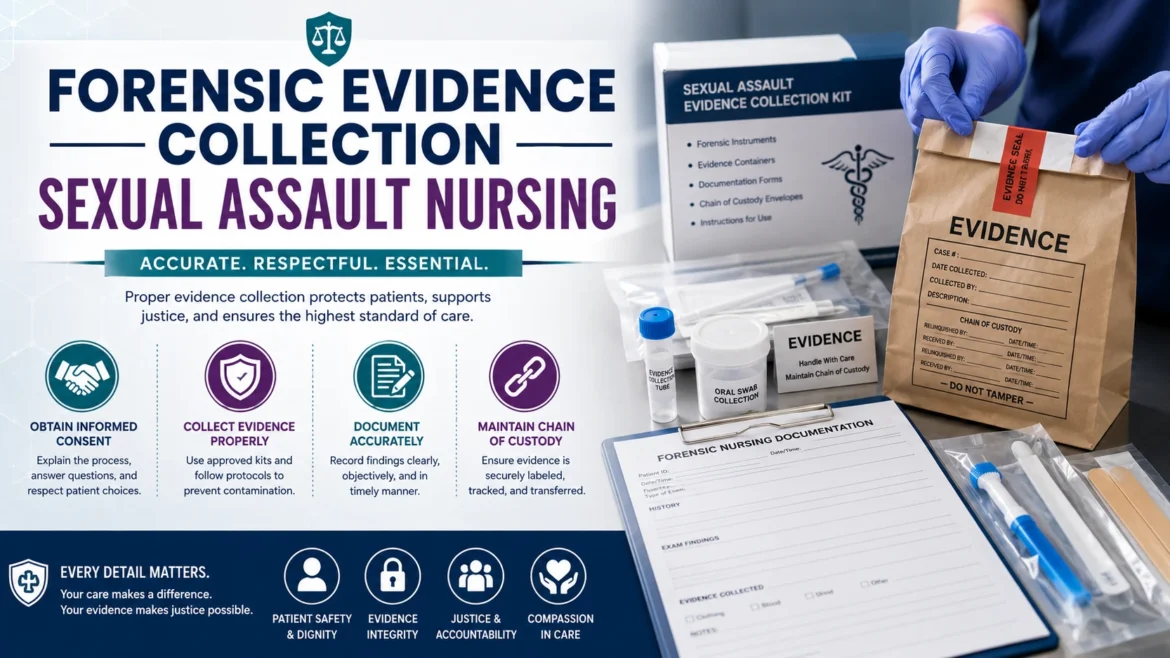

Forensic evidence collection is an important component of sexual assault nursing, but it is only one part of a broader medical forensic examination. The nurse must balance evidence-related responsibilities with the patient’s immediate medical needs, safety, privacy, dignity, and right to participate in decisions about care.
Forensic evidence may provide information that becomes relevant to an investigation, but the collection process should never be separated from patient-centered nursing care. A Sexual Assault Nurse Examiner (SANE) must understand both the clinical and forensic responsibilities involved in caring for a patient after sexual assault.
Effective evidence collection requires careful preparation, appropriate consent, accurate documentation, proper handling, and adherence to applicable procedures. It also requires the nurse to understand why each step matters rather than simply memorizing a collection sequence.
What Is Forensic Evidence Collection?
Forensic evidence collection is the systematic process of identifying, collecting, preserving, documenting, and transferring materials that may have forensic significance following an incident such as sexual assault.
Evidence can potentially include biological material, trace material, clothing, photographs, or other relevant findings depending on the circumstances of the case and the applicable forensic protocol.
The exact evidence collected will vary according to the patient’s history, examination findings, timing, jurisdiction, available evidence collection procedures, and other circumstances.
The purpose of the nurse is not to assume what evidence must exist. Instead, the nurse follows an appropriate assessment and forensic process to determine what may be relevant.
The Role of the SANE Nurse
A SANE nurse combines nursing knowledge with specialized forensic skills when caring for patients who have experienced sexual assault. The nurse’s responsibilities can extend across assessment, treatment, documentation, evidence collection, patient education, and coordination of appropriate follow-up.
Depending on the setting and applicable requirements, the SANE nurse may:
- Assess the patient’s immediate medical needs.
- Evaluate safety concerns.
- Obtain relevant health and assault histories.
- Explain the medical forensic examination.
- Address appropriate consent requirements.
- Perform or assist with the physical examination.
- Collect relevant forensic evidence according to established procedures.
- Document clinical and forensic findings.
- Maintain evidence integrity.
- Provide appropriate patient education and referrals.
The nurse should always work within professional scope, organizational procedures, applicable laws, and current forensic guidance.
Medical Care Comes First
One of the most important concepts in sexual assault nursing is that forensic evidence collection does not replace medical care. A patient may arrive with injuries or symptoms that require immediate attention.
Before focusing on evidence collection, the nurse should consider whether the patient has an urgent or emergent medical concern.
Potential concerns may include:
- Significant bleeding.
- Serious physical injuries.
- Difficulty breathing.
- Altered mental status.
- Suspected strangulation-related complications.
- Possible drug- or alcohol-facilitated assault.
- Severe pain.
- Other findings requiring immediate evaluation.
The appropriate response depends on the patient’s condition and the clinical setting. When an urgent medical problem is present, the nurse should follow the appropriate emergency or clinical response rather than allowing forensic activities to delay necessary care.
Understanding the Difference Between Medical and Forensic Care
Medical care focuses on the patient’s health, treatment needs, recovery, and safety. Forensic care addresses the collection and documentation of information that may have significance beyond the immediate clinical encounter.
These responsibilities can occur during the same examination, but they should not be confused.
| Medical Focus | Forensic Focus |
|---|---|
| Assessing injuries and symptoms | Identifying potentially relevant evidence |
| Treating immediate health concerns | Collecting and preserving evidence appropriately |
| Preventive and follow-up care | Documenting relevant forensic findings |
| Patient education | Maintaining evidence integrity |
| Supporting physical and emotional recovery | Following applicable evidence-handling procedures |
A strong SANE nurse understands how these responsibilities interact without allowing one to unnecessarily compromise the other.
Consent and Forensic Evidence Collection
Consent is a fundamental consideration during a medical forensic examination. Patients should receive appropriate information about the examination and relevant procedures and should be involved in decisions about their care according to applicable clinical and legal requirements.
Consent should not be treated as a single step that occurs only at the beginning of the examination. The nurse should continue communicating with the patient as different components of care are introduced.
Before a procedure, the nurse should explain what will happen and why it is being considered. This can help the patient understand the process and make informed decisions within the applicable framework.
Important concepts to review include:
- Patient autonomy.
- Informed decision-making.
- Explanation of procedures.
- Privacy and dignity.
- Patient questions and concerns.
- Documentation of relevant consent processes.
- Applicable jurisdictional and organizational requirements.
Respecting Patient Autonomy
A patient may have experienced a significant loss of control during an assault. The healthcare environment should therefore avoid unnecessarily removing additional control from the patient.
When clinically and legally appropriate, nurses can support autonomy by explaining procedures, answering questions, providing reasonable choices, and respecting appropriate decisions about aspects of care.
This does not mean that a nurse ignores urgent medical needs or professional responsibilities. Patient autonomy must be considered alongside safety, applicable laws, clinical requirements, and professional standards.
Preparing the Patient for Evidence Collection
Patients may not know what to expect from a medical forensic examination. Explaining the process before beginning can reduce uncertainty and help establish a more trusting relationship.
Preparation may involve explaining:
- The purpose of the medical forensic examination.
- What types of assessment may occur.
- How evidence may be collected.
- Why certain information is being requested.
- What documentation may be completed.
- What questions the patient may ask.
- What follow-up care may be available.
Use clear language rather than relying on technical terminology that the patient may not understand.
Trauma-Informed Evidence Collection
Evidence collection can involve sensitive questions, physical examinations, photographs, and other procedures that may be difficult for a patient who has experienced sexual assault.
A trauma-informed approach does not mean avoiding necessary forensic procedures. Instead, it means carrying them out with respect for the patient’s dignity, autonomy, privacy, and emotional needs.
The nurse can support a trauma-informed process by:
- Explaining procedures before they occur.
- Using calm and respectful communication.
- Avoiding judgmental language.
- Protecting privacy.
- Respecting appropriate patient choices.
- Recognizing signs of distress.
- Allowing reasonable opportunities for questions.
- Following established forensic procedures.
Patients may respond to trauma in very different ways. A patient may be visibly distressed, quiet, angry, confused, emotionally detached, or appear calm. The nurse should not assume that a particular emotional response indicates whether an assault occurred or how seriously the patient was affected.
Preventing Evidence Contamination
Evidence must be handled carefully because contamination, loss, or improper handling can affect its integrity. The nurse should follow the evidence collection procedures established by the relevant jurisdiction, healthcare organization, and forensic protocol.
General evidence-preservation principles may include:
- Using appropriate collection materials.
- Following established collection procedures.
- Preventing unnecessary contact with evidence.
- Keeping collected materials appropriately separated.
- Using correct packaging procedures.
- Labeling materials accurately.
- Maintaining appropriate documentation.
- Following secure storage and transfer procedures.
Specific collection and packaging requirements can vary depending on the evidence type and applicable protocol. Nurses should therefore avoid relying on generalized instructions when current jurisdiction-specific guidance is available.
Why Evidence Integrity Matters
Evidence integrity refers to maintaining the condition and reliability of collected material from the time it is obtained through subsequent handling and transfer.
If evidence is contaminated, improperly packaged, incorrectly labeled, or inadequately documented, its usefulness may be affected.
This is why evidence collection should be treated as a systematic process rather than a series of unrelated tasks.
Types of Evidence That May Be Relevant
The type of evidence available after sexual assault varies from case to case. The nurse should not assume that every patient will have the same evidence or that every collection method will be appropriate.
Depending on the circumstances and applicable protocols, evidence may involve:
- Biological material.
- Clothing.
- Trace evidence.
- Photographic documentation.
- Swabs or other collected specimens.
- Relevant physical findings.
- Other materials identified through the examination process.
The patient’s history and examination findings help guide the collection process according to the appropriate forensic protocol.
Evidence Collection Should Be Individualized
Forensic evidence collection should not be approached as a one-size-fits-all procedure. The nurse considers the patient’s history, examination findings, timing, circumstances, and applicable collection protocol.
For example, the relevance of a particular collection site may depend on information obtained during the history and examination. The nurse should follow the applicable protocol rather than collecting evidence indiscriminately.
Maintaining Patient Dignity During Evidence Collection
Evidence collection can be physically and emotionally demanding. The nurse should continue to protect the patient’s dignity throughout the process.
Practical considerations may include:
- Maintaining appropriate draping.
- Limiting unnecessary exposure.
- Explaining physical contact before it occurs.
- Keeping unnecessary people out of the examination area.
- Using professional and respectful language.
- Providing appropriate opportunities for questions.
These actions do not replace the technical requirements of forensic evidence collection. They complement them by keeping patient-centered care at the center of the examination.
Documentation Begins With Accuracy
Accurate documentation is essential in sexual assault nursing. The nurse should clearly distinguish between what the patient reports, what the nurse observes, what is measured, and what procedures are performed.
When documenting patient statements, follow the documentation standards of the clinical setting and preserve the meaning of what the patient communicated.
Avoid adding assumptions about the patient’s motives, credibility, emotional state, or behavior unless such information is clinically appropriate and objectively supported.
What Makes Forensic Documentation Different?
Clinical documentation already requires accuracy and objectivity, but forensic nursing may involve additional information related to evidence, photographs, injuries, collection procedures, and other aspects of the medical forensic examination.
The record should accurately reflect what occurred during the encounter and should follow applicable organizational and professional standards.
When preparing for SANE-A certification, candidates should practice distinguishing objective documentation from interpretation and should understand why accurate forensic records matter.
Key Points to Remember
- Patient safety and immediate medical needs remain priorities.
- Forensic evidence collection should follow current applicable procedures.
- Consent and patient autonomy are important throughout the examination.
- Trauma-informed communication can support patient dignity and participation.
- Evidence should be protected from contamination and improper handling.
- Documentation should be accurate, objective, and relevant.
- Evidence collection should be individualized according to the patient’s circumstances and applicable protocol.
Understanding Evidence Handling in Sexual Assault Nursing
Collecting forensic evidence is only one part of the forensic nursing process. Once potentially relevant material has been identified and collected, it must be handled carefully so that its integrity is maintained throughout the remainder of the process.
For SANE nurses, this means understanding the purpose of proper collection, packaging, labeling, documentation, storage, and transfer. The exact procedures can vary by jurisdiction, healthcare organization, evidence type, and approved collection protocol, so nurses should always follow current applicable requirements rather than relying on a generic procedure.
Why Proper Evidence Handling Matters
Forensic evidence can lose value when it is contaminated, damaged, misplaced, incorrectly packaged, or inadequately documented. A careful evidence-handling process helps preserve the condition of collected materials and creates a reliable record of what happened to them.
Think of evidence handling as a continuous process rather than a single task. The nurse needs to consider what happens to evidence from the moment it is collected until it is appropriately transferred or stored.
Important considerations include:
- Correct identification of collected materials.
- Appropriate packaging.
- Accurate labeling.
- Protection from contamination.
- Secure storage.
- Documentation of relevant transfers.
- Following established chain-of-custody procedures.
What Is Chain of Custody?
Chain of custody refers to the documented history of the handling and transfer of evidence. It helps establish who had responsibility for evidence, when it was transferred, and how it was maintained throughout the process.
The purpose is to create a clear record that allows authorized parties to understand the movement and handling of the evidence.
When studying chain of custody, remember that it is not simply a signature on a form. It is part of a broader system for maintaining accountability and evidence integrity.
Important Elements of Chain of Custody
The exact documentation process depends on the applicable jurisdiction and facility protocol, but candidates should understand the general principles involved.
- Identify the evidence appropriately.
- Document relevant collection information.
- Record transfers according to established procedures.
- Maintain secure control of evidence.
- Use appropriate storage procedures.
- Prevent unauthorized access.
- Ensure documentation corresponds with the physical evidence.
In an examination question, an option that ignores required evidence-handling procedures should be viewed carefully.
Packaging Forensic Evidence
Packaging is an important part of evidence preservation. The correct packaging method depends on the type of evidence and the applicable forensic protocol.
One of the most important principles is to avoid using an inappropriate container simply because it is convenient. Evidence should be packaged according to the approved procedure for that specific material.
When studying packaging, focus on the reason behind the procedure:
- Protect the evidence.
- Reduce contamination.
- Prevent loss of material.
- Maintain appropriate condition.
- Support accurate identification.
- Follow the established forensic protocol.
Because evidence-handling requirements can vary, candidates should use current official or organizational guidance for exact procedures.
Labeling Evidence Correctly
Accurate labeling helps identify evidence and connect it to the appropriate patient and examination. Labels should be completed according to the applicable evidence collection system and facility requirements.
Errors in identification can create serious problems because the evidence must remain clearly associated with the correct case throughout its handling.
When reviewing evidence-labeling questions, consider whether the proposed action maintains identification, traceability, and evidence integrity.
Preventing Cross-Contamination
Cross-contamination can occur when material from one source is unintentionally transferred to another item or location. Forensic collection procedures are designed to minimize this risk.
General contamination-prevention principles may include:
- Following approved collection procedures.
- Using appropriate personal protective equipment.
- Using suitable collection materials.
- Keeping collected materials appropriately separated.
- Handling evidence carefully.
- Following appropriate packaging requirements.
- Maintaining a clean and controlled examination environment.
Do not assume that one contamination-prevention method applies to every evidence type. Follow the specific protocol associated with the evidence being collected.
Evidence Collection and Patient History
The patient’s history can help guide the forensic examination. Information about what happened, when it occurred, and relevant activities following the assault may affect which evidence collection procedures are considered appropriate.
The nurse should obtain relevant information using appropriate interviewing techniques and should avoid unnecessary or judgmental questioning.
When reviewing a scenario, consider how the patient’s history relates to:
- Potential evidence locations.
- Timing of collection.
- Physical findings.
- Clothing or other materials.
- Potential exposure considerations.
- Additional medical needs.
The nurse should follow the current forensic protocol rather than making assumptions about evidence based solely on a generalized list.
Forensic Photography
Photography may be used as part of the medical forensic examination when appropriate and according to applicable protocols. Photographs can provide visual documentation of relevant findings that may be difficult to describe completely through written documentation alone.
When studying forensic photography, focus on the principles of accurate documentation, appropriate identification, patient consent requirements, privacy, and proper handling of images.
The nurse should understand that photographic documentation is part of the overall forensic record and should be handled according to the applicable policies and procedures.
Photographing Injuries
When injuries are present, photographs may help document their appearance. The exact photographic process should follow the approved protocol used by the organization or jurisdiction.
Important concepts include:
- Accurate identification.
- Appropriate positioning.
- Clear documentation.
- Protection of patient privacy.
- Following applicable consent procedures.
- Secure storage and handling of images.
Photography should complement, not replace, written documentation and physical assessment.
Documenting Physical Findings
Written documentation should accurately describe relevant findings. Avoid vague language when a more objective description is possible.
For example, instead of documenting only that an area “looked abnormal,” appropriate documentation should follow the clinical and forensic documentation standards used by the organization and describe relevant observable characteristics.
Documentation may include details such as location, appearance, measurements when appropriate, patient-reported symptoms, and other relevant findings.
Patient Statements and Objective Documentation
When a patient describes an event or symptom, the nurse should distinguish the patient’s statement from the nurse’s own observations.
This distinction is particularly important in forensic nursing because the medical record may contain information that could later be reviewed by professionals outside the immediate healthcare team.
When documenting patient statements:
- Record relevant information accurately.
- Avoid changing the meaning of the patient’s statement.
- Follow applicable documentation standards.
- Distinguish patient reports from clinical observations.
- Avoid unsupported conclusions.
Evidence and Clothing
Clothing may have forensic significance depending on the circumstances of the assault. The nurse should follow the applicable evidence collection protocol when clothing is relevant.
Patients should be treated respectfully throughout this process. Explain what is happening and provide appropriate privacy while clothing is being handled or changed.
Exact collection and packaging procedures should always be based on current approved protocols rather than generalized instructions.
Biological and Trace Evidence
Biological and trace evidence can potentially provide information relevant to a forensic investigation. The type and location of potential evidence depend on the circumstances of the assault and findings from the history and examination.
The nurse should understand the general purpose of biological and trace evidence without assuming that every patient will have the same findings.
Scenario-based questions may test whether you can connect the patient’s history and examination findings with appropriate evidence-collection considerations.
Medical Treatment and Evidence Preservation
Medical treatment may sometimes be necessary before evidence collection can be completed. The nurse should not allow forensic concerns to override urgent patient-care needs.
For example, if a patient has a serious injury requiring immediate intervention, the clinical priority is to address the patient’s health and safety according to the appropriate emergency response.
Evidence preservation remains important, but it should be considered within the context of the patient’s overall care.
Evidence Collection When the Patient Is Distressed
A patient may become distressed during evidence collection or another part of the examination. The nurse should recognize the patient’s response and communicate appropriately.
Depending on the circumstances, the nurse may need to:
- Explain the procedure again.
- Answer questions.
- Assess immediate safety or medical concerns.
- Provide appropriate reassurance.
- Consider whether a pause is clinically appropriate.
- Follow applicable consent and examination procedures.
Trauma-informed care does not mean abandoning the examination automatically. It means responding thoughtfully to the patient’s needs while following appropriate clinical and forensic requirements.
What Happens When a Patient Declines Part of the Examination?
Patients may have questions or may decline certain aspects of an examination. The nurse should understand the applicable consent process and follow the policies and legal requirements governing the situation.
A trauma-informed approach involves explaining available information appropriately, respecting patient autonomy within the applicable framework, and documenting relevant decisions according to professional standards.
The nurse should never assume that because a patient agreed to one part of an examination, the patient has automatically agreed to every other component.
Maintaining Evidence Security
After evidence is collected and appropriately packaged, it must remain secure until it is transferred or processed according to the established procedure.
Security considerations help prevent:
- Unauthorized access.
- Loss of evidence.
- Accidental damage.
- Improper handling.
- Unrecorded transfers.
The nurse should understand the facility’s established process for securing and transferring evidence.
Common Evidence-Handling Mistakes
Using the Wrong Packaging
Evidence should be packaged according to the applicable protocol. Choosing packaging simply because it is convenient can compromise evidence integrity.
Failing to Label Evidence
Evidence must remain identifiable and traceable. Missing or inaccurate identification can create significant problems.
Breaking the Chain of Custody
Unrecorded or inappropriate transfers can create questions about evidence handling. Follow the established chain-of-custody process carefully.
Mixing Evidence Improperly
Collected materials should be handled according to the applicable procedure to minimize contamination or loss.
Ignoring Documentation
Evidence handling and documentation are closely connected. The physical evidence and its documentation should correspond appropriately.
Allowing Forensic Concerns to Delay Emergency Care
Patient safety remains a priority. Urgent medical conditions should receive appropriate attention even when forensic evidence is also being considered.
How Evidence Collection Can Appear in SANE-A Questions
SANE-A examination questions may present situations in which several actions appear reasonable. The strongest answer usually depends on understanding the patient’s circumstances, the purpose of the procedure, safety, consent, evidence integrity, and professional responsibilities.
When working through a forensic evidence question, ask:
- What happened in the scenario?
- What evidence may be relevant?
- Is there an immediate medical or safety concern?
- What consent considerations apply?
- What procedure or protocol should guide the nurse?
- How should the evidence be protected?
- What documentation is required?
This reasoning approach is more reliable than trying to select an answer based on a single familiar keyword.
Use Scenario-Based Practice
Scenario-based practice can help you connect forensic concepts with clinical decision-making. After answering a question, explain your reasoning rather than simply checking whether your answer was correct.
For each question, consider:
- What cue did I identify?
- What priority did I assign?
- What evidence supported my decision?
- What safety issue did I consider?
- Did I account for consent?
- Why were the other choices less appropriate?
This method can help identify gaps in both knowledge and clinical reasoning.
Build a Forensic Evidence Review Checklist
Before the SANE-A examination, create a short checklist of the forensic evidence concepts you need to review.
- Purpose of forensic evidence collection.
- Patient consent and autonomy.
- Trauma-informed communication.
- Evidence identification.
- Collection principles.
- Packaging.
- Labeling.
- Evidence preservation.
- Chain of custody.
- Forensic photography.
- Objective documentation.
- Evidence security and transfer.
- Balancing medical needs with forensic responsibilities.
Use your current official certification resources and applicable forensic protocols to verify details rather than relying on an outdated checklist alone.
Key Takeaways
- Evidence collection is only one part of comprehensive sexual assault nursing care.
- Patient safety and urgent medical needs remain important priorities.
- Evidence should be collected and handled according to current applicable procedures.
- Chain of custody provides a documented record of evidence handling and transfer.
- Packaging and labeling help protect evidence integrity and traceability.
- Contamination prevention is an important part of evidence handling.
- Forensic photography should follow applicable protocols and privacy requirements.
- Documentation should distinguish patient statements from objective observations.
- Patient autonomy and appropriate consent remain important throughout the examination.
- Trauma-informed care should be integrated into forensic evidence collection.
- Scenario-based practice can help candidates apply forensic principles to SANE-A examination questions.
Applying Forensic Evidence Principles to Clinical Scenarios
Understanding forensic evidence collection is important, but SANE-A preparation also requires the ability to apply those principles to realistic patient situations. A scenario may include medical concerns, emotional responses, evidence considerations, consent questions, and documentation requirements at the same time.
The nurse must determine what deserves priority and how the different responsibilities fit together.
When working through a forensic nursing scenario, ask:
- What does the patient need immediately?
- Is there an urgent medical or safety concern?
- What information is relevant to the forensic examination?
- What consent considerations apply?
- What evidence may be relevant?
- How should the evidence be protected?
- What needs to be documented?
- What follow-up care may be appropriate?
Scenario: Immediate Medical Concern Before Evidence Collection
Imagine a patient arrives for a medical forensic examination but has symptoms suggesting a potentially serious injury.
The nurse should recognize that immediate medical assessment and treatment may take priority over routine forensic activities. Evidence collection remains important, but it should not unnecessarily delay care for an urgent medical condition.
This type of scenario tests whether the nurse can balance forensic responsibilities with basic nursing priorities.
Scenario: The Patient Is Unsure About the Examination
A patient may be uncertain about whether to proceed with some or all aspects of the examination.
The nurse should provide appropriate information, explain relevant procedures, answer questions, and follow the applicable consent process. The nurse should not assume that agreement to one component automatically means agreement to every component.
The appropriate response depends on the patient’s circumstances, clinical needs, applicable requirements, and organizational procedures.
Scenario: The Patient Becomes Distressed
A patient may become increasingly distressed during an examination or while discussing the assault.
The nurse should recognize the change and respond appropriately rather than continuing automatically without considering the patient’s condition.
Depending on the circumstances, the nurse may need to explain the procedure again, assess the patient’s immediate needs, address questions, consider whether a pause is appropriate, or involve additional support according to established procedures.
The key principle is to maintain patient-centered care while continuing to follow appropriate clinical and forensic requirements.
Scenario: Evidence Is Collected but Not Properly Documented
Imagine that evidence has been collected but an important part of the documentation process has been overlooked.
The nurse should recognize that evidence handling and documentation are connected. The appropriate response should follow the applicable facility and forensic protocol rather than attempting to create an undocumented workaround.
This scenario illustrates why every stage of evidence handling needs careful attention.
Scenario: An Evidence Transfer Is Not Documented
Suppose evidence has been transferred to another authorized person, but the required transfer documentation was not completed.
This raises a chain-of-custody concern. The nurse should follow the established procedure for addressing the issue rather than ignoring it.
For examination questions, remember the underlying principle: evidence handling should remain traceable and appropriately documented.
Scenario: Multiple Evidence Sources Are Present
A patient may have several items or areas that could potentially contain relevant evidence. The nurse should not assume that every item needs to be handled identically.
Evidence collection should be guided by the patient’s history, examination findings, applicable protocol, and the circumstances of the case.
The nurse should also consider contamination prevention and appropriate separation of collected materials.
Scenario: The Patient Has Questions About Evidence
Patients may ask what will happen to collected evidence or who will receive it.
The nurse should provide accurate information within the scope of the role and follow applicable procedures. If a question involves legal processes outside the nurse’s role, the patient should be directed to an appropriate resource or professional.
Avoid making promises about legal outcomes or investigative decisions that are outside the nurse’s control.
Scenario: The Patient Appears Calm
A patient may appear calm while discussing a traumatic event. This should not be interpreted as evidence that the event was insignificant or that the patient is unaffected.
Trauma responses vary. The nurse should focus on objective assessment, patient statements, safety, clinical needs, and appropriate forensic procedures rather than judging the patient’s emotional presentation.
Scenario: The Patient Is Concerned About Privacy
A patient may be uncomfortable with the number of people present during an examination or may have concerns about who can access sensitive information.
The nurse should address privacy concerns appropriately and follow applicable confidentiality and organizational requirements.
Protecting privacy is part of both professional nursing practice and trauma-informed care.
Common SANE-A Evidence Collection Mistakes
Putting Evidence Before Patient Safety
Forensic evidence is important, but urgent medical needs should not be ignored. The nurse must recognize when immediate clinical intervention is necessary.
Assuming Every Patient Requires the Same Collection Process
The relevant evidence depends on the patient’s history, examination, timing, circumstances, and applicable protocol. Evidence collection should be individualized.
Ignoring Consent
Patients should receive appropriate information and participate in decisions about their care according to the applicable clinical and legal framework.
Failing to Explain What Is Happening
Patients may feel anxious or vulnerable during the examination. Clear explanations can support understanding and help maintain trust.
Using Judgmental Language
Communication and documentation should remain professional, respectful, and objective.
Neglecting Documentation
Accurate documentation supports continuity of care and helps maintain a reliable record of the medical forensic examination.
Breaking Evidence-Handling Procedures
Improper packaging, labeling, storage, or transfer can affect evidence integrity. Follow the applicable protocol carefully.
How to Study Forensic Evidence Collection for the SANE-A Exam
Start with the current examination content information and applicable professional resources. Then organize your study around concepts rather than isolated facts.
For each topic, ask three questions:
- What is the purpose?
- What is the nurse responsible for?
- What could go wrong if the process is not followed?
For example, when studying chain of custody, do not simply memorize the term. Understand that it creates a documented history of evidence handling and helps maintain accountability and traceability.
Use Practice Questions to Test Your Reasoning
Practice questions can help you determine whether you can apply forensic concepts to unfamiliar scenarios. They are especially useful when you review the reasoning behind each answer.
After answering a question, ask:
- What was the most important cue?
- Was there an immediate medical priority?
- What consent issue was present?
- What forensic principle applied?
- What evidence-handling concern existed?
- Why was the correct option better than the alternatives?
If you repeatedly miss questions in one area, return to that topic before completing another large set of unrelated questions.
Build a Targeted SANE-A Study Plan
A targeted study plan can help candidates use their preparation time efficiently. Instead of spending equal amounts of time on every subject, adjust your schedule according to your current knowledge and practice results.
A sample approach might look like this:
| Study Stage | Primary Focus |
|---|---|
| Initial review | Understand major SANE-A content areas. |
| Focused review | Strengthen weaker clinical and forensic topics. |
| Scenario practice | Apply concepts to patient situations. |
| Error review | Analyze incorrect and uncertain answers. |
| Final review | Consolidate key concepts and testing strategies. |
This structure helps prevent the common mistake of spending the entire preparation period simply reading study material without testing whether you can apply it.
Review the Difference Between Knowledge and Judgment
Knowing that chain of custody is important is knowledge. Recognizing that a missing transfer record represents a potential chain-of-custody problem in a clinical scenario requires application.
Similarly, knowing that consent matters is different from recognizing that a patient who agreed to one part of an examination has not necessarily agreed to every other component.
SANE-A candidates should practice both types of thinking.
Know When to Seek Guidance
Forensic nursing involves clinical, ethical, and legal considerations that can vary by jurisdiction and healthcare setting. Nurses should understand the limits of their own role and know when additional guidance is needed.
During preparation, avoid treating a general study article as a substitute for current organizational policies, jurisdiction-specific requirements, or official certification information.
When a question involves a specific legal requirement, always verify the current applicable rule through an authoritative source.
Final SANE-A Evidence Collection Checklist
Before completing your review of forensic evidence collection, make sure you understand the following concepts:
- Purpose of medical forensic evidence collection.
- Role of the SANE nurse.
- Patient safety and urgent medical needs.
- Consent and patient autonomy.
- Trauma-informed communication.
- Evidence identification.
- Collection principles.
- Contamination prevention.
- Packaging.
- Labeling.
- Evidence preservation.
- Chain of custody.
- Forensic photography.
- Objective documentation.
- Evidence security.
- Appropriate transfer procedures.
- Patient privacy and dignity.
Final Takeaways
Forensic evidence collection is a specialized responsibility within sexual assault nursing. Effective practice requires technical knowledge, clinical judgment, careful documentation, appropriate consent, and respect for the patient throughout the examination.
The strongest SANE-A preparation does not treat evidence collection as a memorization exercise. Instead, candidates should understand why evidence must be collected, protected, documented, and transferred according to established procedures.
Always remember the broader nursing context. A patient may arrive with urgent medical needs, emotional distress, safety concerns, or other issues that require attention before or alongside forensic activities.
Trauma-informed communication also remains important. Explain procedures, protect privacy, respect appropriate patient choices, and avoid making assumptions about how a survivor should respond.
Finally, use practice scenarios to develop clinical reasoning. When you can identify the priority, understand the forensic principle involved, recognize consent considerations, and determine the safest appropriate response, you are better prepared to handle unfamiliar SANE-A questions.
FAQs
What is forensic evidence collection in sexual assault nursing?
Forensic evidence collection is the process of identifying, collecting, preserving, documenting, and appropriately handling materials that may have forensic significance following sexual assault.
What is the role of a SANE nurse in evidence collection?
A SANE nurse may assess the patient, explain the medical forensic examination, obtain appropriate consent, collect relevant evidence according to established procedures, document findings, maintain evidence integrity, and provide appropriate patient care and follow-up.
Why is chain of custody important?
Chain of custody creates a documented history of evidence handling and transfer. It helps maintain accountability, traceability, and evidence integrity.
Can evidence collection delay emergency medical treatment?
Urgent medical and safety needs should receive appropriate attention. Forensic activities should not unnecessarily delay treatment for a potentially serious medical condition.
Does every sexual assault examination involve the same evidence?
No. Relevant evidence varies according to the patient’s history, examination findings, timing, circumstances, and applicable forensic collection protocol.
Why is documentation important in forensic nursing?
Accurate documentation creates a reliable record of relevant patient statements, assessment findings, procedures, evidence-related activities, and care provided during the medical forensic encounter.
How does trauma-informed care affect evidence collection?
Trauma-informed care encourages the nurse to explain procedures, respect appropriate patient choices, protect privacy and dignity, communicate without judgment, and recognize the patient’s emotional response while still following required forensic procedures.
How should SANE-A candidates study forensic evidence collection?
Study the current examination content and authoritative forensic resources, understand the principles behind evidence handling, and practice applying those principles to realistic patient scenarios.
Are practice questions useful for SANE-A preparation?
Practice questions can help candidates identify knowledge gaps and strengthen clinical reasoning. Reviewing why an answer is correct or incorrect is more valuable than simply tracking the score.
Conclusion
Forensic evidence collection requires careful attention to both technical procedures and patient-centered nursing care. SANE nurses must understand evidence integrity, documentation, chain of custody, consent, privacy, and appropriate handling while continuing to address the patient’s immediate medical and emotional needs.
For candidates preparing for SANE-A certification, the most effective approach is to understand the reasoning behind forensic procedures and practice applying that knowledge to realistic clinical situations.
When studying, remember the complete picture: assess the patient, prioritize safety, respect autonomy, follow appropriate forensic procedures, protect evidence integrity, document accurately, and evaluate the patient’s needs throughout the encounter.
That combination of forensic knowledge, clinical judgment, and compassionate patient care provides a strong foundation for both professional practice and SANE-A certification preparation.