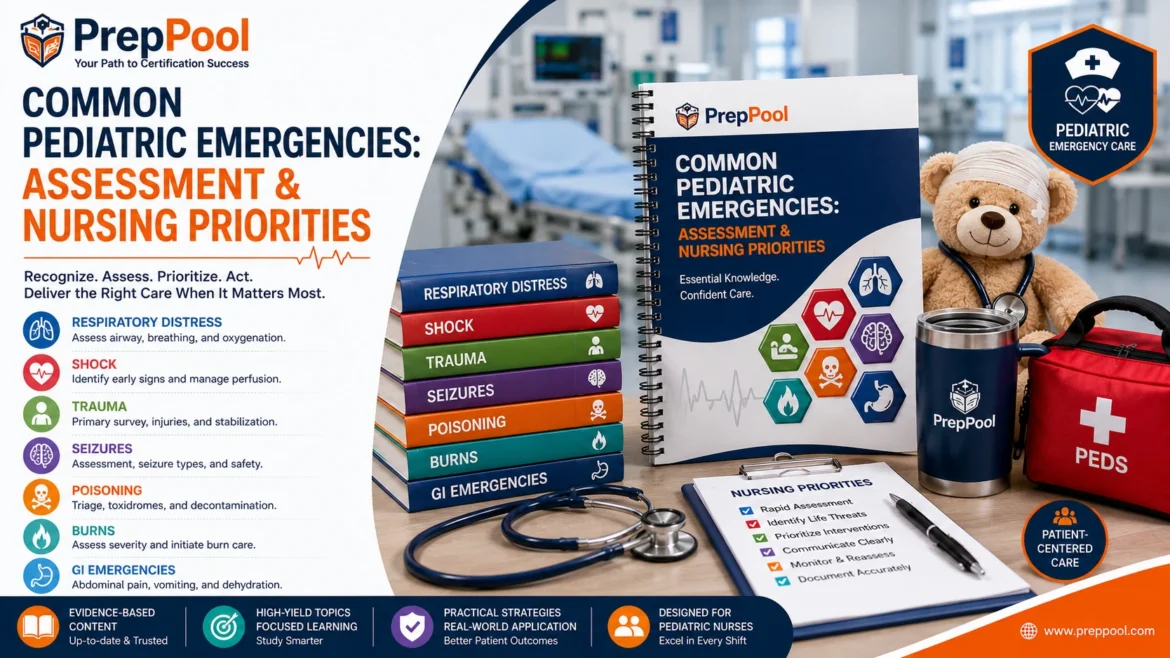

This guide reviews common pediatric emergencies from a practical nursing perspective, including respiratory problems, shock, neurological emergencies, trauma, gastrointestinal conditions, poisoning, burns, foreign-body emergencies, and other situations that may require rapid assessment and intervention.
Important: Specific interventions should always follow current clinical guidelines, institutional protocols, scope of practice, and the child’s individual condition. This article is an educational resource, not a substitute for clinical training or facility policy.
Why Pediatric Emergencies Require Rapid Recognition
Children can compensate for serious illness before their condition becomes obviously unstable. This means that the nurse may need to recognize subtle changes before a dramatic deterioration occurs.
Important clues may include:
- Changes in behavior or interaction.
- Increasing work of breathing.
- Abnormal skin color or perfusion.
- Changes in level of consciousness.
- Increasing fatigue.
- Changes in vital-sign trends.
- Reduced urine output.
- Sudden changes from the child’s baseline.
The significance of any individual finding depends on the child’s age, history, condition, and overall clinical presentation.
The First Question: What Is the Immediate Threat?
Emergency nursing requires prioritization. A child may have several problems at the same time, but not every problem has the same level of urgency.
Before focusing on a diagnosis, consider whether there is an immediate threat involving:
- Airway.
- Breathing.
- Circulation.
- Neurological status.
- Severe bleeding.
- Rapid deterioration.
This approach helps prevent the nurse from becoming distracted by a less urgent complaint while a life-threatening problem develops.
Respiratory Emergencies
Respiratory emergencies are among the most important situations to recognize in pediatric emergency care.
Children with respiratory problems may initially compensate by increasing their respiratory effort. If the underlying problem continues, the child may become fatigued and eventually lose the ability to maintain effective breathing.
Assessment should therefore focus on the entire respiratory picture.
Recognizing Pediatric Respiratory Distress
Potential signs of respiratory distress can include:
- Increased respiratory effort.
- Retractions.
- Nasal flaring.
- Abnormal breath sounds.
- Changes in respiratory rate.
- Abnormal positioning.
- Difficulty speaking or crying appropriately for age.
- Changes in oxygenation.
- Increasing anxiety or agitation.
One finding alone does not necessarily establish the severity of the emergency. The nurse should consider the combination of findings and whether the child is improving or deteriorating.
Respiratory Distress Versus Respiratory Failure
A key clinical distinction is recognizing when a child is compensating versus when compensation is beginning to fail.
| Respiratory Distress | Potential Signs of Worsening Respiratory Status |
|---|---|
| Increased respiratory effort | Increasing fatigue |
| Tachypnea | Declining responsiveness |
| Retractions | Worsening oxygenation |
| Anxiety or agitation | Altered mental status |
The transition toward respiratory failure is not identified by one universal finding. The nurse should look at the child’s overall condition and the direction in which it is changing.
Upper-Airway Emergencies
Upper-airway problems can become serious quickly because airway obstruction can interfere with effective ventilation.
Assessment should include observation of respiratory effort, airway sounds, positioning, ability to vocalize appropriately, oxygenation, and level of consciousness.
When a child has signs of significant airway compromise, airway management takes priority over less urgent history-taking or routine care.
Lower-Airway Emergencies
Lower-airway problems can involve conditions that cause bronchospasm, inflammation, infection, or impaired gas exchange.
The nurse should assess:
- Work of breathing.
- Breath sounds.
- Respiratory rate.
- Oxygenation.
- Ability to communicate.
- Fatigue.
- Response to prescribed treatment.
A child who is becoming increasingly tired or less responsive requires more urgent evaluation than a child whose symptoms remain mild and stable.
Scenario: A Child With Increasing Work of Breathing
Situation: A child presents with wheezing and increased respiratory effort. Initially the child is alert and talking. Later, the child becomes quieter and increasingly fatigued.
What changed?
The child’s clinical status has changed from active compensation toward possible deterioration.
Priority: Reassess the child’s respiratory and overall status immediately and follow the appropriate emergency response protocol.
Clinical lesson: A decrease in activity or responsiveness in a child with respiratory distress can be more concerning than the initial symptoms.
Shock and Circulatory Emergencies
Shock occurs when tissue perfusion is inadequate to meet the body’s needs. Pediatric patients may compensate for circulatory compromise, making early recognition particularly important.
Assessment should consider:
- Heart rate.
- Blood pressure and trends.
- Capillary refill.
- Skin appearance.
- Skin temperature.
- Mental status.
- Urine output.
- Peripheral perfusion.
Do not rely on blood pressure alone. A child may have significant circulatory compromise before obvious hypotension develops.
Recognizing Poor Perfusion
Potential signs of poor perfusion may include changes in mental status, abnormal skin findings, prolonged capillary refill, reduced urine output, and other evidence of inadequate circulation.
Again, the overall pattern matters.
Clinical question: Does the child’s circulation appear adequate for the current situation, and is perfusion improving or worsening?
Types of Shock: Understand the Cause
Different forms of shock have different underlying causes, but they can all result in inadequate tissue perfusion.
For pediatric emergency nursing, it is useful to understand broad categories such as:
- Hypovolemic shock.
- Distributive shock.
- Cardiogenic shock.
- Obstructive shock.
Study each category by connecting the underlying mechanism with the patient’s assessment findings rather than memorizing terminology alone.
Hypovolemic Shock
Hypovolemic shock involves inadequate circulating volume. In pediatric patients, fluid losses may occur through vomiting, diarrhea, bleeding, burns, or other causes.
Assessment should focus on the child’s overall perfusion and the history that may explain volume loss.
Ask:
- Has the child experienced significant fluid loss?
- Is urine output changing?
- Are there signs of poor perfusion?
- Has the child’s mental status changed?
- Is there evidence of bleeding?
Distributive Shock
Distributive shock can occur when abnormal vascular tone and distribution of blood flow contribute to inadequate effective tissue perfusion.
Clinical examples can include septic and anaphylactic processes, although the presentation and management depend on the underlying cause.
The nurse should recognize the signs of deterioration and follow the appropriate emergency protocol.
Sepsis and Serious Infection
Children with serious infections can develop systemic deterioration. The nurse should remain alert for changes in mental status, perfusion, respiratory status, temperature, heart rate, and overall appearance.
Early recognition depends on considering the entire clinical picture rather than waiting for one specific sign.
A child who appears increasingly ill should receive prompt reassessment and escalation according to the clinical setting.
Anaphylaxis
Anaphylaxis is a potentially life-threatening emergency involving a systemic hypersensitivity reaction.
Assessment should focus on signs involving:
- Airway.
- Breathing.
- Circulation.
- Skin and mucosal findings.
- Gastrointestinal symptoms when present.
- Rapid progression of symptoms.
Airway or respiratory compromise and circulatory instability require immediate attention according to emergency protocols.
Neurological Emergencies
Neurological emergencies may present with changes in consciousness, seizures, abnormal movement, weakness, severe headache, altered behavior, or other neurological findings.
The nurse should establish the child’s baseline whenever possible and identify meaningful changes.
Important assessment areas include:
- Level of consciousness.
- Pupil response.
- Motor function.
- Speech or communication.
- Behavior.
- Seizure activity.
- Headache or pain.
- Changes after trauma.
Seizures in Children
During an active seizure, immediate safety and appropriate emergency assessment take priority.
After the seizure, the nurse should continue monitoring the child’s airway, breathing, circulation, neurological status, and recovery.
Important questions include:
- What happened before the seizure?
- How long did the event last?
- Was there a known seizure history?
- Was there recent illness or fever?
- Was there trauma?
- What is the child’s neurological status afterward?
For recurring or prolonged seizure activity, nurses should follow current emergency protocols and facility-specific guidance.
Head Injury
Head trauma requires careful assessment because neurological deterioration may not be immediately obvious.
Monitor for changes in:
- Level of consciousness.
- Behavior.
- Pupils.
- Motor function.
- Speech.
- Vomiting.
- Headache.
- Seizure activity.
Trends are especially important. A child whose neurological status changes after the initial assessment needs prompt reassessment.
Clinical Takeaway
Common pediatric emergencies require nurses to recognize the difference between a symptom and a deteriorating clinical condition. Respiratory distress, poor perfusion, altered mental status, seizures, infection, and allergic reactions can all become urgent when the child’s condition changes.
The safest approach is to begin with immediate threats, assess the whole child, identify meaningful changes from baseline, intervene according to current clinical guidance, and reassess the response.
For nurses preparing for pediatric emergency certification, this clinical approach is also useful when working through pediatric emergency nursing practice questions, because scenario-based questions often require you to identify the most important finding and determine the appropriate priority rather than simply recall a disease definition.
Pediatric Trauma: Think Beyond the Visible Injury
Trauma is one of the situations in which prioritization becomes especially important. A child may arrive with an obvious fracture, laceration, or deformity while also having an airway, breathing, circulatory, or neurological problem that is not immediately visible.
The nurse should therefore begin with a structured primary assessment before becoming focused on secondary injuries.
Important questions include:
- Is the airway patent?
- Is breathing adequate?
- Is circulation adequate?
- Is there major bleeding?
- Is the neurological status appropriate?
- Are there signs of additional injuries?
The visible injury may not be the most urgent problem.
Blunt Trauma
Blunt trauma can result from motor vehicle collisions, falls, sports injuries, or other mechanisms.
The nurse should consider the mechanism of injury because it can provide clues about possible injuries that are not immediately obvious.
Assessment should include:
- Airway and breathing.
- Circulation and bleeding.
- Neurological status.
- Chest and abdominal findings.
- Extremity injuries.
- Pain.
- Changes from baseline.
A seemingly minor external injury does not necessarily mean that internal injury is absent.
Penetrating Trauma
Penetrating injuries require careful assessment because the external wound may not reveal the full extent of internal damage.
The nurse should focus first on immediate threats and follow established trauma protocols.
Bleeding, airway compromise, respiratory abnormalities, and circulatory instability should receive appropriate priority.
Hemorrhage and Blood Loss
Children with significant bleeding can deteriorate quickly. The nurse should assess the amount and source of bleeding while simultaneously evaluating perfusion and overall clinical status.
Look for:
- Visible bleeding.
- Changes in mental status.
- Abnormal skin appearance.
- Changes in heart rate.
- Signs of poor perfusion.
- Weakness or increasing lethargy.
Do not wait for obvious hypotension before taking other concerning findings seriously.
Burn Emergencies
Burn injuries require assessment of more than the affected skin. Depending on the mechanism and extent of injury, the child may also have airway, respiratory, fluid, pain, temperature-regulation, or other concerns.
Important assessment questions include:
- What caused the burn?
- When did it occur?
- What areas of the body are affected?
- Is the face or airway potentially involved?
- Are there signs of inhalation injury?
- Is the child showing signs of circulatory compromise?
- What is the child’s pain level?
The mechanism can be especially important. A thermal injury, chemical exposure, electrical injury, and inhalation injury may create different clinical concerns.
Inhalation Injury
Smoke or other inhaled substances can create serious respiratory concerns even when external burns appear limited.
Monitor for respiratory changes and signs of airway involvement.
Potentially concerning findings can include:
- Respiratory difficulty.
- Voice changes.
- Abnormal respiratory sounds.
- Facial burns.
- Altered mental status.
- Progressive respiratory symptoms.
Any suspected airway or respiratory compromise requires prompt evaluation according to emergency protocols.
Poisoning and Toxic Exposures
Pediatric poisoning can occur through accidental ingestion, medication exposure, household chemicals, environmental substances, or other routes.
The first assessment should establish what happened and determine the child’s current condition.
Important information may include:
- What substance was involved?
- How much may have been involved?
- When did the exposure occur?
- Was the substance swallowed, inhaled, injected, or absorbed?
- Does the child have symptoms?
- Is the child alert and breathing normally?
Whenever possible, obtain the original container or reliable information about the substance and follow the appropriate poison-management and emergency procedures.
Do Not Assume an Asymptomatic Child Is Safe
Some toxic exposures may initially produce few obvious symptoms.
This means that a child who appears well immediately after an exposure may still require professional evaluation depending on the substance, amount, timing, and clinical circumstances.
Emergency nursing assessment should therefore consider both the current presentation and the potential for delayed deterioration.
Foreign-Body Ingestion
Children may ingest objects because of developmental behavior and curiosity. The clinical significance depends heavily on what was swallowed and where it is located.
Assessment should establish:
- What object was swallowed.
- When the ingestion occurred.
- Whether the child has symptoms.
- Whether the airway is affected.
- Whether swallowing is impaired.
- Whether there is pain, vomiting, coughing, or respiratory difficulty.
Some objects, including button batteries and multiple magnets, can create particularly serious risks and require urgent medical evaluation.
Foreign-Body Aspiration
Foreign-body aspiration can create an airway emergency.
A child may present with sudden coughing, choking, abnormal breathing, wheezing, or other respiratory changes.
The nurse should assess the severity of airway compromise and follow established emergency airway procedures.
Clinical reasoning: A sudden respiratory change after a possible choking event should always be taken seriously.
Gastrointestinal Emergencies
Abdominal and gastrointestinal complaints are common in pediatric emergency settings, but the severity can range from minor illness to a surgical emergency.
Assessment should include the child’s overall appearance and not just the abdominal complaint.
Consider:
- Location and characteristics of pain.
- Vomiting.
- Abdominal distention.
- Stool changes.
- Fever.
- Hydration.
- Perfusion.
- Behavior.
- Ability to tolerate fluids.
Appendicitis
Appendicitis may present differently depending on the child’s age and stage of illness.
Common concerns can include abdominal pain, nausea, vomiting, fever, appetite changes, and changes in movement or behavior.
The nurse should assess the pattern and progression of symptoms rather than relying on one classic presentation.
A child with worsening abdominal pain and systemic signs of illness requires careful evaluation.
Intussusception
Intussusception is an important pediatric abdominal emergency in which one segment of intestine telescopes into another.
Potential findings can include intermittent severe abdominal pain, episodes of crying, vomiting, lethargy, and other gastrointestinal changes.
The presentation may evolve, so a child who becomes unusually lethargic or appears increasingly ill requires prompt reassessment.
Dehydration
Vomiting, diarrhea, fever, and inadequate intake can all contribute to dehydration.
Assessment should consider:
- Oral intake.
- Urine output.
- Mucous membranes.
- Behavior.
- Heart rate.
- Perfusion.
- Weight changes when available.
- Overall appearance.
Severity should be determined from the complete clinical picture rather than one isolated finding.
Diabetic Emergencies
Children with diabetes can present with acute metabolic emergencies, including hypoglycemia and diabetic ketoacidosis.
Hypoglycemia can affect neurological function and may present with behavioral or mental-status changes.
Diabetic ketoacidosis may involve dehydration, gastrointestinal symptoms, altered breathing patterns, and changes in mental status.
The nurse should recognize the clinical pattern and follow the appropriate emergency management protocol.
Hypoglycemia: Recognize the Neurological Risk
Because glucose is essential for normal brain function, significant hypoglycemia can produce neurological symptoms.
Possible findings can include:
- Behavioral changes.
- Weakness.
- Confusion.
- Altered responsiveness.
- Seizure activity.
A child with altered mental status should be assessed promptly for potentially reversible causes, including glucose abnormalities when clinically appropriate.
Environmental Emergencies
Children can experience emergencies related to temperature, water exposure, altitude, and other environmental conditions.
The assessment should consider the exposure, duration, environmental conditions, current symptoms, and the child’s overall physiological response.
Drowning and Water-Related Emergencies
A child involved in a drowning or submersion event requires careful assessment even when the initial appearance seems reassuring.
Respiratory status is particularly important.
Assess:
- Breathing.
- Oxygenation.
- Level of consciousness.
- Temperature.
- Circulation.
- Evidence of trauma.
Any respiratory deterioration after a water-related incident requires prompt evaluation.
Heat-Related Illness
Children may be vulnerable to heat-related illness, particularly when exposed to high temperatures, strenuous activity, dehydration, or inadequate access to fluids.
Assessment should include temperature, neurological status, hydration, cardiovascular status, and overall appearance.
Altered mental status in the setting of significant heat exposure is particularly concerning.
Hypothermia
Hypothermia can affect multiple body systems.
The nurse should consider the environmental exposure and assess temperature, mental status, respiratory function, circulation, and other signs of instability.
Management should follow current emergency protocols appropriate to the severity of the condition.
Behavioral and Mental Health Emergencies
Pediatric emergency departments also care for children and adolescents experiencing behavioral or psychiatric crises.
Safety is an immediate concern.
The nurse should assess:
- Risk of harm to self.
- Risk of harm to others.
- Level of agitation.
- Access to dangerous objects or substances.
- Possible medical causes of the behavior.
- Medication or substance exposure.
- Recent stressors and relevant history.
Sudden behavioral changes should not automatically be attributed to a psychiatric disorder. Medical and neurological causes may need to be considered.
Suicidal Ideation and Self-Harm Concerns
When a child or adolescent expresses thoughts of suicide or self-harm, the nurse should treat the disclosure seriously and follow the facility’s current safety and assessment procedures.
The immediate priority is patient safety and appropriate escalation.
Communication should remain calm, nonjudgmental, and direct.
Child Abuse and Neglect: Recognizing Concerning Patterns
Pediatric emergency nurses may encounter injuries or clinical histories that raise concerns about possible abuse or neglect.
The nurse should document objective findings carefully and follow applicable safeguarding, reporting, and institutional procedures.
Potential concerns can include inconsistencies between the reported history and the injury pattern, unexplained injuries, repeated presentations, or developmental inconsistencies.
Assessment should remain objective. The nurse’s responsibility is to recognize concerns, protect the child, document appropriately, and follow required procedures.
Multisystem Emergencies
Some of the most difficult pediatric emergencies involve multiple body systems simultaneously.
Examples may include:
- Severe infection with circulatory compromise.
- Major trauma.
- Severe allergic reactions.
- Serious toxic exposures.
- Severe metabolic emergencies.
In these situations, the nurse should return to immediate priorities rather than trying to solve every problem simultaneously.
Priority framework:
Airway → Breathing → Circulation → Neurological status → Exposure and additional injuries
Use the framework alongside the child’s specific condition and current clinical protocols.
When Several Problems Are Present
Imagine a child involved in a house fire who has burns, coughing, anxiety, and an injured arm.
The arm injury may be obvious, but airway and respiratory concerns may take priority.
This is why emergency nursing requires structured thinking.
Ask:
Which problem could cause the most immediate harm?
Clinical Scenario: The Child With a Burn and Respiratory Symptoms
Situation: A child arrives after being exposed to smoke in a house fire. The child has visible burns and is coughing.
What should the nurse consider?
The visible burns are important, but respiratory and airway assessment must receive immediate attention because inhalation injury may pose a serious threat.
Clinical lesson: Always consider the mechanism of injury and possible internal effects rather than focusing only on visible damage.
Clinical Scenario: The Child With Vomiting and Lethargy
Situation: A child presents with vomiting and becomes increasingly sleepy during the emergency evaluation.
What changed?
The child’s neurological status has changed.
Why does it matter?
Lethargy may reflect dehydration, metabolic abnormalities, infection, neurological disease, toxic exposure, or another serious process.
Clinical lesson: A change in mental status should trigger reassessment rather than being dismissed as ordinary tiredness.
Clinical Scenario: Possible Toxic Exposure
Situation: A caregiver believes a toddler may have swallowed an unknown household substance. The child currently appears normal.
What matters?
The nurse needs accurate information about the possible substance, timing, amount, route of exposure, and current clinical condition.
Clinical lesson: Absence of immediate symptoms does not necessarily eliminate risk. Follow appropriate poison-management and emergency procedures.
Pediatric emergencies extend well beyond respiratory and cardiovascular problems. Trauma, burns, poisoning, foreign-body ingestion, abdominal emergencies, metabolic conditions, environmental exposure, and behavioral crises can all require rapid assessment and careful prioritization.
The same principle applies across these situations: identify the immediate threat, assess the whole child, recognize changes from baseline, and continue reassessment as the situation evolves.
How to Prioritize a Pediatric Emergency
When several clinical problems are present, the nurse must determine which problem requires attention first. The answer is not always the most painful symptom, the most visible injury, or the diagnosis that sounds most serious.
Prioritization should be based on the child’s current condition and the potential for rapid deterioration.
A useful sequence is:
1. Identify immediate threats.
2. Determine which problem is most likely to cause rapid deterioration.
3. Address the highest-priority problem.
4. Reassess the child’s response.
5. Continue evaluating the remaining problems.
Airway, Breathing, and Circulation Still Matter
In a critically ill child, emergency priorities generally begin with immediate threats to airway, breathing, and circulation.
However, this should not become a mechanical exercise. The nurse must consider the actual clinical presentation.
For example, a child with a minor fracture and severe respiratory distress should not have the fracture become the first priority simply because it is the most obvious injury.
Likewise, a child with abdominal pain and altered responsiveness requires assessment beyond the abdominal complaint.
Scenario: Which Child Comes First?
| Child | Presentation | Priority Reasoning |
|---|---|---|
| A | Minor ankle injury; alert and comfortable | No obvious immediate life threat. |
| B | Vomiting but alert and interacting normally | Requires assessment; urgency depends on the complete clinical picture. |
| C | Increasing work of breathing and declining responsiveness | Highest priority because of possible respiratory and neurological deterioration. |
| D | Stable chronic complaint with no acute change | Priority depends on current assessment but no immediate deterioration is described. |
The purpose of the comparison is not to replace an actual triage system. It demonstrates how clinical acuity can change the order in which patients require attention.
Nursing Interventions Should Follow Assessment
Emergency nursing is not simply about performing interventions quickly. The intervention should address the problem identified during assessment.
For example:
- Airway concerns require airway-focused assessment and appropriate emergency management.
- Respiratory compromise requires prompt respiratory assessment and appropriate support.
- Poor perfusion requires evaluation of circulation and the underlying cause.
- Altered mental status requires assessment for potentially reversible causes and neurological deterioration.
- Major trauma requires structured assessment and management according to trauma protocols.
The specific treatment depends on the diagnosis, severity, clinical setting, and current protocols.
Do Not Skip Assessment Because the Diagnosis Seems Obvious
A familiar diagnosis can create a dangerous assumption that the nurse already knows what is happening.
For example, a child with a history of asthma may arrive with respiratory symptoms. The history provides useful context, but the nurse still needs to determine the child’s current respiratory status.
Ask:
What is happening right now?
The current presentation should guide the urgency of care.
Reassessment After Intervention
Emergency care does not end after an intervention is performed.
The nurse should determine whether the child’s condition has improved, remained stable, or deteriorated.
| Problem | Reassessment Focus |
|---|---|
| Respiratory distress | Work of breathing, respiratory pattern, oxygenation, mental status, and overall appearance. |
| Poor perfusion | Perfusion, mental status, vital-sign trends, urine output, and overall response. |
| Pain | Pain severity, behavior, function, and response to the intervention. |
| Altered mental status | Level of consciousness and neurological findings. |
Reassessment provides new clinical information and may change the priority of care.
When the Intervention Does Not Work
If a child’s condition does not improve as expected, do not simply repeat the same approach without reassessing the situation.
Consider:
- Was the original assessment correct?
- Has the child’s condition changed?
- Is there another underlying problem?
- Is the intervention producing the expected response?
- Does the situation require escalation?
Failure to improve can itself be an important clinical finding.
Clinical Scenario: Respiratory Status Is Not Improving
Situation: A child presents with respiratory distress. Initial management is provided, but the child continues to demonstrate increasing work of breathing and becomes more fatigued.
What should the nurse recognize?
The child is not demonstrating the expected improvement and may be deteriorating.
Priority: Reassess immediately, recognize the change in condition, and escalate care according to the emergency response protocol.
Clinical lesson: Lack of improvement is a reason to reassess, not a reason to assume the original plan is working.
Clinical Scenario: A Child With Trauma and Abdominal Pain
Situation: After blunt trauma, a child reports abdominal pain. The child initially appears stable but later becomes pale, increasingly tired, and less interactive.
What changed?
The child’s overall condition has changed from baseline.
What should this trigger?
Prompt reassessment of circulation, neurological status, and other potential injuries, followed by appropriate escalation.
Clinical lesson: A change in appearance after trauma can be more significant than the original complaint.
Clinical Scenario: Possible Foreign-Body Aspiration
Situation: A toddler suddenly begins coughing and develops abnormal breathing while eating.
What matters first?
The nurse needs to determine the severity of airway compromise and follow the appropriate emergency airway response.
Clinical lesson: Sudden respiratory changes associated with a possible aspiration event require immediate attention.
Clinical Scenario: Behavioral Change
Situation: An adolescent is brought to the emergency department because of unusual behavior. The behavior began suddenly and is significantly different from the patient’s normal state.
What should the nurse consider?
In addition to behavioral or psychiatric causes, the nurse should consider possible medical, neurological, toxicological, or metabolic contributors.
Clinical lesson: A sudden behavioral change should be assessed clinically rather than automatically labeled as a psychiatric problem.
Pediatric Emergency Care Is Family-Centered
Children rarely arrive in emergency care without someone who knows them. Parents, guardians, and caregivers can provide valuable information about the child’s baseline and recent changes.
Family-centered care involves communicating appropriately while maintaining the child’s safety, privacy, and clinical needs.
The nurse should listen to caregiver concerns without allowing anxiety to replace objective assessment.
Communicating With a Frightened Child
Fear can make assessment more difficult. A frightened child may cry, resist examination, hide symptoms, or become difficult to engage.
Whenever clinically appropriate, the nurse can improve cooperation by:
- Explaining what will happen in simple language.
- Allowing the child appropriate choices.
- Using age-appropriate communication.
- Involving caregivers appropriately.
- Maintaining a calm environment.
- Explaining unfamiliar equipment or procedures.
Communication should never delay treatment of a life-threatening emergency, but it can improve the assessment experience when time allows.
Documentation in Pediatric Emergencies
Accurate documentation helps communicate the child’s clinical course to the healthcare team.
Depending on the situation and applicable policy, documentation may include:
- Initial assessment findings.
- Vital signs and relevant trends.
- Changes in condition.
- Interventions performed.
- Response to interventions.
- Communication with the healthcare team.
- Relevant caregiver information.
- Reassessment findings.
Documentation should be objective, timely, and consistent with professional and institutional requirements.
Common Mistakes in Pediatric Emergency Nursing
Focusing on the Diagnosis Instead of the Child
A diagnosis provides context, but the current clinical condition determines the immediate priority.
Ignoring a Change in Behavior
A child who becomes unusually quiet, lethargic, confused, or difficult to arouse may be deteriorating.
Waiting for Hypotension
Pediatric patients can compensate for circulatory compromise. Other signs of poor perfusion may appear before obvious hypotension.
Focusing on the Most Visible Injury
A fracture or laceration may be visually obvious while an airway, breathing, or internal injury is more urgent.
Forgetting Reassessment
An intervention does not end the nursing assessment. The child’s response must be evaluated.
Assuming a Quiet Child Is Comfortable
Reduced activity can sometimes indicate fatigue, altered mental status, or deterioration rather than comfort.
Ignoring the Mechanism of Injury
The mechanism can provide important clues about injuries that may not initially be obvious.
Using Adult Expectations
Assessment should account for pediatric age, development, communication, and baseline behavior.
A Practical Pediatric Emergency Decision Framework
When faced with an unfamiliar emergency, use the following questions to organize your thinking:
1. What is happening?
Identify the main clinical problem.
2. Does the child look unstable?
Consider appearance, breathing, circulation, and neurological status.
3. What could cause immediate harm?
Identify the most urgent threat.
4. What information is missing?
Gather the history and assessment findings needed to clarify the situation.
5. What needs to happen now?
Follow the appropriate emergency protocol and scope of practice.
6. Did the child respond?
Reassess after intervention.
7. Is the situation improving or deteriorating?
Continue the assessment cycle.
How to Study Pediatric Emergencies Through Clinical Scenarios
Reading about emergency conditions is useful, but scenario-based practice can help develop the ability to apply knowledge.
For each scenario, try to identify:
- The most concerning finding.
- The immediate threat.
- The highest-priority assessment.
- The most appropriate next step.
- What you would reassess.
Then explain why the other options are less appropriate.
This method is particularly helpful for nurses preparing for pediatric emergency certification because it turns factual knowledge into clinical reasoning.
Use Practice Questions to Identify Weak Areas
Practice questions should not simply be used to generate a score.
After each missed question, determine why the mistake occurred.
| Problem | What to Review |
|---|---|
| Did not recognize the condition | Review signs, symptoms, and underlying physiology. |
| Recognized the condition but missed priority | Review emergency prioritization and immediate threats. |
| Missed a changing clinical finding | Practice identifying trends and deterioration. |
| Chose an intervention without enough assessment | Review assessment-before-intervention reasoning. |
Connecting This Guide With CPEN Preparation
Understanding common pediatric emergencies gives nurses a clinical foundation for working through more complex pediatric emergency scenarios.
If you are preparing specifically for CPEN, combine condition-based learning with assessment, prioritization, and scenario practice. The goal is not simply to recognize a disease name. You should be able to identify what the child is experiencing, recognize deterioration, and determine what requires attention first.
This approach can make pediatric emergency nursing practice questions more useful because you can analyze the clinical reasoning behind each answer rather than relying on memorization.
Final Pediatric Emergency Checklist
Before considering a pediatric emergency assessment complete, ask:
- Did I assess the child’s overall appearance?
- Is the airway patent?
- Is breathing adequate?
- Is circulation adequate?
- Is the child’s neurological status appropriate?
- Is there significant bleeding?
- Has the child’s condition changed from baseline?
- Did I consider the child’s age and developmental stage?
- Did I listen to the caregiver?
- Did I consider the mechanism of injury or exposure?
- Did I identify the most immediate threat?
- Did I follow the appropriate clinical protocol?
- Did I reassess after intervention?
- Did I communicate significant changes?
- Did I document the clinical course appropriately?
Frequently Asked Questions About Pediatric Emergencies
What are some of the most common pediatric emergencies?
Common pediatric emergency presentations include respiratory distress, severe allergic reactions, seizures, trauma, dehydration, serious infections, poisoning, burns, foreign-body emergencies, metabolic problems, and other conditions that can cause rapid deterioration.
What should a pediatric emergency nurse assess first?
The nurse should first identify immediate threats to airway, breathing, circulation, and neurological stability as appropriate to the child’s presentation. The exact priority depends on the clinical situation.
Why is respiratory distress particularly important in children?
Children may compensate for respiratory problems before becoming critically ill. Increasing work of breathing, fatigue, altered responsiveness, and worsening oxygenation can indicate deterioration and require prompt assessment.
Can a child be seriously ill without low blood pressure?
Yes. Children may compensate for circulatory problems, so other findings such as abnormal perfusion, mental-status changes, skin findings, and changes in vital-sign trends should also be considered.
Why is reassessment important after an emergency intervention?
Reassessment determines whether the child’s condition improved, remained stable, or deteriorated. The response to an intervention provides additional clinical information and may change the care priority.
How should nurses prioritize multiple pediatric emergencies?
Prioritize based on immediate threats, clinical acuity, and risk of deterioration. A visible injury or painful symptom is not necessarily the highest priority.
Why are caregiver observations important?
Caregivers can describe the child’s normal behavior and identify subtle changes that may be difficult to recognize during a brief clinical assessment.
What should nurses remember when assessing pediatric trauma?
Consider the mechanism of injury and complete a structured assessment before focusing on secondary injuries. The most visible injury may not be the most serious problem.
How can nurses improve pediatric emergency clinical reasoning?
Practice recognizing patterns, identifying immediate threats, comparing current findings with baseline, prioritizing interventions, and reassessing the patient’s response.
Is this information a substitute for clinical protocols?
No. Pediatric emergency care should always follow current evidence-based guidance, institutional policies, professional standards, and the patient’s individual clinical circumstances.
Final Takeaway
Pediatric emergencies require nurses to combine rapid assessment with careful clinical reasoning. Respiratory distress, shock, trauma, seizures, poisoning, burns, abdominal emergencies, metabolic problems, and behavioral crises can all present differently depending on the child’s age, developmental stage, medical history, and current condition.
The most important skill is not memorizing a long list of emergencies. It is learning to recognize when a child is becoming unstable and determining what needs attention first.
Look at the whole child. Consider the airway, breathing, circulation, neurological status, appearance, behavior, history, mechanism of injury, caregiver observations, and changes over time.
Then reassess.
A child who improves provides one clinical picture. A child who becomes more fatigued, less responsive, poorly perfused, or increasingly distressed provides another. Recognizing that difference is at the heart of effective pediatric emergency nursing.
For nurses preparing for pediatric emergency certification, this clinical foundation can be combined with structured study, scenario-based practice, and targeted review of weak areas. The objective is to develop the confidence to approach both familiar and unfamiliar pediatric emergencies systematically.