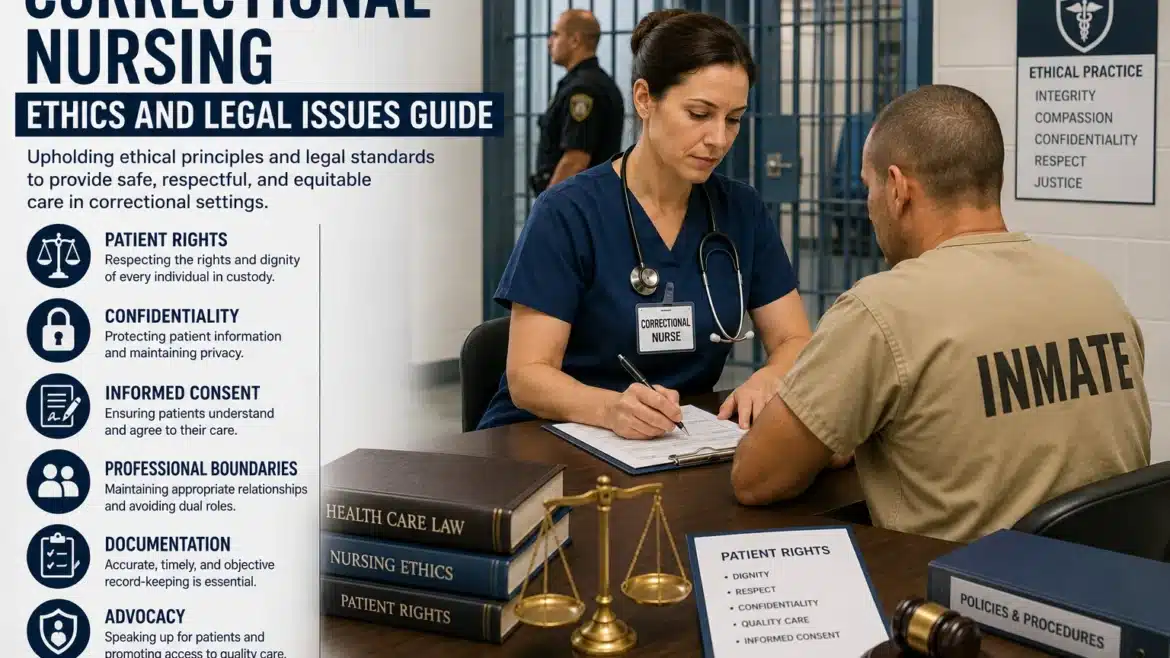

Correctional nursing requires more than clinical knowledge. Nurses working in jails, prisons, and detention facilities must also understand the ethical and legal responsibilities that guide patient care. They provide healthcare to individuals in a structured environment where clinical needs, patient rights, institutional policies, and security requirements can sometimes intersect.
Ethical nursing practice means treating patients with dignity, maintaining appropriate professional boundaries, protecting confidential information, and making decisions based on legitimate healthcare needs. Legal responsibilities add another layer by requiring nurses to practice within their scope, follow applicable laws and regulations, document care appropriately, and respect established standards of professional practice.
These issues are particularly important in correctional healthcare because incarceration changes a patient’s freedom of movement, but it does not eliminate the nurse’s responsibility to provide appropriate healthcare. Nurses must understand where their clinical responsibilities begin and end and how to communicate concerns through the appropriate professional channels.
What Does Ethics Mean in Correctional Nursing?
Nursing ethics refers to the principles that help nurses make responsible decisions when caring for patients. Ethical practice involves considering patient dignity, autonomy, confidentiality, fairness, safety, professional responsibility, and the nurse’s duty to provide appropriate care.
In correctional settings, ethical questions may arise when a patient’s healthcare needs intersect with institutional procedures. A nurse may need to determine how to protect confidential information, respond to a patient’s refusal of care, advocate for necessary treatment, or maintain professional boundaries while working in a highly controlled environment.
Ethical nursing practice does not mean ignoring security procedures. Instead, it means recognizing the patient’s legitimate healthcare needs and addressing them through appropriate clinical and institutional processes.
| Ethical Principle | Application in Correctional Nursing |
|---|---|
| Autonomy | Respecting a patient’s right to participate in healthcare decisions when legally and clinically applicable. |
| Beneficence | Acting to promote the patient’s health and well-being. |
| Nonmaleficence | Avoiding preventable harm and unsafe care. |
| Justice | Providing fair and appropriate healthcare without improper discrimination. |
| Confidentiality | Protecting private health information and sharing it appropriately. |
| Professional Responsibility | Practicing within scope and following applicable professional and organizational requirements. |
Patient Rights in Correctional Healthcare
Patients in correctional facilities remain recipients of healthcare and should be treated with dignity and respect. Correctional nurses may encounter individuals with very different medical histories, cultural backgrounds, health beliefs, and communication styles. Professional nursing care requires the nurse to focus on clinical needs rather than making judgments based on the patient’s incarceration status.
Patient rights can involve several areas of healthcare, including:
- Access to appropriate healthcare services.
- Respectful and professional treatment.
- Participation in healthcare decisions when applicable.
- Protection of confidential health information.
- Appropriate communication about healthcare needs.
- Accurate documentation of care.
- Access to medically appropriate follow-up.
- Respect for applicable consent and refusal processes.
Correctional nurses should become familiar with the laws, regulations, facility policies, and professional standards that apply to their specific practice environment. Requirements can vary depending on jurisdiction and facility type, so nurses should rely on current organizational guidance and applicable authorities rather than assumptions.
Patient Autonomy and Informed Consent
Patient autonomy refers to the individual’s ability to participate in decisions concerning their healthcare. Informed consent generally involves providing relevant information about a proposed intervention so that an appropriate healthcare decision can be made.
Correctional nurses may encounter situations involving consent for examinations, treatments, procedures, medications, or referrals. The exact consent requirements depend on the nature of the intervention, the patient’s circumstances, applicable law, and organizational policy.
Nurses should understand that incarceration itself does not mean that every healthcare decision can automatically be made without the patient’s involvement. At the same time, there may be circumstances in which laws, court orders, emergencies, or other legally recognized conditions affect how consent is handled.
When questions arise, nurses should follow applicable policies and seek guidance from the appropriate healthcare or legal authority rather than making assumptions.
When a Patient Refuses Care
Patient refusal can create challenging situations for nurses. A patient may decline a medication, examination, treatment, or recommended referral for a variety of reasons. The nurse’s response should be professional, objective, and consistent with applicable policies and legal requirements.
A nurse may need to determine:
- What care or treatment the patient is refusing.
- Whether the patient understands the relevant information.
- Whether there are immediate safety concerns.
- Whether the patient has decision-making capacity when that determination is relevant.
- Whether additional healthcare evaluation is necessary.
- What documentation is required.
- Whether the healthcare provider should be notified.
Refusal should not automatically be interpreted as noncompliance or misconduct. The nurse should seek to understand the patient’s concerns and communicate appropriate information while following the facility’s established process.
Ethical Reminder: A patient’s decision about healthcare should be approached as a clinical and professional matter. Nurses should avoid coercive communication and follow the applicable consent, refusal, documentation, and escalation procedures.
Confidentiality in Correctional Healthcare
Confidentiality is one of the most important ethical responsibilities in nursing. Correctional healthcare can make privacy more complicated because nurses may work near correctional officers, other incarcerated individuals, administrative staff, and visitors.
Clinical information should be handled carefully and shared only with individuals who are authorized to receive it or when disclosure is otherwise permitted or required by applicable law or policy.
Confidential information can include:
- Medical diagnoses.
- Medication information.
- Laboratory and diagnostic results.
- Mental health information.
- Substance use information.
- Sexual and reproductive health information.
- Patient statements made during healthcare encounters.
- Other protected health information.
Nurses should be conscious of where clinical conversations take place. Discussing sensitive information in hallways, common areas, elevators, or other locations where unauthorized individuals may overhear the conversation can create unnecessary privacy risks.
Confidentiality and Security Considerations
Correctional facilities have legitimate security responsibilities, and healthcare personnel may sometimes need to communicate information that has safety implications. However, nurses should distinguish between information that is clinically relevant to security operations and information that should remain protected as confidential healthcare information.
When disclosure questions arise, nurses should follow applicable privacy laws, facility procedures, and professional guidance. If the appropriate course is unclear, seeking guidance from a supervisor, privacy officer, healthcare administrator, or other designated professional may help prevent inappropriate disclosure.
The key principle is that security considerations do not mean that all medical information should automatically be shared with all facility personnel.
Professional Boundaries With Patients
Professional boundaries are particularly important in correctional nursing because nurses may develop repeated interactions with the same patients over extended periods. A therapeutic relationship should remain focused on healthcare rather than developing into a personal relationship.
Maintaining appropriate boundaries protects both the nurse and the patient. It also helps ensure that clinical decisions are based on patient needs rather than personal preferences, emotional connections, pressure, or favoritism.
Examples of appropriate boundary practices include:
- Using professional language during patient interactions.
- Avoiding favoritism or preferential treatment.
- Maintaining appropriate physical and emotional boundaries.
- Protecting confidential information.
- Following facility rules concerning communication and patient contact.
- Avoiding inappropriate gifts, favors, or personal arrangements.
- Reporting or seeking guidance about potential boundary violations.
Professional boundaries are not intended to prevent nurses from showing empathy. Compassionate, respectful care can coexist with clear professional limits.
Patient Advocacy in Correctional Nursing
Patient advocacy means helping ensure that legitimate healthcare concerns are recognized, communicated, and addressed appropriately. In correctional settings, advocacy may be especially important when clinical needs and operational procedures intersect.
A correctional nurse may advocate for a patient by communicating significant assessment findings, requesting appropriate clinical evaluation, following up on referrals, clarifying treatment concerns, or ensuring that important health information reaches the appropriate member of the healthcare team.
Advocacy does not mean bypassing security procedures or making decisions outside the nurse’s authority. Instead, it involves using professional judgment and established processes to help ensure that healthcare needs receive appropriate attention.
The broader responsibilities of correctional nurses—including patient assessment, emergency response, chronic disease management, professional boundaries, and care coordination—are discussed in our guide to correctional nursing responsibilities and challenges.
Ethical Challenges in a Secure Environment
Correctional nurses may encounter situations in which several responsibilities appear to compete. For example, a patient may require privacy during a healthcare discussion while security personnel need to maintain awareness of the surrounding environment. A patient may request a treatment that requires additional authorization, or a nurse may identify a healthcare concern that requires coordination with personnel outside the medical unit.
These situations require nurses to avoid making decisions based solely on one consideration. Instead, they should evaluate the clinical facts, applicable policies, patient rights, professional responsibilities, and relevant security requirements.
When a situation is unclear, appropriate consultation is often preferable to making an unsupported assumption. Nurses can seek guidance through established clinical leadership, supervisory channels, organizational policies, or other appropriate resources.
Understanding these ethical principles provides an important foundation for nurses preparing for specialized correctional healthcare certification. Candidates can further apply professional responsibility concepts through a CCHP-N certification Prep Resource that focuses on correctional nursing knowledge and clinical decision-making.
Legal Responsibilities of Correctional Nurses
Ethical responsibilities and legal responsibilities often overlap, but they are not identical. Ethics focuses on principles that guide professional conduct and decision-making, while legal responsibilities arise from applicable laws, regulations, court decisions, licensing requirements, and organizational policies.
Correctional nurses should understand the legal requirements that apply to their specific jurisdiction and practice setting. These requirements can differ between states and facilities, so nurses should rely on current laws, licensing-board guidance, facility policies, and qualified professional resources when addressing specific legal questions.
Important areas of legal responsibility may include:
- Practicing within the authorized scope of nursing practice.
- Following applicable standards of care.
- Maintaining appropriate patient records.
- Protecting confidential health information.
- Obtaining and documenting consent when required.
- Reporting certain conditions or incidents when legally required.
- Following medication administration requirements.
- Recognizing and reporting suspected abuse or other legally reportable situations when applicable.
- Maintaining professional competence.
Understanding these responsibilities helps nurses recognize when a situation requires additional guidance or escalation.
Scope of Practice
Scope of practice defines the activities a nurse is authorized and qualified to perform based on professional licensure, education, competence, applicable law, and organizational requirements. Practicing outside that scope can create risks for both the patient and the nurse.
Correctional nurses may work in environments where staffing levels, available services, and patient needs vary. These circumstances do not automatically expand a nurse’s scope of practice.
Before performing a clinical activity, nurses should consider:
- Whether the activity is permitted under applicable nursing regulations.
- Whether the nurse has the education and competency required.
- Whether an appropriate order or authorization is necessary.
- Whether facility policy permits the activity.
- Whether appropriate supervision or consultation is required.
If a nurse is uncertain about whether an activity is within the authorized scope, seeking clarification before proceeding can help protect patient safety and professional practice.
Documentation and Legal Accountability
Clinical documentation is both a communication tool and an important professional record. In correctional healthcare, accurate documentation can help maintain continuity when patients are evaluated by different nurses, providers, specialists, or facilities.
Documentation should accurately reflect the care provided and the patient’s relevant clinical presentation. Nurses should avoid vague, judgmental, or unsupported statements.
Important documentation principles include:
- Record information as accurately and promptly as required.
- Use objective language when describing observations.
- Distinguish patient statements from clinical observations.
- Document relevant assessments and interventions.
- Record significant changes in the patient’s condition.
- Document appropriate notifications and follow-up.
- Follow facility requirements for corrections or amendments to records.
For example, documenting that a patient was “difficult” provides little clinical information. A more useful record would describe the observable behavior and relevant circumstances objectively, according to the organization’s documentation standards.
Negligence and the Standard of Care
Nurses have a professional responsibility to provide care consistent with applicable standards and their level of education and competence. Failure to meet an applicable standard of care can create patient-safety concerns and may have professional or legal consequences.
Potential areas of concern can include:
- Failure to appropriately assess a patient.
- Failure to recognize or respond to significant changes in condition.
- Medication errors.
- Inadequate documentation.
- Failure to communicate important clinical findings.
- Failure to follow applicable policies or professional requirements.
Not every unfavorable patient outcome means that negligence occurred. Determining legal responsibility requires consideration of the specific facts, applicable standards, and relevant law. Nurses should therefore avoid making assumptions about legal conclusions based solely on an outcome.
Informed Consent and Legal Considerations
Consent is an important part of many healthcare decisions. Depending on the intervention and applicable law, informed consent may require that a patient receive relevant information about a proposed treatment and have an opportunity to make an informed decision.
Correctional nurses may participate in the consent process by providing information within their role, witnessing signatures when authorized, documenting the process, or communicating concerns to the appropriate provider.
The nurse should understand the difference between explaining information within the nursing role and providing information that is the responsibility of another healthcare professional. When questions arise about the validity or requirements of consent, the appropriate provider or organizational authority should be consulted.
Patient Refusal and Legal Considerations
Refusal of healthcare can raise both ethical and legal questions. A patient may refuse medication, an examination, diagnostic testing, or another recommended intervention. The appropriate response depends on the patient’s circumstances, decision-making capacity when relevant, the nature of the treatment, applicable law, and facility policy.
A professional response generally includes:
- Determine what the patient is refusing.
- Provide appropriate information within the nurse’s role.
- Explore the patient’s concerns when appropriate.
- Assess for immediate safety issues.
- Notify the appropriate healthcare professional when required.
- Follow the organization’s refusal-of-care procedures.
- Document the relevant circumstances and actions taken.
Patients should not be pressured simply because their healthcare decision differs from the recommendation. At the same time, nurses must follow applicable procedures when a situation involves immediate danger, impaired decision-making, court requirements, or another legally recognized exception.
Mandatory Reporting and Professional Responsibilities
Healthcare professionals may have legal duties to report certain conditions, injuries, suspected abuse, communicable diseases, or other circumstances. The exact requirements vary by jurisdiction and situation.
Correctional nurses should understand the reporting obligations applicable to their workplace and license. When a situation may require a report, nurses should follow established procedures and seek guidance from the appropriate supervisor or designated professional if they are uncertain.
Examples of situations that may involve reporting requirements, depending on applicable law, include:
- Certain communicable diseases.
- Suspected abuse or neglect.
- Certain injuries.
- Occupational exposures.
- Specific safety or security incidents.
- Other legally designated conditions or events.
Because reporting requirements differ by jurisdiction, nurses should never rely on a generalized checklist when a specific legal determination is required.
Privacy During Clinical Encounters
Privacy can be difficult to maintain in a correctional environment because healthcare services may be delivered in locations where security personnel must remain nearby. Nurses should make reasonable efforts to protect patient privacy while complying with legitimate safety and security requirements.
Privacy considerations can include:
- Conducting sensitive conversations in an appropriate location when possible.
- Limiting unnecessary exposure of patient information.
- Protecting paper and electronic records.
- Using secure communication methods.
- Discussing patient information only with individuals who have an appropriate need to know.
- Following organizational privacy procedures.
Security requirements may affect how privacy is maintained, but nurses should still take appropriate steps to preserve patient dignity and confidentiality.
Ethical Decision-Making in Difficult Situations
Some correctional nursing situations do not have an immediately obvious answer. A nurse may need to balance patient autonomy, safety, confidentiality, professional responsibility, and institutional requirements.
A structured decision-making process can help nurses approach these situations objectively.
| Step | Question to Consider |
|---|---|
| Identify the issue | What clinical, ethical, or legal concern is present? |
| Gather information | What facts, assessment findings, policies, and patient preferences are relevant? |
| Identify responsibilities | What professional, ethical, legal, and clinical duties apply? |
| Consider options | What actions are available within the nurse’s role? |
| Seek guidance | Does the situation require consultation with a provider, supervisor, or other authority? |
| Act appropriately | Which action best supports patient safety and professional responsibilities? |
| Document | What information and actions should be recorded? |
This process does not replace professional or legal advice. Instead, it provides a practical framework for organizing information before making or escalating a decision.
Balancing Patient Advocacy and Institutional Security
One of the distinctive challenges of correctional nursing is maintaining patient advocacy while working within a secure institutional environment. Nurses may sometimes encounter situations where a patient’s preferred course of action conflicts with facility procedures.
Professional advocacy does not require nurses to ignore security rules. Instead, the nurse can communicate the clinical concern, explain the healthcare implications, and work through established channels to identify an appropriate solution.
This distinction is important because healthcare professionals and correctional personnel have different responsibilities. Nurses should maintain their clinical role while cooperating with legitimate security procedures.
Handling Ethical Pressure or Conflicting Requests
Nurses may occasionally receive requests or encounter circumstances that create professional discomfort. For example, someone may ask for information that the nurse is not authorized to disclose, request an action outside the nurse’s scope, or pressure the nurse to change a clinical decision for reasons unrelated to patient care.
When this happens, nurses should avoid acting impulsively. Instead, they can:
- Clarify the request.
- Determine whether the request is within their professional role.
- Review applicable policies.
- Protect confidential information.
- Communicate concerns professionally.
- Seek guidance from the appropriate supervisor or healthcare authority.
- Document relevant events according to organizational procedures.
Knowing when to seek assistance is an important professional skill. Nurses do not need to resolve every ethical or legal question independently.
Preparing for Ethics and Professional Responsibility Questions
Ethics and professional responsibilities can be tested through questions that present realistic situations rather than asking only for definitions. A candidate may need to determine which action best protects confidentiality, which response demonstrates appropriate professional boundaries, or when a clinical concern should be escalated.
When reviewing these questions, focus on the underlying principle rather than memorizing an isolated answer. Ask why one response protects the patient’s rights or safety better than another and whether the proposed action falls within the nurse’s professional role.
It is also useful to distinguish between choices that are clinically reasonable and choices that are the most appropriate first action. In scenario-based questions, several options may appear acceptable, but one may better address the immediate priority while remaining within professional and legal responsibilities.
Key Takeaways
- Correctional nurses have ethical and legal responsibilities in addition to their clinical duties.
- Incarceration does not eliminate the importance of respectful and appropriate healthcare.
- Confidentiality should be protected while recognizing legitimate legal and security requirements.
- Nurses must practice within their authorized scope of practice.
- Patient refusal should be handled professionally and according to applicable procedures.
- Accurate documentation supports communication, continuity, and professional accountability.
- Professional boundaries help maintain appropriate therapeutic relationships.
- Patient advocacy can occur within established clinical and institutional processes.
- When an ethical or legal situation is unclear, appropriate consultation is often necessary.
Understanding these principles gives correctional nurses a stronger foundation for navigating difficult situations while maintaining patient-centered care and professional accountability.
Ethical Decision-Making in Real-World Correctional Nursing
Ethical challenges in correctional nursing are often complex because more than one professional responsibility may apply to the same situation. A nurse may need to protect patient confidentiality while responding to a legitimate safety concern, respect a patient’s preferences while following an authorized treatment plan, or advocate for healthcare needs while working within institutional procedures.
The safest approach is to slow down, identify the actual issue, gather the relevant facts, and determine which professional responsibilities apply. Nurses should avoid making decisions based solely on assumptions about a patient’s behavior, incarceration status, or the expectations of another individual.
A practical approach to an ethical situation may include:
- Identify the patient’s immediate healthcare needs.
- Determine whether there is an immediate safety concern.
- Review the relevant clinical information.
- Consider patient rights and preferences.
- Review applicable facility policies and professional requirements.
- Determine whether additional consultation is necessary.
- Take the appropriate action within the nurse’s scope.
- Document relevant findings and actions according to policy.
This approach encourages nurses to make decisions based on clinical facts and professional responsibilities rather than personal assumptions.
Common Ethical Mistakes to Avoid
Correctional nurses can reduce professional risk by recognizing common ethical mistakes before they occur. Many problems arise from poor communication, unclear boundaries, unnecessary disclosure of information, or failure to follow established procedures.
| Potential Mistake | Better Approach |
|---|---|
| Discussing patient information where others can overhear. | Use appropriate locations and communication methods for confidential information. |
| Providing preferential treatment to a particular patient. | Base care decisions on clinical needs and professional standards. |
| Accepting inappropriate gifts or favors. | Maintain professional boundaries and follow facility policies. |
| Performing an activity outside the nurse’s scope. | Confirm authorization, competency, and applicable requirements before proceeding. |
| Ignoring a patient’s healthcare concern because of behavioral assumptions. | Assess the patient objectively and document relevant findings. |
| Failing to document a significant event. | Follow documentation procedures and record relevant clinical information promptly. |
| Sharing information simply because someone works at the facility. | Determine whether the person has an appropriate need and authorization to receive the information. |
Professional Boundaries and Therapeutic Relationships
A therapeutic relationship is different from a friendship or personal relationship. The nurse’s responsibility is to provide professional healthcare while maintaining appropriate emotional and interpersonal boundaries.
This can be particularly important in correctional environments where nurses may interact with the same patients repeatedly. Familiarity can gradually make professional boundaries less obvious, especially when a patient frequently seeks care or shares personal experiences.
Maintaining boundaries does not mean being cold or unapproachable. A nurse can demonstrate empathy, compassion, and respect while still maintaining appropriate limits.
Warning signs that a professional relationship may be crossing an inappropriate boundary can include:
- Giving one patient special treatment without a clinical reason.
- Sharing personal information unnecessarily.
- Accepting personal gifts or favors.
- Communicating with patients outside approved channels.
- Developing emotional involvement that affects clinical judgment.
- Allowing personal relationships to influence healthcare decisions.
When a nurse recognizes a potential boundary concern, seeking guidance early can help prevent the situation from becoming more serious.
Patient Advocacy Without Compromising Security
Patient advocacy is an important part of professional nursing, but advocacy in a correctional environment must occur within established procedures. Nurses should communicate legitimate healthcare concerns while recognizing that correctional facilities have separate responsibilities for custody and security.
For example, a nurse may determine that a patient requires evaluation outside the facility. The nurse’s role is to communicate the clinical need and follow the appropriate referral or transfer process. The nurse does not independently determine security arrangements that fall outside the healthcare role.
This distinction helps maintain cooperation between healthcare and correctional personnel while keeping patient care at the center of the clinical decision.
Ethics of Equitable Patient Care
Justice is an important ethical principle in nursing. It involves providing fair and appropriate care without allowing irrelevant personal judgments to determine the quality of healthcare a patient receives.
Correctional nurses may care for patients with different diagnoses, backgrounds, behaviors, and healthcare histories. Professional decisions should be based on clinical needs, assessment findings, applicable standards, and the patient’s circumstances rather than assumptions about the individual.
Equitable care does not necessarily mean that every patient receives exactly the same intervention. Different patients may have different healthcare needs. Fair treatment means that clinical decisions are appropriately individualized and supported by legitimate healthcare considerations.
Legal and Ethical Issues in Documentation
Documentation deserves particular attention because the medical record may be used by multiple healthcare professionals and can become important when questions arise about the care provided.
Correctional nurses should document objectively and avoid language that could be interpreted as judgmental, sarcastic, or unsupported. Patient statements should be identified as statements, while clinical observations should be recorded as observations.
For example, rather than writing that a patient was “being difficult,” a nurse should describe the observable behavior and relevant circumstances according to the facility’s documentation standards.
Good documentation should help another qualified healthcare professional understand what happened, what the nurse observed, what actions were taken, how the patient responded, and what follow-up was required.
Ethical Considerations During Emergency Situations
Emergencies can create additional ethical challenges because decisions may need to be made quickly. A nurse may have limited information while needing to prioritize immediate patient safety.
During an emergency, the nurse should focus on immediate clinical needs and follow established emergency procedures. If questions about consent, confidentiality, or other ethical issues arise, the nurse should follow applicable laws and organizational protocols while seeking appropriate guidance when circumstances permit.
Emergency situations also demonstrate why correctional nurses need to understand their roles before a crisis occurs. Familiarity with emergency communication procedures, equipment, escalation pathways, and responsibilities can reduce confusion when rapid action is necessary.
Ethical Considerations in Mental and Behavioral Healthcare
Mental and behavioral health concerns can present additional ethical challenges. Nurses may encounter patients experiencing depression, anxiety, trauma-related symptoms, psychosis, substance withdrawal, or other behavioral health conditions.
Professional nursing care requires nurses to avoid dismissing symptoms simply because they occur in a correctional environment. Behavioral changes can sometimes indicate a medical condition or an urgent mental health concern.
Important considerations may include:
- Taking concerning statements seriously.
- Assessing changes in behavior according to the nurse’s role.
- Communicating significant findings to the appropriate healthcare professional.
- Maintaining confidentiality within applicable requirements.
- Following procedures for urgent behavioral health concerns.
- Documenting objective observations.
The nurse should remain compassionate while also maintaining appropriate safety awareness and professional boundaries.
How Ethics and Legal Knowledge Supports CCHP-N Preparation
Ethical and professional responsibility topics require candidates to understand how nursing principles apply to realistic correctional healthcare situations. Memorizing definitions alone may not be enough when a question asks what a nurse should do first, which action best protects confidentiality, or how a professional should respond to a conflict.
A useful study method is to identify the principle behind each scenario. For example, if a question involves unauthorized disclosure of medical information, the central issue may involve confidentiality. If a question describes a nurse performing an activity without appropriate authorization, scope of practice may be the key concept.
When reviewing practice questions, ask:
- What is the main ethical or legal issue?
- Which patient right is involved?
- What professional responsibility applies?
- Is there an immediate safety concern?
- What action is within the nurse’s scope?
- Does the situation require escalation or consultation?
- What should be documented?
This type of reasoning can help candidates apply principles rather than simply memorizing answers.
Building Ethical Confidence as a Correctional Nurse
Ethical confidence develops through education, experience, reflection, and familiarity with professional standards. Nurses should know where to find their facility’s policies and understand when a situation requires consultation.
No nurse is expected to know every legal requirement from memory. When a situation involves a complicated legal question, uncertain reporting obligation, disputed consent issue, or other significant concern, consulting the appropriate professional authority is often the safest approach.
Continuing education can also help nurses stay familiar with changes in professional expectations, privacy requirements, documentation standards, and correctional healthcare practices.
Key Takeaways for Correctional Nursing Ethics
- Provide healthcare based on legitimate clinical needs.
- Respect patient dignity and applicable healthcare rights.
- Protect confidential information.
- Maintain clear professional boundaries.
- Practice within the authorized scope of nursing practice.
- Document care objectively and accurately.
- Advocate for appropriate healthcare through established processes.
- Understand that security responsibilities and healthcare responsibilities are different but must work together.
- Seek guidance when ethical or legal requirements are unclear.
- Use current laws, regulations, professional standards, and facility policies when making decisions.
Final Thoughts
Ethics and legal responsibilities are central to safe correctional nursing practice. Nurses must protect patient confidentiality, respect appropriate healthcare rights, maintain professional boundaries, document care accurately, and practice within their authorized scope.
The correctional environment can make these responsibilities more complex because healthcare is delivered within a structured security system. Successful nurses learn how to maintain professional nursing responsibilities while cooperating with legitimate institutional procedures.
For nurses preparing for specialized correctional nursing certification, ethical and legal concepts should be studied alongside clinical management, patient safety, communication, and professional responsibilities. The strongest preparation comes from understanding why a particular action is appropriate and how that principle applies to realistic patient situations.
FAQs
Why are ethics important in correctional nursing?
Ethics help nurses make professional decisions that protect patient dignity, safety, confidentiality, fairness, and appropriate healthcare while working within the unique requirements of correctional facilities.
Do incarcerated patients have healthcare rights?
Incarceration does not eliminate the need for appropriate healthcare. Nurses should follow applicable laws, professional standards, and facility procedures regarding patient rights and access to care.
How should correctional nurses protect confidentiality?
Nurses should use appropriate communication methods, avoid unnecessary disclosure, protect medical records, and share health information only when authorized or when disclosure is otherwise permitted or required by applicable law and policy.
Why are professional boundaries important?
Professional boundaries help maintain therapeutic relationships and ensure that healthcare decisions are based on clinical needs rather than personal relationships, favoritism, or outside pressure.
What should a nurse do when an ethical situation is unclear?
The nurse should gather the relevant clinical information, review applicable policies and professional requirements, and seek guidance from an appropriate supervisor, healthcare professional, or designated authority when necessary.
Why is documentation important from an ethical and legal perspective?
Accurate documentation communicates patient information to the healthcare team, supports continuity of care, records the services provided, and demonstrates the clinical reasoning and actions taken during patient care.
How can nurses study ethics for the CCHP-N exam?
Nurses can review professional responsibilities, patient rights, confidentiality, scope of practice, documentation, boundaries, advocacy, and ethical decision-making. Scenario-based practice can help candidates apply these principles to realistic correctional healthcare situations.