
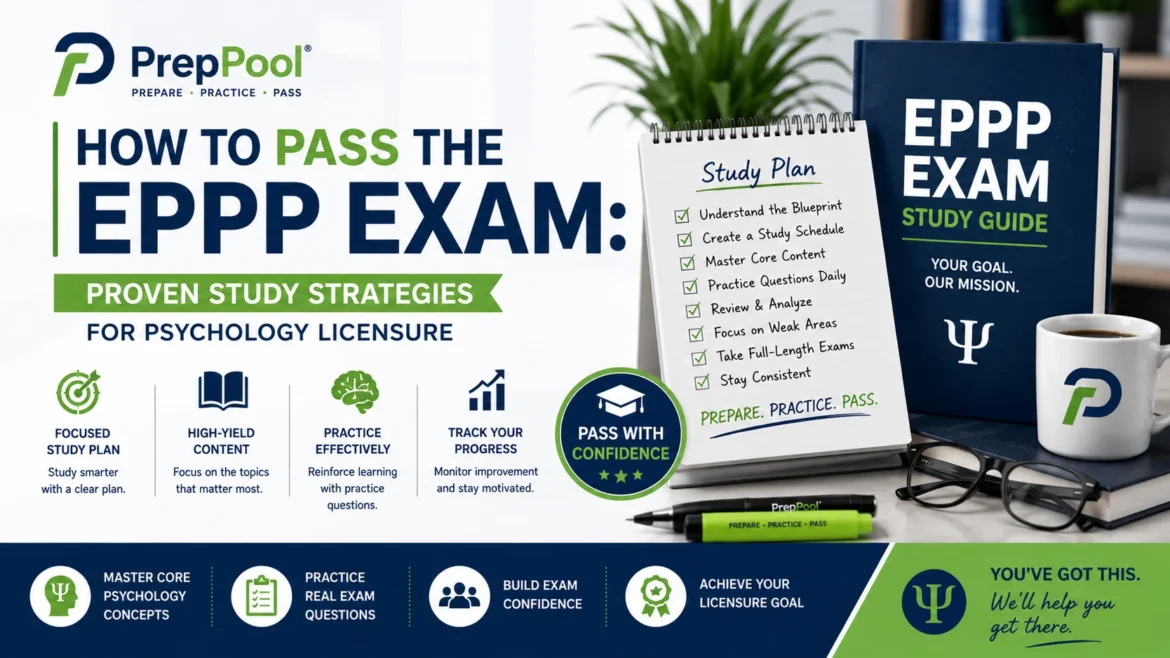

Preparing for the Examination for Professional Practice in Psychology (EPPP) can feel overwhelming. The exam covers a broad range of psychology topics, including biological bases of behavior, assessment, diagnosis, ethics, treatment, research methods, and professional practice. For many candidates, the challenge is not simply learning the material but organizing months of preparation into an effective study strategy.
The good news is that successful EPPP candidates rarely rely on memorization alone. Instead, they follow structured study plans, focus on high-priority content areas, use practice questions strategically, and consistently review weak areas.
Passing the EPPP requires a combination of psychology knowledge, critical thinking skills, and effective test-taking techniques. Understanding how to prepare efficiently can reduce stress, improve confidence, and increase the likelihood of success on exam day.
This guide explores proven study strategies that psychology licensure candidates can use to strengthen preparation and approach the EPPP with greater confidence.
What You’ll Learn
- How to build an effective EPPP study plan
- The most important psychology topics to prioritize
- Common preparation mistakes to avoid
- How to use practice questions effectively
- Ways to improve retention and recall
- Time management strategies for exam day
- Methods for reducing test anxiety
Why Many Candidates Struggle with the EPPP
The EPPP is designed to assess readiness for professional psychology practice. Because psychologists must integrate knowledge from multiple domains, the exam frequently requires candidates to analyze complex situations rather than simply recall isolated facts.
Many candidates struggle because they:
- Attempt to memorize too much information.
- Study without a structured plan.
- Focus on familiar topics while avoiding weak areas.
- Spend insufficient time reviewing practice questions.
- Underestimate the breadth of content covered on the exam.
Recognizing these challenges early can help candidates develop a more effective preparation strategy.
Understand What the EPPP Is Really Testing
One of the biggest misconceptions about the EPPP is that it only measures academic knowledge.
In reality, the exam evaluates whether candidates can apply psychological concepts within professional situations. Questions often require integration of assessment principles, ethics, research findings, developmental considerations, and intervention strategies.
Major content domains include:
- Biological bases of behavior
- Cognitive-affective psychology
- Social and multicultural psychology
- Growth and lifespan development
- Assessment and diagnosis
- Treatment and intervention
- Research methods and statistics
- Ethical and legal standards
Understanding this structure helps candidates allocate study time more effectively.
Create a Realistic EPPP Study Schedule
Successful candidates typically follow a structured preparation plan rather than studying randomly from day to day.
A study schedule provides direction, reduces stress, and helps ensure all major content areas receive adequate attention.
A sample preparation timeline might look like this:
| Study Phase | Primary Focus |
|---|---|
| Weeks 1–2 | Review foundational psychology concepts |
| Weeks 3–4 | Assessment, diagnosis, and intervention |
| Weeks 5–6 | Research methods and statistics |
| Weeks 7–8 | Ethics and professional standards |
| Weeks 9–10 | Practice questions and content review |
| Final Weeks | Weak-area review and exam readiness |
The exact timeline will vary depending on individual experience and available study time, but consistency is generally more effective than occasional intensive sessions.
Focus on Understanding Before Memorization
Because the EPPP emphasizes application, candidates benefit from understanding concepts deeply rather than attempting to memorize large volumes of information.
For example, instead of memorizing a definition of reliability, candidates should understand:
- Why reliability matters.
- How reliability is measured.
- How reliability affects assessment interpretation.
- How reliability relates to validity.
This deeper level of understanding often improves performance on scenario-based questions.
Prioritize High-Yield Psychology Topics
While every content area matters, some topics appear frequently because of their importance to professional practice.
Candidates should devote significant attention to:
- Assessment principles
- Psychological testing
- Ethics and professional conduct
- Research methods
- Statistics
- Evidence-based interventions
- Developmental psychology
- Multicultural competence
Building strength in these areas creates a strong foundation for broader exam preparation.
Use Active Learning Strategies
Passive reading often creates the illusion of learning without producing long-term retention.
Active learning techniques encourage deeper processing of information.
Examples include:
- Creating concept maps
- Teaching material to others
- Answering practice questions
- Summarizing content in your own words
- Reviewing real-world psychology cases
- Building flashcards for key concepts
These techniques often improve both understanding and recall.
Review Psychology Domains as Connected Systems
Many EPPP candidates study each content area independently.
However, professional psychology rarely works that way.
A psychologist evaluating a client may need to consider:
- Biological influences
- Cognitive processes
- Developmental history
- Cultural factors
- Assessment findings
- Ethical responsibilities
Recognizing these relationships can help candidates answer integrated exam questions more effectively.
Build a Strong Knowledge Foundation First
Before focusing heavily on full-length practice exams, candidates should ensure they understand the major psychology content domains.
Many psychology licensure candidates strengthen their preparation by reviewing a comprehensive EPPP psychology content guide that explains assessment principles, ethics, research methods, intervention strategies, and other high-priority exam topics. A strong conceptual foundation often makes practice questions significantly more valuable.
Preparation TipThe goal is not simply to memorize information. The goal is to think like a psychologist and apply psychological knowledge to realistic professional situations.
Why Strategic Preparation Beats Last-Minute Studying
Many candidates underestimate the amount of information covered on the EPPP and attempt to compensate with intensive last-minute studying.
Unfortunately, this approach often increases stress while reducing retention.
Consistent preparation over time allows candidates to build knowledge gradually, identify weak areas, and develop confidence before exam day.
Learn from the Most Common EPPP Preparation Mistakes
One of the fastest ways to improve your chances of passing the EPPP is understanding the mistakes that commonly prevent candidates from reaching their goals.
Many psychology graduates possess strong academic backgrounds but struggle because of inefficient study habits rather than a lack of knowledge.
Common preparation mistakes include:
- Studying without a structured plan
- Ignoring weaker content areas
- Focusing only on memorization
- Taking practice exams without reviewing explanations
- Neglecting ethics and legal standards
- Waiting too long to begin preparation
Avoiding these mistakes can significantly improve preparation efficiency and long-term retention.
Stop Memorizing and Start Applying Concepts
The EPPP is designed to evaluate professional reasoning, not simply factual recall.
Many questions require candidates to apply psychological principles to realistic scenarios involving assessment, diagnosis, intervention, ethics, or research interpretation.
For example, rather than asking for the definition of validity, the exam may present an assessment situation and require candidates to determine whether a testing procedure demonstrates appropriate validity.
This is why successful candidates spend time practicing application rather than relying solely on flashcards or memorization techniques.
How to Use Practice Questions Effectively
Practice questions are among the most valuable tools available to EPPP candidates when used correctly.
However, their value comes from analysis and learning rather than simply counting correct answers.
After completing practice questions:
- Review every incorrect answer.
- Understand why the correct answer is correct.
- Identify recurring weaknesses.
- Study the related concept.
- Track progress over time.
This process helps transform practice questions into powerful learning opportunities.
Strengthen Preparation with Realistic Exam Scenarios
One of the best ways to prepare for licensure exams is exposure to questions that reflect the style and complexity of actual testing situations.
Many candidates improve confidence by working through structured psychology licensure practice questions and answer explanations that reinforce assessment principles, ethics, intervention strategies, and professional decision-making skills. Realistic scenarios often reveal knowledge gaps that may not become apparent through reading alone.
Develop a Mistake Review System
Many successful candidates maintain a review journal throughout the preparation process.
Whenever a question is answered incorrectly, record:
- The topic involved
- The correct answer
- The reason the answer is correct
- The reason the chosen answer was incorrect
- Additional concepts that require review
Over time, this process helps identify patterns and prevents repeated mistakes.
Master Research Methods and Statistics Gradually
Research methods and statistics often create anxiety for psychology candidates.
Rather than attempting to learn everything at once, break the material into smaller sections.
Focus first on understanding:
- Research designs
- Variables
- Reliability
- Validity
- Correlation
- Measures of central tendency
Once these concepts become familiar, more advanced topics generally become easier to understand.
Use Concept Mapping for Complex Topics
Psychology contains many interconnected concepts.
Creating visual concept maps can help candidates understand how topics relate to one another.
For example, a concept map for assessment may connect:
- Reliability
- Validity
- Norms
- Standardization
- Test interpretation
This approach often improves retention and helps candidates answer integrated questions more effectively.
Review Ethics Frequently
Ethics is not a topic that should be reviewed only once.
Because ethical principles influence nearly every area of professional psychology, regular review is important throughout the preparation process.
Candidates should be comfortable with concepts such as:
- Confidentiality
- Informed consent
- Competence
- Professional boundaries
- Recordkeeping responsibilities
- Client welfare
Ethics questions often require nuanced decision-making and careful evaluation of professional responsibilities.
Manage Information Overload
The breadth of content covered on the EPPP can make preparation feel overwhelming.
One effective strategy is organizing information into major content categories.
| Category | Examples |
|---|---|
| Biological Psychology | Brain structures, neurotransmitters, physiology |
| Cognitive Psychology | Memory, learning, attention, decision-making |
| Assessment | Testing, reliability, validity, diagnosis |
| Research | Methods, statistics, evidence-based practice |
| Ethics | Confidentiality, competence, informed consent |
| Intervention | Treatment models, prevention, clinical practice |
This structure can make large amounts of information more manageable.
Improve Retention Through Spaced Review
Research consistently shows that information is retained more effectively when reviewed repeatedly over time rather than through a single intensive study session.
Spaced review involves revisiting concepts at regular intervals.
Benefits include:
- Improved recall
- Stronger long-term retention
- Reduced forgetting
- More efficient learning
Many successful candidates incorporate spaced review into their weekly study schedules.
Build Confidence Through Consistent Practice
Confidence is rarely the result of motivation alone. It is usually the result of preparation, repetition, and familiarity with exam content.
Candidates who consistently review material, analyze mistakes, practice realistic scenarios, and strengthen weak areas often feel significantly more prepared as exam day approaches.
The EPPP is challenging, but a structured and disciplined approach can make the preparation process far more manageable.
Create a Final Week EPPP Review Plan
The final week before the EPPP should focus on reinforcement rather than attempting to learn entirely new content.
Many candidates increase stress levels by trying to cover every psychology topic repeatedly during the final few days. A more effective approach is to concentrate on high-yield concepts and areas that still require improvement.
A sample final-week review plan may include:
- Day 1: Assessment and diagnosis
- Day 2: Ethics and professional standards
- Day 3: Research methods and statistics
- Day 4: Biological and cognitive psychology
- Day 5: Intervention and treatment approaches
- Day 6: Practice questions and weak-area review
- Day 7: Light review and mental preparation
This structure helps maintain focus while reducing last-minute anxiety.
How to Manage Time During the EPPP
Time management can have a significant impact on performance.
Even candidates with strong psychology knowledge may struggle if they spend too much time on difficult questions.
Effective exam-day strategies often include:
- Reading questions carefully before reviewing answers.
- Avoiding unnecessary second-guessing.
- Maintaining a steady pace throughout the exam.
- Flagging difficult questions for later review.
- Focusing on the information provided in the question.
Managing time effectively allows candidates to devote attention to every section of the exam.
How to Approach Challenging Questions
Most candidates encounter questions that seem unfamiliar or unusually complex.
When this happens, avoid making emotional decisions.
Instead, use a systematic approach.
Ask yourself:
- What psychology domain is being tested?
- What is the central issue in the scenario?
- What ethical or professional principles apply?
- Which answer best aligns with evidence-based practice?
This process often helps eliminate incorrect choices and identify the strongest response.
Reduce Test Anxiety Through Preparation
Some level of nervousness before a licensing examination is normal.
However, excessive anxiety can interfere with concentration, recall, and decision-making.
Strategies that may help reduce anxiety include:
- Following a consistent study schedule
- Practicing under realistic conditions
- Maintaining healthy sleep habits
- Taking regular study breaks
- Using stress-management techniques
Preparation is often one of the most effective ways to build confidence and reduce uncertainty.
Review Ethics One More Time
Ethics remains one of the most important areas of professional psychology and often appears throughout the EPPP.
During the final stages of preparation, candidates should review:
- Confidentiality
- Informed consent
- Competence
- Professional boundaries
- Recordkeeping responsibilities
- Client welfare considerations
Because ethical principles frequently intersect with assessment, intervention, and professional decision-making, a strong ethics foundation can support performance across multiple content areas.
Focus on Professional Reasoning
The EPPP is designed to evaluate whether candidates are prepared for professional psychology practice.
Many questions require more than factual knowledge.
Candidates are often expected to demonstrate:
- Critical thinking
- Professional judgment
- Ethical decision-making
- Evidence-based reasoning
- Assessment interpretation skills
Viewing questions through the lens of professional practice can often improve accuracy.
Prepare for Your Future Psychology Career
While passing the EPPP is a major milestone, it represents only one step in a larger professional journey.
Licensed psychologists work in a variety of settings and specialties, including clinical practice, counseling, education, healthcare, research, and organizational consulting.
Many candidates find additional motivation during preparation by exploring the diverse career opportunities available to licensed psychologists and understanding how licensure supports long-term professional growth.
Apply Knowledge Through Realistic Practice
One of the most effective ways to reinforce psychology concepts is by applying them through realistic professional scenarios.
Many candidates strengthen confidence by working through structured EPPP preparation questions with detailed explanations that integrate assessment, ethics, intervention, and research concepts into exam-style situations. This type of practice helps bridge the gap between theoretical knowledge and professional application.
What to Do the Night Before the EPPP
The night before the exam should be dedicated to preparation rather than intensive studying.
Recommended activities include:
- Reviewing summary notes
- Revisiting key ethics concepts
- Looking over major assessment principles
- Preparing testing materials
- Getting adequate sleep
Being rested and focused often contributes more to success than attempting to learn additional content at the last minute.
Final Thoughts
Passing the EPPP requires a combination of psychology knowledge, strategic preparation, and professional reasoning skills.
Candidates who develop a structured study plan, review major psychology domains, analyze mistakes carefully, and practice applying concepts to realistic situations often place themselves in a stronger position for success.
The most effective preparation strategies focus not only on remembering information but also on understanding how psychology concepts work together in professional practice.
By approaching preparation systematically and consistently, aspiring psychologists can build confidence, improve readiness, and move one step closer to achieving licensure.
Frequently Asked Questions
How long should I study for the EPPP?
Study timelines vary, but many candidates spend several months reviewing psychology content, completing practice questions, and strengthening weak areas before taking the exam.
What are the most important EPPP topics?
Assessment, ethics, research methods, intervention, biological psychology, cognitive psychology, developmental psychology, and multicultural competence are among the most important content areas.
Are practice questions helpful for EPPP preparation?
Yes. Practice questions help candidates apply psychology concepts, identify weak areas, improve professional reasoning, and become familiar with exam-style scenarios.
How can I reduce anxiety before the EPPP?
Consistent preparation, realistic practice, proper sleep, effective time management, and structured review plans can help reduce exam-related stress.
What is the best strategy for passing the EPPP?
The most effective strategy combines strong content knowledge, active learning methods, regular practice, mistake analysis, and a focus on professional application rather than memorization alone.