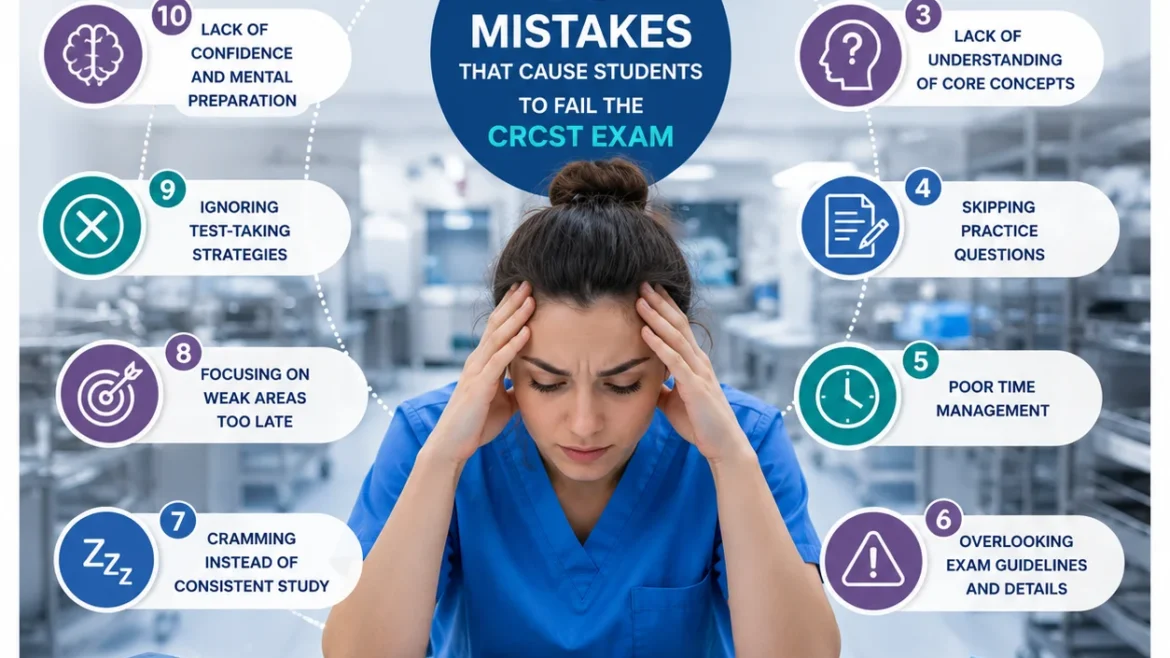

Recognizing the most common mistakes early can help students study more effectively and avoid unnecessary frustration before certification day.
Common Reasons Students Struggle on the CRCST Exam:
- Memorizing without understanding workflow
- Ignoring contamination prevention logic
- Weak sterilization knowledge
- Poor time management
- Lack of realistic scenario practice
Mistake #1: Treating the CRCST Exam Like a Vocabulary Test
One of the biggest mistakes students make is assuming the CRCST exam focuses only on memorizing definitions and technical terms.
Although terminology matters, many questions are designed to evaluate whether students understand why sterile processing procedures exist and how workflow decisions affect patient safety.
For example, students may encounter scenarios involving:
- Improper packaging conditions
- Failed sterilization indicators
- Contaminated instrument handling
- Incorrect workflow sequencing
Students who understand the reasoning behind sterile processing procedures usually perform much better than those relying only on memorization.
Mistake #2: Ignoring Infection Prevention Principles
Every major sterile processing procedure exists to reduce contamination and protect patients from infection.
However, some students focus heavily on technical details while failing to understand the infection-prevention purpose behind each workflow step.
The CRCST exam often evaluates whether candidates recognize:
- Cross-contamination risks
- Microorganism spread
- Safe handling procedures
- Environmental contamination concerns
- Importance of workflow separation
Students who consistently think in terms of patient safety usually answer difficult questions more confidently.
Mistake #3: Weak Understanding of Decontamination Procedures
Many students underestimate how heavily the CRCST exam emphasizes cleaning and decontamination procedures.
Cleaning is the foundation of effective sterilization because instruments cannot be sterilized properly if contamination remains present.
Students preparing for the exam should understand:
- Manual cleaning procedures
- Mechanical cleaning systems
- Safe transport of contaminated items
- Detergent and cleaning-agent use
- Personal protective equipment (PPE)
Questions often evaluate whether students understand why improper cleaning creates major patient-safety risks later in the workflow.
Mistake #4: Avoiding Scenario-Based Practice Questions
Many students spend too much time rereading notes without practicing how real CRCST questions are structured.
This creates false confidence because recognizing information while reading is very different from applying sterile processing logic under timed conditions.
Scenario-based preparation helps students improve:
- Workflow reasoning
- Contamination-risk recognition
- Question pacing
- Decision-making confidence
- Patient-safety awareness
Many future sterile processing technicians strengthen preparation using CRCST certification practice questions based on realistic healthcare workflows because it helps them understand how sterilization, decontamination, and patient-safety scenarios appear during the actual exam.
Mistake #5: Confusing Sterilization Methods and Monitoring Systems
Many students struggle with sterilization questions because they attempt to memorize procedures mechanically without understanding how sterilization systems actually function in healthcare environments.
The CRCST exam often evaluates whether students understand:
- Steam sterilization basics
- Low-temperature sterilization methods
- Biological monitoring systems
- Chemical indicators
- Mechanical monitoring procedures
Students who focus on why monitoring systems exist usually retain this information more effectively than those relying only on memorization charts.
Helpful Study Insight:The CRCST exam repeatedly rewards students who understand workflow logic and patient-safety reasoning instead of isolated fact memorization.
Mistake #6: Ignoring Packaging and Storage Standards
Some students assume sterilization ends once instruments leave the sterilizer, but sterile processing responsibilities continue through packaging, storage, and transport procedures.
The exam may include questions involving:
- Damaged packaging risks
- Storage-condition requirements
- Event-related contamination
- Safe transport procedures
- Package integrity monitoring
Students who fail to study packaging and storage concepts carefully often miss scenario-based questions involving contamination prevention after sterilization.
Mistake #7: Studying Without Understanding the Overall Exam Structure
Many students begin preparing without first understanding what topics appear most heavily throughout the CRCST exam.
As a result, they spend large amounts of time memorizing low-priority details while neglecting major workflow concepts that appear repeatedly during testing.
Students who understand the major exam categories early usually study more efficiently and retain information more effectively.
Future technicians who want a clearer overview of the certification structure can review the core sterile processing topics commonly covered on the CRCST exam before building a long-term study strategy.
Mistake #8: Poor Time Management During the Exam
Some students understand sterile processing concepts reasonably well but still struggle because they lose control of pacing during the exam.
Technical healthcare questions can feel intimidating under pressure, especially when multiple answers appear partially correct.
Common pacing mistakes include:
- Spending too much time on difficult questions
- Rushing through contamination scenarios
- Changing correct answers repeatedly
- Panicking after unfamiliar terminology appears
Students who practice under timed conditions usually feel more comfortable balancing careful reading with steady pacing.
Mistake #9: Memorizing Instruments Without Understanding Their Use
Instrument identification can become overwhelming when students attempt to memorize names mechanically without understanding how instruments function during medical procedures.
Although students do not need advanced surgical expertise, they should understand:
- Basic instrument categories
- Inspection principles
- Assembly procedures
- Functional testing basics
- Safe handling standards
Understanding how instruments fit into sterile processing workflows often improves retention and reduces confusion during the exam.
Mistake #10: Letting Stress Control Decision-Making
Many students prepare consistently for weeks but still underperform because anxiety affects concentration during the actual exam.
One difficult sterilization or contamination question can sometimes cause candidates to panic and lose focus for the rest of the test.
Stress often leads students to:
- Misread technical details
- Rush through workflow questions
- Change correct answers unnecessarily
- Forget patient-safety priorities
- Lose track of pacing
Students who remain calm and focus on workflow logic usually perform much more consistently throughout the exam.
Important Reminder:The CRCST exam is designed to evaluate safe healthcare thinking and workflow understanding — not perfection on every technical detail.
Why Real Workflow Understanding Changes Everything
The strongest CRCST candidates usually prepare by thinking like future sterile processing technicians instead of passive students memorizing isolated facts.
They focus heavily on understanding:
- How contamination spreads
- Why sterilization monitoring matters
- How workflow protects patients
- Why packaging integrity is critical
- How departments maintain safety standards
This practical understanding makes scenario-based questions feel much more manageable because students recognize the logic behind procedures.
How Practice Improves Confidence Before Exam Day
Many students feel overwhelmed before the CRCST exam because they are unsure how real certification questions will feel under pressure.
Practice-based preparation helps reduce uncertainty by exposing students to realistic workflow scenarios and contamination-prevention situations before exam day arrives.
Students who regularly practice healthcare-style questions often improve:
- Technical vocabulary familiarity
- Workflow reasoning speed
- Question pacing
- Decision-making confidence
- Recognition of patient-safety risks
Consistent practice also helps students transition from memorization into practical sterile processing thinking.
Why the CRCST Exam Reflects Real Healthcare Responsibilities
The CRCST certification is designed around real healthcare environments because sterile processing technicians directly support infection prevention and surgical safety every day.
This is why the exam focuses heavily on:
- Contamination prevention
- Safe workflow sequencing
- Sterilization accuracy
- Instrument handling standards
- Patient-safety procedures
Students who understand these responsibilities usually approach preparation with much stronger clarity and purpose.
Final Thoughts on Avoiding CRCST Exam Failure
Most students do not fail the CRCST exam because they lack intelligence or healthcare potential. They struggle because they prepare in ways that do not match how sterile processing questions are structured in real certification testing.
Students who focus on workflow understanding, contamination prevention, patient safety, and realistic practice usually perform much better than those relying entirely on memorization.
Success on the CRCST exam often comes from steady preparation, logical thinking, and understanding how sterile processing procedures function together inside real healthcare environments.
With consistent study habits and practice-based preparation, many students discover the exam becomes far less intimidating than they originally expected.
Frequently Asked Questions (FAQs)
What is the biggest mistake students make on the CRCST exam?
Many students focus too heavily on memorization instead of understanding sterile processing workflow and contamination-prevention logic.
Does the CRCST exam include scenario-based questions?
Yes. Many questions involve realistic healthcare workflow situations and patient-safety decisions.
Why is infection prevention emphasized so heavily?
Because sterile processing procedures directly affect surgical safety and contamination prevention inside healthcare facilities.
Is timed practice important for the CRCST exam?
Yes. Timed practice helps students improve pacing, reduce panic, and become more comfortable analyzing technical questions.
What is the best way to prepare for the CRCST exam?
Students usually perform best when they combine realistic practice questions, workflow understanding, and consistent review of core sterile processing procedures.