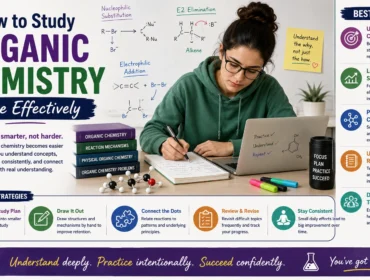
A comprehensive, evergreen guide: what students get wrong, why it happens, exactly how to fix it, and a complete study system you can use today to raise your score reliably.
Why this guide matters — a practical map for improvement
The AP Chemistry exam tests conceptual understanding, quantitative problem solving, and experimental reasoning — all under time pressure. Many students improve only slowly because they repeat the same mistakes without a focused plan. This article gives you that plan: the common errors that cost points, the practical fixes that stop those errors from recurring, and step-by-step study schedules (8-week and 16-week) with daily and weekly routines.
Read this as a coach: take what applies, try one habit for two weeks, and measure the result. Improvement is a loop: practice → identify error → correct method → re-practice. That loop is the backbone of this guide.
Many of these mistakes happen because students underestimate exam difficulty. Understanding how hard the AP Chemistry exam is can help you prepare more strategically.
Most common mistakes — what actually costs the most points
AP graders look for correct method, clear reasoning, and accurate calculation. Many students lose points for avoidable mistakes — here are the ones that appear most often and how to fix them immediately.
- Not showing work clearly. Partial credit is awarded for method. If your steps are missing, graders cannot give partial credit. Fix: write logical steps, label variables, and box your final answer.
- Algebra and units mistakes. Dropped factors (10^3 vs 10^-3), incorrect unit cancellations, or rearranging equations incorrectly are common. Fix: rearrange symbolically, keep units aligned, and estimate magnitude before finalizing.
- Vague conceptual answers. Statements like “the rate increases” are insufficient. Fix: connect statements to a law (Arrhenius, collision theory, Le Châtelier) and quantify when possible.
- Poor time management. Spending too long on early parts of FRQs leaves time short for later sections. Fix: scan FRQs, mark easy parts, and allocate time per part (quick blueprint first).
- Misinterpreting graphs/data. Lab questions often require precise reading and referencing of axes. Fix: annotate graphs and reference exact values when using data to support a claim.
- Confusing equilibrium vs kinetics language. Saying concentration changes K or mixing up Q/K relationships is a conceptual error. Fix: memorize K is constant at fixed temperature; use Q vs K to predict shifts.
- Over-reliance on memorized steps. When problems mix topics, rote steps fail. Fix: practice integrated problems and explain each step in plain language as you work.
- Careless rounding & sig figs. Rounding too early or giving unrealistic sig figs looks sloppy. Fix: keep precision through calculation, round only at the end, and use appropriate sig figs.
- Not using partial-credit strategies. Blank answers lose everything. Fix: if stuck, write the formula you’d use, state any assumptions, and show any partial steps — graders give credit for method.
Why these mistakes happen (diagnosis)
A diagnosis helps pick the right remedy. Here are the underlying causes and how to address them:
- Shallow practice: doing lots of problems without analyzing mistakes causes repeat errors. Remedy: slow down for error analysis and keep an error log.
- Math fatigue: weak algebra or log skills translate into chemistry mistakes. Remedy: include short daily math drills focused on relevant skills.
- Poor strategy: no plan for timed sections or partial credit. Remedy: practice blueprints and timed simulations.
- Fragmented knowledge: viewing topics in isolation rather than as connected concepts. Remedy: use mixed-topic practice sets.
- Stress & pacing issues: anxiety causes simple mistakes. Remedy: timed practice, mindfulness, and realistic simulations to build tolerance.
How to study AP Chemistry — habits and tools that work
Quality matters more than quantity. Below are study methods backed by learning science and repeated success among high scorers.
Deliberate practice & error logs
Deliberate practice is focused, feedback-rich work on specific weaknesses. Use an error log for every problem you miss: record the problem, your attempt, the correct method, the exact error type, and a short corrective rule. Revisit the log weekly and re-solve each logged problem. This turns mistakes into durable learning.
Daily micro-routines
A reliable daily routine reduces friction:
- 10 min math warm-up: algebra, logs, unit conversions.
- 40–60 min focused problem session: one topic, high concentration (Pomodoro style works well).
- 10 min review: update error log and write one corrective rule.
Mixed practice
After you’ve mastered a topic, mix it with others to practice selection of tools. For example, a problem might require stoichiometry, an energy calculation, and Le Châtelier reasoning. The exam favors students who can pick the right approach quickly.
Simulated exams
Simulate the exam at least three times before test day: one mid-prep to benchmark, one two weeks before, and one in the final week. Use the same calculator, timing, and environment you expect on test day.
Teach to learn
Explaining solutions aloud to a peer or even to an imaginary student forces you to structure reasoning. If you can teach a solution clearly, you truly understand it.
High-impact topics and concrete examples
The following topics are frequently tested and are often the quickest route to score improvement when mastered.
Stoichiometry and mole calculations
Core skill: converting grams ⇄ moles ⇄ molecules and solving limiting reagent and percent yield problems. Example common pitfall: failing to use the limiting reagent as the reference for final product. Fix: always compare mole ratios to determine limitation before final mass or yield calculations.
Thermochemistry
Key ideas: sign conventions for enthalpy, Hess’s Law, and calorimetry. Example pitfall: sign error when reversing a reaction enthalpy. Fix: keep track of direction; write enthalpy with the reaction as written and flip the sign if you reverse an equation.
Equilibrium & ICE tables
Practice ICE setups repeatedly. Pitfall: mixing up initial vs. equilibrium concentrations. Fix: label each row clearly (Initial, Change, Equilibrium) and include units.
Acid–base chemistry
Key skills: pH and pOH conversions, Ka/Kb approximations, buffer calculations, titration curve interpretation. Pitfall: using the approximation when it isn’t valid (x ≪ initial concentration). Fix: check the 5% rule or use the quadratic formula when necessary.
Kinetics
Understand rate laws, reaction order determination, and interpreting integrated rate plots (ln vs t for first order, 1/[A] vs t for second order). When Arrhenius or activation energy appears, connect qualitative temperature increases to the exponential effect on k. For focused practice in this area, use dedicated problem sets like ap chemistry kinetics practice problems to build fluency.
Redox & electrochemistry
Be comfortable balancing redox in acidic and basic media, calculating cell potentials and linking E° to ΔG (ΔG = −nFE°). Pitfall: forgetting to multiply electrons when converting potentials to ΔG. Fix: always include n electrons in your ΔG calculation.
Structure, IMFs, and properties
Use structure to explain boiling points, solubility, and reactivity. Pitfall: generic “it has stronger IMFs” without specifying which force (dipole-dipole, hydrogen bonding, London dispersion). Fix: name the IMF and explain how it affects the property.
Lab techniques & data interpretation
Common lab question types: experimental design, error analysis, and interpreting titration/kinetics graphs. Practice evaluating sources of systematic vs random error and suggesting improvements.
Detailed study plans — both 8-week and 16-week options
Choose a plan based on your timeline. Both emphasize deliberate practice, error logs, and timed simulations.
8-Week Intensive Plan (compact, last-minute)
Weekly goal, daily breakdown, and checkpoints to keep you honest.
- Weekly structure: 4 focused problem sessions (50 min), 1 timed MC block (55 min), 1 FRQ practice (40–60 min), daily 10-minute math warmups.
- Week 1 — Stoichiometry & mole calculations: learn mole relationships; do 30 stoichiometry problems of varying formats (limiting reagent, percent yield, empirical formulas).
- Week 2 — Thermochemistry: calorimetry, Hess’s Law, bond enthalpies, and sign convention practice. End the week with 5 mixed energy problems.
- Week 3 — Equilibrium: ICE tables, K calculations, small-x approximations, and Q vs K problems.
- Week 4 — Acid–Base & buffers: pH problems, buffer capacity, Henderson–Hasselbalch, and titration curve interpretation.
- Week 5 — Kinetics: rate law determination, integrated rate laws, Arrhenius plots, and mechanism interpretation.
- Week 6 — Redox & electrochemistry: balancing redox, voltaic cells, standard potentials, and ΔG relationships.
- Week 7 — Structure & IMFs + labs/data: practice explanation questions and experimental design problems.
- Week 8 — Exam practice & review: two full timed exams, error log consolidation, and targeted re-practice of weak topics.
16-Week Distributed Plan (recommended)
Two-week blocks give time for content, guided practice, consolidation, and mixed-topic application.
- Weeks 1–2: Stoichiometry & mole concepts (content + targeted practice).
- Weeks 3–4: Thermochemistry (content + multiple problem sets + one FRQ).
- Weeks 5–6: Chemical equilibrium and ICE table mastery.
- Weeks 7–8: Acid-base chemistry, buffers, and titrations.
- Weeks 9–10: Kinetics and Arrhenius practice (include focused ap chemistry kinetics practice problems during Week 10).
- Weeks 11–12: Redox and electrochemistry, including ΔG ↔ E° conversions.
- Weeks 13–14: Structure, IMFs, physical properties, and lab/data practice.
- Weeks 15–16: Mixed practice, two full timed exams, and final error-log remediation.
Daily and weekly sample schedule (16-week)
A balanced week might look like this:
- Mon: 10-min math warmup; 50-min focused problem set; 10-min error log update.
- Tue: 50-min guided reading + worked examples; 20-min short mixed problems.
- Wed: 10-min math warmup; 50-min focused problem set; 30-min FRQ practice (alternate weeks).
- Thu: 40-min MC practice (timed blocks) + review answers thoroughly.
- Fri: 50-min mixed-topic set; 10-minute error-log update + plan for weekend.
- Sat: Longer practice (90–120 min): mixed problems, one lab/data interpretation task, or a mini-test.
- Sun: Light review, re-solve logged problems, rest and prep for the week.
Practice resources & how to build targeted sets
High-quality practice resources make a big difference. Use a textbook for clear explanations, a problem book for drill, and released AP exams for calibration. When time is limited, focused topical packs accelerate recovery of weak skills.
How to create a targeted problem pack (step-by-step)
- Pick a single skill: e.g., limiting reagent stoichiometry, ICE tables, or calorimetry.
- Gather 10–15 problems: start simple, then increase complexity and introduce one distractor variable (e.g., excess reagent or incomplete reaction).
- Time each problem approximately as on the exam: the goal is accuracy with efficient pacing.
- Log every error: use the template below. Label errors as Math (M), Concept (C), or Careless (S for slip).
- Re-test the pack one week later and compare results — persistent errors need a different intervention (review concept, simpler problems, or tutoring).
For topic-wide remediation, use curated packs organized by topic. Packs labeled by topic — for example, focused stoichiometry sets, targeted thermochemistry collections, or grouped ICE table problems — let you hit weak spots efficiently. If you need thermochemistry practice, try a pack that focuses on calorimetry and Hess’s Law; for stoichiometry practice search for concise collections of mixed stoichiometry questions. A useful complement is a set that groups questions by technique, such as “use ICE,” “find limiting reagent,” or “balance redox in basic solution.”
If you want one resource that groups problems by topic and mimics AP style for review, consider topic collections that provide targeted practice by theme such as ap chemistry practice problems by topic. For thermochemistry drills in particular, targeted packs reduce confusion and speed mastery; try sets organized strictly around energy accounting and Hess’s Law, labeled as thermochemistry practice or calorimetry packs.
Free-response question (FRQ) strategy & sample approach
FRQs reward clear reasoning, structured answers, and correct calculations. Here’s a repeatable approach that reduces mistakes and maximizes partial credit.
A four-step FRQ blueprint
- Quick scan (60–90 seconds): read the entire question, underline what’s asked in each part, and note available data. Circle key words like “calculate,” “explain,” or “predict.”
- Plan (1–2 minutes): write a short outline: which equation you will use, what assumptions you’ll make, and what intermediate variables you need.
- Solve carefully: show steps, label each part (a), (b), etc., and box final numerical answers. Keep precision; round at the end.
- Quick check (2–3 minutes): sanity-check units and magnitudes, scan for missing parts, and write short explanations for conceptual responses linking to a law or principle.
Example FRQ approach (short)
Suppose a question asks: Given initial concentrations and K, find equilibrium concentrations and determine if the reaction favors products. Use these steps:
- Write balanced equation and expression for K.
- Set up ICE table with initial concentrations and unknown x for change.
- Solve for x using K expression; if quadratic is needed, either approximate with small-x or solve quadratic and check validity.
- Compute equilibrium concentrations; compare to K to answer if products are favored.
- Write a one-sentence explanation linking numbers to conclusion (e.g., K ≫ 1, so products are favored quantitatively).
This method ensures you show the method (partial credit) even before the final arithmetic is complete — and graders will award points for correct structure.
Laboratory skills & data interpretation — what to practice
Lab questions focus on experimental design, error sources, graph interpretation, and data analysis. Here’s what to practice frequently.
Common lab question types
- Design an experiment: propose a method, identify controls, and list the measurements you would take.
- Identify errors: distinguish random vs systematic error and recommend improvements.
- Interpret graphs: identify slopes, intercepts, and trends; relate them to reaction order, rate laws, or titration endpoints.
- Analyze data: compute averages, percent errors, or uncertainties and explain how they affect conclusions.
Practical lab tips
- When asked for an error source, always pick a real, specific mechanism (e.g., “incomplete mixing caused an undercount of product in sample” rather than “human error”).
- For graph interpretation, call out axes with units in your answer (e.g., “slope of ln[A] vs t = −k (s⁻¹)”).
- When suggesting improvements, prefer small, realistic changes (e.g., increase sample size or repeat trials to reduce random error) rather than unrealistic fixes.
Printable study flow, checklist, and error-log template
This block is compact, prints cleanly, and contains the essentials to keep daily practice focused. Copy/paste or export to PDF for a quick one-page study aid.
Learn
Read/watch (10–20 min)
Take 3 notes in error log
Practice
10–20 focused problems
Time one mini-set
Analyze
Log error type & fix
Write one corrective rule
Consolidate
Re-do later
Mini test
One-page checklist (print)
- Master stoichiometry & mole conversions (10 varied problems weekly).
- Drill thermochemistry including Hess’s Law and calorimetry.
- Practice ICE tables and equilibrium quant problems until fluent.
- Do targeted kinetics drills weekly (rate laws, integrated forms, Arrhenius).
- Practice pH/buffer problems and one titration simulation per week.
- Interpret one lab graph per session and note sources of error.
- Keep an error log and re-solve logged problems after one week.
- Simulate at least two full timed exams in the final month.
Error log template (copy & paste)
| Date | Problem | Your attempt | Error type (M/C/S) | Correct method & rule |
|---|---|---|---|---|
| 2025-MM-DD | Stoichiometry: limiting reagent | Used grams directly; forgot mole ratio | M | Always convert to moles first; write mole ratio line before final calc |
Final advice — focus, feedback, and small habits
The most effective improvements come from small, consistent changes: a short math warm-up, a focused 50-minute problem session, and a five-minute error log update. Do those three things repeatedly, and you will stop repeating the same mistakes.
If you want a final targeted boost, use topic packs to isolate weaknesses — for example, targeted stoichiometry sets or thermochemistry collections. For stoichiometry practice, dedicated packs speed fluency; similarly, for thermochemistry try a practice pack focusing on enthalpy and calorimetry. If you’d like a ready source of topic-specific, AP-style practice, consider collections of problems organized by theme such as ap chemistry stoichiometry practice problems Questions, ap chemistry thermochemistry, or other curated sets.
Many students also struggle when chemistry questions move beyond basic memorization and start testing reaction analysis, mechanisms, and applied problem-solving. Practicing with more advanced resources such as an advanced chemistry exam preparation questions can help strengthen critical-thinking skills and improve confidence with college-level chemistry questions.
Frequently Asked Questions — Key AP Chemistry Prep Concerns
1. How should I use practice exams to improve?
Use practice exams first as diagnostics to find your weak areas, then later as pacing and stamina training. After each test, spend at least two times the length of the exam reviewing errors. Log each error in your error log and rework similar problems until they’re solved consistently.
- Diagnostic stage: one full exam to find weaknesses.
- Training stage: repeat timed exams to practice pacing.
- Review habit: log errors, extract rules, and re-test the same problem types.
2. Can I self-study AP Chemistry and still score high?
Yes. The keys are structure (a reliable syllabus), feedback (tutor, teacher, or peer review), and practice that focuses on error analysis rather than volume. Combine a good textbook with targeted problem packs and released AP exams, and schedule weekly check-ins to avoid reinforcing mistakes.
Pro tip: a 30–60 minute weekly review with an instructor or peer focused on FRQ explanations gives outsized returns.
3. How do I stop making algebra errors when solving multi-step problems?
Reduce algebra mistakes by following a short checklist: (a) rearrange symbolically before substituting numbers, (b) write units for each substitution, and (c) perform a quick order-of-magnitude check before finalizing. Add a 10–12 minute algebra/log warm-up to each study session.
Example habit: show units on each line — it prevents dropped powers of ten.
4. Where should I focus if I’m short on study time?
Prioritize high-impact topics: stoichiometry, equilibrium (ICE), thermochemistry, acid–base, and kinetics. Within those, target the problem types where you consistently lose points. Use narrow topic packs to remediate efficiently.
If time is very limited, start with stoichiometry and equilibrium — they underpin much of the exam.
5. What small habits lead to the biggest gains?
Small, consistent habits compound quickly. Start with:
- Daily 10-minute math warm-up (algebra, logs, unit conversions).
- One 50-minute focused practice session on a single topic followed by a short error-log update.
- One timed mixed problem set per week to practice method selection and pacing.
These habits reduce careless errors and build reliable accuracy under time pressure.